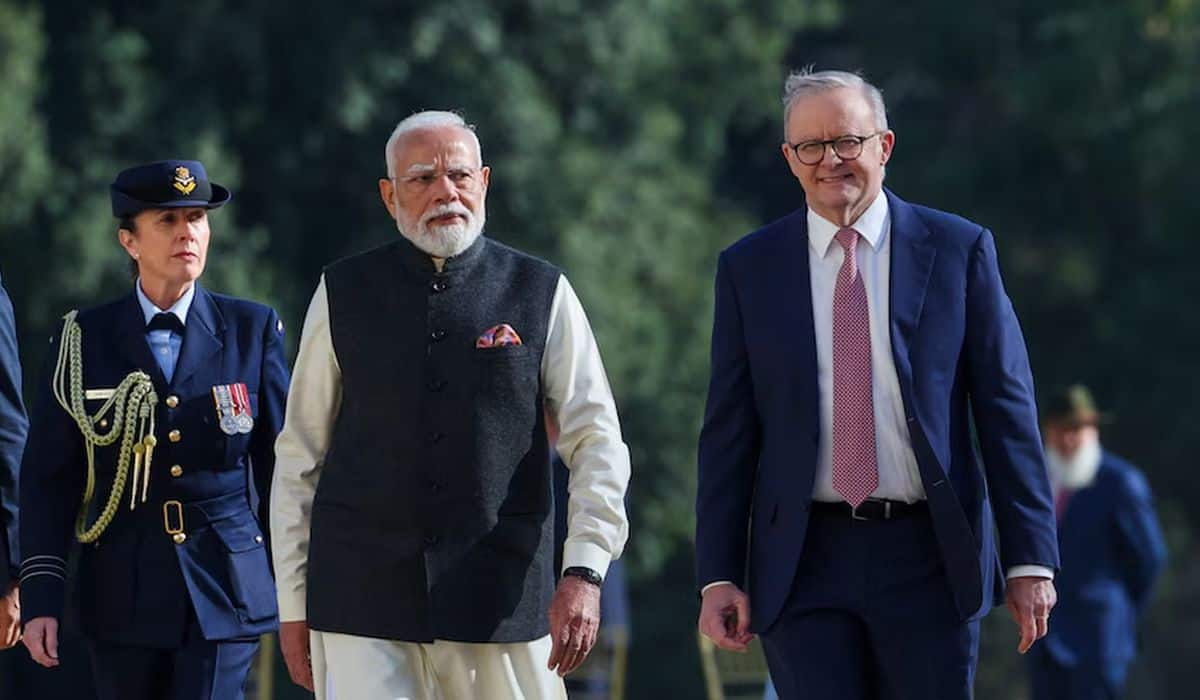
The Prime Minister, Shri Narendra Modi inaugurated, dedicated to the nation and laid the foundation stone of multiple development projects worth over Rs 32,000 crores in Jammu today. The projects relate to several sectors including health, education, rail, road, aviation, petroleum, and civic infrastructure among others. The Prime Minister also distributed appointment orders to about 1500 new Government recruits of Jammu and Kashmir. He also interacted with beneficiaries of various government schemes as part of the ‘Viksit Bharat Viksit Jammu’ program.

Veena Devi from Kishtwar district informed the Prime Minister that she has availed the benefits of Ujjwala Yojna which has made her life better and allowed her to make time for herself and her family. Earlier, she used to fetch wood for cooking from the forests. She also informed the Prime Minister that her family holds Ayushman Cards and thanked the Prime Minister for the same. The Prime Minister wished her and her family good health.
Kirti Sharma of Kathua, a beneficiary of Rashtriya Ajivika Abhiyan, told the Prime Minister about the benefits of being attached to a Self Help Group. She started her enterprise with a loan of 30,000 Rs and later upgraded to three cows with a second loan of 1 lakh rupees. She expressed hope for self-reliance for not only her group but for the women of the entire district. Her group has repaid the bank loan and now they have 10 cows. She and her group members have benefited from many other government schemes. She assured the Prime Minister of full cooperation in his project of creating 3 crore Lakhpati Didis.
Mr Laal Mohammad, a farmer from Poonch informed the Prime Minister that he hails from the border area where his mud house was subjected to shelling from the other side of the border. He thanked the Prime Minister for Rs 1,30,000 received under PM Awas Yojna for building a pucca home where he now resides. The Prime Minister expressed delight that the schemes of the government are reaching the remotest areas of the country and congratulated him for his pucca home. Mr Laal Mohammad also recited a couplet on the theme of ‘Viksit Bharat’ in appreciation of the Prime Minister.
Ms Shaheena Begum from Bandipora, a self-help group member informed the Prime Minister that she holds a post-graduation in Sociology but had to face many difficulties due to unemployment. In 2018, she became a part of the self-help group and availed a loan to start a honey farming business and later expanded it with the help of National Rural Livelihood Mission, thereby helping her get recognition in the field and become a Lakhpati Didi. The Prime Minister congratulated her and expressed delight that women in far-flung villages are taking the opportunities head-on to become Lakhpati Didis and said that she has an inspiration. She also mentioned availing the benefits of Kisan Credit Card for her poultry business. The Prime Minister lauded her parents for her post-graduate level education and also hailed her spirit of dedication to work. Speaking about the development and empowerment of women to accomplish their dreams, the Prime Minister said, “Everything is possible in Modi’s regime”.
Riyaz Ahmed Koli of Pulwama. a beneficiary of Jal Jeevan Mission, told the Prime Minister that every house in his village has piped water which has resulted in a huge transformation of life for his family. He also conveyed the blessing of the women of villages to the Prime Minister. After abrogation of Article 370, he attained the property rights of his land. He and other members of the tribal community greatly benefitted from that. The Prime Minister recalling his days as a political worker praised the hospitality of the Gujjar Community.

Addressing the gathering, the Prime Minister drew comparisons between his previous visits to Jammu to today’s magnificent organization where people have come out in large numbers during harsh weather conditions. He also informed about 3 different venues where citizens of Jammu have assembled in huge numbers to witness the event on large screens. Shri Modi lauded the spirit of the people of Jammu and Kashmir and said that today’s program is a blessing. The Prime Minister underlined that today’s occasion is not limited to Viksit Bharat alone but also includes lakhs of people from educational institutions from all around the country. He also informed that the program is being witnessed by citizens in 285 blocks in Jammu and Kashmir and lauded the spirit of the people of the Union Territory.
The Prime Minister praised the clear articulation of the benefits of the government schemes by the beneficiaries who interacted with him. The Prime Minister complimented the people of Jammu and Kashmir for their spirit of Viksit Bharat Viksit Jammu and Kashmir and Viksit Bharat Sankalp Yatra. Reiterating the government’s commitment to reach the doorstep of every beneficiary the Prime Minister assured that no deserving beneficiary will be left behind. “I have full faith in you. We will surely create a Viksit Jammu Kashmir. Dreams that were lying unfulfilled for 70 years will be accomplished by Modi soon”, said the Prime Minister.
The Prime Minister said that Jammu Kashmir is moving forward with a pledge of becoming Viksit, leaving behind the days of despair and separatism. He said today’s projects worth Rs 32,000 crore will give a boost to education, skill, jobs, health, industry and connectivity. He congratulated the youth of the nation for IIM, IIT and appointment letters.
Pointing out that Jammu and Kashmir has been a victim of dynastic politics for many generations where the welfare of the people was completely neglected and the youth incurred huge losses, the Prime Minister underlined that such governments barely prioritize making policies for the youth. “Those thinking about the welfare of their own families will never spare a thought for the common citizens”, PM Modi exclaimed. He expressed delight that the dynastic politics in the Union Territory is coming to an end now.
The Prime Minister said that to create a Viksit Jammu and Kashmir, the government is focussed on the poor, farmers, youth and Nari Shakti. The Prime Minister noted that Jammu and Kashmir is fast becoming a major hub of education and skill development. The Prime Minister recalled giving the guarantee in 2013 at the same venue about creating IIT and IIM in Jammu and Kashmir; that guarantee, he said, is being fulfilled today. That is why people say “Modi’s guarantee means guarantee of fulfillment of the guarantee”, he added.

Listing the educational infrastructure projects of today’s event, Prime Minister Modi emphasized that the advancement of education and skill development sectors on such a scale was a distant reality ten years ago. “But, this is new India”, the Prime Minister said, highlighting that the government of today indulges in maximum expenditure for the modern education of the present and future generations. In the last 10 years, Shri Modi informed that the country has witnessed a record number of schools, colleges and universities including 50 new degree colleges in Jammu and Kashmir. He further added that 45,000 new children who did not attend schools have now been admitted, and expressed delight that girl students need not travel far for education. “There was a time when schools were run, while today schools are enhanced”, PM Modi added.
Dwelling on the improving health facilities in Jammu and Kashmir, the Prime Minister informed that number of medical colleges in Jammu and Kashmir has risen to 12 today from 4 in 2014, more than 1300 MBBS seats as opposed to 500 in 2014, and more than 650 PG medical seats as opposed to none in 2014. He also informed about the establishment of 45 nursing and paramedic colleges in the last 4 years. Two AIIMS are coming up in Jammu and Kashmir out of which Jammu AIIMS was inaugurated by the Prime Minister today. PM Modi said that in the last 10 years, 15 new AIIMS have been sanctioned in the country.
Talking about the abrogation of Article 370, the Prime Minister said that a new Jammu Kashmir is coming into being as the biggest hurdle to its development was removed and the region is moving in the direction of balanced development. He also mentioned the upcoming film on Article 370.
The Prime Minister reaffirmed the belief in the youth that nobody will be left behind and those who felt neglected for decades can now feel the presence of an effective government. He highlighted that a new wave has emerged in the country that shuns the politics of dynasty and appeasement. “Youth of Jammu and Kashmir are blowing the begul of development and moving forward to create their future”, the Prime Minister remarked, noting the positive change in the atmosphere in the Union Territory. He lamented the neglect shown by the previous governments towards the people of Jammu and Kashmir as well as the defence personnel. The Prime Minister pointed out that the current government fulfilled the long pending demand for One Rank One Pension giving benefits to ex-servicemen including those from the region.
The Prime Minister said that the Constitutional promise of social justice finally reached refugee families, Balmiki Community and Safai Karamcharis. Balmiki Community attained SC status in what the Prime Minister termed as fulfillment of years-old demand. Paddari, Pahari, Gadda Brahmans and Kolis have been included in the Scheduled Tribe category. Pointing out the reservation for ST in the Legislative Assembly and OBC reservation in Panchayats, and urban local bodies, the Prime Minister said, “Mantra of Sabka Saath, Sabka Vikas, Sabka Vishwas and Sabka Prayas is the foundation of the development of Jammu and Kashmir.”
Prime Minister Modi highlighted that women have benefitted the most due to the development work taking place in Jammu and Kashmir and mentioned pucca houses under the PM Awas Yojna being registered under the women, construction of toilets under Har Ghar Jal scheme and distribution of Ayushman Cards. “Abrogation of Article 370 has gifted those rights to women which they were deprived of earlier”, he added.
The Prime Minister touched upon the NaMo Drone Didi scheme where women in large numbers are being trained to become drone pilots. The Prime Minister informed that the government has decided to provide drones worth lakhs of rupees to thousands of self-help groups to assist in farming and gardening. He said that the work of spraying fertilizers or pesticides will become much easier while also creating extra income for them.

Underlining that development works are taking place simultaneously in the entire country today, the Prime Minister mentioned the increased connectivity to Jammu and Kashmir. He mentioned the expansion work of Jammu Airport, connecting Kashmir to Kanyakumari by rail, and the flagging off of trains running from Srinagar to Sangaldan and Sangaldan to Baramulla. “The day is not far when people will be able to travel across the country by taking a train from Kashmir”, PM Modi affirmed. Speaking about the huge campaign of electrification of railways underway in the country, the Prime Minister congratulated the people of Jammu and Kashmir on getting the first electric train today.
Referring to modern trains like Vande Bharat the Prime Minister said Jammu Kashmir was selected among the initial routes of the trains. He said two Vande Bharat trains are running in Jammu and Kashmir and access to Mata Vaishno Devi has improved.
PM Modi listed the road projects in the region. Among today’s projects, he mentioned the second phase of the Srinagar Ring Road which will improve access to Manasbal Lake and Kheer Bhawani temple. Similarly, the Srinagar-Baramulla-Uri highway will benefit farmers and tourism. Delhi Amritsar Katra Expressway will make it easy to travel between Jammu and Delhi.
“Today, there is a lot of enthusiasm in the whole world about the development of Jammu and Kashmir”, the Prime Minister said, recalling his recent visit to the gulf countries where positivity regarding investment in the Union Territory is on a high. PM Modi also touched upon the several G20 meetings organized in Jammu and Kashmir and said that the entire world is enchanted by its natural beauty. He informed that Jammu and Kashmir recorded more than 2 crore visitors last year while the number of pilgrims visiting Amarnath ji and Shri Mata Vaishno Devi has reached the highest in the last decade. The Prime Minister expressed confidence that the number of tourists is only going to increase considering the fast-paced development of infrastructure.

Mentioning India’s entry into the top 5 global economies, the Prime Minister acknowledged the growing capacity of the government to spend on welfare schemes due to the improving economy. He said that India can provide free ration, medical treatment, pucca houses, gas connections, toilets and PM Kisan Samman Nidhi due to an improved economy. “Now we have to make India the third largest economic power in the world in the next 5 years. This will increase the country's ability to spend on poor welfare and infrastructure manifold. Every family of Jammu and Kashmir will benefit from this”, the Prime Minister concluded.
Lieutenant Governor of Jammu and Kashmir, Shri Manoj Sinha, and Union Minister of State for Minister of State for Prime Minister's Office, Dr Jitendra Singh were present on the occasion among others.
Background
Major boost to Education sector
In a significant step towards upgrading and developing education and skilling infrastructure across the country, the Prime Minister inaugurated, dedicated to the nation and laid the foundation stone of several projects worth about Rs 13,375 crores.
The Prime Minister dedicated to the nation permanent campus of IIT Bhilai, IIT Tirupati, IISER Tirupati, IIITDM Kurnool; academic and residential complex in IIT Patna and IIT Ropar; two permanent campuses of Central Sanskrit University - at Devprayag (Uttarakhand) and Agartala (Tripura). The Prime Minister inaugurated permanent campuses of IIM Visakhapatnam, IIM Jammu and IIM Bodh Gaya. He also inaugurated Indian Institute of Skills (IIS) - a pioneer skill training institute on advanced technologies in Kanpur.

The Prime Minister inaugurated and dedicated to the nation, improved infrastructure like hostels, academic blocs, administrative buildings, libraries, auditoriums etc in multiple higher educational institutes across the country like IIT Jammu, NIT Delhi, IIT Kharagpur, NIT Durgapur, IISER Behrampur, NIT Arunachal Pradesh, IIIT Lucknow, IIT Bombay, IIT Delhi, Central University of Kerala Kasaragod, among others.
The Prime Minister laid the foundation stone of multiple projects for upgrading the infrastructure in several higher educational institutes across the country. These projects include the construction of the permanent campus of Sindhu Central University and IIIT Raichur; the construction of academic block, hostel, faculty quarter etc in IIT Bombay; construction of Hostel and Staff Quarter in IIT Gandhinagar, construction of Girls' hostel in BHU, among others.
AIIMS Jammu
In a step that will provide comprehensive, quality and holistic tertiary care health services to the people of Jammu and Kashmir, the Prime Minister inaugurated All India Institute of Medical Sciences (AIIMS), Vijaypur (Samba), Jammu. The institute, whose foundational stone was also laid by the Prime Minister in February 2019, is being established under the Central sector scheme Pradhan Mantri Swasthya Suraksha Yojana.

Established at a cost of over 1660 crore and in an area spanning over 227 acres, the hospital is equipped with facilities like 720 beds, Medical College with 125 seats, Nursing College with 60 seats, AYUSH Block with 30 beds, residential accommodation for faculty and staff, hostel accommodation for UG and PG students, Night Shelter, Guest House, Auditorium, Shopping Complex etc. The state-of-the-art hospital will provide high-quality patient care services in 18 Specialities and 17 Super Specialities including Cardiology, Gastroenterology, Nephrology, Urology, Neurology, Neurosurgery, Medical Oncology, Surgical Oncology, Endocrinology, Burns & Plastic Surgery. The Institute will have an Intensive Care Unit, Emergency & Trauma Unit, 20 Modular Operation Theatres, Diagnostic Laboratories, Blood Bank, Pharmacy etc. The Hospital will also leverage Digital Health Infrastructure to reach out to far-flung areas of the region.
New Terminal Building, Jammu Airport
The Prime Minister laid the foundation stone for a new terminal building at Jammu Airport. To be spread over a 40,000 sqm area, the new terminal building will be equipped with modern facilities catering to about 2000 passengers during peak hours. The new terminal building will be environment friendly and will be built such that it showcases the local culture of the region. It will strengthen air connectivity, boost tourism and trade and accelerate economic growth of the region.
Rail Projects
The Prime Minister dedicated to the nation various rail projects in Jammu & Kashmir including the new rail line between Banihal-Khari-Sumber-Sangaldan (48 Km) and the newly electrified Baramulla-Srinagar-Banihal-Sangaldan section (185.66 Km). The Prime Minister also flagged off the first Electric Train in the valley and also train service between Sangaldan station & Baramulla station.

The commissioning of the Banihal-Khari-Sumber-Sangaldan section is significant as it features the usage of Ballast Less Track (BLT) all along the route providing a better riding experience to the passengers. Also, India’s longest transportation tunnel T-50 (12.77 Km) lies in this portion between Khari-Sumber. The rail projects will improve connectivity, ensure environmental sustainability and boost the overall economic development of the region.
Road Projects
During the programme, the Prime Minister laid the foundation stone of important road projects including two packages (44.22 KM) of Delhi-Amritsar-Katra Expressway connecting Jammu to Katra; Phase two for four-laning of Srinagar Ring Road; five packages for upgrading the 161 km long Srinagar-Baramulla-Uri stretch of NH-01; and the construction of Kulgam Bypass & Pulwama bypass on NH-444.
The two packages of the Delhi-Amritsar-Katra Expressway, once completed will facilitate the visit of pilgrims to the holy shrine of Mata Vaishno Devi, and will also boost economic development in the region; Phase two for four-laning of Srinagar Ring Road involves upgrading the existing Sumbal-Wayul NH-1. This brownfield project of length 24.7 Km, will reduce the traffic congestion in and around Srinagar city. It will improve connectivity to popular tourist destinations like Manasbal Lake and Kheer Bhawani Temple, and also reduce travel time to Leh, Ladakh; The project for the upgradation of 161 km long Srinagar-Baramulla-Uri stretch of NH-01, is of strategic importance. It will also boost the economic development of Baramulla & Uri; Kulgam Bypass & Pulwama bypass on NH-444 connecting Qazigund - Kulgam - Shopian - Pulwama - Badgam - Srinagar will also boost road infrastructure in the region.

CUF Petroleum depot
The Prime Minister also laid the foundation stone for a project to develop CUF (Common User Facility) Petroleum depot at Jammu. The state-of-the-art fully automated depot which will be developed at a cost of about Rs 677 crore, will have a storage capacity of about 100000 KL for storing Motor Spirit (MS), High Speed Diesel (HSD), Superior Kerosene Oil (SKO), Aviation Turbine fuel (ATF), Ethanol, Biodiesel and winter grade HSD.
Other projects
The Prime Minister also inaugurated and laid the foundation stone of several development projects worth more than Rs 3150 crores for strengthening the civic infrastructure and provisioning of public facilities across Jammu and Kashmir. The projects being inaugurated by the Prime Minister include road projects & bridges; grid stations, receiving stations transmission line Projects; Common Effluent Treatment Plants and Sewage Treatment Plants; Several Degree College buildings; Intelligent Traffic Management system in Srinagar city; Modern Narwal Fruit Mandi; Drug Testing Laboratory at Kathua; and Transit accommodation - 224 flats at Ganderbal and Kupwara. The projects whose foundation stones are being laid include development of five new Industrial Estates across Jammu and Kashmir; the Data Centre/ Disaster Recovery Centre for Integrated Command and Control Centre of Jammu Smart City; Up-gradation of Transport Nagar at Parimpora Srinagar; Up-gradation of 62 road projects and 42 bridges and project for development of transit accommodation - 2816 flats at nine locations in districts Anantnag, Kulgam, Kupwara, Shopian & Pulwama, among others.
हम विकसित जम्मू-कश्मीर बनाकर ही रहेंगे: PM @narendramodi pic.twitter.com/YQULR9rOpL
— PMO India (@PMOIndia) February 20, 2024
विकसित भारत, विकसित जम्मू-कश्मीर pic.twitter.com/UH8uOqpM0V
— PMO India (@PMOIndia) February 20, 2024
नया भारत, अपनी वर्तमान पीढ़ी को आधुनिक शिक्षा देने के लिए ज्यादा से ज्यादा खर्च कर रहा है: PM @narendramodi pic.twitter.com/mhZXQ9rERU
— PMO India (@PMOIndia) February 20, 2024
अब जम्मू कश्मीर, एक संतुलित विकास की ओर बढ़ रहा है। pic.twitter.com/nCW6TZbz9I
— PMO India (@PMOIndia) February 20, 2024
भारत के संविधान में जिस सामाजिक न्याय का भरोसा दिया गया है, वो भरोसा पहली बार जम्मू-कश्मीर के सामान्य जन को भी मिला है: PM @narendramodi pic.twitter.com/QXhKvYI5me
— PMO India (@PMOIndia) February 20, 2024
विकसित होते जम्मू कश्मीर को लेकर आज पूरी दुनिया में बहुत उत्साह है: PM @narendramodi pic.twitter.com/OjMnVd10wc
— PMO India (@PMOIndia) February 20, 2024