





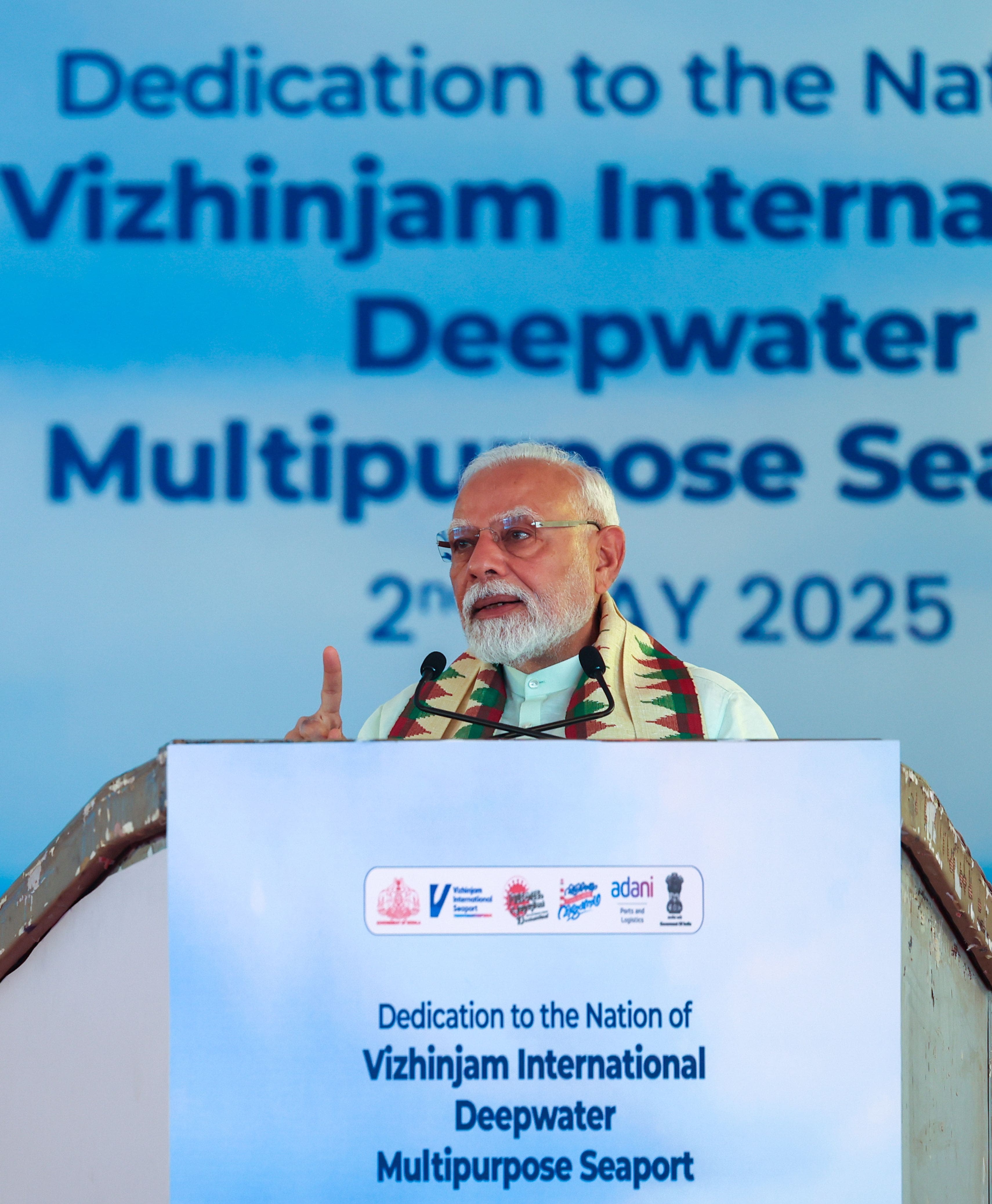
Prime Minister Shri Narendra Modi dedicated Vizhinjam International Deepwater Multipurpose Seaport worth Rs 8,800 crore to the nation today in Thiruvananthapuram, Kerala. Addressing the gathering on the auspicious occasion of the birth anniversary of Bhagwan Adi Shankaracharya, the Prime Minister highlighted that three years ago, in September, he had the privilege of visiting the revered birthplace of Adi Shankaracharya. He expressed his joy that a grand statue of Adi Shankaracharya has been installed in the Vishwanath Dham complex in his parliamentary constituency, Kashi. He emphasized that this installation stands as a tribute to the immense spiritual wisdom and teachings of Adi Shankaracharya. He further highlighted that he also had the honor of unveiling the divine statue of Adi Shankaracharya at the sacred Kedarnath Dham in Uttarakhand. The Prime Minister noted that today marks another special occasion as the doors of the Kedarnath temple have been opened to devotees. Prime Minister Modi underscored that Adi Shankaracharya, originating from Kerala, established monasteries in different corners of the country, awakening the consciousness of the nation. He emphasized that his efforts laid the foundation for a unified and spiritually enlightened Bharat.
Shri Modi highlighted the vast ocean, rich with immense possibilities, standing on one side, while on the other, nature’s breathtaking beauty adds to the grandeur. Amidst all this, he emphasized that the Vizhinjam Deep-Water Sea Port has now emerged as a symbol of new age development. He extended his congratulations to the people of Kerala and the entire nation on this remarkable achievement.

Underscoring that the Vizhinjam Deep-Water Sea Port has been developed at a cost of ₹8,800 crore, the Prime Minister remarked that the capacity of this transshipment hub will triple in the coming years, enabling the smooth arrival of some of the world's largest cargo ships. He pointed out that 75% of India’s transshipment operations were previously conducted at foreign ports, leading to significant revenue loss for the country. Emphasizing that this situation is now set to change, he asserted that India’s money will now serve India and the funds that once flowed outside the country will now generate new economic opportunities for Kerala and Vizhinjam’s people.
Shri Modi remarked that before colonial rule, India witnessed centuries of prosperity, emphasising that at one point, India held a major share in the global GDP. He highlighted that what set India apart from other nations during that era was its maritime capacity and the economic activity of its port cities. Noting that Kerala played a significant role in this maritime strength and economic growth, he highlighted Kerala's historical role in maritime trade, emphasizing that through the Arabian Sea, India maintained trade links with multiple nations. He noted that ships from Kerala carried goods to various countries, making it a vital hub for global commerce. “Today, the Government of India is committed to further strengthening this channel of economic power”, he added and asserted, “India’s coastal states and port cities will become key centers for the growth of a developed India”.

“The port economy reaches its full potential when infrastructure and ease of doing business are promoted together”, emphasised the Prime Minister, stating that over the past 10 years, this has been the blueprint of the Government of India’s port and waterways policy. He highlighted that the government has accelerated efforts for industrial activities and holistic development of states. He further remarked that the Government of India, in collaboration with state governments, has upgraded port infrastructure under the Sagarmala Project and strengthened port connectivity. He noted that under PM Gati Shakti, waterways, railways, highways, and airways are being rapidly integrated for seamless connectivity. He added that these reforms in ease of doing business have led to greater investment in ports and infrastructure sectors. The Prime Minister stated that the Government of India has also reformed regulations concerning Indian seafarers, yielding significant results. He pointed out that in 2014, the number of Indian seafarers was below 1.25 lakh. Today, this figure has surged beyond 3.25 lakh. He emphasized that India now ranks among the top three countries globally in terms of seafarer numbers.
Highlighting that a decade ago, ships faced long waiting times at ports, significantly delaying unloading operations, Shri Modi noted that this slowdown affected businesses, industries, and the overall economy. He stressed that the situation has now transformed and over the past 10 years, India’s major ports have reduced ship turn-around time by 30%, improving operational efficiency. He remarked that due to enhanced port efficiency, India is now handling greater cargo volumes in shorter durations, strengthening the nation’s logistics and trade capabilities.

“India’s maritime success is a result of a decade-long vision and effort”, exclaimed the Prime Minister, underlining that over the past 10 years, India has doubled the capacity of its ports and expanded its National Waterways eightfold. He noted that today, two Indian ports are among the global top 30 ports, while India’s ranking on the Logistics Performance Index has also improved. Additionally, he pointed out that India is now among the top 20 countries in global shipbuilding. The Prime Minister further remarked that after strengthening the country’s basic infrastructure, the focus has now shifted towards India’s strategic position in global trade. He announced the launch of Maritime Amrit Kaal Vision, which outlines India’s maritime strategy to achieve the goal of a developed India. He recalled the G-20 Summit, where India collaborated with several major countries to establish the India-Middle East-Europe Economic Corridor, highlighting Kerala’s critical role in this corridor, emphasizing that the state will greatly benefit from this initiative.
Underscoring the critical role of the private sector in elevating India’s maritime industry to new heights, Shri Modi said that under Public-Private Partnerships, thousands of crores have been invested over the past 10 years. He emphasized that this collaboration has not only upgraded India's ports to global standards but has also made them future-ready. He noted that private sector participation has driven innovation and enhanced efficiency.
Prime Minister highlighted that India is advancing towards the establishment of a shipbuilding and repair cluster in Kochi. He emphasized that once completed, this cluster will create numerous new employment opportunities, providing Kerala’s local talent and youth with a platform for growth. The Prime Minister further stated that India is now setting ambitious targets to strengthen its shipbuilding capabilities. He noted that this year’s Union Budget introduced a new policy to promote the construction of large ships in India, which will significantly boost the manufacturing sector. He emphasized that this initiative will have direct benefits for MSMEs, generating a large number of employment and entrepreneurship opportunities across the country.
“True development is achieved when infrastructure is built, trade expands, and basic needs of the common people are met”, stressed the Prime Minister, remarking that the people of Kerala have witnessed rapid progress over the past 10 years, not just in port infrastructure, but also in highways, railways, and airports. He highlighted that projects like the Kollam Bypass and Alappuzha Bypass, which had been stalled for years, were advanced by the Government of India. He also noted that Kerala has been provided with modern Vande Bharat trains, further strengthening its transport network and connectivity.
Shri Modi emphasized that the Government of India firmly believes in the principle that Kerala’s development contributes to India’s overall growth. He remarked that the government operates with the spirit of cooperative federalism, ensuring Kerala’s progress across key social parameters over the past decade. He highlighted several initiatives that have benefited the people of Kerala, including Jal Jeevan Mission, Ujjwala Yojana, Ayushman Bharat, and Pradhan Mantri Suryagarh Free Electricity Scheme.
Reiterating that the welfare of fishermen remains a top priority, the Prime Minister noted that under Blue Revolution and Pradhan Mantri Matsya Sampada Yojana, projects worth hundreds of crores have been sanctioned for Kerala. He further highlighted the modernization of fishing harbors, including Ponnani and Puthiyappa. Additionally, he remarked that thousands of fishermen in Kerala have been provided Kisan Credit Cards, enabling them to receive financial assistance worth hundreds of crores.

Underlining that Kerala has always been a land of harmony and tolerance, Shri Modi highlighted that centuries ago, Saint Thomas Church, one of the oldest churches in the world, was established here. He acknowledged the recent moment of grief that has touched people across the world when Pope Francis passed away a few days ago, leaving behind a profound legacy. He added that President Droupadi Murmu represented India at his funeral, paying respects on behalf of the nation. Shri Modi once again expressed his condolences to all those mourning this loss from the sacred land of Kerala.
Paying tribute to Pope Francis, acknowledging his spirit of service and his efforts to ensure inclusivity within Christian traditions, the Prime Minister remarked that the world will always remember his contributions. He shared his personal experiences, expressing his gratitude for having had multiple opportunities to meet Pope Francis. He noted that he received special warmth from him and cherished their discussions on humanity, service, and peace, which will continue to inspire him.
Extending his best wishes to all present at the event, Shri Modi envisioned Kerala as a major center for global maritime trade, leading to the creation of thousands of new jobs. He reaffirmed the commitment of the Government of India, working alongside the state government, to advance this goal. Shri Modi concluded by expressing confidence in the capabilities of Kerala’s people and stated, “India’s maritime sector will reach new heights”.
The Governor of Kerala, Shri Rajendra Vishwanath Arlekar, Chief Minister of Kerala, Shri Pinarayi Vijayan, Union Ministers, Shri Suresh Prabhu, Shri George Kurien were present among other dignitaries at the event.
Background
Vizhinjam International Deepwater Multipurpose Seaport worth Rs 8,800 crore is country's first dedicated container transshipment port that represents the transformative advancements being made in India’s maritime sector as part of the unified vision of Viksit Bharat.
Vizhinjam Port, having strategic importance, has been identified as a key priority project which will contribute in strengthening India’s position in global trade, enhance logistics efficiency, and reduce reliance on foreign ports for cargo transshipment. Its natural deep draft of nearly 20 meters and location near one of the world's busiest sea trade routes further strengthens India’s position in global trade.
Click here to read full text speech
Tribute to the great Adi Shankaracharya. pic.twitter.com/HjtH1v0GG4
— PMO India (@PMOIndia) May 2, 2025
India's coastal states and our port cities will become key centres of growth for a Viksit Bharat. pic.twitter.com/HuDnlbeLiI
— PMO India (@PMOIndia) May 2, 2025
Boosting multi-modal connectivity. pic.twitter.com/SZqAkOMCTN
— PMO India (@PMOIndia) May 2, 2025
The world will always remember Pope Francis for his spirit of service: PM @narendramodi pic.twitter.com/NaIi6W9MCf
— PMO India (@PMOIndia) May 2, 2025







