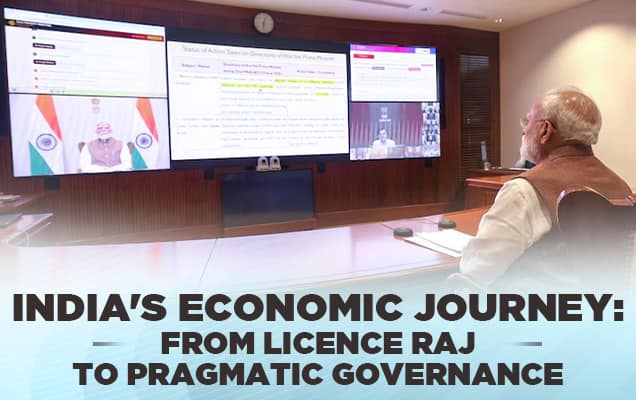
The Prime Minister Shri Narendra Modi addressed the Post-Budget Webinar on Employment via video conferencing today. Addressing the gathering on the occasion, he highlighted the importance of the theme of the webinar, "Investing in People, Economy, and Innovation," which defines the roadmap for Viksit Bharat. He remarked that this year's budget reflects this theme on a large scale and serves as a blueprint for India's future. He emphasized that investments have been prioritized equally across infrastructure, industries, people, economy, and innovation. Underlining that capacity building and talent nurturing are foundational for the nation's progress, Shri Modi urged all stakeholders to step forward and invest more in these areas as the next phase of development requires it. He stressed that this is essential for the country's economic success and forms the basis of every organization's success.
“The vision of investing in people stands on three pillars: education, skill, and healthcare”, said Shri Modi, remarking that India's education system is undergoing a significant transformation after several decades. He emphasized key initiatives such as the National Education Policy, the expansion of IITs, the integration of technology into the education system, and the utilization of AI's full potential. Underlying the efforts like the digitization of textbooks and the availability of learning materials in 22 Indian languages, the PM said, “these mission-mode efforts have enabled India's education system to align with the needs and parameters of the 21st-century world”.

Highlighting that since 2014, the government has provided skill training to over 3 crore youth, the Prime Minister mentioned the upgrade of 1,000 ITIs and the establishment of 5 Centers of Excellence. He emphasized the goal of equipping youth with training that meets the needs of industries. He remarked that with the help of global experts, efforts are being made to ensure that Indian youth can compete at the world level. Shri Modi underlined the critical role of industry and academia in these initiatives and urged industries and educational institutions to understand and fulfill each other's needs, providing youth with opportunities to adapt to the rapidly changing world, gain exposure, and access platforms for practical learning. Highlighting the launch of the PM-Internship Scheme to provide youth with new opportunities and practical skills, he stressed the importance of ensuring maximum industry participation at every level in this initiative.
Touching upon the medical field, Shri Modi mentioned the addition of 10,000 new medical seats in this budget and a target of adding 75,000 seats in the medical field over the next five years has been set. He highlighted the expansion of telemedicine facilities across all Primary Health Centres. He also emphasized the establishment of daycare cancer centers and the development of digital healthcare infrastructure to ensure quality healthcare reaches the last mile. He said that these initiatives will have a transformative impact on people's lives. The Prime Minister said that these efforts will create numerous new employment opportunities for youth and urged stakeholders to work swiftly to implement these initiatives, ensuring the benefits of budget announcements reach the maximum number of people.
Pointing out that over the past decade, investments in the economy have been guided by a futuristic vision, the Prime Minister remarked that by 2047, India's urban population is projected to reach approximately 90 crore, necessitating planned urbanization. He announced the initiative to establish a ₹1 lakh crore Urban Challenge Fund, focusing on governance, infrastructure, and financial sustainability, while also boosting private investment. “Indian cities will be recognized for sustainable urban mobility, digital integration, and climate resilience plans”, emphasized the Prime Minister. He urged the private sector, particularly the real estate and industrial sectors, to prioritize and advance planned urbanization. He also stressed the importance of collaborative efforts to further initiatives like AMRUT 2.0 and the Jal Jeevan Mission.

Emphasising the need to focus on the potential of the tourism sector while discussing investments in the economy, Shri Modi highlighted that the tourism sector has the potential to contribute up to 10% of India's GDP and create employment opportunities for crores of youth. He mentioned several measures in the budget to promote domestic and international tourism. “50 destinations across the country will be developed with a focus on tourism”, said the Prime Minister adding that granting infrastructure status to hotels in these destinations will enhance ease of tourism and boost local employment. Highlighting the expansion of the Mudra Yojana to support homestays, Shri Modi also stressed that initiatives like 'Heal in India' and 'Land of the Buddha' to attract global tourists. “Efforts are being made to establish India as a global tourism and wellness hub”, he added.
Underscoring that tourism offers opportunities beyond the hotel and transport industries, extending to other sectors as well, the Prime Minister urged stakeholders in the health sector to invest in promoting health tourism. He stressed the need to fully utilize the potential of yoga and wellness tourism, remarking on the significant scope for growth in education tourism. He expressed his desire for detailed discussions in this direction and called for the development of a strong roadmap to advance these initiatives.

“The future of the nation is determined by investments in innovation”, exclaimed Shri Modi, highlighting that artificial intelligence has the potential to contribute several lakh crore rupees to India's economy, underscoring the need for rapid progress in this direction. He mentioned the allocation of ₹500 crore in the budget for AI-driven education and research. Mentioning the plans to establish a National Large Language Model to develop AI capabilities in India, the Prime Minister urged the private sector to stay ahead of the global curve in this field. “The world awaits a reliable, safe, and democratic nation that can provide economical AI solutions”, he added, emphasising that investments made in this sector today will yield significant advantages in the future.
“India has become the third-largest startup ecosystem in the world”, said the Prime Minister, adding that several measures have been introduced in this budget to promote startups. He mentioned the approval of a ₹1 lakh crore corpus fund to boost research and innovation. The Prime Minister emphasized that this will increase investments in emerging sectors through the ‘Deep Tech Fund of Funds’. He noted the provision of 10,000 research fellowships at IITs and IISc, which will foster research and provide opportunities for talented youth. The Prime Minister also highlighted the role of the National Geo-spatial Mission and the National Research Foundation in accelerating innovation. He stressed the need for collective efforts at all levels to elevate India to new heights in research and innovation.
Underlining the significance of the Gyan Bharatam Mission in preserving India's rich manuscript heritage, Shri Modi announced that over one crore manuscripts will be digitized under this mission, leading to the creation of a National Digital Repository. This repository will enable scholars and researchers worldwide to access India's historical, traditional knowledge and wisdom, he added. The Prime Minister also mentioned the establishment of a National Gene Bank to preserve India's plant genetic resources. He emphasized that this initiative aims to ensure genetic resources and food security for future generations. He urged for the expansion of such efforts and called on various institutes and sectors to actively participate in these initiatives.

Citing the remarkable observations made by the IMF regarding India's economy in February 2025, Shri Modi noted that between 2015 and 2025, India's economy has recorded a 66% growth, making it a $3.8 trillion economy. He emphasized that this growth surpasses that of several major economies, and that the day is not far when India will become a $5 trillion economy. He stressed the importance of making the right investments in the right direction to continue expanding the economy. He underlined the critical role of implementing budget announcements in achieving this vision and acknowledged the significant contributions of all stakeholders. He mentioned that the tradition of working in silos was broken and now the Government has both pre-budget consultations as well as post-budget discussions for better implementation of the schemes and initiatives with the stakeholders, highlighting the ‘Jan-Bhagidari’ model. He concluded by expressing hope that the fruitful discussions of the webinar will play a remarkable role in fulfilling the aspirations of 140 crore Indians.
Background
Employment generation has been one of the key focus areas of the government. Driven by the vision of the Prime Minister, the government has taken multiple steps to promote job growth and generate greater avenues of employment. The webinar will foster collaboration among government, industry, academia, and citizens encouraging discussions to help translate the transformative Budget announcements towards the same into effective outcomes. With a key focus on empowering citizens, strengthening the economy, and fostering innovation, the deliberations will aim at paving the way for sustainable and inclusive growth; leadership in technology and other sectors; and a skilled, healthy workforce working towards realising the goal of Viksit Bharat by 2047.
Click here to read full text speech
हमने इनवेस्टमेंट में जितनी प्राथमिकता infrastructure और industries को दी है… उतनी ही प्राथमिकता People, Economy और Innovation को भी दी है: PM @narendramodi
— PMO India (@PMOIndia) March 5, 2025
Investment in people का विज़न तीन पिलर्स पर खड़ा होता है- एजुकेशन, स्किल और हेल्थकेयर!
— PMO India (@PMOIndia) March 5, 2025
आज आप देख रहे हैं, भारत का Education system कई दशक के बाद कितने बड़े transformation से गुजर रहा है: PM @narendramodi
सभी Primary Health Centres में टेलीमेडिसिन सुविधा का विस्तार हो रहा है।
— PMO India (@PMOIndia) March 5, 2025
डे-केयर कैंसर सेंटर और digital healthcare infrastructure के जरिए हम quality healthcare को लास्ट माइल तक पहुंचाना चाहते हैं: PM @narendramodi
इस बजट में घरेलू और अंतर्राष्ट्रीय टूरिज़्म को बढ़ावा देने के लिए कई फैसले लिए गए हैं।
— PMO India (@PMOIndia) March 5, 2025
देश भर में 50 destinations को टूरिज्म पर फोकस करते हुए विकसित किया जाएगा।
इन destinations में होटलों को infrastructure का दर्जा दिए जाने से Ease of Tourism बढ़ेगा, स्थानीय रोजगार को भी बढ़ावा…
भारत AI की क्षमताओं को विकसित करने के लिए national Large Language Model की स्थापना भी करेगा।
— PMO India (@PMOIndia) March 5, 2025
इस दिशा में हमारे प्राइवेट सेक्टर को भी दुनिया से एक कदम आगे रहने की जरूरत है।
एक reliable, safe और democratic देश, जो AI में economical solutions दे सके, विश्व को उसका इंतज़ार है: PM…
स्टार्टअप्स को बढ़ावा देने के लिए सरकार ने इस बजट में कई कदम उठाए हैं।
— PMO India (@PMOIndia) March 5, 2025
रिसर्च और इनोवेशन को बढ़ाने के लिए 1 लाख करोड़ रुपये का corpus fund पास किया गया है।
इससे डीप टेक फंड ऑफ फंड्स के साथ उभरते सेक्टर्स में निवेश बढ़ेगा: PM @narendramodi
ज्ञान भारतम मिशन के माध्यम से भारत की समृद्ध manuscript heritage को संरक्षित करने की घोषणा बहुत ही अहम है।
— PMO India (@PMOIndia) March 5, 2025
इस मिशन के माध्यम से एक करोड़ से अधिक manuscript...पांडुलिपियों को डिजिटल फॉर्म में बदला जाएगा: PM @narendramodi