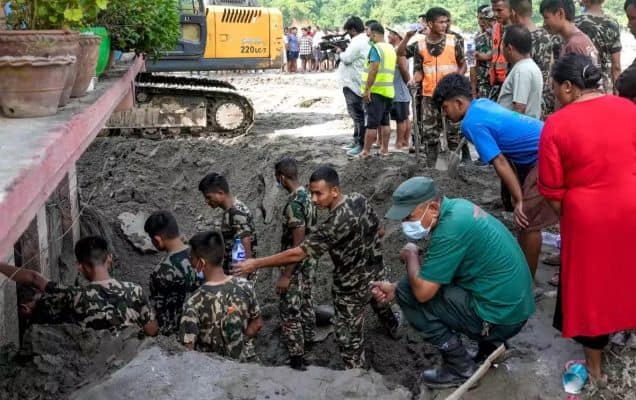
- Floods in Gujarat, Rajasthan, Assam, Arunachal Pradesh, Nagaland and Manipur in the mid of 2017 caused irreplaceable loss of lives and damage to property and livestock. As soon as the news trickled in, concerned Central agencies and government departments were put into action with the Prime Minister monitoring disaster response personally.

- Prime Minister Narendra Modi undertook aerial surveys of flood affected areas and held back to back meetings with state and central government officials toreview steps being taken to mitigate the impact of floods. He held high level meetings with the Chief Minister of flood affected states and assured them of all possible assistance from the centre.

- It was during Prime Minister Narendra Modi’s tenure as the Chief Minister of Gujarat, that he undertook massive rehabilitation of earthquake ravaged parts of Gujarat and finetuned disaster response of the state machinery. Bhuj, a city that was completely razed to the ground during the Gujarat earthquake (in 2001), was resurrected on a remarkable speed and scale under the direct supervision of newly instated Chief Minister Modi. His hands-on style of functioning was also witnessed later when the Chief Minister himself landed in flood-hit Kedar valley in Uttarakhand to supervise relief and rescue operations for people of Gujarat.

- Prime Minister Narendra Modi’s plethora of practical experience in managing disaster related situations as the Chief Minister has helped him in managing natural calamities in various parts of the country. The floods of 2014 that hit Jammu and Kashmir created havoc in the state. Prime Minister Narendra Modi visited the State taking stock of the situation. Declaring the flood as “national level disaster”, he announced additional funds of Rs. 1000 crores to be released for flood relief and reconstruction of the region. Timely deployment of military in relief and rescue operations saved many lives.

- Prime Minister Narendra Modi has always adopteda pro-active approach in times of disasters, deploying machinery to help states get back on feet as soon as possible after getting struck by nature’s fury. In 2015, when Chennai was hit by a feisty deluge, Prime Minister monitored the situation first hand. The Navy's INS Airavat was stationed on Chennai coast to provide medical equipment, medicines and doctors since Chennai was cut off from all road routes.

- During the devastating Nepal earthquake in 2015, India was first to act and extend a helping hand to the neighbourhood in distress. Charting a new course in “disaster diplomacy” Prime Narendra Modi proved India’s credential as a leader in the Indian subcontinent. Tonnes of relief material and NDRF teams with equipment were dispatched to the neighbouring nation. India was hailed globally for its spirited efforts in Nepal with Israeli Prime Minister Benjamin Netanyahu thanking Prime Minister Narendra Modi for assisting Israel in rescuing its citizens from quake hit Nepal as well as allowing relief planes to land on Indian soil. Prime Minister Modi’s diplomacy efforts are focused on building mutual cooperation with various nation-states to find solutions to problems that concern the entire planet such as climate change, natural and man-made catastrophes and so on.

- In another first, Prime Minister Narendra Modi led the launch of ISRO’s satellite aimed at providing critical communication links during disasters. It was India’s unique gift to her neighbours which was applauded by the head of states of the seven SAARC countries.

- Disaster preparedness as well as mitigation have become two necessary conditions for sustainable development of a planet reeling under effects of climate change. Every disaster exposes faults in process of hasty urbanisation. With Sendai Framework for Disaster Risk Reduction in place, Prime Minister Narendra Modi has integrated India’s urban planning according to the globally set standards for disaster risk reduction.

- A comprehensive design to combat challenges arising from disaster risk at all levels of governance has long been missing from India’s infrastructural roadmap. Prime Minister Narendra Modi, identifying the lacuna in planning released India’s first ever National Disaster Management Plan to tackle any eventuality. The NDMP is along the lines of Sendai framework and lays down areas of horizontal and vertical integration at all stages of development process as well as disaster management.

- Speaking at the Asian Ministerial Conference on Disaster Risk Reduction, held first time in New Delhi in November 2016, Prime Minister Narendra Modi outlined 10-point agenda to implement the commitments of Sendai framework into concrete and visible action. The agenda called for enhanced engagement of female force in disaster management as well as greater cooperation among nations to prevent as well as tackle disaster situations.

- India, a fast-growing nation has much to cover in area of disaster resistance and ecologically sustainable urban infrastructure. The link between climate change and frequency of natural disasters has been a global issue of concern. India under Prime Minister Narendra Modi has assumed leadership position from initiating International Solar Alliance to providing an enabling agenda for Sendai framework on disaster risk reduction to achieve scalable outcomes. From local to global, India is devising an all-round response for disaster preparation, mitigation, relief and rehabilitation inbuilt in its development planning.