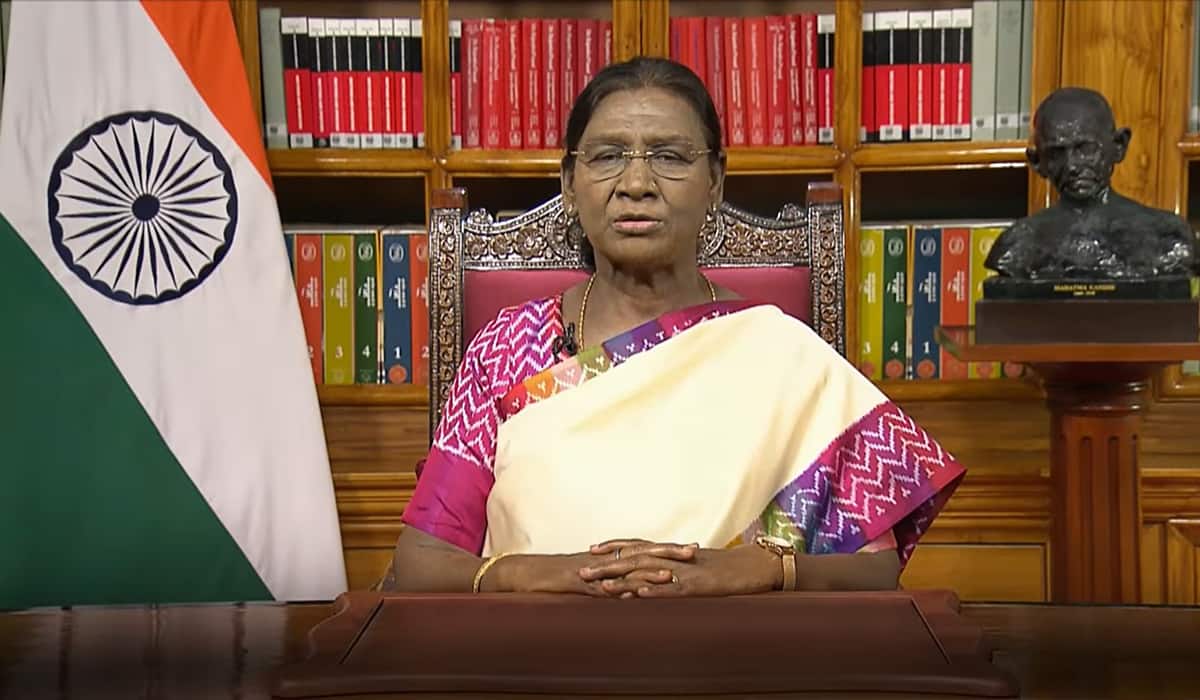
The Prime Minister, Shri Narendra Modi, today delivered the inaugural address at the 106th session of the Indian Science Congress.
Reflecting on the theme of the event this year - ‘Future India: Science and Technology’ - the Prime Minister said that India's true strength will be in connecting its science, technology and innovation, with its people.

He recalled the great Indian scientists of the past, including Acharyas J.C. Bose, C.V. Raman, Meghnad Saha, and S.N. Bose, and said that they served the people through "minimum resources" and "maximum struggle."
"The life and works of hundreds of Indian Scientists are a compelling testament of integration of deep fundamental insights with technology development and nation-building. It is through our modern temples of science that India is transforming its present and working to secure its future," the Prime Minister said.
The Prime Minister recalled our former Prime Ministers Shri Lal Bahadur Shastri ji and Shri Atal Bihari Vajpayee ji. He said that Shastri ji gave us the slogan: "Jai Jawan, Jai Kisan," while Atal ji added "Jai Vigyan" to it. He said that now the time has come to take a step further, by adding "Jai Anusandhan."
The Prime Minister emphasized that the pursuit of science is fulfilled through the achievement of two objectives: generation of profound or disruptive knowledge; and use of that knowledge for socio-economic good.
As we boost our discovery science ecosystem, we must also focus on innovation and start-ups, the Prime Minister said. He said that the Government has launched the Atal Innovation Mission to promote innovation among our scientists. More Technology Business Incubators have been established in the last four years than in the forty years before that, he added.

"Our Scientists must commit themselves to addressing problems of affordable healthcare, housing, clean air, water and energy, agricultural productivity and food processing. While Science is universal, technology must be local for providing solutions relevant to local needs and conditions," the Prime Minister said.
The Prime Minister said that big data analysis, artificial intelligence, block-chain etc should be utilised in the agricultural sector, especially to help the farmers with relatively small farm-holdings.
He urged the scientists to work towards ease of living for the people. In this context, he mentioned issues such as drought management in low rainfall areas; early disaster warning systems; tackling malnutrition; tackling diseases among children such as encephalitis; clean energy; clean drinking water; and cyber security. He called for time-bound solutions through research, in these areas.
The Prime Minister mentioned major achievements of Indian science in 2018, including:
• production of aviation grade biofuel;
• Divya Nayan - a machine for visually impaired;
• inexpensive devices for diagnosis of cervical cancer, TB and dengue
• a real-time landslide warning system in the Sikkim-Darjeeling region.
He said that strong pathways to commercialization, are needed to leverage our Research & Development achievements, through industrial products.

The Prime Minister called for research, which is a fusion of Arts and Humanities, Social Science, Science and Technology.
Noting that our strengths in research and development are built on the backbone of our national laboratories, central universities, IITs, IISC, TIFR and IISERs, the Prime Minister said that a strong research ecosystem must be developed in the State Universities and Colleges, as well.

He announced that the Union Government has approved a National Mission on Interdisciplinary Cyber Physical Systems with an investment of over Rs. 3600 crore. The Mission will cover in a seamless way, R&D, Technology Development, Human resources and Skills, Innovation, Start-up Ecosystem and strong Industry and International Collaborations, he added.

Speaking on achievements in the space sector, the Prime Minister mentioned the success of Cartosat 2 and other satellites. He said preparations are underway for sending three Indians into space, through the Gaganyaan in 2022. He expressed happiness that research has begun to find an effective solution for sickle cell anaemia.

He said that the ‘Prime Minister’s Science, Technology and Innovation Advisory Council’ will help formulate appropriate Science and Technology interventions, catalyze collaborations across stakeholder Ministries and implement multi-stakeholder policy initiatives.

We have launched the ‘Prime Minister’s Research Fellows’ Scheme under which, a thousand bright minds from the best Institutions in the country will be offered direct admission in Ph.D. Programs in IITs and IISc, the Prime Minister said. The scheme will catalyze quality research and address shortage of faculty in the premier Educational Institutions, he added.
The life and works of Indian Scientists are a compelling testament of integration of deep fundamental insights with technology development & nation-building.
— PMO India (@PMOIndia) January 3, 2019
It is through our modern temples of science that India is transforming its present & working to secure its future: PM
हमने कृषि विज्ञान में काफी प्रगति की है, हमारे यहां पैदावार, गुणवत्ता बढ़ी है लेकिन न्यू इंडिया की जरुरतों को पूरा के लिए विस्तार की ज़रूरत है।
— PMO India (@PMOIndia) January 3, 2019
Big Data, AI, Blockchain से जुड़ी तमाम टेक्नॉलॉजी का कम कीमत में कारगर इस्तेमाल खेती में कैसे हो इस पर हमारा फोकस होना चाहिए: PM
2018 was a good year for Indian science.
— PMO India (@PMOIndia) January 3, 2019
Among our achievements this year are:
Production of Aviation Grade Biofuel
Divya Nayan - a machine for visually impaired
Inexpensive devices for diagnosis of Cervical Cancer, TB, Dengue
A real-time landslide warning system: PM
We need strong path-ways to commercialisation, that leverage our Research & Development achievements, through industrial products.
— PMO India (@PMOIndia) January 3, 2019
The future is about convergence and connected technologies.
We should catalyse, harness and manage change for the nation’s prosperity: PM
उन्नत भारत बनाने के लिए आज भारत के विज्ञान को महत्वाकांक्षी बनना होगा।
— PMO India (@PMOIndia) January 3, 2019
हमें सिर्फ प्रतिस्पर्धा नहीं करनी, हमें श्रेष्ठता दिखानी होगी।
हमें सिर्फ रीसर्च करने के लिए रीसर्च नहीं करनी है बल्कि अपनी Findings को उस स्तर पर ले जाना है जिससे दुनिया उसके पीछे चले: PM
किसी भी देश की Intellectual Creativity और Identity उसके इतिहास, कला, भाषा और संस्कृति से बनती है।
— PMO India (@PMOIndia) January 3, 2019
ऐसे में हमें विधाओं के बंधन से मुक्त होकर शोध करना होगा।
अब ऐसी रीसर्च की जरुरत है जिसमें Arts और Humanities, सोशल साइंस, साइंस और टेक्नोल़ॉजी के Innovation का Fusion हो: PM
Our strengths in R&D are built on the backbone of our national laboratories, central universities, IIT, IISc, TIFR & IISER.
— PMO India (@PMOIndia) January 3, 2019
However, over 95% of our students go to state universities & colleges.
A strong research ecosystem must be developed in these Universities & Colleges: PM
I call upon the Prime Minister’s Science, Technology and Innovation Council, to discuss these issues in detail and formulate an action plan in consultation with the Ministry of Human Resource Development, to boost research in our colleges and state universities: PM
— PMO India (@PMOIndia) January 3, 2019
Let us work for building a new India through science.
— PMO India (@PMOIndia) January 3, 2019
An India that is ready to meet the challenges & opportunities of present & future.
An India that is bubbling with ideas, knowledge, wisdom & action.
An India that is stronger, confident, prosperous & healthier: PM