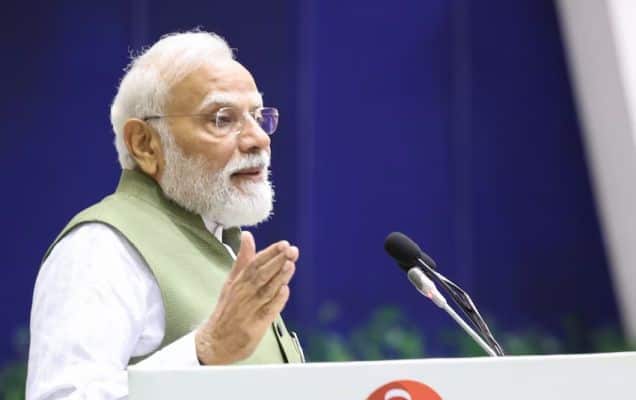
My dear countrymen, Namaskar. Last month, all of us were celebrating Diwali. Like every year, this Diwali too, I had gone to the border, to the China border, to celebrate the occasion with our soldiers, our jawans. I celebrated Diwali with ITBP men and army jawans on the lofty heights of the Himalayas. I do it every time, but this Diwali was an entirely different experience. The heartening effect of the novel way in which our 1.25 billion countrymen dedicated this Diwali to soldiers of our army, to our defence forces, was clearly evident on their faces. They appeared charged with emotions, and not just that, the act of our countrymen of sending greeting messages, including the defence forces of the nation in their rejoicing had elicited a wonderful response. And it is not that people merely sent messages. There was an earnest heartfelt connect. Some wrote poems, some drew pictures, a few created cartoons, others made videos; it was as if every home had been transformed into an army post. And when I saw those letters, I used to be amazed at the magnitude of creativity and emotions behind this endeavour. And this gave rise to a thought in MyGov that out of these, selected items could be compiled to make a coffee table book. Work is under way on that. Your collective contribution, the sentiments of soldiers, your emotional universe dedicated to our security forces as expressed in your creativity will form the content of this volume.
A soldier wrote to me – Mr. Prime Minister, we soldiers have all the festivals like Holi and Diwali on the borders. We are devoted to defending the country every moment. Bu we do miss our near and dear ones back home during festivals. But, to tell you the truth, this time we did not feel so. Never did it appear to us even once that we are not at home for the festivities. It felt as if we were celebrating Diwali together with a hundred and twenty five crore Indians.
My dear countrymen, this warmth of emotion, this fervour that has been kindled in the hearts of our defence forces, our soldiers this Diwali, should this be confined to only a few occasions? I appeal to you that we should make it our nature, our characteristic as a society, as a Nation that whether it be a celebration of a festival or any joyous occasion, we should keep the soldiers, the jawans of the military of our nation in our hearts and minds. When the entire nation stands by the armed forces, their might mutiplies a hundred and twenty five crore times.
A few days ago, all Pradhans from the villages of Jammu & Kashmir had come to see me. They were from the Jammu & Kashmir Panchayat Conference. They had come from different villages of the Kashmir valley, there were around 40-50 Pradhans. I got an opportunity to speak to them at length. They had come to discuss a few points on the development of their villages; they had some demands. But when the deliberations began, issues such as conditions in the valley, the law and order situation, the future of children came up in a natural manner. These village Pradhans spoke about these topics with such affection and openness that everything touched my heart. In the course of the conversation, there was also a mention of schools in Kashmir that had been set afire. And I felt these Pradhans were as saddened as our other countrymen were, at that. They too felt that it was not just schools, it was the future of the children, that had been set ablaze. I had urged them to focus on these children’s future, on their return home. I am feeling happy today that these Pradhans, who had come from the Kashmir valley, kept their word in letter and spirit. They returned to their villages and made people from far and wide aware on this issue. Recently, just a few days ago, when the Board examinations were held, 95% of the sons and daughters of Kashmir, the young students appeared in the examinations. The sheer volume of students, who appeared in the Board Examinations, is a clear indication that our children from Jammu & Kashmir are committed to attain newer heights of progress, to build a bright future through the medium of education. For their resolute zeal I congratulate these students and I also felicitate their parents, their kith and kin, their teachers and all the Gram Pradhans as well from the depths of my heart.
My dear brothers and sisters, this time when I asked people for suggestions for ‘Mann ki Baat’, I can say that almost all the suggestions that were received echoed one theme. Everyone wanted me to speak in more detail about the 500 & 1000 rupee notes. On the 8th of November at 8 in the evening, in my Address to the Nation, I had talked about launching a mega campaign to bring about reforms in the country. When I had taken this decision and presented it before you, then also I had said openly that it was not an ordinary decision, it was one fraught with difficulties. It was a very important decision but implementation of that decision is equally important. And I had also foreseen that this would result in all of us having to face various new difficulties in our day-to-day lives. And I had stated then also that this decision was so enormous that it would take us at least 50 days to come out of its after effects and only then would we be able to move towards normalcy. These maladies have been afflicting us for the past 70 years and the campaign for getting rid of these can never be an easy task. I can very well understand the problems you are going through! But when I see your support, when I look at your co-operation; although numerous efforts are on to misguide you, despite that, and despite witnessing some disturbing incidents, you have whole heartedly comprehended the path of righteousness and truth, you have favourably accepted this step taken in the best national interest.
500 and 1000 rupee notes and such a vast country, wide proliferation of currencies, billions and trillions of bank notes and amidst that, this decision – the whole world is minutely observing, every economist is analysing it, evaluating it. The whole world is watching – will hundred and twenty-five crore Indians finally attain success after facing numerous hardships? This question may be there in the world community. However, India has nothing but faith and faith only and supreme confidence in her hundred and twenty five crore countrymen that they will certainly fulfill their resolve. And our country will emerge shining like gold does after a test by fire. And the reason for that is you, the citizens of this country. The route to this success also has been paved only because of you.
Across the country, central government, state governments, all units of the local self government institutions, one lakh thirty thousand bank branches, lakhs of bank employees, over one and a half lakh post offices, over a lakh Bank-Mitras are relentlessly at work, day and night, with complete dedication. In the midst of immense and varied stress, all these individuals are working hard, maintaining a calm and composed demeanour, taking it as a Yagya of Service to the Nation, an attempt towards a great transformation.
They begin work early in the morning, not knowing when they will wind up at night. Everyone is busy working. And as a precise consequence of this diligence, there are clear indications that India will succeed handsomely in this endeavour. And I have seen that in the midst of such difficulties, all personnel of banks and post offices are working very hard. And when it comes to the practice of humanity, they appear two steps ahead. Someone told me that in Khandwa, an old gentleman met with an accident. Money was needed urgently. This came to the knowledge of local bank personnel, and I was happy to learn that they personally carried and handed over cash at his home, for help in treatment. Innumerable such incidents come to light everyday through television, media, newspapers and mutual conversations. I profusely thank all such compatriots who have striven hard to perform this MAHAYAGYA, and lived up to the lofty virtue of PURUSHARTH. The greatest validation of SHAKTI, strength, comes when the same is put to test. I distinctly remember, when the Prime Minister’s Jan Dhan Yojana was launched, bank personnel earnestly and zealously shouldered their responsibilities and showed that they could achieve what had not been accomplished during the last 70 years. Their capabilities were manifested. Today, once again, they have accepted the challenge and I do believe that the steely resolve of one hundred and twenty five crore countrymen, their collective demonstration of PURUSHARTH will go a long way in investing our nation with a new power and strength on its path of progress.
But vices are so widespread and deep-rooted that even today there are people whose vicious habits refuse to die. Even now, some people think that they can re-introduce into the system, money from corruption, black money, unaccounted wealth and Benami money (money in unknown person’s name), using some route or the other. They seek illegal means to save their ill-gotten wealth. The saddest part is that, for this too, they have chosen to misuse the poor, the underprivileged people. By misguiding the poor, enticing them through the vices of avarice and temptation, wrongfully pumping money into their bank accounts, or getting them to undertake some wrong activities, some people are trying to save their black money. I want to tell such people today - whether you reform or not is up to you, whether you respect and follow the law or do otherwise is again up to you; of course, the law will take its own course to decide on the requisite action; but, for God’s sake, please do not play with the lives of poor people. Do not do anything that may bring the names of the poor on record for wrong reasons and land my dear poor people into trouble during the investigation later on account of your foul deeds. And the law regarding Benami property that has been enacted and is being implemented is very stringent and it is going to be extremely tough on wrong doers. The government does not wish that our countrymen should face undue hardships.
One Mr. Aashish has called me up and appreciated the fight against corruption and black money through the action on 500 and 1000 Rupee notes: -
“Sir, Namaste. My name is Aashish Paare. I am an ordinary citizen of Village Tiraali of Tehsil Tiraali in District Harda of Madhya Pradesh. Your move to demonetize 1000 and 500 rupee notes is a commendable step. I wish that in Mann Ki Baat, you quote instances of people, who, despite facing hardships, have welcomed this step for the nation’s progress. This will further enhance people’s zeal. A cashless economy is necessary for nation building. And I am with the whole country on this. I am truly happy that you have done away with 1000 and 500 rupee notes.”
I have received a similar call from Mr. Yellappa Velankar Ji from Karnataka: -
“Modi Ji, Namaste. I am calling from a village in Koppal district of Karnataka. My name is Yellappa Velankar. I want to thank you wholeheartedly because you had said that good days will come, but nobody had ever thought that you would take such a big step. You have taught a lesson to black money mongers and the corrupt through the demonetization of 1000 and 500 rupee notes. For each and every citizen of India there could be no better days than these. For this I thank you from the core of my heart.”
We get to know certain things through media, through the people and through government sources which add to our enthusiasm for work. It gives us such a great happiness and a sense of pride to know that the common man in my country has such a wonderful capability. A restaurant on the National Highway-6 in Akola in Maharashtra has displayed a board saying that if you have only old currency notes in the pocket and want to have food, please, do not worry about money and do not leave hungry from this place. Please, do have your food and pay later whenever you happen to pass through this place. So people go and eat there and make payments on their next visit after 2, 4 or 6 days. This is the strength of my country which encompasses the spirit of service, of sacrifice and also of genuineness and honesty.
During elections, I used to have ‘चाय पर चर्चा’, that is discussions over tea and this got publicised around the whole world. People in many countries of the world even learnt to utter the phrase – ‘Chai Par Charcha’. But, I did not know ‘Chai Par Charcha’ could be linked to a marriage also. I learnt that on 17th November, a marriage was solemnised with ‘Chai Par Charcha’ in Surat. One daughter at Surat in Gujarat served only tea to all the guests who had come to her wedding. There was no big function, no feast or banquet because there was a shortage of cash due to demonetisation. Guests from the bridegroom’s side also gracefully accepted it as their ceremonial welcome. Bharat Maaroo and Dakshaa Parmar from Surat, through their marriage, have made a valuable contribution in the ongoing fight against corruption and black money and set up a very inspiring example. I convey my blessings to the newlyweds Bharat and Dakshaa and profusely compliment them also for having transformed their wedding occasion into an offering for the great task and thereby converting it into a new opportunity. Whenever confronted by such difficult times, people do succeed in exploring and finding good avenues and solutions.
I once saw in the news on TV, when I had returned late in the night, a report about a small village called Dhekiajulli (धेकियाजुली) in Assam, where tea workers reside. These tea workers get their wages on weekly basis. Now, what they did when they received a 2000 rupee note as wages? Four women from the neighborhood got together and jointly made purchases and made the payment with the 2000 Rupee note; they did not need small currency as they had jointly made their purchases and had decided that they would settle accounts later when they were to meet next week. People are themselves finding ways. And just look at this change. The government received a message that people of tea gardens in Assam are demanding setting up of ATMs in their areas. See, how the village life is also getting transformed. Some people are getting instant benefits from this campaign. The nation will reap these benefits in the days to come but some people have got benefits instantly. On asking how things were going on, I got to know about the impact in small towns. On the basis of reports received from about 45-50 cities, I gathered that demonetisation had encouraged people there to pay their arrears accumulated due to non-payment of dues earlier; many people were in the habit of not making tax payments such as water tax, electricity bills, etc., they just did not pay. Now all of us know very well that the poor people always like to clear their dues 2-3 days in advance. It is the well-off people, who do not pay their taxes and bills as they have higher connections and know that nobody is going to ask or do anything against them. Thus there are big arrears of payments, which remain pending. All municipalities receive hardly 50% of their tax revenues. But, this time after the decision taken on the 8th instant, people rushed to deposit their old currency notes. 47 urban institutions had received about 3 to 3.5 thousand crore rupees in taxes last year. You will be surprised and also happy to know that during this one week, these institutions received 13 thousand crore rupees. Imagine the difference - from 3 to 3.5 thousand crores to 13 thousand crores. And, that too with the self initiative of those making payments. Now that these municipalities have received 4 times the money, it is quite natural that poor localities and slums will get better drainage facilities, better water supply and better Aanganbari system. Many such examples are coming to light where direct benefits of this demonetisation can clearly be seen.
Brothers and sisters, our villages and our farmers are strong pillars of our economy. Every citizen is making requisite adjustments amidst the difficulties as a result of the new changes. But, I especially wish to compliment the farmers of our country. I was just gathering data of the sowing of this crop season. I am glad that be it wheat, be it pulses, be it oilseeds, the data received till 20th November indicates that sowing has increased substantially as compared to sowing during the last year. Our farmers have discovered new avenues amidst the present difficulties. The government has also taken many important decisions, wherein priority has been accorded to our farmers and villages. Despite these measures, some difficulties persist but I am confident that our farmer who bravely faces every difficulty, including natural calamities, is standing firm in the face of present odds also.
Small traders and businessmen of our country provide employment opportunities besides adding to the economic activities. In the last budget we had taken an important decision that just like the big malls, small shopkeepers in the villages will also be allowed to operate round the clock and no rule will stop them from doing so because I felt that when the big malls can function 24 hours, why the poor village-shopkeepers should not get the same facility? A number of initiatives were taken to grant them loans under Mudra Yojana. These small traders were provided loans worth lakhs and crores of rupees under Mudra Yojana because there are crores of such small traders and they impart momentum to the business activities worth billions of rupees. But naturally they too had to face difficulties due to this decision. However, I have seen that these small businessmen too have kept providing services to their customers in their own ways through the use of technology such as Mobile App, Mobile Bank and Credit Card and on the basis of mutual trust also. And, I want to tell our small trader brothers and sisters that this is a ripe opportunity for them too to make their entry into the digital world. You too download Apps of Banks on your mobile phones. You too keep a POS machine for transactions in Credit Cards. You too learn to do cashless business. You can see how the big malls are expanding their business with the help of latest technology. A small trader can also expand the business with the help of this user friendly technology. There is no possibility of things going wrong, but there certainly is an opportunity to grow. I invite you all. You can make a very big contribution in creating a cashless society. You can create a full-fledged banking facility on your mobile phone and there are many ways now to run our business without using paper currency. There are technological methods which are safe, secure and instantaneous. I want that you not only extend your cooperation in making this campaign successful but also lead the process of transformation and I have full confidence that you can be the leader for this change. I am sure you can handle the entire business in your village using this technology.
I want to tell my worker brothers and sisters too that you have faced heavy exploitation. Wages shown on paper are much higher than the wages actually paid to you. If sometimes full wages are paid, someone stands outside to forcibly take his cut and the worker is compelled to accept this as his fate. We want that under this new system you should have a bank account; your wages should be deposited directly into your bank so that payment of minimum wages is ensured. You get your due wages in full, without anybody extracting a cut. No one should exploit you. And, once the money is credited into your bank account, you can use your mobile phone as an e-wallet and you do not need any hi-fi smart phone for this, because even with the help of your ordinary mobile phone itself you can make purchases from the neighbourhood shops and make payments as well. That is why, I specially urge our worker brothers and sisters to participate in this scheme because after all I took such a momentous decision for the benefit of the poor people, the farmers, the workers, the deprived and the suffering people of the country and, hence, these benefits must reach them.
I specially want to talk to our young friends today. We keep telling with great fanfare the whole world that India is a country where 65% of the population is below the age of 35 years. I know, dear young men and women of my country, that you have liked my decision. I also know that you support my decision. I even know that you are making a big contribution in positively taking this mission forward. But dear friends, you are my true soldiers, my true partners. We have got a wonderful chance to serve our mother India and to take our country to new economic heights. Dear youngsters, can you please help me? You will be with me but that alone is not enough. The older generation does not have the exposure and experience of the new world which you possess. Possibly your elder brother and even your parents and uncles and aunts also may not know. You know what an ‘App’ is, what ‘online banking’ is and how ‘online ticket booking’ is done. For you these are routine things and you also make use of them. But, the great task that the country wants to accomplish today is the realisation of our dream of a ‘Cashless Society’. It is true that a hundred percent cashless society is not possible. But why should India not make a beginning in creating a ‘less-cash society’? Once we embark on our journey to create a ‘less-cash society’, the goal of ‘cashless society’ will not remain very far. And I require your physical help, your own time, your own resolve and I am sure that you will not disappoint me because we are the ones nurturing the desire to change for better the life of the poor people of India. You know how many opportunities there are today for a cashless society, for digital banking or for mobile banking. Every bank provides online banking facility. Every bank in India has its own ‘mobile App’. Every bank has its wallet. Wallet simply means an e-purse. Various types of cards are available. Under Jan Dhan Yojana, crores of poor families in India have Rupay Cards. Used scarcely earlier, after 8th November the poor people have started using Rupay Cards and this usage has seen almost 300% surge. Just as there is a prepaid card for mobile phones, prepaid cards are also available in banks to facilitate expenditure. UPI is a very useful platform for carrying on trade activities which enables you to make purchases, send money and even receive money. And, this procedure is as simple as sending messages through WhatsApp. Even an illiterate person today knows how to send and also forward WhatsApp messages. Not only this, with the simplification of technology, we do not require any big smart phones for this purpose.
Cash can be transferred even with a phone with ordinary features. A washerman, vegetable vendor, milk supplier, newspaper vendor, tea stall owner or a chanaa vendor, everyone can easily use this facility. I have provided further impetus to simplifying this system even more. All banks are engaged in this and are doing their best. We have now cancelled the online surcharge and you might have seen in the newspapers during last 2-4 days that all extra charges for such cards have been abolished in order to strengthen the movement towards achieving a ‘cashless society’.
My dear young friends, despite all these things, there is an entire generation which is ignorant in these matters. And I know it very well that all of you are actively contributing in this great task. The kind of creative messages that you send on WhatsApp - slogans, poems, anecdotes, cartoons, new imagination, jokes – I am seeing all these signifying the creative power of our young generation amidst the present challenges. This is the speciality of our ‘Bharat Bhoomi’, our motherland where GITA was created on a battlefield. Today when we are passing through the times of such gigantic changes, your original creativity is manifesting itself within you. But, my dear young friends, I once again tell you that I need your help in this task. Yes, yes, yes – I repeat that I NEED YOUR HELP and I am very sure that millions of young people of our country will accomplish this tremendous task.
You just do one thing, take a resolve today itself that you will yourself become a part of the ‘cashless society’. Every technology needed for online spending will definitely be available on your mobile phone. But not only this, you must devote half an hour, one hour or two hours daily to educate at least 10 families about what this technology is, how this technology is to be used, how to download the Apps of your banks, how to spend money from one’s account, how to make payment to shopkeepers. Also teach the shopkeepers to conduct their business with this technology. You have to voluntarily lend your leadership to this great campaign, this Maha Abhiyan, to create a ‘cashless society’, to eradicate corruption from our country, to abolish the scourge of black money and to help people in overcoming their difficulties and problems. Once you teach the poor people about the usage of Rupay Card, they will shower their blessings upon you. When you teach the common citizen these new techniques, he will probably become free from all his worries. And if all the young people of India join in this great endeavour, I don’t think it will take much time. We can emerge and take our place in the world as a new modern India within a period of one month. And you can do this through your mobile phone by going to 10 houses daily and bringing 10 families daily under the ambit of this campaign. I invite you – come, do not just support this transformation but become one of its leading soldiers and ensure that we achieve the desired transformation. We shall carry forward this struggle to free our country from the evils of corruption and black money. There are many countries in the world where the youth have changed the nation’s life and it has to be accepted that it is the youth which brings about the great changes, which creates revolutions. Kenya made a resolve and set up a mobile based system M-PESA, adopted appropriate technology which was named M-PESA and today in Kenya, in this region of Africa, total business is ready to shift to this system. That country has brought about a big revolution.
My dear young friends, I once again earnestly appeal to you to take forward this campaign. I invite you to work for this mission individually and collectively in every school, in every college, in every university, in NCC and in NSS. We must take this forward. We have got an opportunity to render a great service to our nation; this chance must not be missed.
Dear brothers and sisters, today is the birth anniversary of a great poet of our country – Shriman Harivansh Rai Bachchan Ji and on this occasion today, Shriman Amitabh Bachchan Ji has given a slogan for Swachhta Mission. You must have noticed, that Amitabh Ji, the most popular actor of this century, has been whole-heartedly promoting the campaign for cleanliness. It appears as if the subject of cleanliness has become so dear to him that even on his father’s birth anniversary he remembered the Cleanliness Mission. He has quoted one line from a poem written by Harivansh Rai Bachchan Ji wherein he said: “Mitti Ka Tann, Masti Ka Mann, Kshan Bhar Jeewan, Mera Parichay. (feV~Vh dk ru] eLrh dk eu] {k.kHkj thou] esjk ifjp;)” Harivansh Rai Ji used to give his introduction through this line. His son Shriman Amitabh Ji, who has the cleanliness mission running in his veins, has written to me –“Swachchh Tann, Swachchh Mann, Swachchh Bharat, Mera Parichay. LoPN ru] LoPN eu] LoPN Hkkjr] esjk ifjp; ” based on Harivansh Rai Ji’s lines. I respectfully bow to Harivansh Rai Ji. I also thank Shriman Amitabh Ji to connect in such a warm manner with ‘Mann Ki Baat’ and for taking forward the Cleanliness Campaign.
My dear countrymen, now your views and your sentiments on ‘Mann Ki Baat’ though your letters, on MyGov, on NaarendraModiApp keep me constantly connected with you. Presently Mann Ki Baat is broadcast at 11 AM but we are going to start its broadcast in regional languages immediately after my Hindi broadcast. I am grateful to Akashvani for taking up this initiative which will definitely provide an opportunity to connect our countrymen even in those areas, where Hindi language is not prevalent. Many thanks to all of you.
Last month we all celebrated Diwali. Like always, I celebrated this festival with our Jawans: PM @narendramodi #MannKiBaat
— PMO India (@PMOIndia) November 27, 2016
देश ने जिस अनूठे अंदाज़ में, दिवाली सेना के जवानों को, सुरक्षा बलों को समर्पित की, इसका असर वहाँ हर जवानों के चेहरे पर अभिव्यक्त होता था: PM
— PMO India (@PMOIndia) November 27, 2016
सेना के एक जवान ने मुझे लिखा - हम सैनिकों के लिये होली, दिवाली हर त्योहार सरहद पर ही होता है, हर वक्त देश की हिफाज़त में डूबे रहते हैं: PM
— PMO India (@PMOIndia) November 27, 2016
कुछ समय पहले मुझे जम्मू-कश्मीर से, वहाँ के गाँव के सारे प्रधान मिलने आये थे : PM @narendramodi #MannKiBaat https://t.co/Iy8hu3Nre5
— PMO India (@PMOIndia) November 27, 2016
काफ़ी देर तक उनसे मुझे बातें करने का अवसर मिला | वे अपने गाँव के विकास की कुछ बातें लेकर के आए थे : PM @narendramodi
— PMO India (@PMOIndia) November 27, 2016
मैंने उनसे आग्रह किया था कि आप जाकर के इन बच्चों के भविष्य पर अपना ध्यान केन्द्रित करें : PM @narendramodi #MannKiBaat
— PMO India (@PMOIndia) November 27, 2016
जम्मू-कश्मीर के हमारे बच्चे उज्ज्वल भविष्य के लिये, शिक्षा के माध्यम से - विकास की नई ऊँचाइयों को पाने के लिये कृतसंकल्प हैं : PM
— PMO India (@PMOIndia) November 27, 2016
इस बार जब मैंने ‘मन की बात’ के लिये लोगों के सुझाव मांगे, तो मैं कह सकता हूँ कि एकतरफ़ा ही सबके सुझाव आए : PM @narendramodi #MannKiBaat
— PMO India (@PMOIndia) November 27, 2016
सब कहते थे कि 500/- और 1000/- वाले नोटों पर और विस्तार से बातें करें : PM @narendramodi #MannKiBaat
— PMO India (@PMOIndia) November 27, 2016
जिस समय ये निर्णय किया था, आपके सामने प्रस्तुत रखा था, तब भी मैंने सबके सामने कहा था कि निर्णय सामान्य नहीं है, कठिनाइयों से भरा हुआ है: PM
— PMO India (@PMOIndia) November 27, 2016
70 साल से जिस बीमारियों को हम झेल रहे हैं उस बीमारियों से मुक्ति का अभियान सरल नहीं हो सकता है : PM @narendramodi #MannKiBaat
— PMO India (@PMOIndia) November 27, 2016
#PMonAIR: आपकी कठिनाइयों को मैं समझता हूँ, भ्रमित करने के प्रयास चल रहे हैं फिर भी देशहित की इस बात को आपने स्वीकार किया है #DeMonetisation
— All India Radio News (@airnewsalerts) November 27, 2016
Governments, post offices, banks...they are all working very hard and are working with dedication: PM @narendramodi #MannKiBaat
— PMO India (@PMOIndia) November 27, 2016
इतनी कठिनाइयों के बीच बैंक के, पोस्ट ऑफिस के सभी लोग काम कर रहे हैं : PM @narendramodi #MannKiBaat
— PMO India (@PMOIndia) November 27, 2016
| शक्ति की पहचान तो तब होती है, जब कसौटी से पार उतरते हैं : PM @narendramodi #MannKiBaat
— PMO India (@PMOIndia) November 27, 2016
#PMonAIR लेकिन बुराइयाँ इतनी फैली हुई हैं कि आज भी कुछ लोगों की बुराइयों की आदत जाती नहीं है | #MannKiBaat #DeMonetisation pic.twitter.com/BpxMhsJzaw
— All India Radio News (@airnewsalerts) November 27, 2016
इतना आनंद होता है, इतना गर्व होता है कि मेरे देश में सामान्य मानव का क्या अद्भुत सामर्थ्य है : PM @narendramodi #MannKiBaat
— PMO India (@PMOIndia) November 27, 2016
Audio calls from MyGov users Ashish Pare from Madhya Pradesh and Yellappa Velankar from Karnataka mentioned by PM in #MannKiBaat.
— MyGovIndia (@mygovindia) November 27, 2016
हमारा गाँव, हमारा किसान ये हमारे देश की अर्थव्यवस्था की एक मज़बूत धुरी हैं : PM @narendramodi #MannKiBaat
— PMO India (@PMOIndia) November 27, 2016
हमारे देश के छोटे व्यापारी, वे रोजगार भी देते हैं, आर्थिक गतिविधि भी बढ़ाते हैं : PM @narendramodi #MannKiBaat
— PMO India (@PMOIndia) November 27, 2016
अर्थव्यवस्था के इस नये बदलाव के कारण, कठिनाइयों के बीच, हर कोई नागरिक अपने आपको adjust कर रहा है. #Demonitsation #MannKiBaat pic.twitter.com/KAH88aGpC0
— ALL INDIA RADIO (@AkashvaniAIR) November 27, 2016
इतना बड़ा मैंने निर्णय देश के ग़रीब के लिये, किसान के लिये, मज़दूर के लिये, वंचित के लिये, पीड़ित के लिये लिया है: PM @narendramodi
— PMO India (@PMOIndia) November 27, 2016
देश को आर्थिक ऊंचाइयों पर ले जाने का अवसर आया है : PM @narendramodi #MannKiBaat
— PMO India (@PMOIndia) November 27, 2016
Youngsters are agents of change: PM @narendramodi #MannKiBaat
— PMO India (@PMOIndia) November 27, 2016
मेरे नौजवानो, मैं फिर एक बार, फिर एक बार बड़े आग्रह से आपको कहता हूँ कि आप इस अभियान को आगे बढ़ाइए : PM @narendramodi #MannKiBaat
— PMO India (@PMOIndia) November 27, 2016
हमारे देश के एक महान कवि - श्रीमान हरिवंशराय बच्चन जी का आज जन्म-जयंती का दिन है : PM @narendramodi #MannKiBaat
— PMO India (@PMOIndia) November 27, 2016
आज हरिवंशराय जी के जन्मदिन पर श्रीअमिताभ बच्चन जी ने “स्वच्छता अभियान” के लिये एक नारा दिया है : PM @narendramodi #MannKiBaat @SrBachchan
— PMO India (@PMOIndia) November 27, 2016
आपने देखा होगा, इस सदी के सर्वाधिक लोकप्रिय कलाकार अमिताभ जी स्वच्छता के अभियान को बहुत जी-जान से आगे बढ़ा रहे हैं: PM @narendramodi
— PMO India (@PMOIndia) November 27, 2016
Shri Amitabh Bachchan wrote to me- ‘स्वच्छ तन, स्वच्छ मन, स्वच्छ भारत, मेरा परिचय” : PM @narendramodi #MannKiBaat @SrBachchan
— PMO India (@PMOIndia) November 27, 2016
अब तो 11 बजे ये ‘मन की बात’ होती है, लेकिन प्रादेशिक भाषाओं में इसे पूरा करने के तुरंत बाद शुरू करने वाले हैं : PM @narendramodi
— PMO India (@PMOIndia) November 27, 2016