Hon’ble Mr Chairman Sir,
I stand here today to express my gratitude for the President’s address.
Hon’ble Mr Chairman Sir,
It is my privilege to place my sentiments before this House in support of the motion of thanks.
Hon’ble Mr Chairman Sir,
In the journey towards a developed India, the past year has been one of rapid progress and growth. Every sphere of life, every section of society has witnessed a transformative phase. The nation is advancing in the right direction, at great speed. The Honourable President has presented this before us with remarkable sensitivity and clarity.
Hon’ble Mr Chairman Sir,
I have a humble request. Considering the age of Honourable Kharge ji, it would be better if he could raise slogans while seated, so that he does not suffer discomfort. There are many young members behind him, so kindly permit Kharge ji to raise slogans from his seat itself.
Hon’ble Mr Chairman Sir,
The President spoke in detail about the middle class, the lower middle class, the poor, the villages, the farmers, women, science, technology, and agriculture. Her words echoed the progress of India throughout Parliament. She elaborated on how the youth are advancing India’s strength. She highlighted the capabilities of every section of society, and above all, he expressed confidence in India’s bright future. This in itself is inspiring for all of us.
Hon’ble Mr Chairman Sir,
The first quarter of the 21st century has concluded. Just as the second quarter of the last century proved decisive in India’s struggle for independence, I clearly see that this second quarter will be equally powerful and will propel India rapidly towards becoming a developed nation.
And therefore, Hon’ble Mr Chairman Sir,
Every citizen feels that we have reached a crucial milestone. We must not stop, nor look back. We must look forward, move faster, and breathe only after achieving our goals. This is the direction in which we are advancing.
Hon’ble Mr Chairman Sir,
At present, India is blessed with several favourable circumstances simultaneously. This is indeed a rare and fortunate convergence. The most important aspect is that while the richest nations of the world are ageing, with their populations reaching senior stages, our country is scaling new heights of development while simultaneously becoming younger. India is a nation of youth, and this is a great advantage.
Hon’ble Mr Chairman Sir,
On the other hand, I see the growing global attraction towards India, and the recognition of India’s talent. Today, we possess one of the world’s most significant talent pools-young, ambitious, determined, and capable. This is another blessing, a true strength bestowed upon us.
Hon’ble Mr Chairman Sir,
India today stands as a beacon of hope, offering solutions to global challenges. Another favourable circumstance is that among major economies, India’s growth is high, coupled with low inflation. This unique combination demonstrates the strength of our economy.
Hon’ble Mr Chairman Sir,
When the people of this country entrusted us with the opportunity to serve, India was counted among the “Fragile Five.” At independence, we were the sixth-largest economy in the world, but under previous leadership, we slipped to eleventh. Today, we are advancing rapidly towards becoming the third-largest economy.
Hon’ble Mr Chairman Sir,
Look at any sector-science, space, sports-India today stands with confidence and self-belief. After COVID, the world has struggled to cope with new challenges, and it is evident that the world is moving towards a new global order. After the Second World War, one world order was established; now, a new order is emerging swiftly. The most gratifying aspect is that an impartial analysis of these developments shows a clear tilt towards India. As a trusted partner and friend, India has become a reliable ally for many nations. We stand shoulder to shoulder with the world, contributing to global welfare with our strength.
Hon’ble Mr Chairman Sir,
Today, the entire world speaks of the Global South, and India has become its resounding voice on international platforms. India is entering into “future-ready trade deals” with many nations. Recently, we have concluded nine major trade agreements with important countries, including the “Mother of all Deals” with the European Union, involving 27 nations simultaneously. Those who grew weary and left the stage will one day have to answer why they left the nation in such a state that no country was willing to deal with us. Perhaps they tried, made endless rounds, but no one even looked their way. How did such a situation arise? Today, countries are not entering into deals with India by chance-they are doing so because of India’s strength and standing.
Hon’ble Mr Chairman Sir,
The most important point here is that when developed countries enter into agreements with a developing nation, it sends a powerful message to the global economic community. This is not new to me. When I had the opportunity to serve in Gujarat, I organized the Vibrant Gujarat Summit, and I was proud that a state of India had Japan-a developed country-as its partner nation. A state demonstrated this capability then, and today my country is demonstrating it at the national level. This happens only when you have economic strength, when your citizens are energized, and when you have a strong ecosystem for manufacturing. Then the world comes forward to deal with you. Those immersed in vote-bank politics never prioritized strengthening such aspects of the nation, and the result is evident. As far as the Congress Party is concerned, I say this clearly: if you do not trust my words, I urge the people of this country to simply analyze the speeches of Congress Prime Ministers from the Red Fort. You will see plainly that they had no vision, no ideas, and no willpower-and the nation suffered greatly because of it.
Hon’ble Mr Chairman Sir,
I am deeply grateful to the citizens of this country for giving me the opportunity to serve. Much of our strength today is spent correcting their mistakes. The image of India that the world carried from their time requires effort to erase. They left the nation in ruins. To repair this, we emphasized future-ready policies. Today, you can see that the country is governed by policy, not by ad hoc decisions, and this has built global trust. We advanced with the mantra of Reform, Perform, Transform, and today the nation is riding the Reform Express. We have implemented structural reforms, process-related reforms, and policy reforms. We have worked to empower our manufacturing sector and entrepreneurs, ensuring value addition in everything India produces. I can say with confidence today that India is fully prepared to compete with the world. When I attend global CEO forums, I see that the world now views our entrepreneurs as equals. Recently, delegations from all parties visited abroad, and upon returning, honourable members told me with pride that India was being treated as an equal. This is an achievement in itself.
Hon’ble Mr Chairman Sir,
The vast MSME network is a long-term strength for the economy. We have emphasized this sector and introduced many reforms. Today, the world’s trust in our MSMEs is growing. We may not manufacture entire airplanes, but many of the components in aircraft are produced by India’s smallest MSMEs.
Hon’ble Mr Chairman Sir,
The results of these efforts are visible to all. Major nations are eager to establish trade relations with India. Whether it is the trade deal with the European Union or the recent agreement with the United States-about which our colleague Piyush ji provided detailed information in this House-the entire world is openly praising these deals. When the EU trade deal was signed, the world gained confidence that global stability was increasing. After the US trade deal, the world felt not only stability but also momentum. This is a positive sign for the world.
Hon’ble Mr Chairman Sir,
The greatest beneficiaries of this will be the youth of our country. And when I say youth, I mean the young from the middle class, from cities, from villages-sons and daughters alike. We must not view them in fragments. We should take pride in the strength of India’s youth. The global market is now open to them, presenting endless opportunities. I say to them: Come forward, my friends! I stand shoulder to shoulder with you. Be courageous, move ahead! The nation stands with you, and the world awaits to welcome you.
Hon’ble Mr Chairman Sir,
The demand for our young professionals is rising across the world-even for caregivers. Everywhere I go, people say they need such talent. Some are even setting up special offices here to recruit and search for qualified professionals. This means enormous opportunities are opening up globally for India’s professionals.
Hon’ble Mr Chairman Sir,
This Upper House of Parliament represents the states. Observing the details of the discussions here, I feel the level should have been higher. Especially from those who have governed for so many years, the standard of debate should have been elevated. But they squandered this opportunity. How can the nation trust them?
Hon’ble Mr Chairman Sir,
Yesterday, I listened to an honourable member who proudly calls himself a king. Yet he was speaking about economic inequality. Imagine! One who calls himself a king talking about inequality-it makes one wonder if this is what we were meant to witness.
Hon’ble Mr Chairman Sir,
Our colleagues from the TMC spoke at length. But they should look within. Their government is ruthless, setting new records on every parameter of decline, yet they come here to lecture us. The people’s future under such a government is sinking into darkness, but they do not care. Their only aspiration is the pleasure of power, and they come here to preach. Even the richest nations expel illegal immigrants, but in our country, pressure is created even on the judiciary to protect infiltrators. How will India’s youth forgive those who defend infiltrators who snatch away their rights, their livelihoods, the land of tribals, and threaten the lives of sons and daughters? Women continue to suffer atrocities, yet they remain indifferent. They do nothing beyond power politics, and then come here to lecture us. On such grave issues, they sit with their eyes closed. Another honourable member spoke at length, though his entire government is drowning in liquor, and their palaces of glass have become symbols of hatred in every household. Perhaps that is why they prefer the word “black.” Everyone has a past-who knows what old connection they have with “black.”
Hon’ble Mr Chairman Sir,
To all such colleagues, I say today: How long will you deceive the world? How long will you deceive the world? When you look in the mirror, where will you hide your truth? Congress, TMC, DMK, Left-they have all been in power at the Centre for decades, sharing in governance. They have also had opportunities to govern in the states. But what is their identity today? When deals are discussed now, we speak with pride. But in their time, when deals were discussed, it was the Bofors deal that came to mind. Those were their deals. They only filled their pockets. Improving the lives of citizens was never their priority.
Hon’ble Mr Chairman Sir,
I must give examples because these topics have come up in the discussion. Let me cite the banking sector, which is the backbone of the economy. Before 2014, it was the era of “phone banking.” Leaders would make calls, and on that basis, crores of rupees were handed out, while the poor were treated with disdain at banks. More than 50% of the population had never even seen the doors of a bank. On Congress leaders’ phone calls, billions were given away, and those who took the money treated it as their personal property. This was the game under Congress and UPA rule. Today, the so-called INDIA alliance states had banking systems on the verge of collapse. When I first became Prime Minister, I spoke with the head of another nation. I said we must advance in banking. They replied, “Sir, you are new-first study your banking system before you think of progress. How can we trust it?” That leader knew the reality. But here, they did not care. NPAs had piled up like mountains. Everywhere, the discussion was: What will happen to NPAs? How will we survive?
Hon’ble Mr Chairman Sir,
The challenge was immense, but we acted wisely. We took the stakeholders of the banking system into confidence. Reforms were needed, and we carried them out with courage. We created a transparent system, introduced numerous banking reforms, and merged weak public sector banks with stronger ones. I recall that one gentleman, who considered himself very learned, once wrote: “If the Modi government can reform the banks, it will be one of India’s greatest reforms.” I accomplished that task immediately upon assuming office.
Hon’ble Mr Chairman Sir,
The result of all these efforts has been that the disease which had taken root in our banks has been eradicated. The health of the banks has improved steadily and continues to strengthen, and they are now racing ahead. As banking health improved, transactions increased, and ordinary citizens began to receive credit. Loans were extended even to the poorest, who once found the doors of banks closed to them. Today, the MUDRA Yojana empowers the youth of the nation to stand on their own feet. It inspires self-employment, but self-employment cannot be achieved through speeches alone-it requires support, guidance, and assistance. Through MUDRA, we have disbursed more than ₹30 lakh crore in loans, without collateral, directly into the hands of our youth. They have expanded their enterprises, and it is a matter of pride that a large number of women have also become beneficiaries. Women’s Self-Help Groups, rural women with big dreams, who wanted to stand independently, have been strengthened. We extended the reach of Self-Help Groups and provided direct financial support to 10 crore women. Our MSME sector has received abundant loans. And today, with great satisfaction and responsibility, I declare in this august House that the mountains of NPAs that existed before 2014 have been reduced to below 1 percent. This is a remarkable achievement for banking health. Not only that, our banks are now recording historic profits. A strong banking system strengthens the entire economy, and we have accomplished this task.
Hon’ble Mr Chairman Sir,
Let me give another example. Our PSUs were once widely perceived as entities destined to fail, destined to collapse, destined to shut down. We have succeeded in changing this mindset with facts. These people spread falsehoods about PSUs, inciting workers outside their gates like urban Naxals, misleading them. They maligned institutions like LIC, State Bank of India, and HAL in crude ways. When they were in power, they could neither manage nor reform them.
Hon’ble Mr Chairman Sir,
We showed courage here as well. We introduced reforms in PSUs, establishing a continuous tradition of reform. Today, LIC has delivered its best performance since its inception. PSUs that Congress leaders had pushed to the brink of closure, using them for political gain, are now recording historic profits. They are driving Make in India, acting as catalytic agents in realizing that dream. They are creating jobs in record numbers. Some of our PSUs are now expanding globally, showcasing their strength, partnering in the development journeys of many nations, and securing major orders both domestically and internationally. This demonstrates that India has reached a crucial milestone, a signal of the transformative 25 years ahead.
Hon’ble Mr Chairman Sir,
Congress, in its betrayal, did not spare even the farmers of this country. There are 10 crore farmers with less than two hectares of land-small farmers. They were never cared for, never considered. Congress never recognized their importance, believing that managing a few large farmers was enough to keep the system running. That was their politics.
Hon’ble Mr Chairman Sir,
We felt the pain of small farmers. We were familiar with ground realities, and that is why we introduced the PM Kisan Samman Nidhi Yojana. In a short time, we have transferred ₹4 lakh crore directly into the accounts of small farmers. Hon’ble Mr Chairman Sir, ₹4 lakh crore is no small figure. It has given our small farmers new strength, new dreams, and new capabilities. I am confident that our farmers will deliver results in line with the nation’s hopes and expectations.
Hon’ble Mr Chairman Sir,
Some colleagues have spoken at length about implementation issues. Perhaps they came prepared to say such things, and their alliance was visible in this, though not elsewhere.
Hon’ble Mr Chairman Sir,
They speak grandly about implementation. Let me share an anecdote-not to criticize anyone, but to present facts. Facts may trouble some, but facts remain facts. A leader of our country once visited Himachal Pradesh. After returning, she herself narrated this incident, and it is on record. She said: “For a long time, I struggled with the Planning Commission because they were unwilling to create separate schemes for hill regions. I went to Himachal Pradesh, and when I returned, I told the Planning Commission that our workers did not need jeeps, they needed mules to carry loads.” She continued: “But I was told, ‘We will only provide funds for jeeps, because there is no policy for mules.’” In the same speech, she added: “There were no roads there.” Her point was that in Himachal, where she visited, there were no roads. Without roads, what use are jeeps? Who would drive a jeep where there are no roads? Yet the Planning Commission insisted: either jeeps or nothing.
Hon’ble Mr Chairman Sir,
This speech was not by anyone else, but by Congress’ senior leader and then Prime Minister Indira Gandhi. This was the work culture of Congress’s long rule. Indira ji herself knew this malpractice was happening, yet she took no steps to correct it. The Planning Commission she criticized was created by her own father. Two decades had passed between its creation and her speech, yet the situation remained unchanged. Until 2014, everyone was unhappy, everyone saw the mistakes, but no one was willing to reform. After 2014, when we were given the opportunity, we abolished the Planning Commission and established NITI Aayog. Today, NITI Aayog is working at great speed. Look at the Aspirational Districts program-it is a powerful example. Global institutions are now endorsing it as a model for development in developing countries. This is the success of the Aspirational Districts initiative. Many districts once dismissed as backward, where millions of people’s basic needs were ignored, have now been transformed. Previously, such districts were used for punishment postings, worsening conditions further. That was the work culture. We changed this. We placed young, capable officers there, gave them three years to work, and took decisions one after another. Today, look at Bastar in Chhattisgarh, once an Aspirational District. Today, Bastar is known nationwide for the Bastar Olympics. Development is reaching every village. In some villages, buses have arrived for the first time, and the entire community celebrated. This is the transformation we have brought, while others left behind such conditions and now seek to mislead the nation.
Hon’ble Mr Chairman Sir,
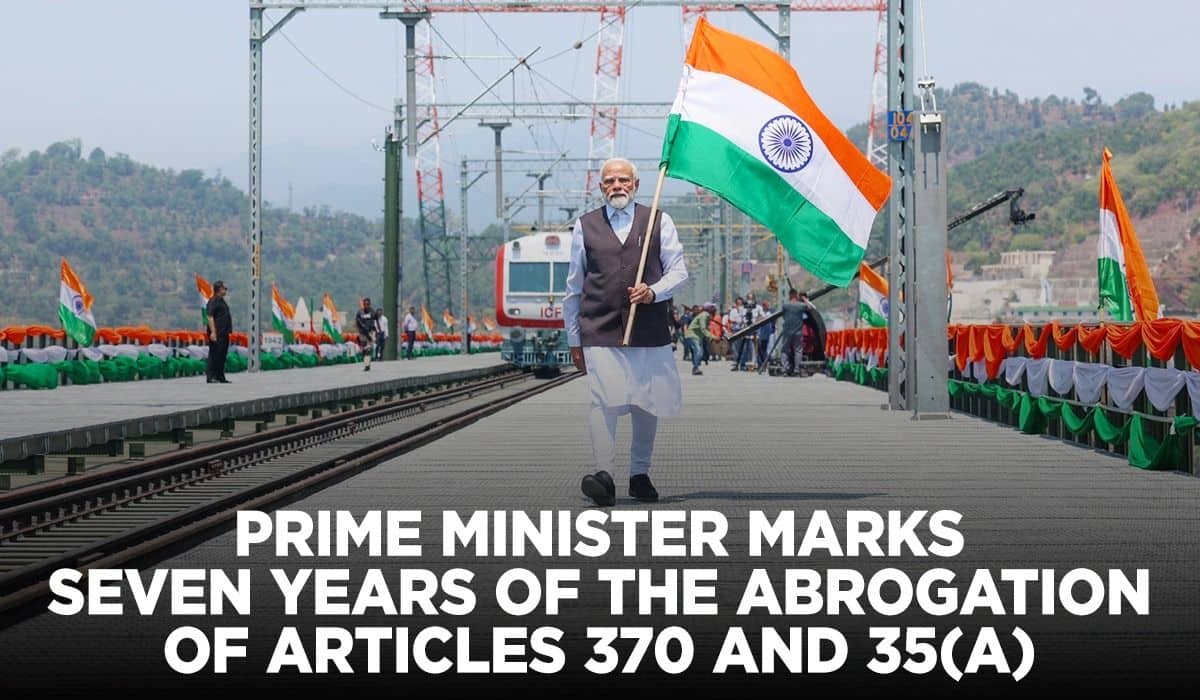
The Aspirational Districts initiative is a shining example of what true implementation means. There are hundreds of such examples, but I cite this one to illustrate. Our colleagues in Congress fail to see the implementation behind the transformation taking place. Their only model is the old Planning Commission approach-the “jeep and mule” model. They know nothing beyond that. Consider implementation: before I was even born, Sardar Vallabhbhai Patel envisioned a dam on the Narmada River. The plan was finalized, but Sardar Patel passed away. Later, Nehru ji laid the foundation stone. Yet, decades passed without progress. By the time I became Prime Minister, I had the honour of inaugurating it. As Chief Minister, I had to sit on a three-day fast for the Sardar Sarovar Dam, staking myself for the farmers of my state. Only then did the Government of India relent, and construction gained momentum. Today, pure Narmada water reaches even Khavda in Kutch, where BSF jawans are stationed. That is what implementation means. Congress, by contrast, made announcements for political gain, lit ceremonial lamps, laid stones, but did nothing. To change this culture, I created a technology platform called PRAGATI. Let me give you an example: in Himachal, a train project was announced in Parliament-perhaps Una-but by the time I came, not even a drawing existed. It was declared only to win elections. Through PRAGATI, I reviewed such projects. We examined why each project was stuck, which department was at fault, what legal hurdles existed, and why costs had escalated. A project meant to cost ₹900 crore had ballooned to ₹90,000 crore. We instituted monthly reviews; I have now completed the 50th episode of these meetings. By involving states and ministries, we unlocked ₹85 lakh crore worth of projects. Imagine the scale of national strength we unleashed. Railways, roads, irrigation, rural infrastructure-all were accelerated. The Jammu–Udhampur–Srinagar–Baramulla rail line, stuck for three decades, is now complete. A video of the Vande Bharat train running through snow-clad valleys went viral, with people saying, “Don’t mistake this for abroad-this is India.” That is implementation.
Hon’ble Mr Chairman Sir,
Let me speak of Assam-not because of elections, but because of Congress’s failures. Congress only imagines; they never implement. Take the Bogibeel Bridge, connecting Arunachal Pradesh and Assam. This vital project languished for years. Through PRAGATI, we reviewed it, and today it stands completed, bringing immense benefit to Assam and the entire Northeast.
Hon’ble Mr Chairman Sir,
When we speak of implementation, we have facts to show that we complete projects on time-and often ahead of schedule. We pledged to achieve certain solar targets by 2030, but accomplished them by 2025. Ethanol targets were also met two to three years in advance. This demonstrates that our implementation capacity is not only strong, but ahead of time.
Hon’ble Mr Chairman Sir,
The approach of BJP and NDA differs vastly from that of Congress. Our perspective, our problem-solving mindset, is worlds apart. We believe that 1.4 billion Indians are capable of providing solutions to challenges. We trust our people, their strength, and that is the true power of democracy. Congress, however, sees the people themselves as the problem. Let me illustrate. Indira Gandhi once spoke in Iran, recounting a conversation with Nehru ji. When asked about the problems he faced, Nehru replied: “Thirty-five crore.” At that time, India’s population was 35 crore. To him, every citizen was a problem. Indira ji added that with the population at 57 crore, her problems had multiplied. Imagine-leaders who saw their own people as problems. This is the difference between their mindset and ours. For us, every citizen is a solution, a partner in building India’s future. For them, citizens were burdens.
Hon’ble Mr Chairman Sir,
I have said this many times, not out of rhetoric but conviction: however great the challenges, we have 1.4 billion solutions. Our people are our greatest capital. Every citizen is a creator, a builder, a custodian of India’s bright future. How can we ever call them problems? Those who think this way only serve their families, not the nation.
Hon’ble Mr Chairman Sir,
Insulting the people of India has become ingrained in Congress’s nature and culture. Recently, they insulted the President of India. The words they used after the election were shameful. To insult the President, a woman from a tribal family who rose from poverty to occupy the highest constitutional office, is to insult the tribal community, to insult women, and to insult the Constitution itself.
Hon’ble Mr Chairman Sir,
Whatever Congress may think, this is their grave mistake. I thank you and the House for granting me extra time.
Hon’ble Mr Chairman Sir,
What happened in the Lok Sabha was deeply painful. Frustration and despair may be understandable, but to desecrate the sacred temple of democracy in such a manner is unacceptable. At that time, the Chair was occupied by an honourable member from Assam. Papers were thrown, tables were climbed. Was this not an insult to the Northeast? Later, when the Chair was held by a son of a Dalit family from Andhra, he too was insulted. This shows Congress’s disdain-insulting the Northeast, insulting Dalits. It seems they harbour hatred for the people of Assam, simply because they no longer support Congress. Is this how democracy should function?
Hon’ble Mr Chairman Sir,
I was deeply pained when I recalled Bharat Ratna Bhupen Hazarika ji, a revered figure whose songs and voice united the nation. We had the honour of awarding him the Bharat Ratna. Yet Congress opposed even this. Kharge ji’s reaction when Bharat Ratna was mentioned is on video-his face betrays disdain. To dismiss Hazarika ji as “just a singer” is to insult Assam, to insult India’s art lovers. Congress opposed his Bharat Ratna, opposing the pride of Assam and the nation. I am certain Assam will never forget this insult.
Hon’ble Mr Chairman Sir,
Yesterday, in this very House, a Congress member-one of their so-called crown princes-called a fellow MP a “traitor.” Their arrogance has reached the seventh heaven. Many have left Congress, the party has splintered, and leaders have joined other parties. Yet none of them were ever branded traitors. But yesterday, this MP was called a traitor simply because he was a Sikh. This was an insult to Sikhs, an insult to the Gurus. It revealed the deep-seated hatred towards Sikhs that runs through Congress. The member who said it sits in this House, yet felt no remorse. He could have stood today and said, “What happened yesterday was against the dignity of Parliament, we regret it.” But he did not. A family that gave its blood for the nation was insulted because one of its members changed political views. To call him a traitor is no small matter. How can the nation tolerate any citizen being called a traitor-especially a Sikh? This is deeply unfortunate, and such conduct will only sink Congress further.
Hon’ble Mr Chairman Sir,
On one side we see this, and on the other, the example of Master Sadanand ji. Because of political vendetta, both his legs were cut off in his youth. He lives with artificial limbs, yet his speech carries no bitterness, his conduct no harshness. It fills us with pride. Yesterday, when he delivered his first speech in this House, he respectfully placed his artificial limb beside him with your permission. That sight was painful for the nation. The INDIA alliance is responsible for this-cutting off the legs of a young teacher simply for ideological differences. Yet he feels no bitterness, no anger. I salute Master Sadanand ji from my heart. Despite such a brutal attack, he continues his vow of service to the nation and contributes to policymaking today. This is a matter of pride. It is on the strength of such people that we live and work in politics. Their sacrifice inspires us to live and die for the nation.
Hon’ble Mr Chairman Sir,
These days, Congress colleagues show me a special kind of affection. Even without responsibility, we have learned to live for the nation. We are laying the foundation of a developed India, strengthening it. While I prepare solid ground for the youth, Congress organizes programs to dig Modi’s grave. Those who claim to open shops of love chant “Modi, your grave will be dug.” What kind of shop of love dreams of digging the grave of a fellow citizen? What constitutional principle teaches them to speak of such things? Is this not an insult to the Constitution, to humanity, to the dignity of public life? They feel no remorse. Afterwards, they even said, “The Prime Minister was crying in the Rajya Sabha.” What kind of upbringing produces such conduct?
Hon’ble Mr Chairman Sir,
My experience is long. Since 2002, when they were in opposition, and from 2004 when they came to power, and from 2014 when I entered this House-over 25 years-not a single session has passed without Congress abusing Modi. Someone once asked me the secret of my health. I replied: “I consume two kilos of abuse daily.”
Hon’ble Mr Chairman Sir,
Why do they want to dig Modi’s grave? This slogan is not just rhetoric-it reflects the hatred within them. Because we abrogated Article 370, they want Modi’s grave dug. Because we brought peace and development to the Northeast, once shadowed by bombs and guns, they want Modi’s grave dug. Because we struck back at Pakistani terrorists inside their own homes, they want Modi’s grave dug. Because we carried out Operation Sindoor, they want Modi’s grave dug. Because we took bold steps to free the nation from Maoist terror, they want Modi’s grave dug. Because we put the unjust Indus Water Treaty signed by Nehru into abeyance, they want Modi’s grave dug.
Hon’ble Mr Chairman Sir,
Congress’s problem is different. They cannot digest how Modi reached here. Their frustration grows: not only did Modi arrive, but he has endured. And so, they see only one path left-chanting “Modi, your grave will be dug.”
Hon’ble Mr Chairman Sir,
They believe the Prime Minister’s chair is their family’s inheritance. No one else can sit there. This hatred within them, this fire burning in their so-called shop of love, is why they chant about digging Modi’s grave.
Hon’ble Mr Chairman Sir,
The Congress dynasty was given decades of opportunity. The nation staked its future on them. They raised slogans of “Garibi Hatao” (Remove Poverty), but misled the people. Every Congress Prime Minister spoke of removing poverty from the Red Fort, but none ever acted. Their slogans were empty. Modi chose a different path-empowering the poor. I salute the poor of my country. They trusted our policies and intentions, and worked tirelessly to strengthen themselves. Twenty-five crore poor families have defeated poverty and lifted themselves out of it. I salute them. Once hopeless, they saw a ray of hope, rose, and now march with us.
Hon’ble Mr Chairman Sir,
Before 2014, hundreds died at railway crossings. School buses collided with trains, killing dozens of children. Unmanned crossings were left unattended. Congress could not fix even this. We eliminated all unmanned crossings, saving countless lives. And for this, they want Modi’s grave dug.
Hon’ble Mr Chairman Sir,
Before 2014, 18,000 villages had never seen electricity. They did not know what a wire, a bulb, or a lamp was. After 2014, when the people entrusted us, we brought light to those 18,000 villages. For this too, they want Modi’s grave dug.
Hon’ble Mr Chairman Sir,
There was a time when headlines screamed: soldiers lacked ammunition, bulletproof jackets, even boots for snow. We opened the treasury for our soldiers, resolved to give them whatever they needed. And for this, they want Modi’s grave dug.
Hon’ble Mr Chairman Sir,
Once, the current Chief Minister of Uttar Pradesh cried in this House while speaking of children dying from encephalitis. Congress never thought of freeing the nation from this disease.
Hon’ble Mr Chairman Sir,
Tracoma, an eye disease, blinded many. Science had advanced, cures were possible, but Congress did nothing. We freed the nation from encephalitis and saved eyes from tracoma. These successes, this sensitivity, this vow to live and die for society-this is what troubles them. And so they chant “Modi, your grave will be dug,” while pretending to speak of democracy and love. Is this what public life should be?
Hon’ble Mr Chairman Sir,
Their government was run by remote control. My government too runs by remote control-but my remote is 1.4 billion Indians. Their dreams, their aspirations, their resolve guide us. For us, power is not a path to pleasure, but a medium of service. Through MUDRA, crores received support for self-employment. Congress never promoted startup culture. They barely knew of a few hundred startups. They could not even support their own family’s startup. Today, under our government, there are more than 200,000 startups. Success after success wins the hearts of the people, and Congress sees only one path left-chanting “Modi, your grave will be dug.” Remember the days when BSNL was a joke, the subject of cartoons. Today, we have built an indigenous 4G stack. We rolled out 5G faster than any country in the world. We advanced communication with new technology and new thinking. And so, their pain spills out in words: “Modi, your grave will be dug.”
Hon’ble Mr Chairman Sir,
Serving the poor is my greatest privilege. Providing 40 million poor families with permanent homes gives me peace in life. Electricity, water, gas cylinders, toilets-these are blessings I feel God has inspired me to deliver. For the first time, village women proudly say, “Yes, I have become a Lakhpati Didi.” Others say, “By this year, I too will become one.” And those who already have, now say, “No sir, now we are thinking of becoming millionaires.” This change in mindset, this rise in confidence-when such blessings from millions of citizens and the protective shield of millions of mothers and sisters surround a person, no matter how many slogans are raised, no grave can be dug. The devotion with which I have served mothers and sisters, those whom no one cared for but whom Modi reveres, is the reason for their blessings. And it is these blessings that trouble my opponents, which is why they speak of digging graves.
Hon’ble Mr Chairman Sir,
For some, theft is a hereditary trade. They even stole the surname of a Gujarati-Mahatma Gandhi. But the people of this country are wise; they know how to deliver a resounding blow to such deceit.
Hon’ble Mr Chairman Sir,
We have set out with the dream of a developed India, and today, that dream has become a national resolve, powered by the energy of the people. Everywhere you go, people say: “By 2047, India must be developed.” Yet I am astonished that some colleagues in this House are so pessimistic, so disconnected from reality, so unaware of a changing world. They ask, “Why is Modi speaking of 2047? Who has seen 2047?” Did the young men and women who fought for freedom, who climbed the gallows, who endured bullets, lathis, and the horrors of cellular jail in the Andamans ever think, “Independence will not come in my lifetime, so why should I fight?” If they had, would India ever have been free? These pessimists once mocked me when I spoke of Digital India, of fintech, of UPI. They said, “How will a poor man ever transact money on a mobile phone?” Within three years, the nation proved it possible. I recall the day such a speech was made in Parliament, and their ecosystem celebrated, saying, “Modi has been given a strong reply.” But Modi did not reply-the mobile phone in your hand, working through UPI, gave the reply itself.
Hon’ble Mr Chairman Sir,
During Congress’s time, a common phrase became popular-even in serious discussions, even in jokes: India missed the bus. It became a cliché. Opportunities lost, chances gone-India missed the bus.
Hon’ble Mr Chairman Sir,
Today, India is not missing any bus. Today, India is leading the convoy.
Hon’ble Mr Chairman Sir,
To build a bright future for the nation, we must work tirelessly to brighten the present. We chart five-year plans for the flight towards a developed India, and annual budgets to stay on course. Our goal is not the next election-it is 2047, a developed India. Elections will come and go, but my nation is eternal. Our dream is to hand over a prosperous India to the youth. When I see children in homes today, I think: I must leave them a nation so strong that I can feel satisfaction in my work. That is why we speak of 2047.
Hon’ble Mr Chairman Sir,
Look at the initiatives we have taken-in space, science, technology, the depths of the oceans, land, sky, and outer space. New resolve, new energy, new steps, new achievements-India is advancing in every field. We are working on green hydrogen, preparing for the future. We are speaking of quantum computing, advancing an AI mission. Today, the world believes India can contribute greatly to AI. Critical minerals and rare earths have become geopolitical weapons, and we are focusing on them so India never has to stretch out its hand to anyone.
Hon’ble Mr Chairman Sir,
There are countless projects attracting foreign investment, because everyone now sees their future on Indian soil. Everyone sees their future secured by India’s talent. Everyone sees their own bright future linked to India’s bright future. That is why the world understands why we speak of a developed India. Those who cannot grasp it should know-the world sees India has chosen the right path. Once, the phrase was “India missed the bus.” Today, the world fears being late to India’s journey. Nations now compete to join us.
Hon’ble Mr Chairman Sir,
The coming era is full of opportunities for India, for our youth, for our bright future. I can clearly outline these possibilities, and we are advancing policies in that direction. I invite my fellow citizens, and I urge honourable members of this House to tell people in their constituencies: when opportunities arise globally, they endure only if we deliver excellence. We must never compromise on quality. Even if profits are smaller, quality must be supreme. We must innovate, research, change materials if needed-but ensure India is known for the best quality. Then the world will sing only of Made in India, Made in Bharat.
Hon’ble Mr Chairman Sir,
I also thank my Congress friends. They had tried before-five or six times in the past decade they stopped me from speaking, knowing that once I begin, I do not stop. They have now learned from experience that there is no point in trying. I hope such wisdom continues to dawn upon them.
Hon’ble Mr Chairman Sir,
I thank all members who contributed to the discussion on the President’s address. The valuable ideas expressed here will surely aid the nation’s progress. I express my heartfelt gratitude to the Honourable President for this inspiring address, and with that, I conclude my speech.
Thank you very much!