PM addresses programme at Tulsi Peeth in Chitrakoot, Madhya Pradesh

Published By : Admin | October 27, 2023 | 15:53 IST
“Ashtadhyayi is a thousands-year-old text of India's linguistics, India's intellectuality and our research culture”
“Time refined Sanskrit but could never pollute it, it remained eternal”
“Whatever national dimension you look at in India, you will witness Sanskrit’s contribution”
“Sanskrit is not only the language of traditions, it is also the language of our progress and identity”
“Chitrakoot has spiritual enlightenment as well as natural beauty”

The Prime Minister, Shri Narendra Modi visited Tulsi Peeth in Chitrakoot today. He performed pooja and darshan at Kanch Mandir. He received the blessings of Jagadguru Rambhadracharya of the Tulsi Peeth and attended a public function, where he released three books - ‘Ashtadhyayi Bhashya’, ‘Rambhadracharya Charitam’ and ‘Bhagwan Shri Krishna ki Rashtraleela’.

Addressing the gathering, the Prime Minister expressed gratitude for performing puja and darshan of Shri Ram in multiple shrines and being blessed by saints, especially Jagadguru Rambhadracharya. He also mentioned releasing the three books namely ‘Ashtadhyayi Bhashya’, ‘Rambhadracharya Charitam’ and ‘Bhagwan Shri Krishna ki Rashtraleela’ and said that it will further strengthen the knowledge traditions of India. “I consider these books as a form of Jagadguru’s blessings”, he emphasized.

The Prime Minister said “Ashtadhyayi is a thousands-year-old text of India's linguistics, India's intellectuality and our research culture.” He highlighted the genius of Ashtadhyayi as it encapsulates grammar and science of language in pithy capsules. He said that many languages came and went but Sanskrit remains eternal. “Time refined Sanskrit but could never pollute it”, he said. mature grammar of Sanskrit lies in the base of this permanence, he said. Based on just 14 Maheshwara Sutras, this language has been the mother of Shastr and Sahstra (implements and scholarship). “Whatever national dimension you look at in India, you will witness Sanskrit’s contribution”, he said.

Throwing light on the efforts to uproot the culture and heritage of India during the thousand year old era of slavery, Shri Modi mentioned the alienation of Sanskrit language. He pointed out the slavery mentality which was carried forward by certain individuals resulting in a feeling of enmity towards Sanskrit. Prime Minister Modi lamented the mentality where knowing the mother tongue was praiseworthy for foreign countries but the same did not apply to India. “Sanskrit is not only the language of traditions, it is also the language of our progress and identity”, Shri Modi interjected as he highlighted the efforts to strengthen the language in the country. “Scriptures like Ashtadhyayi Bhashya will play a crucial role towards successful efforts in modern times”, he added.

Prime Minister Modi paid rich tributes to Jagadguru Rambhadracharya and mentioned his enormous wisdom and contributions. “This level of wisdom is never personal, this wisdom is national treasure”, the Prime Minister said. Swamiji received Padam Vibhushan in 2015. Referring to nationalistic and social aspects of Swami ji the Prime Minister remembered his active contribution in Swachh Bharat as one of the nine key ambassadors.

Shri Modi expressed happiness that national goals like cleanliness, health and clean Ganga are being realized now. He informed “Jagadguru Rambhadracharya ji has played a big role in fulfilling another dream of every countryman. The Ram temple for which you have contributed so much, in and outside the court, is also going to be ready”, the Prime Minister said as he mentioned the invitation received to participate in the Pran Pratishtha ceremony by Shri Ram Janmabhoomi Teerth Kshetra Trust in Ayodhya.

In the Amrit Kaal, the Prime Minister underlined that the nation is taking development and heritage along. “Chitrakoot has spiritual enlightenment as well as natural beauty”, Shri Modi said as he mentioned the emphasis on the development of places of pilgrimage. He mentioned Ken-Betwa Link Project, Bundelkhand Expressway, and the Defence Corridor and said that it will create new opportunities in the region. Concluding the address, the Prime Minister expressed the belief that Chitrakoot will scale new heights of development and also bowed before Jagadguru Rambhadracharya.

Jagadguru Rambhadracharya of the Tulsi Peeth, Governor of Madhya Pradesh, Shri Mangubhai Patel, Chief Minister of Madhya Pradesh, Shri Shivraj Singh Chauhan were among those present on the occasion.

Background

Tulsi Peeth is an important religious and social service institution in Chitrakoot, Madhya Pradesh. It was established by Jagadguru Rambhadracharya in 1987. Tulsi Peeth is one of the leading publishers of Hindu religious literature.

Click here to read full text speech

Explore More
ଶ୍ରୀରାମ ଜନ୍ମଭୂମି ମନ୍ଦିର ଧ୍ଵଜାରୋହଣ ସମାରୋହରେ ପ୍ରଧାନମନ୍ତ୍ରୀଙ୍କ ଅଭିଭାଷଣ

ଲୋକପ୍ରିୟ ଅଭିଭାଷଣ

ଶ୍ରୀରାମ ଜନ୍ମଭୂମି ମନ୍ଦିର ଧ୍ଵଜାରୋହଣ ସମାରୋହରେ ପ୍ରଧାନମନ୍ତ୍ରୀଙ୍କ ଅଭିଭାଷଣ
Emerging cities see 42% growth in GCC jobs, outpacing metros: Report

Media Coverage

Emerging cities see 42% growth in GCC jobs, outpacing metros: Report
NM on the go

Nm on the go

Always be the first to hear from the PM. Get the App Now!
...
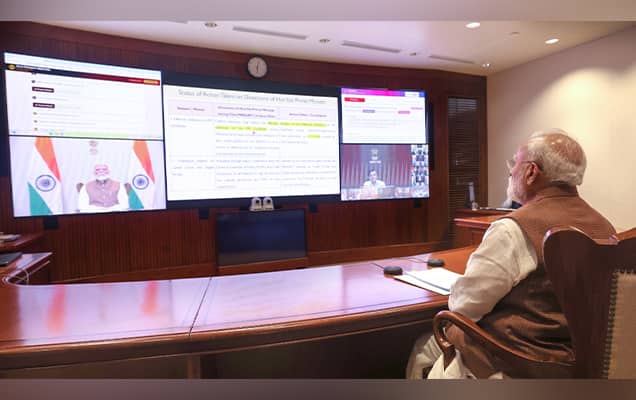
PM Modi chairs 51st PRAGATI Meeting
May 27, 2026
PM reviews seven critical infrastructure projects across the Railways, Power and Road sectors
Projects reviewed span across 9 States with cumulative investment of around ₹30,000 crore
PM also reviews Ken Betwa Link Project and Swachh Bharat Mission-Urban 2.0
PM says Ken-Betwa River Inter-linking Project should serve as a model for other States to resolve inter-State water issues amicably
PM asks States to expedite the completion of solid waste management-related infrastructure, including waste processing plants and GOBARdhan plants
PM calls for mission-mode rooftop solar coverage in urban areas
Acting upon the advice of PM, system of monthly review of social sector schemes at State level operationalised, starting with review of Swachh Bharat Mission

Prime Minister Shri Narendra Modi chaired the 51st meeting of PRAGATI, the ICT-enabled, multi-modal platform aimed at fostering Pro-Active Governance and Timely Implementation, by seamlessly integrating efforts of the Central and State governments, at Seva Teerth, earlier today.

During the meeting, the Prime Minister reviewed seven critical infrastructure projects across the Railways, Power and Road sectors covering nine States worth around ₹30,000 crore. These projects, pivotal to economic growth and public welfare, were reviewed with a focus on timelines, inter-agency coordination, and timely issue resolution. Prime Minister also reviewed Ken Betwa Link Project and Swachh Bharat Mission-Urban 2.0.

While reviewing power sector projects, Prime Minister emphasized the need to accelerate rooftop solar adoption across urban areas, with a special focus on cities, residential clusters and public institutions. He underlined that rooftop solar should be taken up in mission mode to reduce electricity costs, improve energy security and promote clean energy at the household and community level.

While reviewing road and port connectivity projects, it was emphasised that Vadhavan Port should be developed as a model of port-led, multi-modal development, where every major mode of transport is seamlessly integrated to create a future-ready logistics ecosystem. The project should not be seen merely as a port, but as a national gateway connected through coastal shipping, inland waterways, dedicated freight corridors, high-speed rail connectivity, highways and airport linkages.

Prime Minister emphasised the need for effective implementation of Swachh Bharat Mission 2.0 and underlined that the mission should move beyond infrastructure creation and ensure measurable outcomes through regular monitoring, citizen participation and convergence between various stakeholders. He asked States to expedite the completion of solid waste management-related infrastructure, including waste processing plants and GOBARdhan plants.

While reviewing Ken-Betwa River Inter-linking Project, Prime Minister observed that Ken-Betwa project should serve as a model for other States to resolve inter-State water issues through cooperation, timely clearances, technology-based monitoring and mission-mode execution. States were encouraged to identify similar opportunities where river-linking, water conservation, groundwater recharge and efficient irrigation can be taken up in an integrated manner to ensure long-term water security.

Prime Minister also underlined that the delay in the implementation of public projects leads not only to cost escalation but also deprives citizens of timely access to essential facilities and development benefits. He observed that every delay has a direct impact on people’s lives, regional growth and public resources. He stressed that Ministries, Departments and States must adopt a more proactive and time-bound approach to resolve pending issues, remove bottlenecks and ensure faster execution.

Prime Minister also emphasized that innovative use of canal networks should be explored, including installation of solar panels along canals and over canals for clean electricity generation. This would help optimize land use, reduce evaporation losses, generate renewable energy and create additional economic value from water infrastructure.

At the beginning of the meeting, the Cabinet Secretary informed that, in pursuance of the directions of the Prime Minister, a system of monthly review of social sector schemes at the State level has also been operationalised. This mechanism aims to ensure regular monitoring, faster resolution of implementation issues and greater accountability at the State and district levels. As part of this initiative, Swachh Bharat Mission has been taken up for review at the State level in the first instance.