A great son of Gujarat, a towering leader of India - Tributes to Sardar Patel

Published By : Admin | October 31, 2012 | 19:50 IST

Dear Friends,

Today we pay our heartfelt tributes to Sardar Vallabhbhai Patel on his 137th birth anniversary.

It is a matter of immense honour and pride for us that Sardar Patel is a great son of Gujarat. There is surely no need to write about his more than well-known contribution towards India’s freedom struggle, but I would like to say that Sardar Patel was a true Satyagrahi who was blessed with a wonderful ability to mobilise the people. His popularity among the farmers and the downtrodden remains undisputed. Coming from a humble background, he rose to colossal heights but never forgot his roots.

His scruples and strict adherence to probity and integrity remained with him throughout his public life. He gave up his lucrative practice as a barrister as well as all material comforts to join the freedom struggle. Even when he became the country’s first Home Minister and Deputy Prime Minister his tryst with simplicity continued.

When India was on the threshold of winning freedom, there were over 500 princely states. These states were of varying sizes and each ruler had to be engaged with in a very different manner. At that crucial juncture, the enormous task of integrating these princely states fell on the shoulders of Sardar Patel. He embarked on this mission with his characteristic determination and ensured that one by one the princely states join India. The integration of Junagadh in Saurashtra is just one example of his vision to create a united India for which we will be forever grateful to him.

We should remember that it was Sardar Patel’s swiftness that ensured that Kashmir was not taken away by Pakistan just a couple of months after Independence. This was the only province with which he was not given a free hand. I am certain that had Sardar Patel got that free hand in dealing with Kashmir’s accession to India things would have been very different today. It is not only about Kashmir – I say this very often that had this nation adopted Sardar Patel’s
Disha the situation in the country would have been very different today.

Like all great men of his time, Sardar Patel has been the subject of immense discussion. But it is indeed beyond our ability to measure and appraise Sardar Patel’s contributions in making the dream of India into a reality. Many people have given him various titles. Some call him India’s Bismarck others say he is a modern day Chanakya. Sarojini Naidu described him as a “golden jewel hidden inside an iron made strong match box”. Some thinkers have compared him to a gentle flower that blooms in Bajrakund. Others have described him as Janak of Vaidehi.

As a student of political science and someone who is passionate about the history of Gujarat and our nation, in my limited understanding I see Sardar Patel as someone who demonstrated in action the principles laid down by Mahatma Gandhi. From his participation in Bardoli Satyagraha of 1924 to the mass movement Satyagraha in Kheda, Sardar Patel assembled the building blocks of the freedom movement that Mahatma Gandhi had envisioned. As I said, to compare Sardar Patel with any other person would be grossly unfair to Sardar Patel. At this point I remember the words of noted Gujarati poet and thinker Gunvant Shah who said, “Sardar and only Sardar, nothing else!” Sardar Patel remains immortalised in our hearts and minds and a very simple indication of that comes when, on many occasions even today, you hear: “If only Sardar Sahib was alive!” Go to any part of the country and you will hear this said. People continue to place immense trust and respect in Sardar Patel’s ability to steer India out of any crisis.

Ironically, Sardar Saheb has not got his due from the same party to which he devoted his entire life and remained a disciplined soldier of till his last breath. What could be more unfortunate than the fact that Sardar Patel was honored with the Bharat Ratna as late as in 1991, a full 41 years after his demise?

We in Gujarat have always tried to walk on the path shown by Sardar Patel in the last decade and have sought to preserve his ideals for our future generations. In this quest we are building Sardar Patel’s ‘Statue of Unity’ as a tribute to this great man! At a height of 182 metres, this statue will be built on Narmada and is envisioned as a pilgrimage centre encapsulating the unity and integrity of India along with its rich culture and heritage. It will also have a high tech museum covering 90 years of India’s freedom struggle from 1857 till 1947. I am sharing a video on this initiative. Hope you will have a look at it.

On this special day, I bow to this architect of modern India and great son of Gujarat who has inspired me immensely. I am certain he will continue to inspire the people of our nation in the years to come!

Jai Hind!


Yours,

Narendra Modi


Explore More
ଶ୍ରୀରାମ ଜନ୍ମଭୂମି ମନ୍ଦିର ଧ୍ଵଜାରୋହଣ ସମାରୋହରେ ପ୍ରଧାନମନ୍ତ୍ରୀଙ୍କ ଅଭିଭାଷଣ

ଲୋକପ୍ରିୟ ଅଭିଭାଷଣ

ଶ୍ରୀରାମ ଜନ୍ମଭୂମି ମନ୍ଦିର ଧ୍ଵଜାରୋହଣ ସମାରୋହରେ ପ୍ରଧାନମନ୍ତ୍ରୀଙ୍କ ଅଭିଭାଷଣ
Govt rolls out Rs 4,531-cr market access support for exporters

Media Coverage

Govt rolls out Rs 4,531-cr market access support for exporters
NM on the go

Nm on the go

Always be the first to hear from the PM. Get the App Now!
...
2025 – ସଂସ୍କାରର ବର୍ଷ
December 30, 2025

India has emerged as the centre of global attention. This is due to the innovative zeal of our people. Today, the world sees India with hope and confidence. They appreciate the manner in which the pace of progress has been accelerated with next-generation reforms, which are cross-sectoral and amplify the nation’s growth potential.

I have been telling many people that India has boarded the Reform Express.

The primary engine of this Reform Express is India’s demography, our young generation and the indomitable spirit of our people.

2025 will be remembered as a year for India when it focused on reforms as a continuous national mission, building on the ground covered over the past 11 years. We modernised institutions, simplified governance, and strengthened the foundations for long-term, inclusive growth.

We moved ahead decisively…with higher ambition, faster execution and deeper transformation. The reforms have been about enabling citizens to live with dignity, entrepreneurs to innovate with confidence and institutions to function with clarity and trust.

Let me cite a few examples of the reforms undertaken.

GST reform:

• A clean two-slab structure of 5% and 18% has been implemented.

• The burden has been eased on households, MSMEs, farmers and labour-intensive sectors.

• The purpose is to ensure dispute reduction and better compliance.

• This reform has boosted consumer sentiment and demand. Sales have grown in the festive season.

Unparalleled relief for the middle class:

• In a first, individuals earning up to Rs. 12 lakh a year faced no income tax at all.

• Obsolete Income-tax Act of 1961 has been replaced with the modern and simple Income Tax Act, 2025.

• Together, these reforms mark India’s move towards a transparent, technology-driven tax administration.

Boost to small and medium businesses:

• Definition of “small companies” has been expanded to include firms with turnovers up to Rs. 100 crore.

• Compliance burdens and associated costs for thousands of companies will get reduced.

100% FDI Insurance reform:

• 100% FDI permitted in Indian insurance companies.

• This will give a fillip to insurance penetration and security for the people.

• Apart from enhanced competition, it would offer better insurance choices and improved service delivery for the people.

Securities Market Reform:

• Securities Market Code Bill has been introduced in Parliament. It will enhance governance norms in SEBI, also enhance investor protection, reduce compliance burden and enable a technology-driven securities market for a Viksit Bharat.

• Reforms will ensure savings thanks to reduced compliances and other overheads.

Maritime and Blue Economy Reforms:

• In a single Parliament session, the Monsoon Session, five landmark maritime legislations were passed: the Bills of Lading Act, 2025; the Carriage of Goods by Sea Bill, 2025; the Coastal Shipping Bill, 2025; the Merchant Shipping Bill, 2025; and the Indian Ports Bill, 2025.

• These reforms simplify documentation, make dispute resolution easier and reduce logistics costs.

• Outdated Acts dating back to 1908, 1925 and 1958 have also been replaced.

Jan Vishwas…Ending the Era of Criminalisation:

• Hundreds of outdated laws have been scrapped.

• 71 Acts have been repealed through the Repealing and Amendment Bill, 2025.

Boosting Ease of Doing Business:

• A total of 22 QCOs were revoked across synthetic fibres, yarns, plastics, polymers, and base metals, while 53 QCOs were suspended in various steel, engineered, electrical, alloy, and consumer end product categories, covering a broad spectrum of industrial and consumer materials.

• This will increase India’s share of apparel exports; lower production costs in diverse industries like footwear, automobiles; ensure lower prices for domestic consumers for electronics, bicycles and automotive products.

Historic labour reforms:

• Labour laws have been reshaped, merging 29 fragmented laws into four modern codes.

• India has created a labour framework that secures the interests of workers while boosting the business ecosystem.

• The reforms focus on fair wages, timely payment of wages, smoother industrial relations, social security and safer workplaces.

• They ensure greater female participation in the workforce.

• Unorganised workers including contract workers are brought under the ESIC and EPFO expanding the coverage of formal workforce.

Diversified and expanded markets for Indian products:

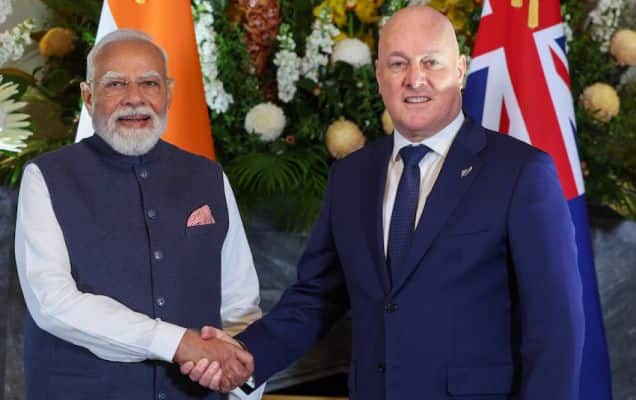
Trade deals inked with New Zealand, Oman and Britain. These will add to investments, boost job creation and also encourage local entrepreneurs. They reinforce India’s position as a trusted and competitive partner in the global economy.

The FTA with the European Free Trade Association, comprising Switzerland, Norway, Iceland and Liechtenstein, has been operationalised. This marks India’s first FTA with developed European economies.

Nuclear Energy Reforms:

The SHANTI Act is a transformational step in India’s clean-energy and technology journey.

• Ensures a strong framework for the safe, secure and responsible expansion of nuclear science and technology.

• Enables India to meet the rising energy demands of the AI era, like powering data centres, advanced manufacturing, green hydrogen and high-technology industries.

• Promotes the peaceful application of nuclear technologies in healthcare, agriculture, food security, water management, industry, research and environmental sustainability, supporting inclusive growth and improved quality of life.

• Opens new pathways for private sector participation, innovation and skill development. Creates opportunities for India’s youth to lead in frontier technologies and next-generation energy solutions.

This is an opportune moment for investors, innovators and institutions to partner with India, to invest, innovate and build a clean, resilient and future-ready energy ecosystem.

A Landmark reform in Rural Employment guarantee:

• Viksit Bharat- G RAM G Act, 2025 Rozgar Guarantee framework raises employment guarantee from 100 to 125 days.

• This will result in increased spending towards strengthening village infrastructure and livelihoods.

• The aim is to turn rural work into a means to ensure higher incomes and better assets.

Education Reforms:

Bill has been introduced in Parliament. 

• Single, unified higher education regulator will be established.

• Multiple overlapping bodies like the UGC, AICTE, NCTE will be replaced with the Viksit Bharat Shiksha Adhishthan.

• Institutional autonomy will be strengthened, with innovation and research boosted.

What makes the reforms of 2025 significant is not only their dimension but also their underlying philosophy. Our Government has prioritised collaboration over control and facilitation over regulation in the true spirit of a modern democracy.

These reforms were designed with empathy, recognising the realities of small businesses, young professionals, farmers, workers and the middle class. They were shaped by consultation, guided by data and anchored in India’s constitutional values. They add momentum to our decade-long efforts to move away from a control-based economy to one that operates within a framework of trust, keeping the citizen at its core.

These reforms are aimed towards building a prosperous and self-reliant India. Building a Viksit Bharat is the polestar of our development trajectory. We will continue pursuing the reform agenda in the coming years.

I urge everyone in India and abroad to deepen their bond with the India growth story.

Keep trusting India and investing in our people!