Twin city model to be replicated in many other cities of Gujarat

Published By : Admin | May 3, 2012 | 18:07 IST

GUDA Jansuvidha Vikas Parva

GOG to implement solid waste management and water treatment management projects in 50 towns

39 villages under GUDA will be benefited from Rs.165 cr public amenity works

Twin city model to be replicated in many other cities of Gujarat

The state government has planned to implement solid waste management and water treatment management projects on pilot bases in 50 towns of Gujarat, said Chief Minister Narendra Modi today during a programme of Gandhinagar Urban Development Authority (GUDA).

The Chief Minister dedicated to people four projects and performed ground breaking of nine public amenity works of GUDA, which are taking place on the outskirts of Gandhinagar at the cost of Rs.165 crore. These projects will benefit 39 villages that falls under GUDA. The Chief Minister also announced a special grant of Rs.31 crore for the development of infrastructural facilities in GUDA regions surrounding Gandhinagar city.

Speaking on the occasion the Chief Minister said the state government has mulled a revenue model with a view to make cities clean. Under this, he said, unclean water will be treated and then will be supplied to the farmers. “Solid waste will also be converted into organic fertilizer and will be given to the farmers”, he said.

Mr. Modi said that he had put this excellent revenue model before the Prime Minister and suggested him to implement it in 5000 towns of India on public private partnership bases. “The Prime Minister praised the modalities of the project and asked me to refer it to Planning Commission. But nothing has been done even after passing of one and half years since I made representation before the Planning Commission”, he said.

Speaking about the monotonous lifestyle in Gandhinagar he said, “A day in Gandhinagar seems to begin and end with the office timings only. But the state government desires to infuse this city and its people with fresh vitality and dynamism.”

The area belonging to GUDA along with the other parts of Gandhinagar is emerging as ‘knowledge corridor’. This area has got various specialized universities which are unique in entire world. In the coming days people in Gandhinagar will be able to generate, use and sell the solar power by installing solar panels on the roof of their houses. “The state government has envisioned such an all-inclusive development that many will take at least a decade to grasp the government’s insight behind it”, he said.

He said the state government has taken up ‘rurban’ project with an objective to combine village-like tranquil atmosphere and city-like facilities and to lessen the burden of population in the cities.

He also outlined the metro rail project between Ahmedabad and Gandhinagar and Ahmedabad-Gandhinagar twin city project. He said that state government will also replicate the twin city model of urban development for the cities like Halol-Vadodara, Madhapar-Bhuj and Surendranagar-Vadhavan.

Speaking on the occasion Urban Development Minister Nitin Patel expressed happiness for GUDA’s public amenity works. He said the state government is also ensuring development in industries, agriculture, health services and education. “Earlier the Gandhinagar used to be known as a city of government employees only. But during the Chief Minister Narendra Modi’s regime, the city has created a new identity for itself in few years”, he said.

GUDA’s chairman Ashok Bhavsar gave details of Rs.165 crore public amenity works.

The Chief Minister distributed cleaning equipments and tools to 39 village panchayats belonging to GUDA. A demonstration of the system of solid waste collection from every house was done on the occasion.

Minister of State Jaysinh Chauhan, AUDA chairman Dharmendra Shah, Gandhinagar MLA Shambhuji Thakor, Dhahegam MLA Kalyansinh Chauhan, Principal Secretary to Urban Development I. P. Gautam, dignitaries and invited citizens were present on the occasion.

Explore More
अयोध्येत श्री राम जन्मभूमी मंदिर ध्वजारोहण उत्सवात पंतप्रधानांनी केलेले भाषण

लोकप्रिय भाषण

अयोध्येत श्री राम जन्मभूमी मंदिर ध्वजारोहण उत्सवात पंतप्रधानांनी केलेले भाषण
Tier 2 cities emerge as next frontiers for India's growing GCC ecosystem

Media Coverage

Tier 2 cities emerge as next frontiers for India's growing GCC ecosystem
NM on the go

Nm on the go

Always be the first to hear from the PM. Get the App Now!
...
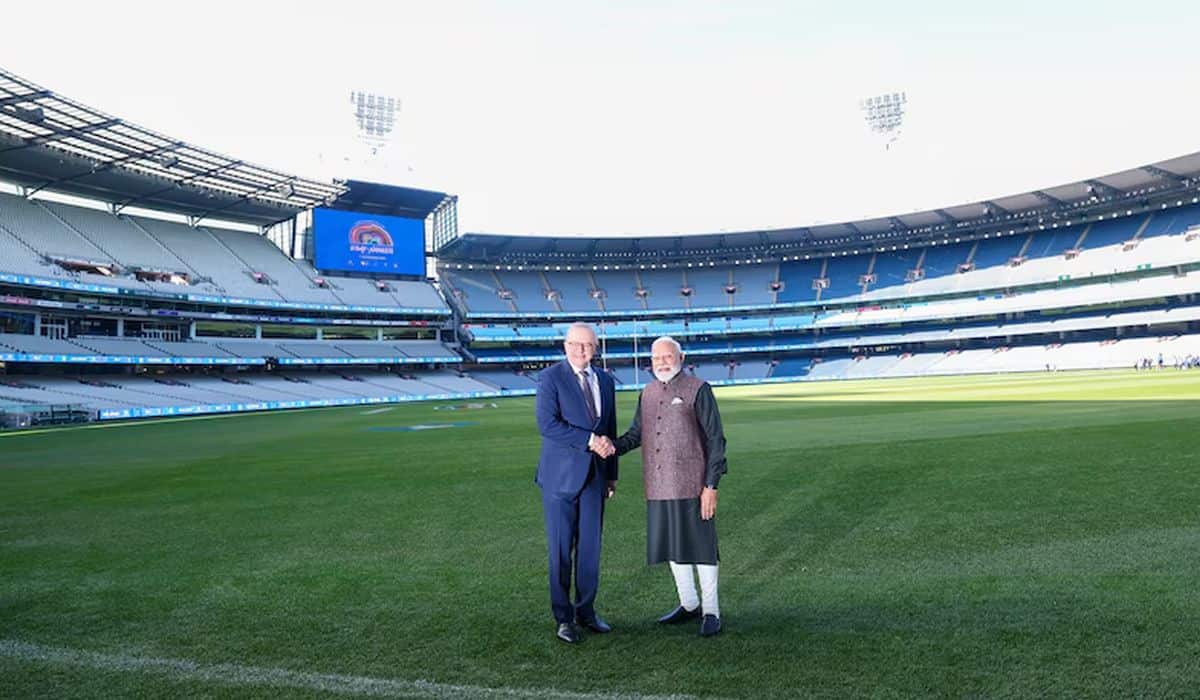
India-Australia Roadmap for Sports Collaboration
July 10, 2026

Sports is a powerful bridge between India and Australia, bringing communities together and opening new pathways for collaboration.

Building on the 2023 MoU on Cooperation in Sports, the India-Australia Roadmap for Sports Collaboration sets out practical, future-focused priorities and opportunities to strengthen this cornerstone of our bilateral relationship.

Recognising the decade of opportunity ahead — including the 2030 Commonwealth Games in Ahmedabad, the Brisbane 2032 Olympic and Paralympic Games, and India’s ambition to host a future Olympic and Paralympic Games — this Roadmap identifies targeted areas of cooperation aligned to shared priorities, capabilities and resources.

Respecting differences in the governance of sport and the development of sport ecosystems in Australia and India, and recognising the leadership role of sporting bodies, businesses, state–level governments, universities and community groups in promoting elite and community sports, we are committed to facilitating engagement and supporting collaborative ways of working between relevant institutions, to encourage stronger sports partnerships at all levels that benefits both countries.

Implementation will be pragmatic and outcomes-focused, with activities prioritised in line with available resources and major event timelines.

Cooperation will be delivered through established partnerships, supported by flexible, demand-led arrangements, whereby responsibility for resourcing activities will be negotiated on a case-by-case basis. This approach ensures practical, sustainable and mutually beneficial outcomes.

In this context, the following have been identified as focus areas for collaboration under this Roadmap:

A. Capacity Building:

o Collaborate for sharing best practice in establishing and operating High-Performance Sports Centres in India in priority sports.

o Identify Para sport as a key priority and opportunity for collaboration, including Australian expertise in Para classification, coaching and performance support, with potential links between Indian and Australian universities where appropriate.

o Drawing on Australia’s coach development models, facilitate two-way exchanges that bring Indian coach and coach educators to Australia and Australian coaches and coach educators to India, using a Train the Trainer approach where appropriate.

o A physical education exchange programme between India and Australia may be introduced to facilitate mutual learning, sharing of best practices, and collaboration in areas such as school sports, sports science, and community participation in physical education.

o Recognising the physical and mental health benefits of yoga and the World Yogasana, the federation for yogasana sports based in India, identify opportunities to share knowledge, foster collaboration and encourage participation in yoga in Australia.

o Work with the Australian Sports Commission to build the capability of select Indian coaches as part of the India Australia High Performance Coach Development program.

o Explore opportunities through relevant non-government stakeholders such as sporting organisations and universities to support talented young Indian sportspersons as part of high-performance programs in Australia through student scholarships funded by Government of India.

B. Collaborative Sports Science and Technology Research:

o Encourage joint research and development projects between universities in India and Australia on athlete performance analytics, injury prevention, sports nutrition, wearable performance technology, recovery techniques and Para sport.

o Encourage partnerships between Indian and Australian universities to co-develop sports curriculums.

o Sport Integrity Australia and National Anti-Doping Agency India contribute to international anti-doping efforts by supporting World Anti-Doping Agency (WADA)-led capacity building programs through engagement with the WADA Asia/Oceania Office, and through representation on the UNESCO International Convention against Doping in Sport (Convention) Groups.

C. Major Sporting Events:

o Collaborate with Australian States and Territories, and National Sporting Organisations to exchange best practices for hosting large events.

o Explore opportunities to host exhibition matches and youth events in both countries to promote sports of mutual interest (such as Kabaddi and Kho Kho in Australia, and Australian Football League and basketball in India).

o Leverage the build-up to major sporting events such as Olympic, Paralympic and Commonwealth Games to establish formal, reciprocal arrangements between Indian and Australian sporting bodies for shared facilities, competitions and support networks during and in the build-up to major sporting events.

o Welcoming the inaugural Big Bash League match to be played in India in Chennai in December 2026, encourage Cricket Australia and the Board of Control for Cricket in India to work towards a commitment to host annual BBL matches in India.

D. Sports Industry and Investment Platform:

o Build on the Australia-funded Sports Industry Summit in Mumbai in December 2026 to promote collaboration between Indian and Australian companies on sports equipment manufacturing, sports media and broadcasting, event management, and sports start-ups.

o Facilitate Australian sports sector businesses in the Indian sports market through information sessions and vice-versa.

o Expand India’s export of high quality, competitively priced sports goods to Australia.

o Expand the export of Australian expertise in high performance sports, including coaching, coach development, strength and conditioning, athlete wellbeing, nutrition and psychology.

E. Women in Sports Partnership:

o Launch joint initiatives promoting women’s leadership, health, high performance and participation in sport, including bilateral tournaments for women athletes, drawing on the Australian Sports Commission’s flagship programs, recognising that sport is a powerful pathway for women’s economic empowerment, leadership, health and social inclusion.