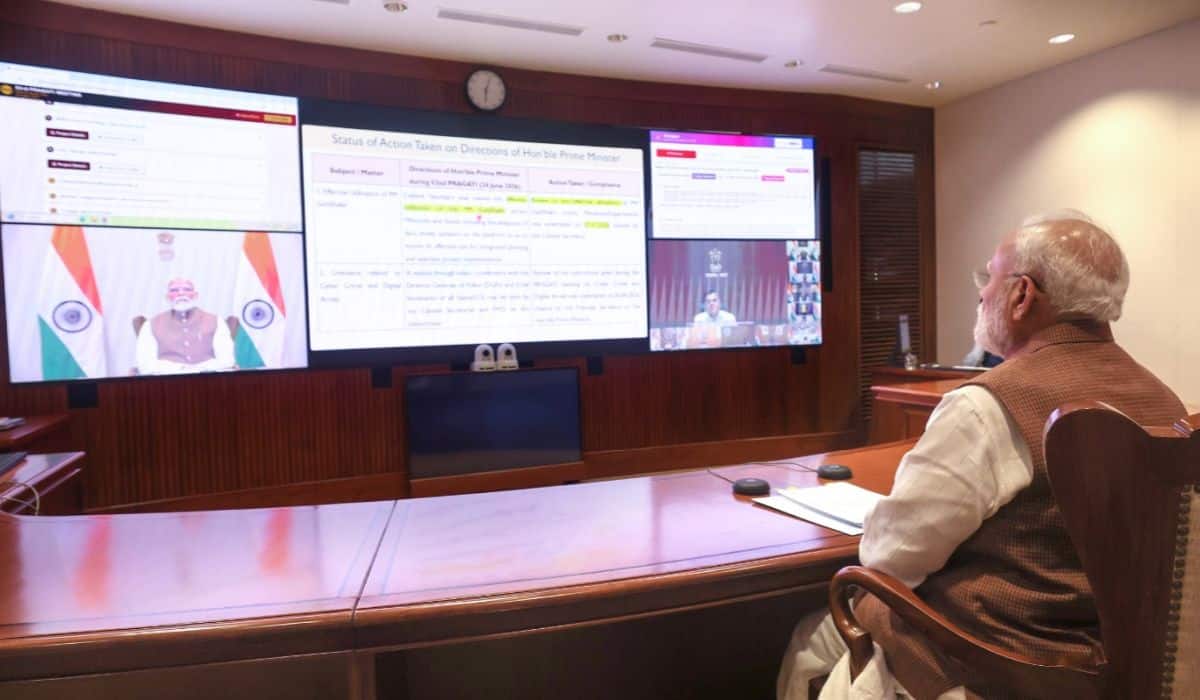
The Prime Minister, Shri Narendra Modi addressed the inauguration ceremony of ‘Kalam no Carnival’ Book Fair organised by Navbharat Sahitya Mandir in Ahmedabad via video message.
Addressing the gathering, the Prime Minister conveyed his heartiest congratulations on the grand event of ‘Kalam no Carnival’. The Prime Minister expressed delight that the tradition of the book fair started by 'Nav Bharat Sahitya Mandir' in Ahmedabad is getting richer with each passing year. The Prime Minister acknowledged that the book fair has become a platform for new and young writers, and it is also helping in expanding the literature and knowledge of Gujarat. The Prime Minister congratulated Navbharat Sahitya Mandir and all its members for this rich tradition.
The Prime Minister added that 'Kalam no Carnival' is a huge convention of books in Hindi, English and Gujarati languages. Shri Modi mentioned that when he was the Chief Minister of Gujarat, the state had also started the 'Vanche Gujarat' campaign, and today, campaigns like the 'Kalam no Carnival' are only taking that resolve of Gujarat forward. He further added that both books and texts are the basic elements of our Vidya Upasana. “There is a very old tradition of libraries in Gujarat.” The Prime Minister highlighted the contributions of Vadodara Maharaja Sayajirao Gaikwad ji who established libraries in all the villages of his area, Maharaja Bhagwat Singh Ji of Gondal who gave a huge dictionary called 'Bhagwat Gomandal', and the heroic poet Narmad who edited 'Narm Kosh'. The Prime Minister said, “The history of Gujarat has been very rich in terms of books, authors, literary creation. I would like that such book fairs reach the people in every corner of Gujarat, especially the youth so that they get to know about the rich history and get inspired.
The Prime Minister drew everyone’s attention that the book fair is taking place during the Azadi Ka Amrit Mahotsav. He further added that reviving the history of our freedom struggle is one of the key facets of Amrit Mahotsav. “We are bringing the glory of the forgotten chapters of the freedom struggle before the country. Events like 'Kalam no Carnival' can give impetus to this campaign in the country”, the Prime Minister said. He stressed that special importance should be given to books related to the freedom struggle and such writers should be provided with a strong platform. The Prime Minister added, “I am sure this event will prove to be a positive medium in this direction.”
The Prime Minister reiterated that one should study the scriptures, texts and books, again and again for them to remain effective and useful. He further elaborated that it is even more important in today’s day and age where people tend to take the help of the internet. “Technology is undoubtedly an important source of information for us, but it is not the way to replace books, the study of books.” The Prime Minister said that when information is in our mind, the brain processes that information deeply, and it gives rise to new dimensions. “This opens the way for new research and innovation. Books become our best friend in this”, the Prime Minister added.
The Prime Minister concluded his address by stressing that it is extremely important to indulge in the habit of reading books, especially in a world that is rapidly changing. “Whether the books are in physical form or in digital form!”, he said, “I believe, such events will play a big role in creating the necessary attraction for books among the youth and help them in understanding their importance.”
जब मैं गुजरात में आप सबके बीच था, तब गुजरात ने भी ‘वांचे गुजरात’ अभियान शुरू किया था।
— PMO India (@PMOIndia) September 8, 2022
आज ‘कलम नो कार्निवल’ जैसे अभियान गुजरात के उस संकल्प को आगे बढ़ा रहे हैं: PM @narendramodi
पुस्तक और ग्रंथ, ये दोनों हमारी विद्या उपासना के मूल तत्व हैं।
— PMO India (@PMOIndia) September 8, 2022
गुजरात में पुस्तकालयों की तो बहुत पुरानी परंपरा रही है: PM @narendramodi
इस वर्ष ये पुस्तक मेला एक ऐसे समय में आयोजित हो रहा है जब देश अपनी आजादी का अमृत महोत्सव मना रहा है।
— PMO India (@PMOIndia) September 8, 2022
अमृत महोत्सव का एक आयाम ये भी है कि हम हमारी आजादी की लड़ाई के इतिहास को कैसे पुनर्जीवित करें: PM @narendramodi
आज इंटरनेट के जमाने में ये सोच हावी होती जा रही है कि जब जरूरत होगी तो इंटरनेट की मदद ले लेंगे।
— PMO India (@PMOIndia) September 8, 2022
तकनीक हमारे लिए निःसन्देह जानकारी का एक महत्वपूर्ण जरिया है, लेकिन वो किताबों को, किताबों के अध्ययन को रिप्लेस करने का तरीका नहीं है: PM @narendramodi