GoG gives assistance upto Rs.2 lakh to the poor patients suffering from critical illnesses

GKM has given the poor a new strength to battle against poverty, ailments and illiteracy

The Chief Minister Naerndra Modi addressed 1.15 lakh beneficiaries of 27 Garib Kalyan Melas (GKM) through video conferencing today. He said the present government of Gujarat has given the poor a new strength to battle against poverty, ailments and illiteracy.

Benefits worth Rs.224 crore were distributed today in 27 talukas by the ministers.

The Chief Minister appealed the poor to take vows for not remaining poor, ailing and illiterate.

“This government knows what it feels when the ailment strikes in the house of poor. And so, it has prepared a strategy to save the poor people from various diseases”, he said. The state government has spent thousands of crore of rupees in order to make available clean water in villages. This has helped the villagers in not becoming victims of epidemics. Gujarat has proved that providing clean water is an important way to save poor from being victims of various diseases, said the Chief Minister.

Mr. Modi said the budget for providing health services to poor has touched Rs.3000 crore. The state government has come up with Rs.200 crore ‘Chief Minister Amrutam’ scheme, under which the government gives assistance of up to rupees two lakh to the poor patients suffering from critical illnesses.

To facilitate the safer deliveries of pregnant women of poor families the state government has implemented Chiranjivi scheme. In past, 51 out of 100 women were able to go for delivery in hospital. Now, this number has increased to 93. Under Balsakha scheme the state government has launched a campaign to save infants of poor families. Due to which the infant mortality has declined from 60 per thousand to 44, he said.

The 108 emergency ambulance service gives speedy help to poor pregnant women for safe delivery. The service has also become instrumental in giving a new life to 29 lakh people who suffered the road accident, he said.

Mentioning various other pro-poor schemes the Chief Minister said the government provides nutrient food to the poor children, pregnant women and girls in order to save them from malnutrition. The State government has also started six new nursing colleges for tribal girls and the seats for nursing have been increased from 40 to 1240 in last decade. The government constructed lakhs of sanitation units for the women in villages. The health of school children is being examined. As many as 26,000 poor children have been given free of cost treatment in super specialty hospital. Around four lakh poor children have been given eye treatment and free of cost spectacles have been given to them.

If the poor have a healthy atmosphere in their houses, they will get strength for coming out of poverty, said the Chief Minister.

Explore More
अयोध्येत श्री राम जन्मभूमी मंदिर ध्वजारोहण उत्सवात पंतप्रधानांनी केलेले भाषण

लोकप्रिय भाषण

अयोध्येत श्री राम जन्मभूमी मंदिर ध्वजारोहण उत्सवात पंतप्रधानांनी केलेले भाषण
UPI — an eventful journey

Media Coverage

UPI — an eventful journey
NM on the go

Nm on the go

Always be the first to hear from the PM. Get the App Now!
...
PM chairs 53rd PRAGATI Meeting
August 25, 2026
PM reviews six key infrastructure projects across the Railway, Road and Power sectors
Projects reviewed span across 9 States with cumulative investment of more than ₹30,000 crore
PM says Infrastructure projects should be viewed as an integrated whole, rather than as individual sections or packages
PM calls for continuous reforms across all stages of project implementation and a proactive work culture across Ministries and States
PM says Speed must go hand-in-hand with quality
While reviewing AgriStack, PM emphasises the need to leverage the latest digital technologies including AI to derive greater value from agricultural data
On cyber fraud and ‘digital arrest’, PM stresses training, public awareness, cyber-safety education and coordinated action

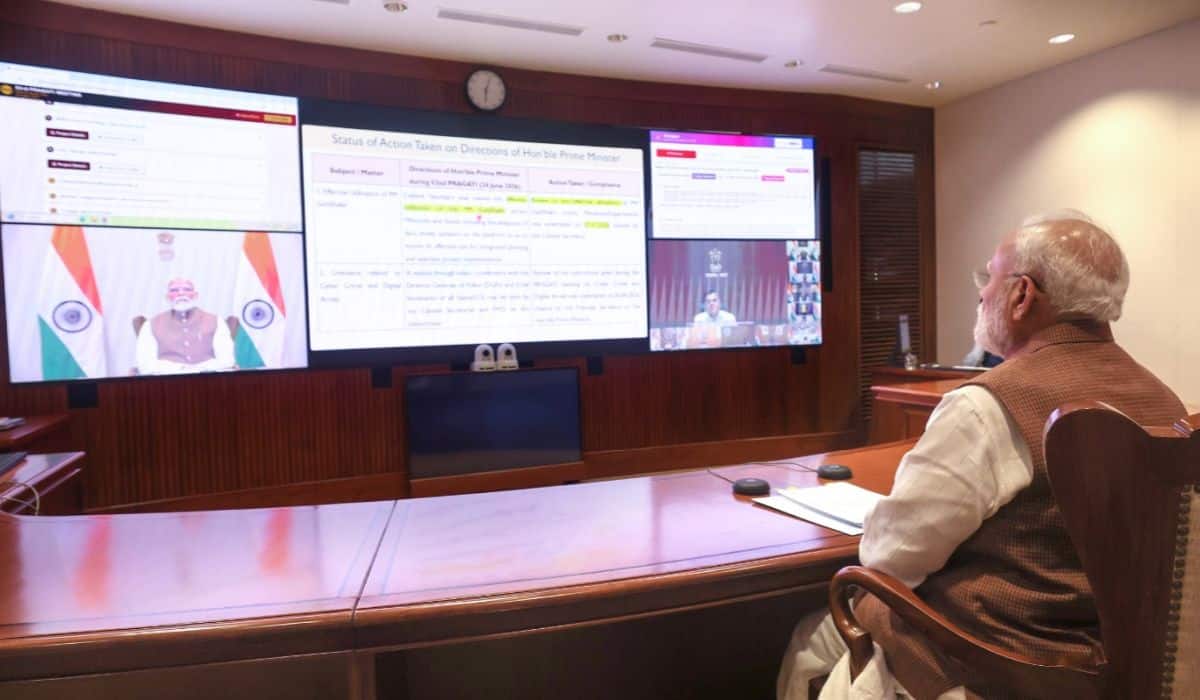
Prime Minister Shri Narendra Modi chaired the 53rd meeting of PRAGATI, the ICT-enabled, multi-modal platform for Pro-Active Governance and Timely Implementation, at Seva Teerth earlier today.

During the meeting, Prime Minister reviewed six key infrastructure projects across the Railway, Road and Power sectors, spanning nine States with a cumulative cost of more than ₹30,000 crore. The projects, significant for strengthening connectivity, supporting industrial and economic activity and improving public services, were reviewed with particular emphasis on adherence to timelines, inter-agency coordination, resolution of pending issues and expeditious completion.

Prime Minister emphasised that delays in infrastructure projects have consequences beyond cost escalation, as they also postpone the benefits intended for citizens, businesses and the economy. He said that infrastructure projects should be viewed and monitored as an integrated whole, rather than as isolated sections, stretches or packages. He noted that progress in individual packages should ultimately translate into timely completion and operationalisation of the entire project. Ministries and States were therefore asked to adopt an end-to-end approach, and address critical gaps that could delay the overall commissioning and delivery of benefits. He called for fostering a proactive work culture across Ministries and State Governments, with greater ownership at every level of project implementation.

Prime Minister stressed the need to explore common utility corridors for infrastructure services, wherever feasible, particularly while planning major transport and infrastructure projects. He called upon Ministries and States to examine such integrated approaches at the planning stage itself, keeping in view their technical and economic feasibility.

Prime Minister said that speed of execution must be accompanied by uncompromising quality. He called upon Ministries, States and implementing agencies to adopt modern technologies and strengthen quality assurance and supervision at every stage.

While reviewing AgriStack under the Digital Agriculture Mission, Prime Minister emphasised the need to leverage the latest digital technologies, including Artificial Intelligence, to derive greater value from agricultural data. He stressed that the data ecosystem should be effectively utilised across the agricultural value chain, from input planning to processing, enabling more informed interventions, better targeting and data-driven decision-making. He appreciated the efforts of the States and the Central Government in building the AgriStack ecosystem and called for further strengthening its use for delivering better outcomes for farmers.

During the review of cyber fraud cases, including incidents of digital arrest, Prime Minister said that prevention must be strengthened through a sustained focus on training, awareness and education. He stressed the need for continuous and targeted public-awareness campaigns, particularly for senior citizens, youth and other vulnerable sections, to familiarise them with common fraud techniques, warning signs and safe digital practices. He also called for regular capacity-building of personnel involved so that emerging modes of cyber fraud are identified and acted upon swiftly.