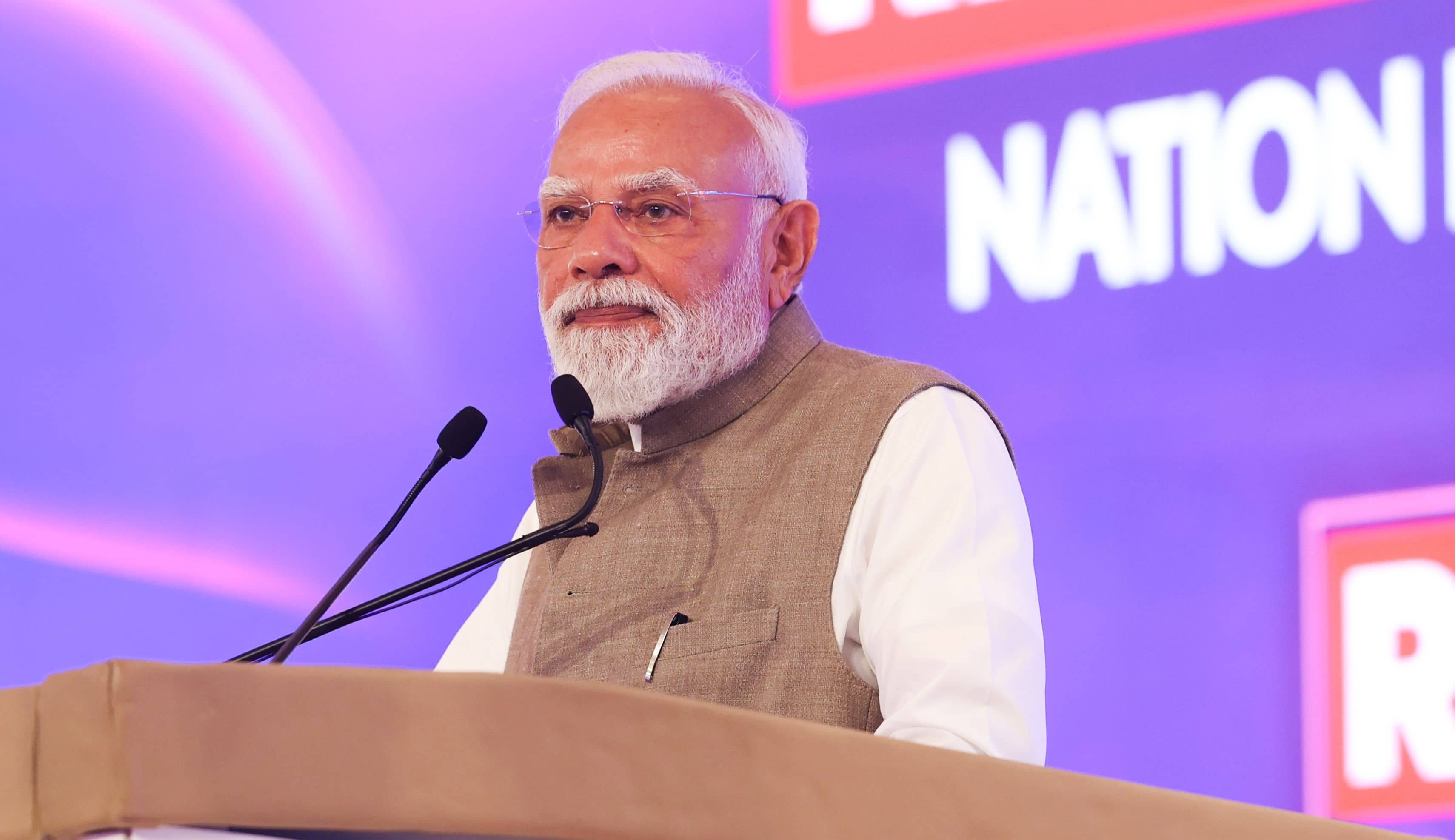
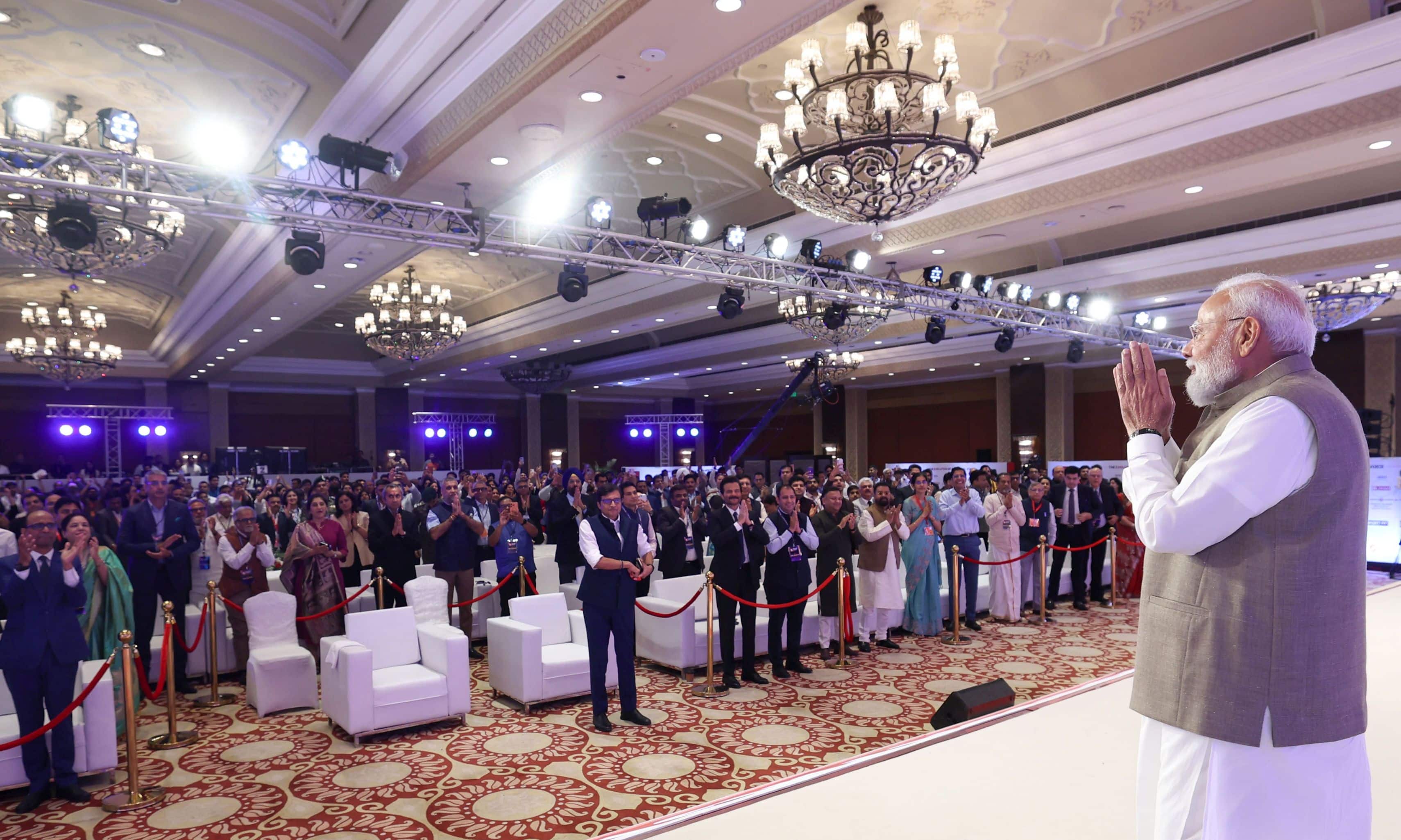
Present on this historic occasion my cabinet colleagues, representatives from the industrial world of the country, other dignitaries, ladies and gentlemen!
This summit is global but the voice is local. Moreover, the beginning too is local. Today is a special day to witness as well as showcase the potential of the developing India of the 21st century. In this period of 'Azadi Ka Amrit Mahotsav', the date October 1, 2022 is going to be recorded in history. Secondly, the Navratri festival has begun. This is a festival of worshipping ‘Shakti’. Similarly, the biggest strength of the 21st century is also being unveiled today to take it to a new height. Today, on behalf of the country and the telecom industry of the country, 130 crore Indians are receiving a wonderful gift in the form of 5G. 5G has started a new era in the country. 5G is the beginning of an infinite sky of opportunities. I congratulate every Indian for the same.

Friends,
Apart from these moments of pride, I am also delighted that as 5G is getting introduced, the children from the rural schools, the villages, the labourers and the poor are also participating with us in the event. A short while ago, I was getting acquainted with a daughter of a rural school in UP through 5G hologram technology. When I was campaigning in the 2012 elections with holograms, it was a wonder for the world. Today this technology is reaching every household. I realized how new technology was changing the meaning of education for them. Similarly, through 5G, children even from the remotest schools in villages of Gujarat, Maharashtra and Odisha are learning new things in the classroom with top experts. It is indeed a thrilling experience to be a part of a new age classroom with them.
Friends,
India's efforts on 5G have another message for all. New India will not remain as a mere consumer of technology, but India will play a very active role in the development and implementation of that technology. India will play a crucial role in designing the wireless technology of the future as well as in the manufacturing related to it. During the era of 2G, 3G and 4G India was dependent on other countries for technology. But with 5G, India has created a new history. With 5G, India is setting a global standard in telecom technology for the first time. India is leading others. Today, every person using the Internet understands that 5G will change the entire framework of the Internet. That is why today 5G has brought a huge opportunity for the youth of India. I am glad that our country, which is moving forward with the resolve of a developed India, is walking hand in hand with the other countries of the world. This is a huge success for India, as well as for the Digital India campaign.
Friends,
When we talk about Digital India, some people think that it is just a government scheme. But Digital India is not just a name, it is a big vision for the development of the country. The goal of this vision is to carry that technology to the common people, which works for the people and works by connecting with the people. I still remember, when the strategy was being chalked out for this vision related to the mobile sector, I had reiterated that our approach should not be piecemeal, but holistic. For the success of Digital India, it was necessary to cover all the dimensions of this sector at once. So we focused on the 4 pillars and the four directions at once. First - cost of the device, second - digital connectivity, third - cost of data, fourth and most importantly - the idea of 'digital first'

Friends,
When it comes to the first pillar i.e. the price of the device, one thing is very clear; the cost of a device can come down only when we are self-reliant. You might remember that many people had mocked me when I had spoken of self-reliance. Till 2014, we used to import almost 100 per cent mobile phones from abroad. Hence, we decided to become self-reliant in this sector. We increased mobile manufacturing units. In 2014, there were only 2 mobile manufacturing units in the country i.e. 8 years ago there were only 2. But now their number is above 200. We gave incentives to increase the production of mobile phones in India and encouraged the private sector. Today the PLI scheme is an extension of this initiative. The results of these efforts were very positive. Today, India ranks number 2 in the world in mobile phone production. Moreover, earlier we used to import mobiles. Today we are exporting mobiles and taking them to the world. Just imagine! From exporting zero mobile phones in 2014, today we have become a country exporting mobile phones worth thousands of crores. We have become an exporting country. Naturally, all these efforts have had an impact on the cost of the device. Now we have started getting more features at a lower cost.
Friends,
The second pillar we worked on after the device cost is digital connectivity. You are well aware that the real strength of the communication sector lies in connectivity. The more the people connect, the better for the sector. If we talk about broadband connectivity, then in 2014 there were 6 crore users. Today their number has increased to more than 80 crores. Speaking of the number of internet connections, in 2014 there were 25 crore internet connections but today its number is reaching about 85 crores. It is also worth noting that today the number of internet users in our rural areas is increasing faster than the number of internet users in the cities. And there is a special reason for the same. In 2014, the optical fiber had reached less than 100 panchayats in the country while today optical fiber has reached more than one lakh 70 thousand panchayats. Now compare 100 with one lakh 70 thousand! Just like the government had started a campaign to provide electricity to every household, like it worked on the mission of providing clean water to everyone through the Har Ghar Jal Abhiyan, delivered gas cylinders to the poorest of the poorest people through the Ujjwala scheme and connected crores of people deprived of bank accounts to the bank through Jan Dhan Yojana, similarly, our government is working on the goal of ‘Internet for all’

Friends,
With the expansion of digital connectivity, the cost of data becomes equally important. This was the third pillar of Digital India on which we worked with full force. We have removed all the hurdles coming in the way of the telecom sector. Earlier, the telecom sector had to face many difficulties due to lack of vision and lack of transparency. You are familiar with the way by which we have given policy support for the expansion of 4G technology. This led to a drastic reduction in the cost of data and the birth of a data revolution in the country. Seeing these three factors, the cost of the device, the cost of digital connectivity and data – its multiplier effect started appearing everywhere.
But Friends,
Besides these things, another important thing happened i.e. the idea of 'digital first' developed in the country. There was a time when a handful of people from the elite class , the scholarly class, used to watch some speeches of the House and mocked it. They used to think that poor people did not have the ability to go digital or they could not understand digital. They used to doubt it. They suspected that poor people would not even understand the meaning of digital. But I have always had the trust in the intellect of the common man of the country and his inquisitive mind. I have seen that even the poorest of the poor Indians are ahead in terms of adopting new technologies and let me share one experience. Probably it was the period of 2007-08 or 2009-10, I don't clearly remember. I was the Chief Minister of Gujarat but there was one area where I had never been to. It was a tribal area and a very backward one. So, we had to organise an event there once. That area was such that there was no possibility of any major project. It was largely a forest-land. So finally a chilling centre was supposed to come up there. The chilling centre of milk was worth Rs 25 lakh. I said, "I will inaugurate it myself. It doesn’t matter if it is a Rs 25 lakh project or just a Rs 25,000 project’’. Now people feel that the Chief Minister should not be inaugurating small projects. But it doesn't really matter to me. So I went to that village. There was no place for me to even hold a public meeting. There was a small school ground 4 km away from the place. So, a public meeting was organized there. But when we went to the chilling centre, I found the tribal mothers and sisters standing in a queue to fill milk. So when we went there and started with the inauguration programme, they placed their pots of milk down and started taking photos with their mobiles. I was surprised that people in such a remote area were clicking photos with mobiles. So I went to them and asked- "what will you do with this photo?" They said that they would ‘download

I was really surprised to hear these words. Such is the power in the villages of our country. The poor mothers and sisters of the tribal area who had come to fill milk were taking photos from their mobile phones and they knew that they could download it. The word 'download' coming out of their mouths gives us an idea of their intellect and their acceptance of new things. I was in Gujarat yesterday. When I was going to visit Ambaji pilgrimage area, there were small villages on the way. More than half the people were recording videos with their mobiles. That is the strength of our country! We cannot ignore this power and only some people from the elite class of the country did not believe in our poor brothers and sisters. Eventually we managed to go ahead with the approach of 'digital first'. The government itself went ahead and made the way for digital payments easier. The government itself has promoted citizen-centric delivery service through the app. Whether it is about farmers or small shopkeepers, we have given them a way to meet their daily needs through the app. Today you can see the result of the same. Today technology has become truly democratic. You have also seen how much our approach of 'digital first' has helped the people of the country during the Corona pandemic when the major developed countries of the world were struggling to help their citizens. There were rupee, dollars, pounds, euros and everything else in their treasury. They had also decided to give away funds but there was no way to reach the people. Whereas, India was transferring thousands of crores of rupees to the accounts of the citizens of my country with a single click. It was due to the power of Digital India that even when the world had come to a halt, our children were taking online classes and studying. Hospitals were faced with an extraordinary challenge, but doctors were treating their patients through tele-medicine. Offices were closed, but 'work from home' was going on. Today we have small traders, small entrepreneurs, local artists, artisans and Digital India has given a platform to everyone. It has opened a market. Today, if you go to the vegetable market or a local market, even a small street vendor will ask you to pay with UPI. Once I came across a video where even a beggar was taking the money digitally. Look at the Transparency! This change shows how one becomes empowered when facilities are easily accessible.
Friends,
The revolution that the country is witnessing in the telecom sector today is proof that if the government works with the right intention, then it does not take long to change the intentions of the citizens. This is the difference between the intention of 2G and the intention of 5G. Better late than never. India today is one of those countries in the world where data is so cheap and affordable. Earlier, where the cost of 1GB data was close to Rs 300, today the cost of 1GB data has come down to only Rs 10. Today in India, a person is using an average of 14 GB data on mobile in a month. In 2014, the cost of this 14 GB data was around Rs 4200 per month. Today, the same amount of data is available for Rs 100 or Rs 150. That is, today about Rs 4000 of the poor and the middle class is being saved every month on mobile data. With so many efforts of our government, the cost of data in India remains very low. Saving 4000 rupees every month is not a small thing, but you realised it after I told you because we never blew our own trumpet. We did not advertise. We only focused upon the convenience of the people of the country to enhance their ease of living.

Friends,
It is often said that India could not take advantage of the first three industrial revolutions. But I believe that India will not only take full advantage of the Fourth Industrial Revolution but will also lead it and scholars have started saying that it is not just India's decade but this entire century belongs to India. This is not a decade but a century. We are all witnesses to the way India has leapfrogged in the world of technology after the arrival of 4G. When the citizens of India get equal opportunities in technology, then no one in the world can beat them. So today when 5G is being launched in India, I feel very confident friends. I am able to foresee the future and we will see the dreams in our hearts and minds getting fulfilled. We are the ones who are going to see it happen in front of our eyes. Coincidentally, just a few weeks back India has become the 5th largest economy in the world. And so, this is an opportunity for our youth, who with the help of 5G technology can make innovations that grab the attention of the world. This is an opportunity for our entrepreneurs who can expand and grow themselves using 5G technology. This is the opportunity for the common man of India who can use this technology to improve his skills, up-skill, re-skill and convert his ideas into reality.
Friends,
Today's historic occasion has brought new inspiration for us as a nation and as citizens of India. Why don't we use this 5G technology to accelerate India's development at an unprecedented pace? Why don't we use this 5G technology to expand our economy very fast? Why don't we increase our productivity by using this 5G technology?
Friends,
In these questions there is an opportunity, a challenge, a dream and a resolution for every Indian. I am aware that today the class which is watching the launching of 5G with the most enthusiasm is the youth or the younger generation of my country. There are several major opportunities waiting for our telecom industry. Several new employment opportunities are going to be created. I am sure, our industry, our institutes and our youth will work together in this direction ceaselessly. I was trying to understand the exhibition which is going on for a long time. I am not so tech-savvy but I was trying to comprehend. Seeing this, I felt like informing the government to see where this could be applied and incorporated in the various departments of our government so that its impact could also be seen in the policies of the government. This exhibition is going to run for five days. I would especially urge the students of technology to come, see it, and understand the way the world is changing. Once you see it, you will notice many new things. You can also add to that. I would also like to say to the people of this telecom sector that I was very happy when I visited every stall and they said that it was Indigenous, made in a self-reliant way. Everyone was saying it with great pride. I was happy but something else was going on in my mind. I was wondering that there are various different types of cars. Each has its own brand and uniqueness. But those who deliver the spare parts for these cars belong to the MSME sector. The same factory from the same MSME makes spare parts for six types of vehicles and makes minor repair works. I felt that you were also displaying the hardware. Should the MSME sector be given work to make small parts of the hardware needed for this too? I want to create a huge ecosystem. I am not a trader or businessman. I have nothing to do with money, but I believe that this way the cost will come down at once. This is the strength of our MSME sector

You have to provide that service only by adding your uniqueness and other things like software etc. So I understand that all of you will have to work together and only then the cost will come down. There are many things that we generally do together. I have also seen that most of the youngsters who have worked in startups have been skilled-up in this field. I also wish to tell the startups to find out the number of services you can provide in this field. How many user-friendly systems can be developed? That's the benefit of it after all. But I would like one more thing. Could your association run a movement together? How could this 5G be useful in the lives of the people in at least all the district headquarters of India? Could exhibitions educating the people be organised? Let me give a small example from my experience. It was a dream in our country to have 24 hours electricity. When I was in Gujarat I had come up with a scheme called Jyotigram Yojana and my dream was to give 24x7 electricity to every household in Gujarat. Now all my officers used to say that maybe it was not possible to do that. So I gave a simple solution. I said that we should separate the agriculture feeder and the domestic feeder. After doing that, we completed the work in each and every district. So, one job was completed. Then we would hold a major summit in that district. 2-2.5 lakh people used to attend the event because getting 24 hours electricity was an occasion of great joy! That was the period of 2003-04-05. I held an exhibition of all the works that could be accomplished with electricity and all the machines that could run on electricity. Otherwise people might have equated electricity just with being able to eat dinner at night or watching TV. But electricity could be used in various ways. So, educating about it was also necessary. But what I realised was that after the huge exhibition even the tailors would try to think about how to set up their machines with 24 hours electricity; even the potter decided the type of electric equipment he would purchase and the mothers and daughters across the country too started thinking about the electric equipments they could use in the kitchen. That is when a huge market came up and multiple utility of electricity had started. Similarly, with 5G people would start thinking of multiple uses in their lives as the videos could be downloaded pretty fast. It wouldn't buffer for long if a person wants to watch reels. The phone doesn't get disconnected from the internet. There can be video conferences with clear video and audio. You can make phone calls. Moreover, this is going to be a life changing system. Therefore I would ask the association of this industry to go to schools, colleges, universities and every district of India and find out the number of aspects that exist where 5G could be applied and we need to add value to the same. So this will be a service for you and this technology should not be limited to just talking or watching any video in life. It should be used to bring about a complete revolution and we have to reach 130 crore people. This won't take much time. I had just come up with the Drone Policy. Today I have seen that in many areas they have started the work of spraying pesticides from the drone. They have learnt to operate drones and that's why I believe we should go towards these systems.
And friends,
In the coming times, the country will continuously lead such technologies, which will originate in India, which will make India a global leader. With that belief, I wish you all the very best! Once again, I congratulate all the countrymen for the launch of 5G, a great medium of power, on the auspicious festival of Shakti worship. Thanks a lot!