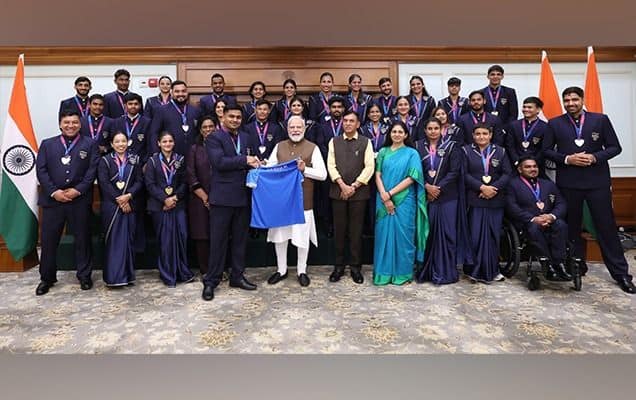
PM inaugurates the Nano Urea (Liquid) Plant constructed at IFFCO, Kalol
“Cooperation is a great medium for the self-sufficiency of the village, it has the energy of AtmaNirbhar Bharat”
“High prices and lack of availability in the global market due to the pandemic and war were not allowed to trouble the farmers”
“Union Government gave fertilizer subsidy of Rs 1 lakh 60 thousand crore last year, this year this subsidy is going to be more than Rs 2 lakh crore”
“Whatever was necessary for the interest of the farmers of the country was done and we will continue to strengthen the farmers of the country”
“Solution to many of India's difficulties in self-reliance. Co-operative is a great model of self-reliance“
“Government is continuously moving forward to connect the spirit of cooperation with the spirit of the Amrit Kaal”

Bharat Mata ki Jai!

The popular Chief Minister of Gujarat Shri Bhupendra Bhai Patel; my cabinet colleagues Amit Bhai Shah, Mansukh Bhai Mandaviya; my Parliamentary colleague CR Patil; Minister of the Gujarat Government Jagdish Bhai Vishwakarma, MPs, Legislators, all the ministers of the Gujarat Government; all senior dignitaries associated with the cooperative movement! Another major event is running parallel to it in the IFFCO premises. My greetings to the IFFCO Chairman Dileep Bhai, all the members of IFFCO as well as the lakhs of farmers from across the country who are connected to the Mahatma Mandir in Gandhinagar, Gujarat. Today we are talking about 'Sahkar Se Samrudhi' here. ‘Cooperative’ is also a great medium for the self-reliance of the villages and it holds the energy of self-reliant India. To build a self-reliant India, it is very crucial for the village to be self-reliant. And that's why according to the path shown by Pujya Bapu and Sardar Sahib, today we are moving forward in that direction, to set up model cooperative villages. Six such villages have already been identified in Gujarat, where complete cooperative systems will be implemented.

Friends,

Today, even while dedicating the country's first Nano Urea Plant for self-reliant agriculture, I was really feeling immense pleasure. Just imagine the scenario when the farmer goes to collect the bag of urea. Just think about that situation and l will give you the description of what exactly is going to happen. Now the power of one sack of urea is available in just one bottle. That is, half a litre bottle of nano urea will meet the requirement of one bag full of urea for the farmers. The cost of transportation and everything else will be reduced drastically! Just imagine the huge support this initiative is going to provide to the small farmers.

Friends,

The modern plant which is set up in Kalol has the capacity to produce 1.5 lakh bottles. But in the future, 8 more such plants are going to be set up in the country. This will reduce foreign dependence on urea and save the country's money. I hope this innovation will not be limited to nano urea only. I am sure that in future other nano fertilizers will also be available to our farmers. Our scientists are still working on that.

Friends,

I would like every countryman to understand the importance of the step we have taken towards self-reliance in nanotechnology for fertilizers. India is the world's second largest consumer of fertilizers but we are at number three in terms of production. Moreover, till 7-8 years ago, most of the urea used to land in black market instead of going to our farms and the farmer had to face hardship. The major urea factories were also compelled to shut down due to lack of new technology. Hence after the formation of the government in 2014, we took the initiative of 100% neem coating of urea. This ensured sufficient urea supply to the farmers of the country. Besides, we also took the initiative of restarting those five closed fertilizer factories in Uttar Pradesh, Bihar, Jharkhand, Odisha and Telangana. And of those, the factories of UP and Telangana have been reopened and the production is also going on. And the rest will also start production very soon.

Friends,

India has been heavily dependent on foreign countries for decades to meet its requirement of fertilizers. We import fertilizers. We import almost a quarter of our requirements and our needs for potash and phosphate are met by almost 100% importing from abroad. In the last 2 years, due to the Corona lockdown, the prices of fertilizers in the international market have increased a lot. On top of that, the war aggravated the situation. The war not only limited the availability of fertilizers in the global market but also increased the prices manifold.

Friends,

Our government that is sensitive towards the farmers realized that the international situation was worrisome. Prices are rising and we are looking at every nook and corner of the world to obtain fertilizers. These are troubled times; there are difficulties. So, we have decided that we will continue to bear all these troubles but will not let the farmers get affected by it. And that's why in spite of every difficulty, we did not allow any major fertilizer crisis to hit the country.

Friends,

India imports urea from abroad and a 50 kg bag of urea costs Rs 3500. Mind it, a bag costs Rs 3500! But in the villages of the country, the same urea bag which is bought at Rs 3500 is given to the farmers for only Rs 300. That is, our government is bearing the burden of more than Rs 3200 for one bag of urea. Similarly, on a 50 kg bag of DAP, the previous governments had to bear Rs 500. Despite the spurt in the prices of DAP in the international market, our government has continuously attempted to minimize the burden on the farmers. Now our government is bearing 2500 rupees on a 50 kg bag of DAP. That is, within 12 months, the central government has taken 5 times the load of every bag of DAP. Last year, the central government gave a subsidy of Rs 1 lakh 60 thousand crore in fertilizers so that the farmers of India do not face any problem. This assistance to the farmers is going to be more than Rs 2 lakh crore this year.

Friends,

Whatever is necessary in the interest of the farmer of the country, we will do that and will continue to empower the country's farmers. But we should think -can we leave our farmers at the mercy of foreign countries in the 21st century? Why should the lakhs of crores of rupees that the central government is spending every year go abroad? Shouldn't this be of use to the farmers of India? Shouldn't we be looking for a permanent solution to reduce the rising input cost of farmers due to expensive fertilizers?

Friends,

These are the questions that were before every government in the past. It is not that only I had to face all these issues alone. But earlier, only temporary and immediate solutions were provided. Limited efforts were made to prevent those situations from cropping up in the future. In the last 8 years, we have not only taken immediate measures but also found permanent solutions to the problems. Health infrastructure is being focused upon so that situations like corona pandemic do not arise in the future. In order to minimize the problem of edible oil, work is underway on Mission Oil Palm. To reduce foreign dependence on crude oil, efforts are being made on a large scale today on biofuels, green hydrogen and other measures. Massive investment in nanotechnology is also a result of this approach. Similarly, the campaign which is going on in the country to encourage farmers towards natural farming, is also a part of the permanent solution. And I especially congratulate the farmers of Gujarat. The farmer of Gujarat is progressive. Even if he is a small farmer, he has the courage. And I have this information that the small farmer of Gujarat has also started moving towards natural farming. Lakhs of farmers in Gujarat have started with natural farming. I heartily congratulate all the farmers and salute them for this initiative.

Friends,

'Cooperative' is the solution to many of the challenges of India in terms of self-reliance. And it is a great model of self-reliance. We have experienced this with great success in Gujarat; and all of you, my friends, are part of this success. All the stalwarts associated with the cooperative sector of Gujarat are present here. I was observing everyone's face. They are all my old friends who are carrying forward the development journey of Gujarat in the cooperative sector today. Such veterans are sitting in front of me! It is a great pleasure to see the efforts with which you are taking this work forward and carrying the co-operative spirit forward.

Friends,

Gujarat has also been fortunate because we got the leadership of Pujya Bapu and Sardar Saheb here. Sardar Saheb did the work of implementing the path of 'self-reliance through cooperatives' shown by revered Bapu. And as Amit bhai mentioned, when it comes to cooperatives, it is very natural to remember Venkatbhai Mehta. Even today the Government of India runs a huge institute after him. But that too was gradually forgotten. This time we have started the work of making it more powerful with a provision of Rs 25 crores in the budget. Moreover, here we have a society for housing, which is a cooperative society. It was the first experiment of the concept here. Pritam Nagar in Paldi is an example of that. It is a living example of the country's first cooperative housing scheme.

Friends,

Amul has made a mark in the cooperative sector. A brand like Amul has introduced the power of cooperative movement of Gujarat to the whole world and has created an identity. Gujarat has the success stories of cooperative movement in the dairy, sugar and banking sectors. In the last few years, the scope of cooperatives has increased in other sectors including fruits and vegetables.

Brothers and Sisters,

Among the successful experiments of cooperatives, a big model is in front of us to strengthen the rural economy of the country. The example of the cooperative model of the dairy sector is before us. Today India is the largest milk producer in the world in which Gujarat has a major share. In the past years, the dairy sector has been growing rapidly and is also contributing more to the rural economy. Today India produces milk worth about 8 lakh crore rupees in a year. And this business is handled mostly by our mothers and sisters. While on the other hand, the combined market of wheat and paddy is less than milk production. That is, if milk is worth 8 lakh crores, the total production of wheat and paddy is less than that. You see, the power our country has created in milk production. Similarly, if we look at the entire sector of animal husbandry, it is worth more than Rs 9.5 lakh crore. This is a great support for the small farmers and landless labourers of India.

Friends,

The reason why the villages in Gujarat have seen more prosperity in the last decades is due to the cooperatives associated with the dairy sector. And you will be surprised to know this... If we remind you of something, some may feel that we are criticizing someone. But we are not criticizing. Sometimes a few things need to be reminded to understand the things that used to happen earlier. Provisions were made to halt dairy production in Kutch, Saurashtra of Gujarat. That is, in a way it was put under illegal activities. When I was here, we tried to reason that if Amul is growing, then the dairy industry of Kutch and Amreli too can grow. Why should we restrict it? And today in Gujarat the dairy sector has stood with great strength in all four directions. In Gujarat also, milk based industries were widely spread because the restrictions on the part of the government were minimal in this. The government tried to escape as much as it could and gave full freedom to the cooperative sectors to flourish. The government plays the role of just a facilitator here, the rest of the work is being done either by all our colleagues dedicated to our cooperative sector like you, or by our farmer brothers and sisters. Both the milk producer and the private and cooperative sectors engaged in the business of milk are interlinked and have created an excellent supply and value chain.

Friends,

The biggest thing is that most of us in the dairy sector are small farmers, and like I said before, our mothers and sisters handle this work. Around 70 lakh sisters and 50 lakh families in Gujarat are a part of this movement today. Today our mothers and sisters are running more than 5500 milk cooperative societies in Gujarat. Our sisters from Gujarat have also played a crucial role in building an international brand like Amul. In a way, cooperatives have given new dimensions to women entrepreneurship in Gujarat. We all have heard of Lijjat Papad. It was started by the poor mothers and sisters of the tribal area. Now it has become a multinational brand. Just like the Indians, Lijjat Papad too has reached every part of the world. And I feel so proud that Lijjat Papad has been expanding over the years. It has grown so much, yet it did not get its due recognition. Last time we gave the Padma Shri award to one of the founders of Lijjat Papad. Now her age is above 90. She is originally a Gujarati, but lives in Mumbai. But that elderly lady came and showered her blessings. That is, just like the spirit of our cooperative and the skills of our mothers and sisters have become a brand of Amul, similarly Lijjat has also turned into a brand. We can clearly see the management skills of our sisters and daughters in the cooperatives.

Friends,

We are following the mantra of 'Sabka Saath, Sabka Vikas, Sabka Vishwas, Sabka Prayas'. This mantra itself is the soul of the cooperative. This mantra is within the boundaries of the cooperative. Therefore, we are continuously moving forward to link the spirit of co-operatives with the spirit of the 'Azadi Ka AmritKaal'. With this objective, a separate Ministry for cooperatives was formed at the centre. And the effort is to encourage cooperative based economic models in the country. For this, several new steps are being taken one after the other. We are trying to make cooperative societies, institutions competitive in the market, by providing them a level playing field with other market players. In the last few years, we have provided assistance to the cooperative societies by reducing the taxes. Amit bhai has mentioned it in a few words but we have taken several initiatives. He talked about the surcharge. Earlier there were issues regarding this. While making reforms, we have given the cooperatives equal status to that of the Farmer Producer Organizations. This will go a long way in helping the cooperatives to grow.

Friends

Moreover, a huge initiative is also underway to connect cooperative societies, cooperative banks with modern digital technology. A commendable work is going to start in this direction in Gujarat. Also, when I was the Chief Minister, income tax was imposed on the cooperative sector as mentioned by Amit Bhai. So, I used to write letters to the central Government, and the people handling this department in the centre too were associated with the cooperative movement. But they did not pay any heed to Gujarat or to the people of the cooperative sector around the country. But we went and solved that problem too.

Friends,

I am told that the District Co-operative Banks have issued Rupay Kisan cards to about 8 lakh farmers. Like other banks, the facilities of online banking are also available to the farmers today. Like Amit bhai mentioned, when all of the country's 63,000 Primary Agricultural Credit Society (PACS) will be computerized, the entire image of our cooperatives will transform completely. This will greatly benefit our farmers as most of the members of these societies are farmers. There is one more piece of good news. I came to know that now several people from the cooperative sector are using the GeM portal of the Government of India for buying. This has brought transparency; the process has speeded up and the need is being fulfilled in less cost. The people of the cooperative sector have accepted the government's GeM portal. Therefore, I sincerely thank the people of the cooperative sector.

Friends,

The biggest strength of a co-operative is trust, cooperation and the ability to increase the capacity of the organization with the help of everyone. This is the guarantee of India's success in the 'Azadi Ka AmritKaal'. We are working on empowering those who were considered small and were underestimated in the AmritKaal'. Small farmers are being empowered in every way today. Similarly, small scale industries - MSMEs are being made a strong part of India's self-reliant supply chain. A digital technology platform, ONDC- Open Network for Digital Commerce, is also being made available to our small shopkeepers and traders. This will encourage healthy competition in the digital space, giving equal opportunity to the small traders of the country. This will strengthen the potential of India's e-commerce market, which will definitely benefit the small traders of Gujarat.

Friends,

Gujarat has been a state associated with the tradition of trade and business. The test for a good businessman is how well he handles the business even in difficult situations. The government faces a similar test as to how it can find new ways to find solutions even in the midst of challenges. All these provisions and all the reforms we are witnessing from the past few years are our attempt to turn a crisis into an opportunity. I am sure that our spirit of co-operation will help us in fulfilling our resolutions. And just now Bhupendra Bhai has mentioned really good lines in his speech that non-cooperation was a weapon for gaining independence before. 'Cooperative' is a weapon to achieve prosperity after independence. This journey from non-cooperation to cooperatives is our path to attain the heights of prosperity and to fulfil the mantra of ‘Sabka Saath, Sabka Vikas’. Let us walk on this path with confidence. We should also connect the people of the country with this auspicious work. The expansion of the cooperative movement of Gujarat in more areas of India will work for the betterment of the people of that region. I am very grateful to the Gujarat government that today I got the opportunity to meet the stalwarts of the cooperative sector because when I was in Gujarat, they always used to come with their grievances. But today they came with their report cards. "So we have reached here in such a short time; we have taken our society to this position; we have brought our organization here. Earlier our turn-over was this much, now our turn-over has become this much". When the people of small societies meet, with great pride they say – "we all work on computers, sir; we have started going online here". The change that is seen in the cooperative sector of Gujarat is something to be proud of. Today I bow to your hard work, salute this great tradition. And as we are celebrating 75 years of independence, the seeds which were sown earlier have turned into a banyan tree today in the creative dominance of the public life of Gujarat and is growing in the form of economy as well as cooperative dominance. With this delight and joy, I would like to end my speech by thanking you from the bottom of my heart and saluting everyone.

Say aloud with me:

Bharat Mata Ki – Jai,

Bharat Mata Ki - Jai,

Bharat Mata Ki – Jai,

Thank you.


Explore More
প্রধান মন্ত্রীনা শ্রী রাম জন্মভুমি মন্দির দ্বাজরোহন উৎসবতা পীখিবা ৱারোলগী মৈতৈলোন্দা হন্দোকপা

Popular Speeches

প্রধান মন্ত্রীনা শ্রী রাম জন্মভুমি মন্দির দ্বাজরোহন উৎসবতা পীখিবা ৱারোলগী মৈতৈলোন্দা হন্দোকপা
India's Merchandise Exports Defy Global Headwinds, Rise 15 Per Cent In April–14 June Period

Media Coverage

India's Merchandise Exports Defy Global Headwinds, Rise 15 Per Cent In April–14 June Period
NM on the go

Nm on the go

Always be the first to hear from the PM. Get the App Now!
...
India is not only a fast-growing economy, but also a credible one: PM Modi
June 22, 2026
India is not only a fast-growing economy, but also a credible one: PM
Along with being a rising power, India is also a reliable power: PM
For India, Nation First is the highest guiding principle: PM
Maoist terror is breathing its last in India: PM
The shift in mindset from "this can never be done" to "this will be done" is India's greatest achievement: PM
The government is empowering the poor and middle-class: PM
The collective efforts of 140 crore Indians will realise the dream of a Viksit Bharat: PM

Swar Sadhana, Manokamana, Aradhana - after such an auspicious beginning, it would have been wonderful if your program had continued. Greetings to all of you.

I extend my regards to all viewers of Republic TV Network, which now broadcasts in many languages. I also welcome all companions who have come to participate in this summit. In 24-hour news channels, breaking news holds great importance. And nowadays, if you look anywhere in the world, the entire world seems to be in breaking news mode. Amidst such hustle and bustle, you are hosting and participating in this summit, and therefore you deserve special congratulations. This time, your theme of discussion is equally significant: Great Power India: Nation First.

Friends,

Our scriptures say: Yato Dharmastato Jayah! - meaning, the root of victory and strength is Dharma. And Dharma means duty, Dharma means justice, Dharma means equality, Dharma means dialogue, Dharma means compassion. This very essence is embedded in the spirit of Nation First. India views its power through this lens, weighing it on this scale.

Friends,

India has another unique quality, which the world has now acknowledged. We are not a nation that reacts hastily to momentary events. We are a nation that has witnessed both development and destruction, endured them as well. We are a nation with the memory chip of ages embedded in our consciousness - a nation with the memory chip of millennia. That is why what India is doing today - and I say this with full responsibility - what India is doing today will write the future of the next thousand years. This is India’s greatest guarantee to the world. India is not only a fast-growing economy, it is also a credible economy. Alongside being a rising power - and you even stretched the dictionary to call it a superpower - I would certainly say that India is a reliable power. Just a few days ago, I returned from the G7 Summit, and every leader, every country understands very well that for today’s India, Nation First is the greatest mantra, the highest principle.

Friends,

Just a few days ago, our government completed 12 years. Arnab even compelled you to clap for that. If you weigh the achievements of the past twelve years, you will find that at the core of every decision, every step, every effort lies the spirit of Nation First. From the Swachh Bharat Abhiyan to Make in India, from emphasizing khadi to encouraging local products - all these initiatives succeeded because the people of the country placed the nation above all and fulfilled their duty. I salute the citizens of this country.

Friends,

Here with us is our companion, Shri Sridhar Vembu ji. When our entrepreneurs walk with the spirit of Nation First, when they set their goals by understanding the needs of the nation, institutions are built and the country prospers. I don’t know how much has been discussed here about Shri Vembu ji’s work, but recently I went to VivaTech in France. There were nearly 1.5 to 2 lakh young people there. As I and the President of France walked through different stalls to see the innovations of the youth, we came to the Zoho stall. I was astonished and filled with pride to see the crowd of European youth gathered there, eager to understand what this new creation was. Perhaps in India it is not discussed as much, but what I saw in France was remarkable. Congratulations to you.

Friends,

The impact of Nation First in government policy and decisions can be seen in our tribal regions. I am not here to deliver philosophy, but let me share a few light examples so you can understand how work happens. I speak of tribal areas - a population of more than 100 million, the tribal society. We all know that for decades, Maoist terror had entrenched itself there. Even in the 21st century, these terrorists did not allow a single facility to reach those areas. No government vehicle could pass through; they would be riddled with bullets. Many governments came and went, generations passed, and it seemed this misfortune of violence would remain forever. You can imagine - between 2004 and 2014, in those ten years, due to Maoist terror, more than 17,000 violent incidents occurred, and nearly 7,000 lives were lost.

Friends,

For you, today’s headline or half-hour TV debate might be that Maoist terrorism has ended. But things don’t happen like that. It requires immense effort, and that is why I want to explain. Nowadays, some people keep waving the Constitution, but when they were in government, in Naxal-affected areas, even uttering the word “Constitution” could get you shot. At that time, they sat silently, their hands trembling, unable to hold up the Constitution. The Congress was hardly affected by that painful situation.

Friends,

After 2014, we moved forward with the spirit of Nation First to change the situation. We did not just talk, we did not just announce, we acted. We resolved to uproot Naxalism-Maoism completely, and today the whole country can see the result. Maoist terrorism in India is now counting its final breaths.

And friends,

Often the final outcome is so vast and significant that the hard work behind it goes unnoticed. I want to especially tell Republic TV viewers about this.

Friends,

In those Naxal-affected areas where even going out in daylight would terrify ordinary people - fearing abduction, extortion, or looting - where even speaking of development was impossible, we advanced with a pledge of progress. In the past 12 years, our government has built more than 12,000 kilometers of roads in such regions. Many times, our construction equipment was burned, contractors were chased away. If 25 people worked on a road, 200 police personnel had to guard them so the work could continue. We did all this because we had resolved to do it.

Friends,

We built more than 9,500 mobile towers. Earlier, even one tower could not be installed, and if installed, it would be destroyed. Because they always wanted to fuel anger. We brought mobile connectivity to nearly 45,000 villages. In Naxal-affected districts, more than 1,800 bank branches were opened. Around 75,000 banking correspondents and more than 6,000 new post offices were established. We did not rely only on bombs, guns, and bullets, friends - we invested every ounce of strength given by God to win hearts.

Friends,

With firm resolve, we went into Naxal-affected areas to fulfill the hopes and aspirations of ordinary people. You will be astonished - a notorious Naxalite, with a bounty of crores on his head, his mother received a ration card from us for the first time. Her son never allowed her to get one, because he wanted to run his terror regime. There are countless such incidents. I was shocked. And the government of that time sat silently, blind to the Constitution. But the result of all these efforts was a new wave of trust among the people. Today, look at Bastar - instead of bombs and guns, Bastar Olympics are celebrated with great enthusiasm. Two editions have already been held. In the first, more than 1.5 lakh youth participated, and in the second, nearly 4 lakh youth joined. Where once there was terror, now talent is finding opportunity, and sports are flourishing.

Friends,

One of the greatest achievements of these 12 years of service has been building an India filled with hope and aspiration, rising out of despair.

Friends,

Naxalism may have been concentrated in certain areas, but its pain was felt across every corner of India. And when news began to spread that Naxalism was ending, the sense of trust was not limited to those affected regions - it spread across the entire nation. In the ten years before 2014, under the Congress government, the discontent was not only about governance. The despair was far deeper. The nation had lost hope. People felt nothing could change, nothing could improve.

Friends,

In the past 12 years, India has transformed despair into hope, and this gives me the greatest satisfaction. Today, everyone feels that with a little more effort, things can be achieved. Gone are the days when the only refrain was “It cannot happen, it cannot happen.” That era has passed. Today, the spirit is “It will happen.” This new confidence is India’s true achievement, and this is real power. Challenges remain, and they always will. Challenges are shape-shifters, appearing in new forms. But whatever form they take, we will fight and we will win. When the nation moves forward with the belief that “it can be done and we will do it,” dreams are fulfilled.

Friends,

I want to speak here about more than 100 districts and over 500 blocks in India. These were left behind on every parameter of development, and earlier governments had stamped them as “backward districts” and “backward areas.” We lifted these vast regions out of the despair of backwardness and ignited aspirations for development. First, we changed their identity. We said these are “aspirational districts,” these are “aspirational blocks.” We created programs for aspirational districts and aspirational blocks, and the government began working meticulously on every parameter of development. In each district, we identified three aspects to overcome, in others six aspects, and focused efforts began. Today, these aspirational districts and blocks are driving the overall growth of states. Earlier, they dragged growth backward. These districts had large populations living in poverty and deprivation. In recent years, 250 million poor people have defeated poverty, and aspirational districts have played a major role in this.

Friends,

We see that when one person is cured of illness, it is not just that individual who recovers - the whole family feels relief. Similarly, when a son or daughter achieves something, it is not just their achievement, but the entire family is filled with pride and confidence. In the same way, when someone rises out of poverty, the entire society benefits, the nation benefits. When 250 million people have come out of poverty and entered the neo-middle class, the benefit is not limited to those families. The middle class also gains, because these are new consumers who drive the economy, ultimately creating opportunities for the middle class. Thus, poverty reduction is not merely a matter of welfare - it is a story of expanding opportunities, a source of new aspirations.

Friends,

The vast middle class that has emerged in the country over the past 12 years has been a major priority for the government. For the ease of living of the middle class, the government has worked at every level. Take the dream of owning a home. Every middle-class family desires to have their own house. In 2014, if a family wanted to buy a home, home loans came with double-digit interest rates. Today, loans are available from banks at 7–8 percent interest. Earlier, getting a loan was like winning a war, requiring immense effort. Today, it is possible from the comfort of one’s home. Here in Delhi-NCR, people know how thousands of urban middle-class homes were stuck incomplete. Families had paid their life savings to builders, who showed glossy pamphlets and dreams, but the houses were never delivered. Families had to pay rent while waiting endlessly for their homes. It was a terrible situation. To complete these stalled projects, we created a special fund of ₹25,000 crore. You will be glad to know that nearly 60,000 long-delayed homes have now been delivered across the country.

Friends,

Another aspect that affects daily life is connectivity and transport. Today, if you look at social media, tourists from around the world are amazed by our metro system.

Friends,

In 2014, about 2.8 million people traveled daily by metro. Today, nearly 12.8 million people travel by metro every day. Now, high-speed trains like Vande Bharat, Namo Bharat, and Amrit Bharat are connecting the nation. With better roads and highways, not only is time saved, but vehicle maintenance costs have also reduced. In recent years, the number of airports has doubled. This has given the middle class in many smaller cities the opportunity to fly for the first time.

Friends,

In the past 12 years, India has not only increased the earnings of the middle class but also their savings. In 2013–14, income up to about ₹2 lakh was taxable, and the middle class bore that burden. Today, income up to ₹12 lakh is tax-free. In other words, tax-free income has multiplied several times.

Friends,

GST reforms have also brought great convenience to the middle class. Filing taxes has become easier, saving both time and money. Income tax returns can now be filed from home, and even settlement issues are handled in a faceless manner.

Friends,

A major expense for middle-class families is treatment for diabetes and other lifestyle-related conditions. At Jan Aushadhi Kendras, such medicines are available at an 80 percent discount. If earlier you spent ₹1,000, today you spend only ₹200, saving ₹800. Over the years, this has resulted in savings of nearly ₹40,000 crore for countless families. Another significant portion of the middle-class budget goes toward healthcare for the elderly. Today, every citizen above 70 years of age is entitled to free treatment up to ₹5 lakh.

Friends,

It is human nature to forget past difficulties when conveniences become routine. Earlier, you paid tax on ₹2 lakh income; now, up to ₹12 lakh is tax-free. Yet applause comes only when reminded. On the other hand, if a bus or train is delayed, complaints pour in. This is the most vocal class.

Friends,

As I said, people forget old troubles. You may not even remember the difficulties once faced in getting a driving license or passport. Earlier, it was a struggle. Today, obtaining a driving license is easier, and passports are usually issued within three days.

Friends,

I know the way our government works has raised people’s aspirations. Once a demand is met, people immediately seek something better, something upgraded. If earlier the demand was for a new road, once built, the next question is: when will the metro arrive? Earlier, expectations were that trains should arrive on time and provide clean seating. Today, the demand is: why isn’t Vande Bharat running on our route?

Friends,

Some see this as dissatisfaction, but it is aspiration. In fact, even the Congress party constantly says, “Modi ji, this should happen, that should happen.” They trust that if anyone can deliver, it is this government.

Friends,

Aspirations arise only where people believe dreams can be fulfilled. This is the aspiration of India’s youth, poor, and middle class. Today, it is the driving energy of BJP-NDA governments.

Friends,

On one side, a large section of the nation is aspirational. On the other side, there is a political group whose life mantra has become “Always Against.” This group is filled with chronic dissatisfaction. Let me share some symptoms so Republic TV viewers can recognize them. They will say, “Why doesn’t this place have 24-hour electricity?” But the next day, they protest against dams, solar parks, thermal plants, or nuclear projects. One day they ask why there is no electricity, the next day they oppose power generation. These are the same people who once opposed mineral mining, but today ask where India’s rare earth mineral reserves and supply chains are, and why India doesn’t have an EV ecosystem like other countries. They once debated “data versus flour,” but now demand to know what India has done in AI. In one breath, they say AI should have advanced further, and in the next, they oppose data centers and semiconductor plants, listing endless drawbacks on social media, TV debates, and newspapers.

Friends,

These people bring up corruption indices from around the world to put India in the dock. Their ecosystem’s media amplifies it 24/7. But when action is taken against corruption, they are the first to cry foul, claiming raids and investigations are harassment. They question why action is taken now, why not then, why against A and not B. This is their game.

Friends,

It is vital for the nation to understand their character. Especially our youth, and Gen Z in particular, must recognize them quickly. Otherwise, as I say, “Suryavanshi has arrived,” and he explains swiftly.

Friends,

These people claim the armed forces lack freedom and weapons. But when the government makes a defense deal or buys modern arms, they are the first to question why. They challenge India’s diplomacy worldwide, but when India builds infrastructure projects for diplomacy and security, they protest loudly.

Friends,

At this crucial juncture, India must identify such people, understand their flawed arguments, and remain alert. Unfortunately, today the main opposition party, Congress, has been taken over by such elements. To imagine Congress speaking of Nation First, as it did in Gandhi ji’s time, is now a false dream.

Friends,

The world today is challenging old paradigms, and the scale of disruption is immense. But these challenges also bring new opportunities. Every youth, entrepreneur, innovator, and startup in India must focus on these opportunities. The government, with the spirit of Nation First, stands fully with the people. India is now riding the Reform Express. This momentum will only accelerate. From this Republic TV platform, I say again: our dreams are vast, and our efforts will be equally immense. The collective endeavor of 1.4 billion Indians will build a developed India. And I assure you, you will see this developed India with your own eyes. It will not be left for future generations to wait. With this confidence, I once again extend my best wishes to Republic TV, its viewers, and all of you. Thank you very much!