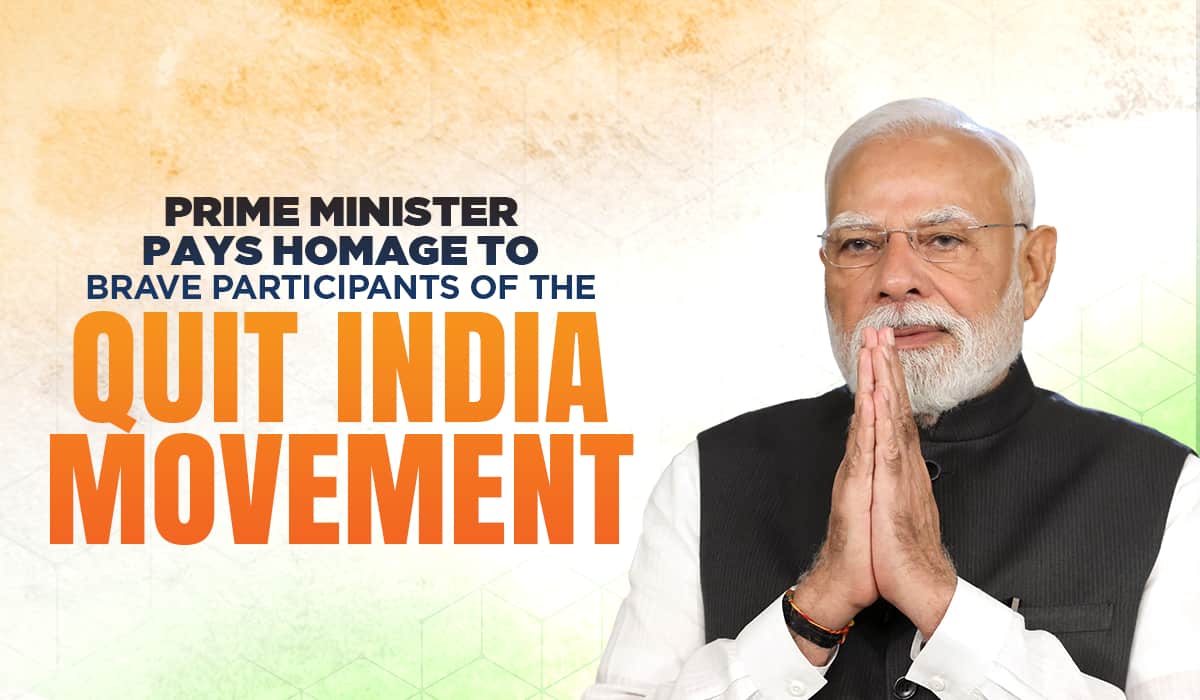
Swachh Bharat mission has benefited the poor and the women most: PM Modi

Published By : Admin | September 25, 2019 | 06:31 IST
PM Modi receives 'Global Goalkeeper Award' for the Swachh Bharat Abhiyan
In last five years a record more than 11 crore toilets were constructed: PM Modi
Swachh Bharat mission has benefited the poor and the women most: PM Modi

Mrs and Mr Gates,
Excellencies,
Friend,

I am extremely grateful to you all for this honour. This honour is not mine but for those crores of Indians who have not only proved the resolve of Swachh Bharat but have also applied it in their everyday lives. Receiving the award from the Bill and Melinda Gates Foundation is special to me for two other reasons. Firstly, the Foundation is working in remote areas of India as an important partner in the Swachh Bharat Mission. Secondly, the way Bill and Milinda Gates are now contributing to social life after achieving several successes in personal life, I see it with great appreciation.

Friends,

It is also very important for me personally to get this award on the 150 birth anniversary of Mahatma Gandhi. This is a proof that if 130 crore people resolve to accomplish any resolution, then one can overcome any challenge. I remember the kind of reaction that I received when I mentioned about Swachh Bharat five years ago. Even today people often taunt me. But when any work is done with a goal, with a purpose, and a commitment to one's work, then such things do not matter. What matters to me is the coming together of 130 crore Indians to make our country clean. What matters to me is to develop a vision among 130 crore Indians for cleanliness. Every effort made by those 130 crore Indians to make India clean matters to me. And so, I dedicate this honour to the Indians, who transformed the Swachh Bharat Mission into a mass movement; who began to make cleanliness a top priority in their daily lives. Today I want to mention about the old lady who sold her goats to build toilets in the village. Today I want to mention about those retired teachers who donated their full pension for the construction of toilets. Today I want to mention about a woman who even sold her Mangalsutra to build a toilet in the house.

Brothers and sisters,

Of late, such a campaign was not heard of and seen in any country. This campaign was started by our government, but the command was taken by the people themselves. As a result, in the last five years, over 11 crore toilets could be constructed in the country, which is a record. As a result, the percentage of ​​rural sanitation which was once less than 40 percent before 2014, is now almost reaching 100 per cent. Just imagine, less than 40 per cent in 70 years after independence and about 100 per cent in 5 years. But I believe that the success of Swachh Bharat Mission is beyond any figure. If this mission has provided the greatest benefit to any section of the society, then it is the poor of the country and the women of the country. For those who are a little well-off, it is normal to build two to three toilets in their homes. But those deprived of this facility knew the pain of not having a toilet very well. For women, daughters and sisters in particular, not having toilets was one of the greatest difficulties in their lives. It was against their dignity. From my personal experience I can say that despite being aware of the whole situation, there was no concern about the importance of constructing toilets in the house. Can you imagine that the women used to wait for the evening the entire day! Besides being prone to the diseases caused as a result of open defecation, this wait (for relieving themselves) pushed them further towards more diseases.

Due to lack of toilets, many girls had to drop out from schooling midway. Our daughters want to study, but the lack of toilets had forced them to drop out from school and sit at home. It was the responsibility of my government to pull away the poor women and daughters of the country from this situation, and we have done it with all our strength and honesty. Today, it is a matter of great satisfaction for me that the Swachh Bharat Mission has become a medium for the survival of millions. As per the report of the World Health Organization, there is a possibility of saving 3 lakh lives due to clean India. Similarly, UNICEF has estimated that every family living in the village who are constructing toilets in their homes is saving at least 50 thousand rupees. I have been told that as per a new report by Bill and Melinda Gates Foundation, the increase in Rural Sanitation in India has reduced the heart problem in children and also improved the Body Mass Index of women. Looking at all these advantages of cleanliness, Mahatma Gandhi had said that he considered cleanliness more important than independence. Today I am glad that Mahatma Gandhi's dream of cleanliness is now going to come true. Gandhiji used to say that an ideal village can be built only when it is completely clean. Today we are moving towards making the whole country ideal in terms of cleanliness, and not just the villages.

Brothers and sisters,

Since the inception of the United Nations, its main objective has been to improve people's lives. The Swachh Bharat Mission has not only made the lives of crores of people better, but has also protected their dignity and has also played an important role in achieving the goals of the United Nations.

I would like to remind you of another study of UNICEF. This report has revealed that the quality of ground water has improved in the last five years and I believe that Swachh Bharat Mission is also a major contributor to the same. The Swachh Bharat Mission has another impact that has not been very well discussed. More than 11 crore toilets built during this campaign has also opened a new door to economic activity at the village level. The raw material mobilized for the construction of toilets, and the women being given the major work of construction as heads has given new employment opportunities to the poor at the very grassroots level.

Friends,

The simple meaning of democracy is that people should remain at the center of the systems and schemes. A strong democracy is the one that makes policies keeping the needs of the people at the center. And when the expectations and needs of the people, as well as the policies and decisions of the government are on a single platform, then the people make the schemes successful. This power of democracy is also reflected in the Swachh Bharat Abhiyan. The success of Swachh Bharat Mission is also an example of bringing alive a system of the Constitution.

Friends,

India had seen only Constitutional Federalism for decades. Our government has tried to convert this into Cooperative Federalism and over a period we are now moving towards the path of Competitive-Cooperative Federalism. The way in which different states of India went ahead and participated in this campaign, made people aware, worked for the construction of toilets, is also commendable. During this campaign, the central government has made the states partners in every subject related to cleanliness. No stone was left unturned from training to funding. The states were helped in every way so that they could speed up the Swachh Bharat Abhiyan in their own way and fulfil the resolutions related to it. Today, I am glad that through the Swachhta Survekshan, there is a competition among the states to reach the top in the cleanliness rankings.

Friends & Excellencies,

I am also pleased with this contribution of India to the world because we have considered the world as our family. For thousands of years, we have been taught that the उदार चरितानाम तु वसुधैव कुटुम्बकम्। That is, for the down to earth person or for the golden-hearted person, the whole earth is a family. Therefore, India wants to play a strong role in the International Cooperation for Sanitation and Hygiene. We are ready to share our experience and expertise with other countries of the world. India is close to achieving its goal of cleanliness, at the same time India is also working at a rapid pace on other major missions. A campaign to promote Fitness and Preventive Healthcare is underway through Fit India Movement. By 2025, we have set the target for India to be free from TB and we are also moving rapidly towards Universal Immunization. With the National Nutrition Mission, India is also overcoming problems like anemia and stunting very fast. Our focus under the Jal Jivan Mission is on water conservation and recycling so that every Indian gets adequate and clean water.

And India has also launched a campaign to get rid of single-use plastic by 2022. Today, while I am talking to you, the work of collecting plastic waste is going on in many parts of India. Many such mass movements are going on in India today. I have full faith in the strength of 1.3 billion Indians. I am confident that like the Swachh Bharat Abhiyan, other missions will also be successful. With this expectation, I conclude my speech thanking all the friends of the Bill & Melinda Gates Foundation once again for this award, and also other friends present here today.

Thanks a lot!!!

Explore More
প্রধান মন্ত্রীনা শ্রী রাম জন্মভুমি মন্দির দ্বাজরোহন উৎসবতা পীখিবা ৱারোলগী মৈতৈলোন্দা হন্দোকপা

Popular Speeches

প্রধান মন্ত্রীনা শ্রী রাম জন্মভুমি মন্দির দ্বাজরোহন উৎসবতা পীখিবা ৱারোলগী মৈতৈলোন্দা হন্দোকপা
Govt directs faster processing of city gas projects, hikes commercial LPG allocation to ease supply stress

Media Coverage

Govt directs faster processing of city gas projects, hikes commercial LPG allocation to ease supply stress
NM on the go

Nm on the go

Always be the first to hear from the PM. Get the App Now!
...
Dialogue and diplomacy are the only solutions: PM Modi in Lok Sabha on West Asia conflict
March 23, 2026
The situation in West Asia is concerning at this time: PM
In the past two-three weeks, Mr. Jaishankar and Mr. Hardeep Puri have provided the necessary information to the House on this matter: PM
This crisis has been going on now for more than three weeks, It is having a very adverse impact on the global economy and on people's lives, the entire world is urging all parties for the earliest resolution of this crisis: PM
This region is important to us for yet another reason ,as nearly one crore Indians live and work in the Gulf countries: PM
Among the commercial ships that sail in these seas, the number of Indian crew members is also very high: PM
Due to these several reasons, India's concerns are naturally high, it is essential that a unanimous and united voice from India's Parliament on this crisis reaches the world: PM
India has extensive trade relations with countries at war and affected by war, The region where the war is taking place is also an important route for our trade with other countries of the world: PM
A large quantity of essential items such as crude oil, gas, and fertilizers come to India through the Strait of Hormuz, Since the war began, the movement of ships through the Strait of Hormuz has become highly challenging: PM
Despite this, our government has been trying to ensure that the supply of petrol, diesel and gas is not affected much and common families of the country face minimum inconvenience, This has been our focus: PM
India has always stood for peace in the interest of humanity, Dialogue and diplomacy are the only solutions to this problem: PM
Our efforts are aimed at reducing tensions and ending this conflict: PM
Putting anyone's life at risk in this war is not in the interest of humanity, India's efforts are to encourage all parties to reach a peaceful resolution as soon as possible: PM

Honourable Speaker,

I have come before this esteemed House to speak on the ongoing conflict in West Asia and the challenges it has posed for India. The situation in West Asia is deeply concerning. In the past two to three weeks, Shri Jaishankar ji and Shri Hardeep Puri ji have provided the House with necessary updates on this matter. Now that the crisis has lasted for more than three weeks, its adverse impact on the global economy and on people’s lives is evident. The entire world is urging all parties for a swift resolution to this crisis.

Honourable Speaker,

This war has created unexpected challenges for India as well as economic, national security related, and humanitarian. India has extensive trade relations with the countries at war and those affected by it. The region where the war is taking place is also a crucial route for our trade with other parts of the world. Most importantly, a significant portion of our crude oil and gas requirements is met by this region. For another reason too, this region is vital for us-nearly ten million Indians live and work in the Gulf countries. A large number of Indian crew members also serve on commercial ships sailing in these waters. For all these reasons, India’s concerns are naturally greater. Therefore, it is essential that from the Parliament of India, a united and unanimous voice goes out to the world regarding this crisis.

Honourable Speaker,

Since the war began, every Indian in the affected countries has been provided necessary assistance. I myself have spoken twice over the phone with the Presidents of most West Asian countries. All of them have assured full safety for Indians. Unfortunately, during this period, some people have lost their lives and some have been injured. In such difficult circumstances, their families are being given all possible support, and the injured are receiving the best possible medical treatment.

Honourable Speaker,

All our missions in the affected countries are continuously engaged in helping Indians. Whether they are workers or tourists, everyone is being given every possible assistance. Our missions are issuing regular advisories. Here in India and in other affected countries, 24/7 control rooms and emergency helplines have been set up. Through these, timely information is being provided to all those affected.

Honourable Speaker,

In times of crisis, the safety of Indians at home and abroad has been our highest priority. Since the war began, more than 375,000 Indians have safely returned to India. From Iran alone, nearly 1,000 Indians have returned safely, including more than 700 young students pursuing medical education. In Gulf countries, thousands of students study in Indian schools. The CBSE has cancelled the scheduled Class 10 and Class 12 examinations in all such schools. To ensure uninterrupted education for these children, CBSE is taking appropriate measures. This shows that the government is sensitive, vigilant, and ready to provide every possible assistance.

Honourable Speaker,

India imports large quantities of crude oil, gas, and fertilizers through the Strait of Hormuz. Since the war began, shipping through the Strait of Hormuz has become highly challenging. Despite this, our government has worked to ensure that the supply of petrol, diesel, and gas is not severely disrupted. Our focus has been to minimize difficulties for ordinary families. We all know that India imports 60% of its LPG requirements. Due to uncertainty in supply, the government has prioritized domestic use of LPG and is also increasing domestic production. Continuous efforts have been made to ensure smooth supply of petrol and diesel across the country.

Honourable Speaker,

In today’s circumstances, the steps taken over the past decade for energy security have become even more relevant. Over the last 11 years, India has diversified its energy imports. Earlier, crude oil, LNG, and LPG were imported from 27 countries. Today, India imports energy from 41 countries.

Honourable Speaker,

In the past decade, India has also prioritized crude oil storage for times of crisis. Today, India has a strategic petroleum reserve of more than 5.3 million metric tonnes, and work is underway to expand it to over 6.5 million metric tonnes. The reserves maintained by our oil companies are separate. In the past 11 years, our refining capacity has also increased significantly.

Honourable Speaker,

The government is in constant contact with suppliers from different countries. Efforts are being made to ensure supply of oil and gas from wherever possible. The Government of India is keeping a close watch on shipping routes in the Gulf and surrounding areas. Our aim is to ensure that ships carrying oil, gas, fertilizers, and other essential goods reach India safely. We are in continuous dialogue with all our global partners to keep our maritime corridors secure. As a result of these efforts, several of our ships stuck in the Strait of Hormuz have recently reached India safely.

Honourable Speaker,

At this time of crisis, another preparation of the country is proving very useful. In the past 10–11 years, unprecedented work has been done on ethanol production and blending. A decade ago, India had only about 1.5% ethanol blending capacity. Today, we are close to achieving 20% ethanol blending in petrol. This has reduced oil imports by about 45 million barrels annually. Similarly, railway electrification has brought huge benefits. Without such electrification, about 1.8 billion litres of additional diesel would have been required every year. We have also expanded the metro network. In 2014, India’s metro network was less than 250 kilometers; today it has grown to nearly 1,100 kilometers. We have strongly promoted electric mobility. The central government has provided states with 15,000 electric buses. At the scale at which work is being done on alternative fuels today, India’s future will be even more secure.

Honourable Speaker,

We know that energy is the backbone of the economy, and West Asia is a major source of meeting global energy needs. Naturally, the world economy is being affected by the current crisis, and continuous efforts are being made to ensure that India faces the least possible adverse impact. The government is working with a clear strategy for short-term, medium-term, and long-term effects. The fundamentals of India’s economy are strong, which has also helped the country greatly. We are holding discussions with stakeholders across every sector, and wherever necessary, support is being provided. The Government of India has also set up an inter-ministerial group, which meets daily to assess difficulties in imports and exports and works continuously on necessary solutions. I am confident that through the combined efforts of the government and industry, we will be able to face these circumstances more effectively.

Honourable Speaker,

A major question is what impact the war will have on agriculture. Our farmers have filled our food grain reserves, so India has sufficient food stocks. Our effort is also to ensure proper sowing for the Kharif season. In recent years, the government has made adequate arrangements for fertilizers to deal with emergencies. In the past too, our government ensured that global crises did not burden farmers. During the COVID period and wars at that time, global supply chains were disrupted. The price of a bag of urea in world markets had reached ₹3000, but Indian farmers were provided the same bag at less than ₹300.

Honourable Speaker,

To protect farmers from such crises, many steps have been taken in recent years. In the past decade, six urea plants have been started in the country, adding more than 7.6 million metric tonnes of annual production capacity. During this period, domestic production of fertilizers like DAP and NPKS has also increased by nearly 5 million metric tonnes. Not only this, fertilizer imports have also been diversified, just like oil and gas. For DAP and NPKS imports too, we have expanded our options.

Honourable Speaker,

The government has also given farmers the option of Made-in-India nano urea. Farmers are being encouraged towards natural farming. Under the PM-KUSUM scheme, more than 2.2 million solar pumps have been provided to farmers, reducing their dependence on diesel. Through this House, I assure the farmers of the country that the government will continue to provide every possible assistance.

Honourable Speaker,

Another major challenge of the war is that summer is beginning in India. With rising temperatures, electricity demand will increase in the coming months. At present, all power plants in the country have adequate coal stocks. India has set a record of producing 1 billion tonnes of coal for the second consecutive year. From power generation to power supply, all our systems are being continuously monitored, and renewable energy has also supported our preparedness. In the past decade, India has taken major steps towards renewable energy. Today, half of our total installed power generation capacity comes from renewable sources. Our total renewable capacity has crossed the historic mark of 250 gigawatts. In the past 11 years, solar power capacity has risen from about 3 gigawatts to 140 gigawatts. Nearly 4 million rooftop solar installations have been set up in recent years, with the PM Surya Ghar Free Electricity Scheme providing significant help. Under the GobarDhan scheme, 200 compressed biogas plants are already operational in the country. All these efforts are proving very useful today. The government has also promoted nuclear energy production through the Amrit Kaal Energy Transition initiatives. Just a few days ago, the Small Hydro Power Development Scheme was approved, which will add 1500 megawatts of new hydro capacity in the next few years.

Honourable Speaker,

As far as diplomacy is concerned, India’s role has been clear. From the beginning, we have expressed deep concern over this conflict. I myself have spoken with all relevant leaders in West Asia. I have urged them to reduce tensions and end the conflict. India has opposed attacks on civilians, energy, and transport-related infrastructure. Attacks on commercial ships and obstruction in international waterways like the Strait of Hormuz are unacceptable. Through diplomacy, India is continuously working to ensure safe passage for Indian ships even in this war environment.

Honourable Speaker,

India has always raised its voice for humanity and in favor of peace. I repeat again-dialogue and diplomacy are the only solutions to this problem. All our efforts are aimed at reducing tensions and ending this conflict. Any threat to human life in this war is against the interest of humanity. Therefore, India’s effort is to encourage all parties towards a peaceful resolution at the earliest.

Honourable Speaker,

In times of such crises, some elements also try to misuse the situation. Therefore, all law enforcement agencies have been kept on alert. Coastal security, border security, cyber security, and protection of strategic installations are all being strengthened.

Honourable Speaker,

This war has created difficult global conditions that may persist for a long time. Hence, we must remain prepared and united. We faced similar challenges during the COVID crisis with unity. Now again, we must prepare in the same way. With patience, restraint, and calmness, we must face every challenge-that is our identity, that is our strength. At the same time, we must remain vigilant and cautious. Those who try to exploit the situation will attempt to spread falsehoods, but we must not let them succeed. Through this House, I also urge all state governments that during such times, black-marketeers and hoarders become active. Strict monitoring is necessary, and wherever such complaints arise, immediate action must be taken. When every government and every citizen of the country works together, we can challenge any challenge. With this appeal, I conclude my statement.

Thank you very much.