PM Modi addresses public meeting in Doda, Jammu & Kashmir

Published By : Admin | September 14, 2024 | 12:30 IST
Congress is most dishonest & deceitful party in India: PM Modi in Doda
Royal family of Congress is most corrupt family in India: PM Modi in Doda
Congress can’t think beyond showing hatred: PM Modi in Doda
Dynastic politicians here didn’t want youth to rise in politics: PM Modi in Doda
BJP has consistently worked to uplift youth & underprivileged: PM Modi in Doda

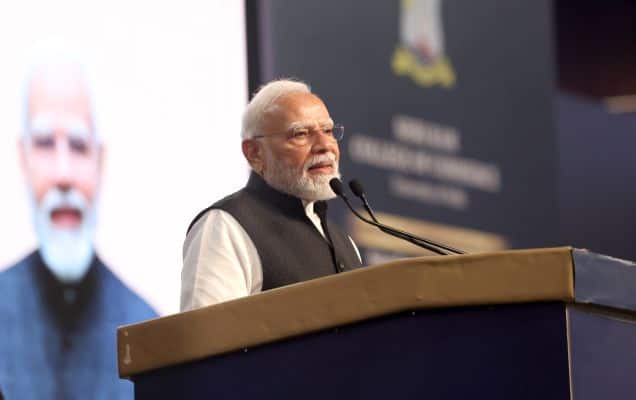
Prime Minister Narendra Modi addressed a public meeting in Doda, Jammu & Kashmir. He began his address by emphasizing his commitment to fostering a safe, prosperous, and terror-free Jammu and Kashmir.

PM Modi expressed his gratitude towards the large gathering, particularly acknowledging the significant presence of women. “I see, so many of our sisters and daughters have come here in large numbers to bless us,” he said. “I will repay your love by working twice or even three times harder.” He assured the people of his firm dedication to building a secure and thriving future for the region, stating, “Together, we will build a safe and prosperous Jammu and Kashmir. And that’s Modi’s guarantee.”

PM Modi highlighted the transformation of Jammu and Kashmir's political landscape under his government, emphasizing the decentralization of power through Panchayat, Block Development Council, and District Development Council elections. He remarked that dynasty politics had long prevented the youth of Jammu and Kashmir from rising in the political arena, but now, for the first time, elections were held to empower grassroots democracy.

"The dynastic politicians here didn’t want the youth to rise in politics. We challenged the intentions of these dynasty-driven forces. After local body elections, 30,000 to 35,000 young people entered politics. The credit for the new wave of development in Jammu and Kashmir over the past few years goes to these young leaders," PM Modi said.

PM Modi highlighted the significant strides made in the past few years, with the establishment of new schools, medical colleges, AIIMS, and IITs in the region. He emphasized that these efforts are aimed at ensuring that every child in Jammu and Kashmir has access to quality education, saying, “I care about your children, I care about you. I want every child here to advance and thrive.”

PM Modi underscored the significance of the upcoming Assembly elections, which he portrayed as a choice between three political dynasties, Congress, National Conference, and PDP, and the aspirations of Jammu and Kashmir's youth. He mentioned the BJP as the party that opposes these dynasties and has consistently worked to uplift the youth and underprivileged.

Focusing on infrastructure development, PM Modi highlighted the extensive efforts to improve regional connectivity. He recalled the challenges people once faced while traveling from Jammu to Ramban and Banihal, journeys that used to take 6-8 hours but have now been reduced to 3-5 hours due to the development of new roads, tunnels, and flyovers. He also expressed confidence that Jammu and Kashmir would soon be fully integrated into the national railway network, with the completion of the Delhi-Srinagar rail link via Ramban.

He further emphasized that the ‘Chenab Valley’ once engulfed in the darkness of terrorism, is now witnessing a resurgence. He remarked that the transformation of Jammu and Kashmir in the past decade is nothing short of a dream. Referring to the youth, he said, “The stones that were once picked up to hurl at police and army are now building a new Jammu and Kashmir. And who made this happen? It wasn’t Modi, it was the people of Jammu and Kashmir.”

Highlighting the importance of agriculture, PM Modi referred to the ‘Purple Revolution,’ which has transformed the lives of small farmers in the region through lavender farming. He assured the people that, under the BJP, everyone in Jammu and Kashmir, regardless of their religion, faith, or class, would have their rights protected. He expressed the BJP’s commitment to restoring Jammu and Kashmir’s status as a full state while cautioning against political forces that he claimed had historically deprived the region of its rights.

PM Modi also emphasized his government’s focus on social justice and inclusive development. He criticized previous regimes for their failure to provide reservations to marginalized groups like the ‘Pahari community,’ and credited the BJP government for introducing these long-awaited changes. “Why were the Pahari brothers and sisters denied reservation for so many years?” he asked and pointed out that his government has worked to ensure the rights of SC/ST/OBCs in the region.

Taking a sharp jibe at Congress, PM Modi said, “I’m telling you that Congress is the most dishonest and deceitful party in India. The royal family of Congress is the most corrupt in India. You must beware of them. These are people who use dishonest tactics, leveraging the government treasury to win elections. They put the public in trouble. They don’t contest elections based on their policies... When I was warning the nation and cautioning against their dangerous intentions. All these people were mocking me, insulting me. And today, the whole country can see. How, in such a short time, major disasters have unfolded in Congress-ruled states.”

“If they had a positive vision, they would have said if they win, they’ll do it for Jammu and Kashmir, for the country. But they can’t think beyond showing hatred. Jammu has also been a victim of their hatred. Congress and the National Conference have always discriminated against Jammu,” he added.

Talking about a shocking event with an Indian journalist in America, PM Modi said, “Congress talks about Constitution and wanders holding ‘Nafrat ki Dukan’ in the name of ‘Mohabbat ki Dukan’. Today I read in a newspaper, how an Indian journalist was tortured in America. He happened to be a journalist, who works to protect India’s constitution, and the way he was treated, doesn’t represent an act depicting a democracy in any way.”

PM Modi in his concluding remarks urged the people of Jammu and Kashmir to be cautious of those who have historically undermined their rights. He assured them that the BJP’s vision for Jammu and Kashmir is one of peace, development, and empowerment, reiterating that his government has consistently delivered on its promises. PM Modi asked the people to come out in large numbers to vote for BJP candidates in the upcoming elections, expressing confidence that this time, they would break all previous voting records.

Click here to read full text speech

Explore More
প্রধান মন্ত্রীনা শ্রী রাম জন্মভুমি মন্দির দ্বাজরোহন উৎসবতা পীখিবা ৱারোলগী মৈতৈলোন্দা হন্দোকপা

Popular Speeches

প্রধান মন্ত্রীনা শ্রী রাম জন্মভুমি মন্দির দ্বাজরোহন উৎসবতা পীখিবা ৱারোলগী মৈতৈলোন্দা হন্দোকপা
India's electronics production rises 6-fold, exports jump 8-fold since 2014: Ashwini Vaishnaw

Media Coverage

India's electronics production rises 6-fold, exports jump 8-fold since 2014: Ashwini Vaishnaw
NM on the go

Nm on the go

Always be the first to hear from the PM. Get the App Now!
...
PM chairs Fifth National Conference of Chief Secretaries in Delhi
December 28, 2025
Viksit Bharat is synonymous with quality and excellence in governance, delivery and manufacturing: PM
PM says India has boarded the ‘Reform Express’, powered by the strength of its youth
PM highlights that India's demographic advantage can significantly accelerate the journey towards Viksit Bharat
‘Made in India’ must become a symbol of global excellence and competitiveness: PM
PM emphasises the need to strengthen Aatmanirbharta and strengthen our commitment to 'Zero Effect, Zero Defect’
PM suggests identifying 100 products for domestic manufacturing to reduce import dependence and strengthen economic resilience
PM urges every State must to give top priority to soon to be launched National Manufacturing Mission
PM calls upon states to encourage manufacturing, boost ‘Ease of Doing Business’ and make India a Global Services Giant
PM emphasises on shifting to high value agriculture to make India the food basket of the world
PM directs States to prepare roadmap for creating a global level tourism destination

Prime Minister Narendra Modi addressed the 5th National Conference of Chief Secretaries in Delhi, earlier today. The three-day Conference was held in Pusa, Delhi from 26 to 28 December, 2025.

Prime Minister observed that this conference marks another decisive step in strengthening the spirit of cooperative federalism and deepening Centre-State partnership to achieve the vision of Viksit Bharat.

Prime Minister emphasised that Human Capital comprising knowledge, skills, health and capabilities is the fundamental driver of economic growth and social progress and must be developed through a coordinated Whole-of-Government approach.

The Conference included discussions around the overarching theme of ‘Human Capital for Viksit Bharat’. Highlighting India's demographic advantage, the Prime Minister stated that nearly 70 percent of the population is in the working-age group, creating a unique historical opportunity which, when combined with economic progress, can significantly accelerate India's journey towards Viksit Bharat.

Prime Minister said that India has boarded the “Reform Express”, driven primarily by the strength of its young population, and empowering this demographic remains the government’s key priority. Prime Minister noted that the Conference is being held at a time when the country is witnessing next-generation reforms and moving steadily towards becoming a major global economic power.

He further observed that Viksit Bharat is synonymous with quality and excellence and urged all stakeholders to move beyond average outcomes. Emphasising quality in governance, service delivery and manufacturing, the Prime Minister stated that the label "Made in India' must become a symbol of excellence and global competitiveness.

Prime Minister emphasised the need to strengthen Aatmanirbharta, stating that India must pursue self-reliance with zero defect in products and minimal environmental impact, making the label 'Made in India' synonymous with quality and strengthen our commitment to 'Zero Effect, Zero Defect.’ He urged the Centre and States to jointly identify 100 products for domestic manufacturing to reduce import dependence and strengthen economic resilience in line with the vision of Viksit Bharat.

Prime Minister emphasised the need to map skill demand at the State and global levels to better design skill development strategies. In higher education too, he suggested that there is a need for academia and industry to work together to create high quality talent.

For livelihoods of youth, Prime Minister observed that tourism can play a huge role. He highlighted that India has a rich heritage and history with a potential to be among the top global tourist destinations. He urged the States to prepare a roadmap for creating at least one global level tourist destination and nourishing an entire tourist ecosystem.

PM Modi said that it is important to align the Indian national sports calendar with the global sports calendar. India is working to host the 2036 Olympics. India needs to prepare infrastructure and sports ecosystem at par with global standards. He observed that young kids should be identified, nurtured and trained to compete at that time. He urged the States that the next 10 years must be invested in them, only then will India get desired results in such sports events. Organising and promoting sports events and tournaments at local and district level and keeping data of players will create a vibrant sports environment.

PM Modi said that soon India would be launching the National Manufacturing Mission (NMM). Every State must give this top priority and create infrastructure to attract global companies. He further said that it included Ease of Doing Business, especially with respect to land, utilities and social infrastructure. He also called upon states to encourage manufacturing, boost ‘Ease of Doing Business’ and strengthen the services sector. In the services sector, PM Modi said that there should be greater emphasis on other areas like Healthcare, education, transport, tourism, professional services, AI, etc. to make India a Global Services Giant.

Prime Minister also emphasized that as India aspires to be the food basket of the world, we need to shift to high value agriculture, dairy, fisheries, with a focus on exports. He pointed out that the PM Dhan Dhanya Scheme has identified 100 districts with lower productivity. Similarly, in learning outcomes States must identify the lowest 100 districts and must work on addressing the issues around the low indicators.

PM also urged the States to use Gyan Bharatam Mission for digitization of manuscripts. He said that States may start a Abhiyan to digitize such manuscripts available in States. Once these manuscripts are digitized, Al can be used for synthesizing the wisdom and knowledge available.

Prime Minister noted that the Conference reflects India’s tradition of collective thinking and constructive policy dialogue, and that the Chief Secretaries Conference, institutionalised by the Government of India, has become an effective platform for collective deliberation.

Prime Minister emphasised that States should work in tandem with the discussions and decisions emerging from both the Chief Secretaries and the DGPs Conferences to strengthen governance and implementation.

Prime Minister suggested that similar conferences could be replicated at the departmental level to promote a national perspective among officers and improve governance outcomes in pursuit of Viksit Bharat.

Prime Minister also said that all States and UTs must prepare capacity building plan along with the Capacity Building Commission. He said that use of Al in governance and awareness on cyber security is need of the hour. States and Centre have to put emphasis on cyber security for the security of every citizen.

Prime Minister said that the technology can provide secure and stable solutions through our entire life cycle. There is a need to utilise technology to bring about quality in governance.

In the conclusion, Prime Minister said that every State must create 10-year actionable plans based on the discussions of this Conference with 1, 2, 5 and 10 year target timelines wherein technology can be utilised for regular monitoring.

The three-day Conference emphasised on special themes which included Early Childhood Education; Schooling; Skilling; Higher Education; and Sports and Extracurricular Activities recognising their role in building a resilient, inclusive and future-ready workforce.

Discussion during the Conference

The discussions during the Conference reflected the spirit of Team India, where the Centre and States came together with a shared commitment to transform ideas into action. The deliberations emphasised the importance of ensuring time-bound implementation of agreed outcomes so that the vision of Viksit Bharat translates into tangible improvements in citizens’ lives. The sessions provided a comprehensive assessment of the current situation, key challenges and possible solutions across priority areas related to human capital development.

The Conference also facilitated focused deliberations over meals on Heritage & Manuscript Preservation and Digitisation; and Ayush for All with emphasis on integrating knowledge in primary healthcare delivery.

The deliberations also emphasised the importance of effective delivery, citizen-centric governance and outcome-oriented implementation to ensure that development initiatives translate into measurable on-ground impact. The discussions highlighted the need to strengthen institutional capacity, improve inter-departmental coordination and adopt data-driven monitoring frameworks to enhance service delivery. Focus was placed on simplifying processes, leveraging technology and ensuring last-mile reach so that benefits of development reach every citizen in a timely, transparent and inclusive manner, in alignment with the vision of Viksit Bharat.

The Conference featured a series of special sessions that enabled focused deliberations on cross-cutting and emerging priorities. These sessions examined policy pathways and best practices on Deregulation in States, Technology in Governance: Opportunities, Risks & Mitigation; AgriStack for Smart Supply Chain & Market Linkages; One State, One World Class Tourist Destination; Aatmanirbhar Bharat & Swadeshi; and Plans for a post-Left Wing Extremism future. The discussions highlighted the importance of cooperative federalism, replication of successful State-level initiatives and time-bound implementation to translate deliberations into measurable outcomes.

The Conference was attended by Chief Secretaries, senior officials of all States/Union Territories, domain experts and senior officers in the centre.