



| S. No. | Title | Brief description |
|---|---|---|
|
1 |
Joint Declaration on Defense and Security Cooperation (JDDSC) |
Renews the existing Joint Declaration on Security (2009). It identifies interoperability of forces, capacity building, maritime domain, defense industrial collaboration, cyber security and technology, counter terrorism, HADR, and unified approach in UNCLOS, ASEAN, PIF, IORA, as areas of cooperation. |
|
2 |
Maritime Security Collaboration Roadmap (MSCR) |
Enhances maritime security cooperation by promoting information sharing, and capability development, and operational coordination. |
|
3 |
India-Australia Joint Statement on Energy Security |
Reaffirms the commitment of both countries to energy security in the face of geopolitical tensions. |
|
4 |
Finalisation of Administrative Arrangement of the India-Australia Civil Nuclear Agreement |
Operationalises the India-Australia Civil Nuclear Agreement signed in 2014, and enables supply of uranium from Australia to India. |
|
5 |
Australia-India Partnership for Cyber, Critical Technologies, Supply Chains (PACTS) |
Builds on the 2020 Framework Arrangement on Cyber and Cyber Enabled Critical Technology Cooperation. Aims to support national and regional security, promote collaboration to make critical supply chains more resilient, and strengthen collaboration in critical technologies, cyber security, and digital resilience. |
|
6 |
MoU between Indian Coast Guard (ICG) and Maritime Border Command (MBC) of Australia |
Establishes cooperation in the field of Maritime Law Enforcement, domain awareness, and maritime border protection between ICG and MBC |
|
7 |
Australian invite for an Indian military instructor in Australian Defense College for 2028-29 |
Announces the deployment of an Indian military instructor in Australian Defense College in 2028-29 |
|
8 |
MoU between Ministry of Skill Development and Entrepreneurship (MSDE),and Technical and Further Education (TAFE), Government of Western Australia to set up a Centre of Excellence in Mining and Mining Equipment, Technology and Services (METS |
Sets up a Centre of Excellence in Mining Equipment, Technology and Services at National Skill Training Institute (NSTI), Bhubaneswar to develop a Centre of academic excellence in sub-domains of mining operations, mine safety, mineral processing, mine machinery, etc. It will enable exchange of students/trainees between National Centre for Excellence and TAFE, Western Australia. |
|
9 |
Handing over Letter of Intent (LoI) to Flinders’ University for setting up its campus in India (Bengaluru) |
Enables setting up of the campus of Flinders University in Bengaluru. |
|
10 |
Signing of Letter of Intent (LoI) between National Council for Vocational Education and Training (NCVET) and Australian Skills Quality Authority (ASQA) |
Acknowledges the importance of quality assurance in Technical and Vocational Education and Training (TVET). It will strengthen regulatory frameworks in vocational training systems, co-development and alignment of occupational standards in priority sectors, and enable capacity building of officials, staff exchanges, joint workshops/research activities. |
|
11 |
Repatriation of Indian artifacts |
Brings back 3 Indian antiquities: a. The sacred bull Nandi, vehicle of Shiva [Description: Tamil Nadu, India, 11th to 12th century Granite] |
|
12 |
Operationalisation the Rooftop Solar Training Academy |
Established and operationalised in the Pandit Deendayal Energy University, Gandhinagar in collaboration by Department of Climate Change, Environment and Water (DCEEW), India’s Sector Skills Council for Green Jobs (SSCGJ), ReNEW. Aims to train 2000 women and youth as solar technicians/installers/helpers. Supports the PM Surya Ghar Yojana launched by Hon PM in January 2024, and India’s green energy journey |
|
13 |
MoU under Australia-Canada-India Technology and Innovation (ACITI) Partnership |
Aims to advance trilateral cooperation in emerging technologies and innovation, under the Australia–Canada–India Technology and Innovation (ACITI) Partnership |
|
14 |
MoU between GeoScience Australia (GA) and Geological Survey of India (GSI) |
Builds on the MoU on Scientific and Technical Cooperation signed in 2015. Aimed at adoption of advanced exploration methodologies, capacity building and skill development, and enable technological upgradation and modernization of GSI infrastructure. |
|
15 |
Traditional Knowledge Digital Library access agreement between Council of Scientific & Industrial Research (CSIR) and IP Australia |
Provides access of the Traditional Knowledge Digital Library (TKDL) database to IP Australia. |
|
16 |
MoU between Council of Scientific and Industrial Research (CSIR) and University of Melbourne |
Establishes linkages between both institutions for future collaboration including collaborative research programs towards drug target identification, trainee programs, and faculty exchange Programs |
|
17 |
MoU between Satyajit Ray Film and Television Institute (SRFTI), Kolkata with Griffith Film School, South Brisbane, Australia. |
Establish flexible and open-ended framework for collaboration including joint academic activities and workshops, development of joint projects in cinema and allied fields, and collaboration on short-term workshops, or summer schools. |
|
18 |
Handing over of Letter of Approval to Victoria University |
Permits the Victoria University to set up and operate its campus in Gurugram. |
Published By : Admin |
July 9, 2026 | 12:34 IST
-
Share
-

-

-


- Tags

- Australia
- Modi in Australia
- Anthony Albanese
- India First
- Defence
- Security
- Cyber Security
- Technology
- Capacity Building
- Maritime Sector
- Terrorism
- ASEAN
- Development
- Energy
- Civil Nuclear Energy
- Global Supply Chains
- Indian Coast Guard
- Indian Military
- Skill Development
- Education
- NCVET
- Innovation
- Satyajit Ray
- Kolkata
Login or Register to add your comment
Explore More

Popular Speeches
Today, the entire country and entire world is filled with the spirit of Bhagwan Shri Ram: PM Modi at Dhwajarohan Utsav in Ayodhya
Media Coverage
From 'chalta hai' to 'badal sakta hai': Decoding PM Modi's Punctuality narrative

Nm on the go
Always be the first to hear from the PM. Get the App Now!

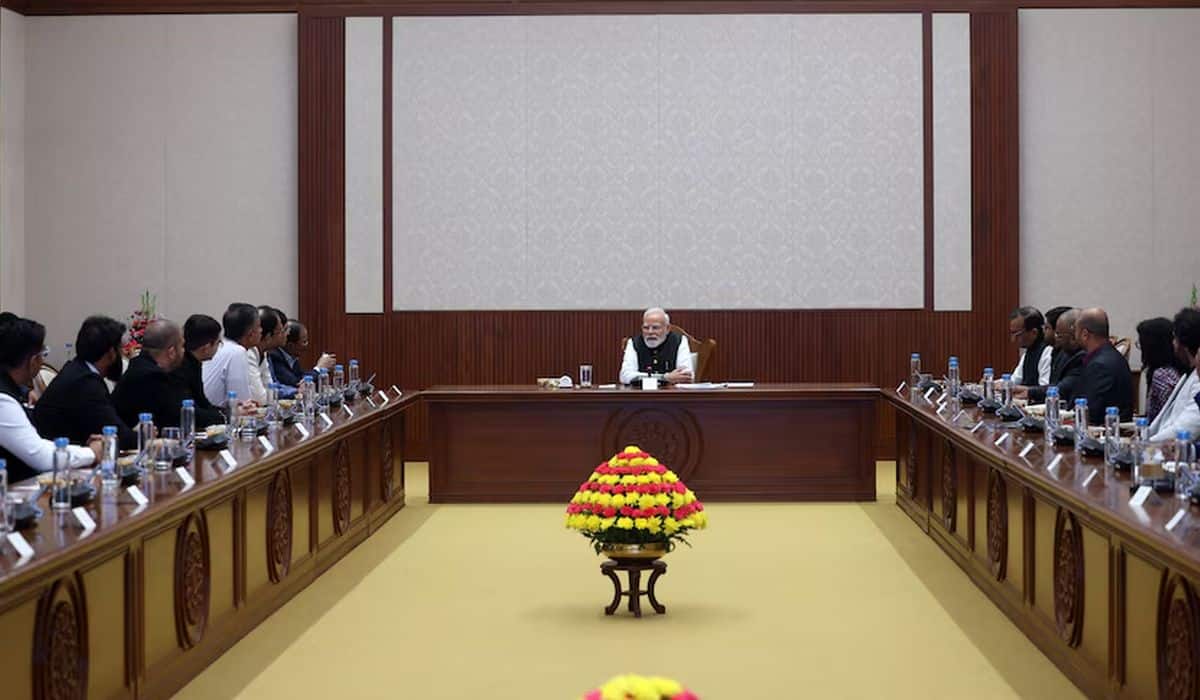
The world must now be looking for Indian startups: PM Modi during the interaction with Space Startup CEOs
August 23, 2026
-
Share
-
-
-
Prime Minister highlights policy consistency, global opportunities and India’s growing strengths in the space sector
We should create an aura that makes people across the world look to India to build their future: PM
We can establish ourselves very fast as we are highly competitive in terms of cost; our talent and the risk-taking capacity of our people is also very high: PM
Prime Minister – You have shown courage in a new field. The most important thing is that you trusted the government’s word. My view has always been that whatever decisions we take, we must remain consistent in them, we must not keep changing them again and again, so that anyone who wants to take a risk can have confidence that, fine, if something goes wrong it will be because of my mistake, but no one will abandon me. And this was our effort - to create that trust.
CEO – We are India’s first Space Tech Unicorn. On July 18 we successfully launched India’s first private rocket, ejecting satellites. And this is just the beginning. Generally, we say this is just a warm‑up for Skyroot, it is only the start. By mid next year we will be doing one launch per month. And also, thanks to you sir for opening up the sector. Three factories have already been built. We already have the capacity for one rocket per month. And this is just the beginning. Our future dream is to do one launch per week and several launches per day.
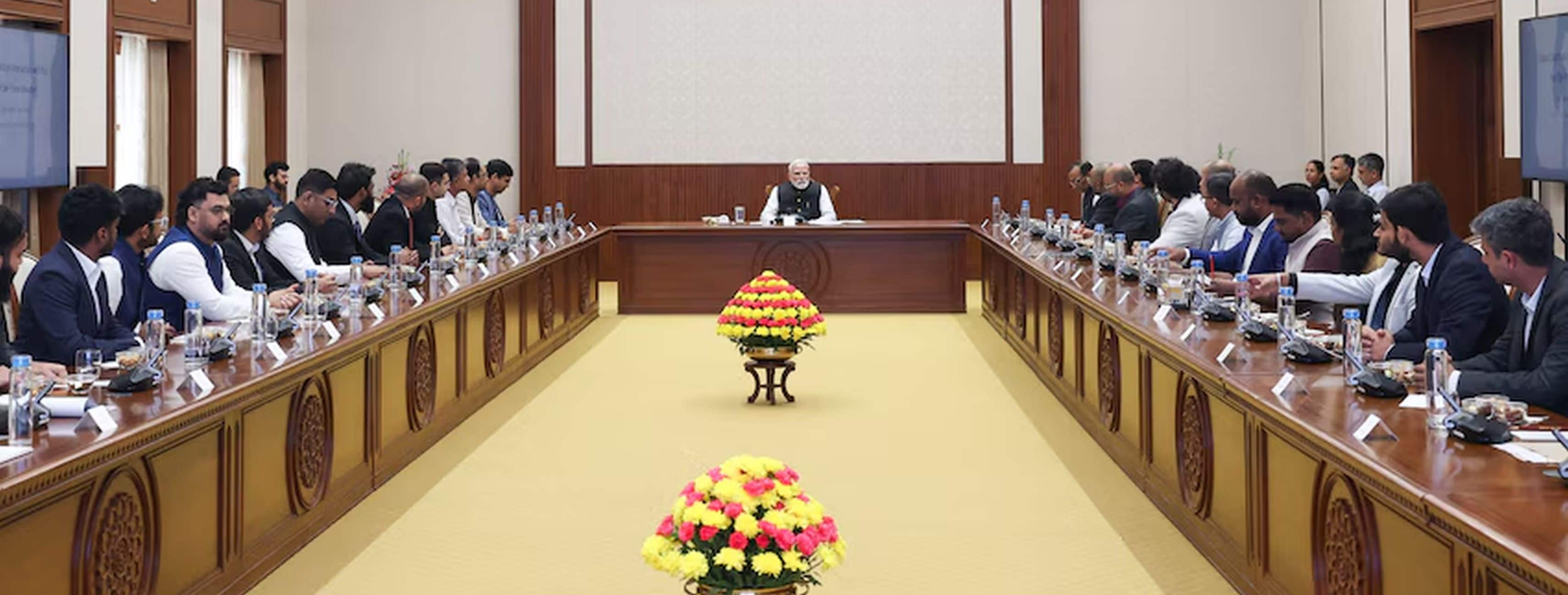
CEO – We have made an engine that comes among the most modern engines in the world. Sir, we have prepared it, and its testing is ongoing.
Prime Minister – Do they have confidence, the investors?
CEO – Sir, after Skyroot’s first launch, their confidence has increased.
Prime Minister – Good. That route is helping you?
CEO – It is helping a lot.
Prime Minister – Now the world must be searching for India’s startups, wondering who is behind this. Because when there is a breakthrough, immediately people’s attention goes there.
CEO – I think, after the space industry opened up, we have seen a very good trend. Our citizens who are in the US and Europe want to come back and work with us.
Prime Minister – We have to connect many people, and as Mehta said, now people who had gone abroad are coming back. I believe we must create such an aura that people all over the world feel that if they want to build their life, they should come to Hindustan. Join some Indian startup. Join some Indian space agency. I firmly believe that the entire talent pool, like a magnet, because of you we can attract, and that can become a very great strength for us.
CEO – Our vision is that in the next 18 months we want to set up a global ground station network.
CEO – We make the engines that satellites use to move from one place to another in space, for 5 years or 15 years. Globally we have received very good traction. And sir, your effort has been very important in this too, because now Indian companies have government support for exporting.
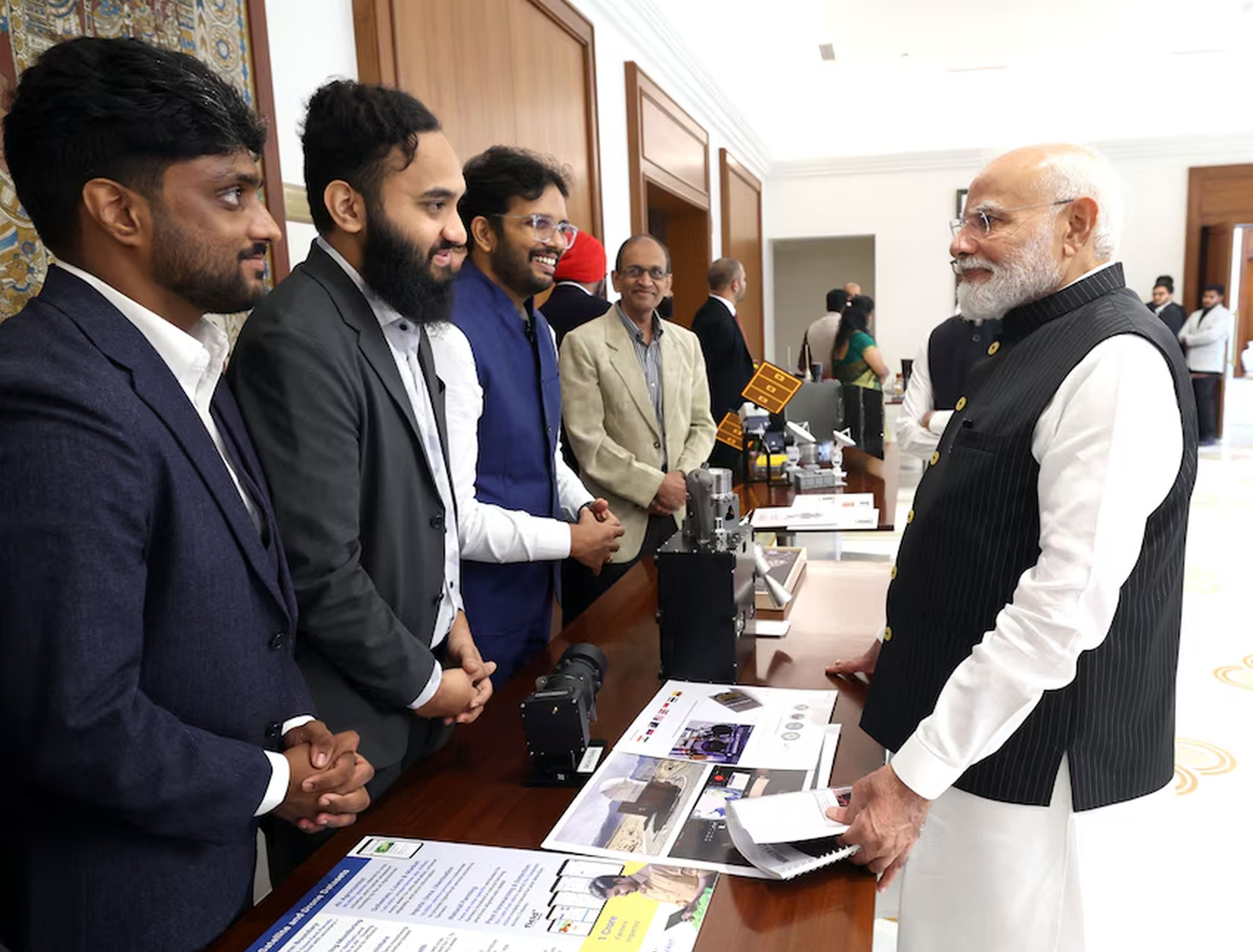
Prime Minister – In cost we are very competitive, in talent there is no question at all, and the risk‑taking capacity of our people is anyway greater. And because of that we can very quickly make our place.
CEO – This robotic spacecraft will go to space, physically capture the dead satellite and remove it from orbit.
CEO – We are the first Indian company working on docking and refueling technologies, with the vision of establishing a fuel station in space.
CEO – My name is Antariksh, my co‑founder Monika is also here. Sir, we are India’s first space pharma startup. We are making satellites that can go to space, manufacture pharmaceuticals there, and bring them back from space.
Prime Minister – Your name is Antariksh - was your family already in this field?
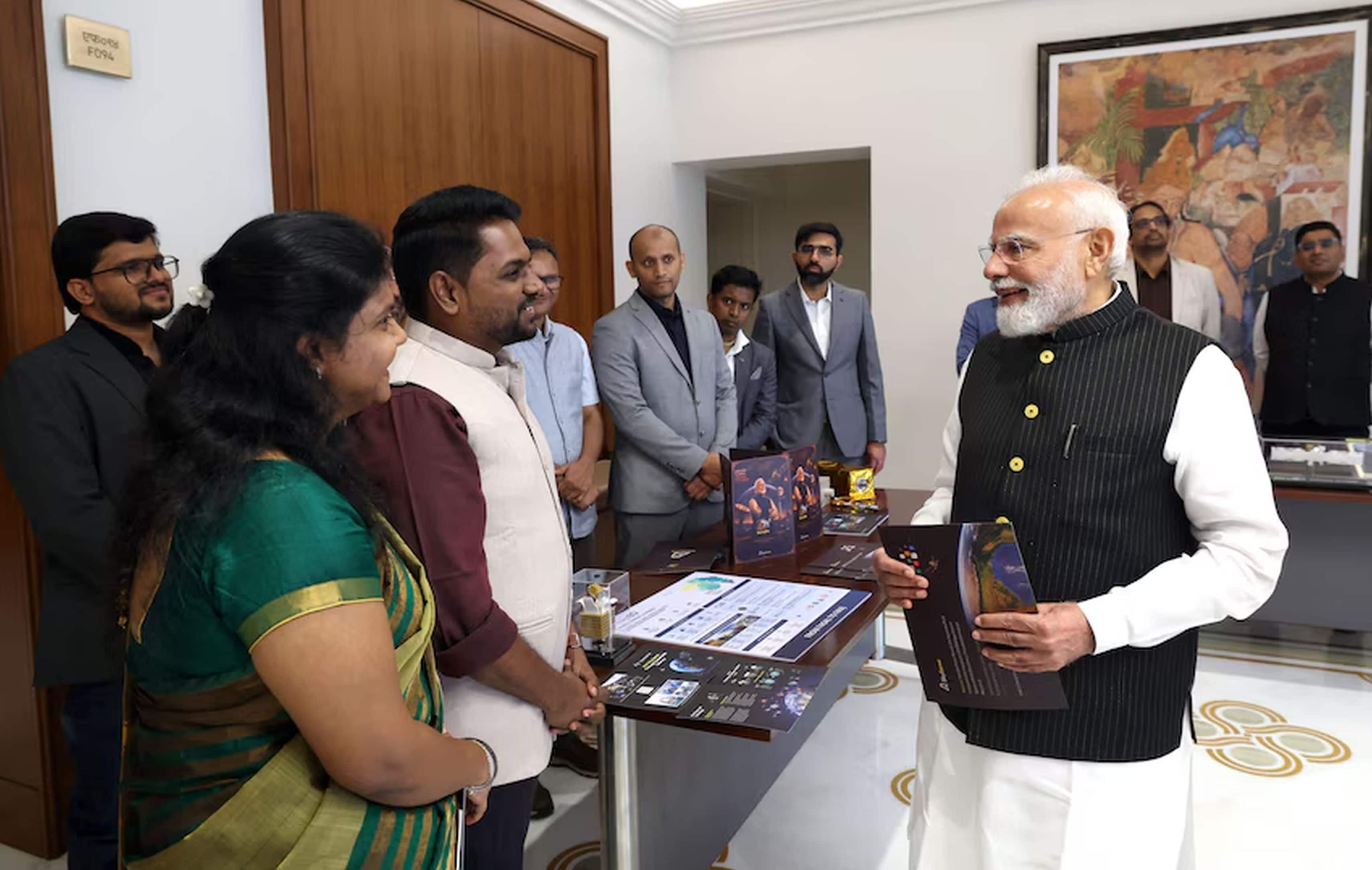
CEO – No sir, my mother gave me this name.
CEO – After one launch, in the last one month we have received eight launch contracts.
Prime Minister – Good, good.
CEO – And mostly they are international.
CEO – Sir, right now we are planned to launch this innovation with 1 million farmers.
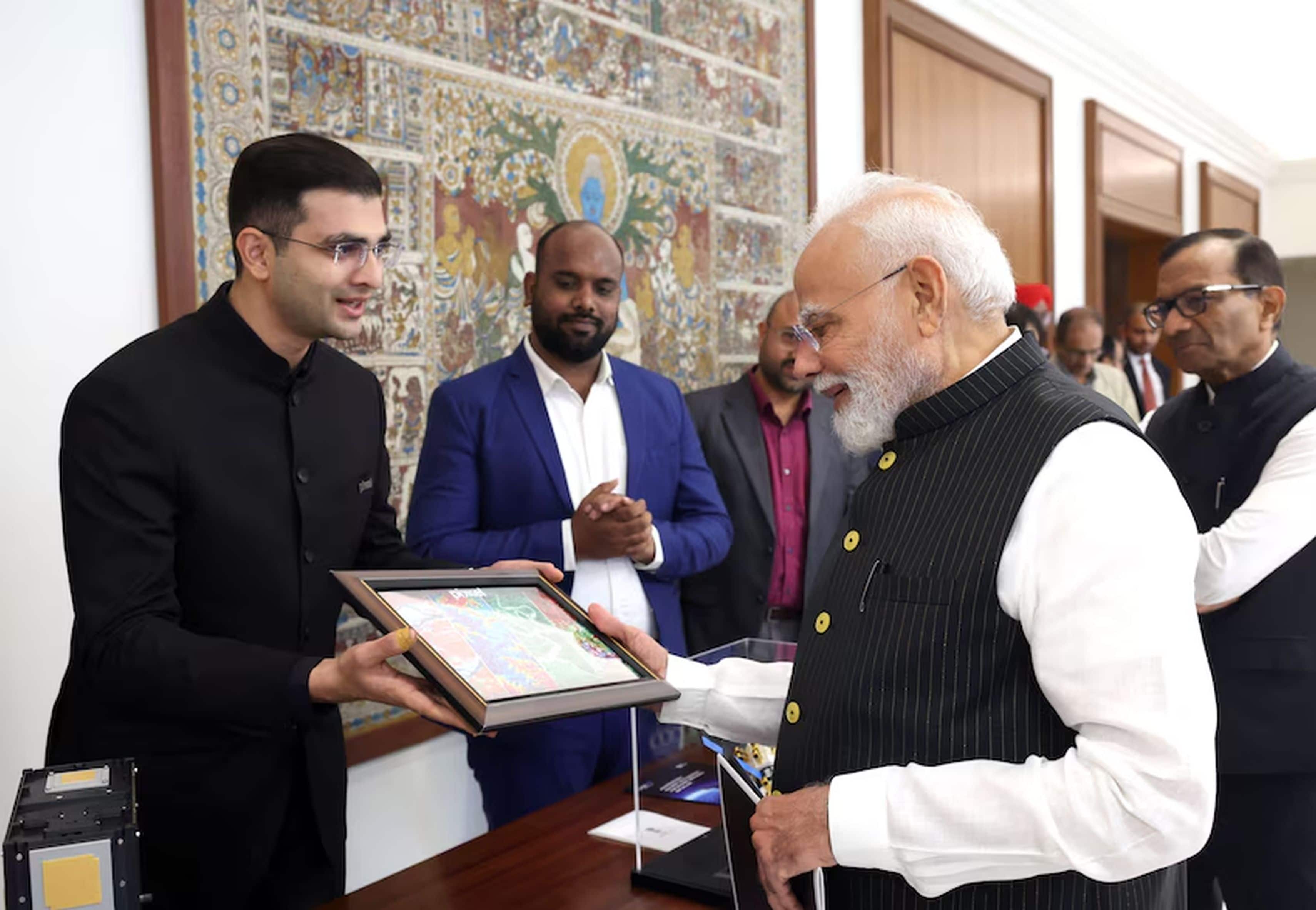
CEO – Sir, this is for you, so that a memory will remain.
Prime Minister – Wonderful.
CEO – This opening, which you did for the private sector, through that the private satellites are now showing the beauty of India.


Posted via www.narendramodi.in