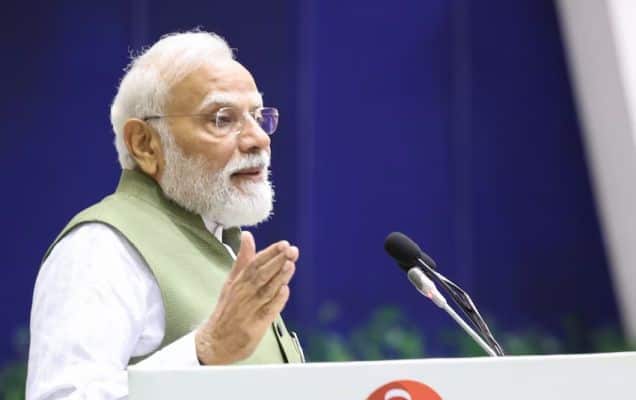
Gujarat’s Chief Minister Shri Vijay Rupaniji, Deputy Chief Minister Shri Nitin Patelji, ministers in Gujarat government, parliamentarians and my dear brothers and sisters. How are you the people of Kutch? There is also corona over and above winters. So take good care of yourself. I am doubly delighted by coming here because Kutch has always remained close to my heart and secondly, today Kutch has added one more star and carved a name for itself not only in Gujarat but in the country as well.
Friends,
Today is also the death anniversary of Sardar Vallabhbhai Patelji, the great son of Gujarat and the country. Sardar Saheb's dream of rejuvenating Gujarat from the water of Mother Narmada is being fulfilled rapidly. His statue in Kevadia, the tallest in the world, inspires us to work together day and night for the country. Remembering Sardar Saheb, we need to heighten the pride of the country and Gujarat.
Friends,
Today, new energy is also pervading Kutch. Think of the world's largest Hybrid Renewable Energy Park in Kutch. And how big is it? It is as big as Singapore or Bahrain. The Renewable Energy Park in Kutch will be almost as large as that area. Now you can guess how massive it is going to be. The Renewable Energy Park in Kutch will be spread over 70,000 hectares, i.e., bigger than several Indian cities. It sounds so good. Don’t the people of Kutch feel the same way? One feels so proud.
Friends,
Today, Kutch has taken an important step in the twin directions of New Age Technology and New Age Economy. The foundation laying of Renewable Energy Park in Khavda, desalination plant in Mandvi and the new automatic plant at Sarhad Dairy in Anjar is going to create new milestones in the development journey of Kutch. The benefit of these projects would accrue to my farmers, cattle ranchers and common people, and specially our mothers and sisters of the region.

Friends,
Several old memories come to my mind when I talk about the development of Kutch. At one point of time, it was being said that Kutch is so far away, there is no trace of development and there is no connectivity. Electricity-water-roads were a kind of synonym to challenges. Same was the feeling in the government that Kutch is a place for punishment posting and people also considered it as “Kala Pani” punishment. Such is the situation today that people beg to work in Kutch. Earlier, some people would often say that no development was possible in this region. And then the tragedy of the earthquake struck in Kutch. Whatever was left was destroyed by the earthquake. But, on the one hand, was the blessing of Mata Ashapura Devi and Koteshwar Mahadev and, on the other, was the courage, efforts and will-power of the people. In just a few years, people of the region did a turnaround which nobody could imagine. The people of the Kutch turned despair into hope. I think this is the blessing of Mata Ashapura Devi. There is no despair. Instead, there is hope all around. The earthquake might have flattened their homes, but such a massive earthquake could not dampen the morale of the people of Kutch. My brothers and sisters of Kutch again stood up. And see, where they have taken this region to.
Friends,
The identity of Kutch has changed today. Today, the glory of Kutch is growing rapidly. Today, Kutch has become one of the fastest growing regions of the country. The connectivity here is getting better day by day. Earlier there used to be a continuous exodus in this border area and the population also recorded negative growth. Elsewhere, the population was increasing and here it was on the decline, because most of the people in the border areas used to migrate. As a result, there was naturally a problem of security. Now that the migration has come to a halt, people are returning to villages which were once deserted. It also has cast a huge positive impact on national security.
Friends,
Kutch, which once used to be deserted, is now becoming one of the important destinations for domestic and foreign tourists. Corona, for sure, has created problems, but the White Rann of Kutch and the festival of Rann attract the entire world. On an average, 4-5 lakh tourists visit during Rann Utsav (festival) and enjoy the white desert and blue sky. It was hard to imagine holding such a large-scale cultural programme, large-scale sale of local goods from Kutch and the popularity of traditional food here. Today, I got the opportunity to talk to several of my old acquaintances. They were telling me that their children have learnt to speak in English. I asked them how. They told me that they offer home stays. And their children also picked up English while talking to the people who come to stay here. Kutch has shown the entire country how to move towards self-sufficiency by relying on its resources and potential. I would tell this to the development experts of the world and to those who are doing research in universities to do a case study and research as to how Kutch has made all-round development after the earthquake and how this model is working. So much all-round development within two decades of such a huge tragedy and that too where most of the land is just desert is a matter of study.
Friends,
I always believe that God has been very kind to me and that is the reason why God gave me the opportunity to serve the people of Kutch, especially at the time of that earthquake. It is a coincidence that when the elections were held in the state one year after the earthquake, the results came on 15th December and today is also 15th December. Nobody could imagine that people would bless our party in the wake of such a massive earthquake. People were talking in negative. But when the election results came on 15th December, the love and blessings which Kutch showered, that tradition is still continuing. Today also, it is all due to your blessings. Friends, there is one more coincidence associated with 15th December. Perhaps, the information will be pleasant for many people. Look at the foresightedness of our forefathers. Nowadays, sometimes, when the new generation trashes the bygone … I would tell you about an incident. On 15th December, 118 years ago, an industrial exhibition was held in Ahmedabad. The main attraction of this exhibition was Bhanutap yantra (instrument). Look at the outlook of our entrepreneurs 118 years ago. This was the biggest attraction. This instrument used to function with the heat of the sun. In a way, they developed something akin to a solar cooker. Today, 118 years later and that too on December 15, such a huge hybrid Renewable Energy Park has been inaugurated today. The park will have the capacity to generate about 30,000 MW of electricity from both the solar as well as wind energy. This Renewable Energy Park will have an investment of about 1.5 lakh crore rupees. Imagine the utilization of such a huge tract of desert. The border security will also improve with windmills along the border. It will also help the country in meeting the target of reducing the electricity bill of the common man. This project will greatly benefit both farmers and industries. And, above all, it will reduce pollution and benefit our environment also. The electricity that will be generated from this renewable energy park will help prevent emission of 5 million tonnes of carbon dioxide every year and from the point of environment it will be equivalent to planting about 9 crore trees. This energy park will also make a huge contribution in reducing per capita carbon dioxide emission in India. It will also provide new employment opportunities to about one lakh people. It will be a great benefit to my youth in Kutch.
Friends,
There was a time when the people of Gujarat had this demand of getting electricity at least during dinner. Today, Gujarat is one of the states in the country where 24 hours of electricity is ensured in villages and cities. The 20-year-old youth today will not know about the situation which existed then. He can’t even guess that such a big change has come about. This change has been made possible only through the tireless efforts of the people of Gujarat. Now, under the Kisan Sunrise scheme for farmers, a separate network is also being developed. Special lines are being laid so that the farmers do not have to irrigate at night.
Brothers and sisters,
Gujarat is the first state in the country to formulate policies and make decisions keeping in view the solar energy. We put up solar panels on canals which has been discussed abroad. I remember, when Gujarat started promoting solar power, questions were raised regarding the costly electricity. When Gujarat took such a big step, the cost per unit of electricity generated from solar power was around Rs. 16-17. But, Gujarat continued to work on it keeping the future prospects in mind. Today, the same electricity is available at Rs.2-3 per unit not only in Gujarat, but across the country. What Gujarat did then, its experiences are giving a direction to the country. Today, India is the world's fourth major force in the production of renewable energy. Friends, every Indian will be proud that the capacity of our solar power has increased 16 times in the last six years. Recently, a clean energy investment ranking is out. Under this clean energy investment ranking, 104 countries were evaluated and India has made its place in the first three out of 104 countries in the world. Today, India is giving a direction to the world and leading in the fight against climate change.
Friends,
Water security is as important as energy security for India in the 21st century. This has been my firm belief that the development of people and the region should not be affected due to scarcity of water. The work that Gujarat has done on water has also become a role model for the country today. There was a time when people used to make fun whenever there was a discussion regarding bringing the waters of the Mother Narmada to Kutch. They would say these are political gimmicks and nothing would happen. Sometimes, people would say how it is possible to bring water from Mother Narmada which is 600-700 kms away. It will never happen. Today, Kutch is getting the waters of Narmada and is also being blessed by Mother Narmada. The problem of water has been resolved for both the farmers of the Kutch and the soldiers on borders. I will especially praise the people here for turning water conservation into a people’s movement. People in villages came forward and extended their help. Water committees were formed, women also contributed, check dams were built, water tanks were constructed and canals were dug. I can’t forget the day when the waters of Narmada reached here. I vividly remember it. There were tears of joy in people’s eyes. I have seen that. Nobody can understand the importance of water better than the people of Kutch. Millions of people are being benefited through special grids and a web of canals for water in Gujarat. The efforts of the local people here have become the basis of the Jal Jeevan Mission at the national level. Campaign is underway to provide piped water to every household in the country. In just 15 months, piped water has been made available to almost three crore households under this campaign. In Gujarat also, 80% of the households have the piped water facility. I am told that the piped water will be available to every district in Gujarat shortly.
Brothers and sisters,
It is equally important to develop new sources of water besides bringing water to homes. With this goal, a comprehensive plan to purify the saline water of the sea is also under way. The upcoming desalination plant at Mandvi will further complement the Narmada Grid, SAUNI network and waste water treatment. When this water desalination plant is ready, it will benefit lakhs of families of Mundra, Nakhatrana, Lakhpat and Abdasa besides Mandvi. Ten crore litres of clean water will be supplied to about eight lakh people of the region every day through this plant. Another advantage is that we will be able to better utilize the Narmada water reaching here from hundreds of kilometers away. This water will also be available to talukas of Rapar, Bhachau, Gandhidham and Anjar.
Friends,
Similar projects are being launched at Dahej, Dwarka, Ghogha Bhavnagar and Gir Somnath very soon. I am sure that this Mandvi plant will inspire and encourage the sea-shore states.
Brothers and sisters,
The strength of Kutch and Gujarat is to change according to time and needs. Today, the farmers, herders and our fishermen friends in Gujarat are in a much better position. One of the reasons is that modernity was introduced in traditional farming and focus was made on the varieties of crops. Farmers in Gujarat, including Kutch, turned towards crops which had high demand and yielded high prices, and today they are making progress. Did anybody ever imagine that farm products from Kutch will be exported? It is happening now. There is increased farming of dates, kamalam and dragon fruit. The agriculture production has increased more than one-and-a-half times in Gujarat in just 1.5 decades.
Brothers and sisters,
One of the major reasons behind the growth of the agricultural sector in Gujarat is that the government does not unnecessarily interfere in agri-related business like other industries. The government has very limited interference and has opened it up. Today we find that the two sectors related to dairy and fisheries are making giant progress in the country. Not many people have done studies and write about it. The comprehensive growth of milk-related industries in Gujarat was possible because there were bare minimum restrictions from the government. The government only provides necessary facilities, but the rest of the work is done by either the cooperatives or our farmer brothers and sisters. The Sarhad Dairy at Anjar is a great example. I still remember people would talk in negative whenever I would express my desire to have a dairy in Kutch. Not everybody was excited. I said let’s start on a small scale and then we will see. And see, the expansion of that small initiative. This dairy has played a big role in changing the lives of cattle farmers. Till a few years ago, a very small quantity of milk used to be brought to dairies of Gandhinagar for processing. But the same milk processing is being done at Anjar’s dairy plant now. Now, farmers are saving lakhs of rupees in transportation every day. The capacity of the Sarhad Dairy automatic plant is going to be ramped up. In the coming days, this dairy plant will process more than two lakh litres of milk every day. The cattle farmers of the nearby districts will also greatly benefit. Not only that, there will be value addition to several milk products like curd, butter milk and condensed milk.
Friends,
Most of the cattle farmers who are benefiting in the dairy sector are small farmers. Somebody has 3-4 cattle or 5-7. And the situation is the same across the country. The Banni buffalo of Kutch is making a name for itself in the world. The Banni buffalo is very comfortable whether the temperature in Kutch is 45 degrees or below zero degree. It needs less water and it has no problems going far away for grazing. On an average, one buffalo gives about 15 litres of water every day and due to this the annual income is around Rs. 2-3 lakhs. I am told that one Banni buffalo was sold for more than Rs. 5 lakhs recently. People from other parts of the country would be baffled to hear about the price of a Banni buffalo, because one can buy two small cars in that price.
Friends,
Banni buffalo was accorded national importance in 2010. This was the first breed after independence which got such recognition at the national level.
Friends,
The milk business of Banni buffalo and the systems in place here have been very successful. In the rest of the country as well, the private and cooperative sectors in milk production and business have set up a fantastic supply chain together. Similarly, the government does not have direct interference in businesses related to fruits and vegetables.
Friends,
I am sharing these examples in detail because a massive conspiracy is underway to misguide farmers in Delhi and nearby areas. They are being intimidated that others will occupy the land of farmers after the new agricultural reforms.
Brothers and sisters,
I want to know from you whether any dairy owner who enters into a contract with you for milk takes away your cattle. Whether the land of those trading in fruits and vegetables is taken away?
Friends,
The contribution of the dairy industry in our country is more than 25 per cent of the total value of the agricultural economy.
This contribution is worth almost eight lakh crore rupees. The total value of milk production is more than the total value of cereals and pulses combined. In this system, the cattle farmers have been given freedom. Today, the country is asking why such freedom should not be given to small and marginal farmers who produce cereals and pulses.
Friends,
The demand for the recent agricultural reforms was being made for several years. Many farmers’ organisations demanded earlier also to give them the option to sell their produce anywhere. Those in the opposition who are misguiding farmers were in favour of these agricultural reforms when they were in power. But they could not make the decisions while in power and gave false hopes to farmers. When the country has taken this historic step today, then these people are misleading the farmers. I reiterate this to my farmer brothers and sisters that the government is always ready to address your concerns. The welfare of farmers has remained the utmost priority of our government. We have always endeavoured to ensure that there should be less farm expenditure, farmers should get new options, their incomes should increase and their problems should lessen. I am confident that our farmers will defeat those forces that are spreading rumours and doing politics as the farmers from across the country have blessed our government’s honest intentions and efforts.
Brothers and sisters,
With this, I once again congratulate Kutch. I am always fascinated with festivals. I will also become part of the festival which salutes the heritage and culture of Kutch. I would like to relive that moment. I will take back the memories of the world famous White Desert with me to Delhi. May Kutch achieve new heights of progress; this will always be my desire. Once again, I extend my congratulations and best wishes to you.
Many many thanks!!!