The BRICS grouping "has an important role to play in shaping the multipolar world," Indian Prime Minister Narendra Modi told Nikkei in an exclusive interview, adding that this is especially so "at a time when the world order is under pressure and institutions of global governance lack effectiveness or credibility to deliver."

The "reciprocal" tariffs unleashed by U.S. President Donald Trump in recent months have roiled global trade and prompted geopolitical shifts. Since Wednesday, India has been subject to a 50% duty by the U.S., as Washington tries to pressure New Delhi over its purchase of Russian oil.
Modi, who earlier Friday began a two-day visit to Japan, told Nikkei Editor-in-Chief Hiroshi Yamazaki that the agenda of the group -- which has grown beyond its original members of Brazil, Russia, India, China and South Africa to include 10 countries -- aligns with issues important to New Delhi, such as global governance reform, defense, multilateralism, development and artificial intelligence.

Edited excerpts from the interview follow.

Q: Tell us about the significance of your visit to Japan, and your thoughts on specific areas where Japanese technology and investment are needed.

A: It's always a pleasure to visit Japan. My visit to Japan this time is for the Annual Summit with Prime Minister [Shigeru] Ishiba. Although I have met Prime Minister Ishiba twice on the sidelines of multilateral events since last year, this visit feels special.

We are returning to the practice of holding summit meetings every year in each other's country. The Annual Summit mechanism gives us a chance to sit together as leaders of our nations, exchange notes on evolving national and global priorities, explore new areas of convergence and strengthen existing avenues of cooperation.
India and Japan are two vibrant democracies and two of the world's leading economies. You see, we are both among the top five economies of the world. Our relations are anchored in trust, friendship and mutual goodwill. So, we have a role to play to safeguard a rules-based order, stabilize the world economy and provide new growth impetus at home at a time of fast-changing technology. Our visions are convergent and our resources are complementary, which makes India and Japan natural partners. Since my last Annual Summit meeting with Japan in 2022, the world and the Indo-Pacific region have undergone many changes. Our own policy priorities have evolved.

For example, take economic security or supply chain resilience. The premise of globalization itself is under scrutiny. Every country is feeling the need for diversification in trade and technology. There are many countries that are looking at India as a reliable partner in this effort. Naturally, this time, I hope to jointly assess these major changes with Prime Minister Ishiba and try to set new goals and mechanisms to steer our partnership for the coming years in a direction of stability and growth.

Right from the time when I was chief minister of the Indian state of Gujarat, I have had a great friendship with Japanese people and Japan. I have been a big believer in the India-Japan partnership. The bond continues to grow stronger.

In fact, just a couple of days before coming here, you may have noted that I was part of a program where the Suzuki group's very first battery electric vehicle was flagged off. The fact that these will be manufactured in India and exported across the world has created immense excitement in India.

At the same place, we also inaugurated a joint effort of Toshiba, Denso and Suzuki that will revolutionize the battery ecosystem and green mobility.

These are a couple of examples from just one domain. So, you can imagine the excellent work happening in many other collaborations under the Make in India program.

But it is the need of the hour and need of the world that we take this partnership to the next level.

India-Japan ties is a large canvas. There is a lot that we can achieve together, be it in the realm of trade and investment, science and technology, defense and security, or people-to-people exchanges.

Japan's technological prowess and investment opportunities offered by India make us perfect partners. Our next generation infrastructure program -- PM Gati Shakti -- and other initiatives such as Startup India, Digital India, Semiconductor Mission, AI Mission and high-technology development plan offer limitless possibilities.

Q: Human resource exchange is a key pillar of Japan-India relations. What kind of talent does India hope to attract from Japan, and is there a target number of people to be sent from India to Japan?

A: Immense goodwill between the people of India and Japan naturally lends to cooperation in human resource. India has among the world's largest populations of skilled, talented and tech-savvy youth. And wherever you go, the Indian diaspora is known for its professionalism, discipline and hard work.

I see a natural complementarity between our two countries. High-skilled and semi-skilled professionals, students and scientists from India can learn immensely from Japan and at the same time, they can contribute to Japan's growth. Similarly, Japanese expertise, investment and managerial acumen is most welcome in India's manufacturing, clean energy, infrastructure and high-technology related sectors.

Through this medium, I also invite the Japanese people to explore and experience "Incredible India." We would love to welcome many more Japanese tourists and students in India.

I look forward to discussing many of these aspects of our bilateral ties with the prime minister and setting new ambitions for people-to-people exchanges between our nations.

Q: India has decided to introduce Japan's latest shinkansen model, the E10, around 2032. Is it correct that the E10 will be jointly produced in Japan and India? What effects do you expect from joint production on India's Make in India initiative? Do you also aim to eventually export shinkansen trains from India to other Global South countries?

A: The Mumbai-Ahmedabad High-Speed Rail project is a flagship project between India and Japan. We appreciate Japan's association with this project over the years. We also welcome Japan's willingness to introduce its most advanced and futuristic high-speed rail technology for this. Apart from the MAHSR project, we have now targeted a larger network of high-speed rail in India. Participation of Japanese firms in this endeavor is welcome.

Japan has systems. India brings speed, skill and scale. Our combination is creating wonders.

Whether it is automobiles, auto components or electronics, there are many examples of Japanese companies that are manufacturing in India and exporting products to the world successfully.

If we can find the right model of partnership and replicate the success story in this sector as well, we will be able to co-innovate and co-develop more products and services for the world.

Q: The Quad has taken Japan-India relations to the next level. It is said that a summit meeting of the leaders of the four countries will be held in India at the end of the year. What role do you expect the Quad to play, and what role do you expect Japan to play in particular?

A: It may be remembered that the Quad first came together as a spontaneous coordination among four democracies in response to the devastating Indian Ocean tsunami of 2004. It started out as a platform to deliver public goods but over time, it showed what we could achieve together. So, it has steadily evolved into a broader and more ambitious framework of cooperation.

Today, the Quad has acquired real momentum. Its agenda covers a wide spectrum. Maritime and health security, cyber resilience, undersea cable connectivity, STEM education, disaster-resilient infrastructure and even logistics coordination.

The Quad has also placed strong emphasis on collaboration with three key subregions of the Indo-Pacific -- Southeast Asia, the Pacific Islands and the Indian Ocean rim. It clearly recognizes the central role of ASEAN, the Pacific Islands Forum and the Indian Ocean Rim Association.

Beyond the initiatives and projects, what's even more important is what the Quad stands for. As vibrant democracies, open economies and pluralistic societies, we are committed to a free, open and inclusive Indo-Pacific. Together, the Quad is committed to a rules-based international order, free from coercion, anchored in international law, respectful of sovereignty and territorial integrity, and oriented towards the peaceful resolution of disputes.

Q: Within BRICS, India and Brazil appear to have built very good relations. However, both India and Brazil have suffered losses due to U.S. tariff issues. How do you envision BRICS evolving as an organization in the future?

A: BRICS is an important plurilateral grouping with an important agenda that includes a host of issues important to India such as the reform of global governance, enhancing voice of the Global South, peace and security, strengthening multilateralism, development issues and artificial intelligence.

BRICS has an important role to play in shaping the multipolar world, especially at a time when the world order is under pressure and institutions of global governance lack effectiveness or credibility to deliver.

Q: As you mentioned in your Independence Day speech on Aug. 15, India suffered under colonial rule in a position akin to slavery. However, it appears that advanced nations still view the growth of the Global South as a threat and are attempting to suppress it. What is your perspective on this matter?

A: When global organizations work with a 20th century mindset, how can they deal with the challenges of the 21st century? That is why India has consistently called for the reform of global institutions, including the United Nations Security Council and Bretton Woods institutions to make them relevant, effective and credible.

We stand for a multipolar and inclusive world order, where the voice of the Global South gets its rightful place in the global conversation. After all, the Global South accounts for a large and growing part of humanity and their progress benefits the entire world. No plan for the future of the planet can succeed without fair representation and participation of the Global South in decision-making frameworks.

India has been at the forefront of this debate. Whether through our G20 presidency, the Voice of the Global South Summits or other multilateral engagements, we are always pushing for a model of human-centric globalization.

Q: In the past, Japanese manufacturers led the world in semiconductors and liquid crystal panels. However, these are now legacy industries. There are an increasing number of companies that want to transfer this technology to India and form joint ventures with Indian companies. This would be mutually beneficial in reducing dependence on China, and Japan could also give its technology a second life. What is the prime minister's opinion on this?

A: Science and high-tech are a big priority for our government. Semiconductors are a great example of this. The industry in India is growing leaps and bounds. Six units are already coming up, and four more are on the way. And by the end of this very year, you'll see "Made in India" chips in the market.

We're backing the semiconductor sector with strong policy support and incentives, both at the center (central government) and the states. We are blessed with a strong demographic dividend. To harness that, we're also training tens of thousands of skilled professionals. The idea is not only to meet India's needs but also to support the global tech sector as well.

Japan, as you know, has been a technology leader in semiconductors and electronics, and it still has unique strengths in areas like machinery and specialty chemicals.

You mentioned the display sector. That is also an area of interest. Because there is a rising demand for audio-visual products and applications in India. At the same time, there is a growing taste for technology as well. It makes strong sense for India and Japan to collaborate in all these areas.

We have already made a strong start in the semiconductor sector with a G2G MOU (government-to-government memorandum of understanding) in 2023 and several business collaborations.

On the one side is our attractive market, skilled manpower, economy of scale and policy support. On the other side is Japanese technological expertise and managerial acumen. With these two coming together, there are no limits to what can be achieved together.

Q: In terms of defense cooperation, India has begun technology transfer and joint production with the United States. What specific technologies is India requesting from Japan, and what form of joint production is being considered?

A: Cooperation in defense and security is a key pillar of our Special Strategic and Global Partnership with Japan. The momentum for this emanates from the level of political trust both countries enjoy, along with a shared vision for a peaceful, stable, prosperous and coercion-free Indo-Pacific.

A key focus is our defense equipment and technology partnership with Japan. Discussions on the UNICORN (Unified Complex Radio Antenna) project, which will further elevate operational capabilities of the Indian Navy, are progressing well. The Indian Navy and the Japanese Maritime Self-Defense Force are also exploring possible cooperation in the area of ship maintenance in India.

The Indian defense industry sector has seen strong growth in the past 10 years, and has many indigenous capabilities. This provides opportunities for meaningful collaboration in co-development and co-production of equipment and technologies.

Q: A meeting between Prime Minister Modi and governors from across Japan is scheduled. This is the first such initiative by an Indian prime minister. Why was this meeting planned?

In the recent years, it has been very heartening to see a particularly positive trend in our relationship. Indian states and Japanese prefectures are deepening their partnerships immensely.

I am told that in this year alone, over half a dozen chief ministers from India have visited Japan with their official and business delegations to promote investment, tourism and other ties. Similarly, there is a great sentiment among Japanese prefectures to discover India, work together, do business together and benefit from our relative strengths and advantages.

I had already mentioned to you how keenly I worked with Japan even when I was a chief minister of an Indian state. I have always strongly believed that our states and prefectures can play a role in spreading the benefits of our ties to the grassroots level.

I am told that PM Ishiba also values the role of regions in Japan's rejuvenation. That is why, in my meetings with governors of Japanese prefectures during this visit, I'm looking forward to hearing their ideas on how India and Indians can work more closely with them and how we can contribute to their vision for their prefectures.

In fact, one of my priorities in this visit is to encourage even greater engagement between our people, with our states and prefectures as key stakeholders in this journey.

Source: Nikkei Asia

Explore More
શ્રી રામ જન્મભૂમિ મંદિર ધ્વજારોહણ ઉત્સવ દરમિયાન પ્રધાનમંત્રીના સંબોધનનો મૂળપાઠ

લોકપ્રિય ભાષણો

શ્રી રામ જન્મભૂમિ મંદિર ધ્વજારોહણ ઉત્સવ દરમિયાન પ્રધાનમંત્રીના સંબોધનનો મૂળપાઠ
India’s electric PV retail sales jump 44% in February; Tata Motors leads: FADA

Media Coverage

India’s electric PV retail sales jump 44% in February; Tata Motors leads: FADA
NM on the go

Nm on the go

Always be the first to hear from the PM. Get the App Now!
...
"ભારત વૈશ્વિક સ્તરે ટોચની ત્રણ AI સુપરપાવર્સમાં સામેલ થવું જોઈએ": પીએમ મોદીએ 2047 નું વિઝન નક્કી કર્યું.
February 17, 2026

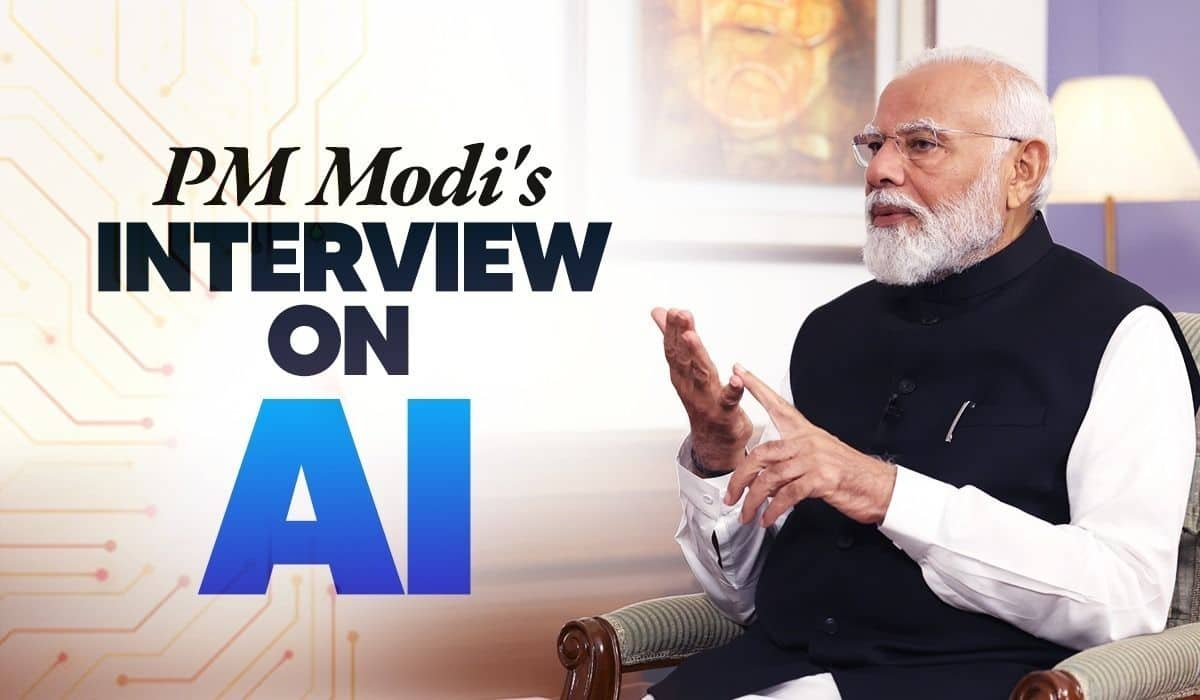
As the India AI Impact Summit 2026 commenced in the national capital marking the first time that a global convening of this scale on artificial intelligence is being organised in the Global South, Prime Minister Narendra Modi in a special interview to ANI's text service underlined the guiding spirit of the summit under the umbrella "Sarvajan Hitay, Sarvajan Sukhaye" ("Welfare for all, happiness for all"). The Summit brings together the Heads of State and Government, ministers, global technology leaders, and industry stakeholders to deliberate on the role of AI in advancing inclusive growth, strengthening public systems and enabling sustainable development.

Prime Minister Modi in his interview highlights India's vision for this new era highlighting that AI must accelerate global development while remaining deeply human-centric.The transcript of the interview is as follows:

ANI: India is hosting the AI Impact Summit 2026 for the first time anywhere in the Global South. The Motto of the Summit is "Sarvajan Hitay, Sarvajan Sukhaye" (Welfare for all, happiness of all). What's the vision of this Summit, and why this motto?

PM Narendra Modi: Today, AI stands at a civilisational inflection point. It can expand human capability in unprecedented ways, but it can also test existing social foundations if left unguided. That is why we have deliberately framed this Summit around Impact that ensures meaningful and equitable outcomes, not just innovation.The guiding spirit, "Sarvajan Hitay, Sarvajan Sukhaye", reflects India's civilisational philosophy. The end goal of technology should be 'Welfare for All, Happiness of All'. Technology exists to serve humanity, not replace it.The Summit is structured around People, Planet and Progress. AI systems draw upon knowledge and data generated across societies worldwide. Therefore, we want AI's benefits to be diffused to everyone and not just hoarded by early adopters. As the first global AI summit hosted in the Global South, India is creating a platform that amplifies under-represented voices and development priorities.AI governance, inclusive datasets, climate applications, agricultural productivity, public health, and multilingual access are not peripheral issues for us. They are central. Our vision is clear: AI must accelerate global development while remaining deeply human-centric.

ANI: You have always spoken about using technology for empowerment and development. How do you see AI's role in Viksit Bharat 2047?

PM Narendra Modi: AI represents a transformative opportunity in India's journey towards Viksit Bharat 2047. Leveraging AI mindfully, with a strategic lens, helps address deep developmental challenges while creating entirely new economic opportunities, enabling inclusive growth, bridging the urban-rural divide and expanding access to opportunity.In healthcare, AI is already delivering impact. We are seeing AI-based solutions addressing early detection of tuberculosis, diabetic retinopathy, epilepsy and many other ailments at primary and district health centres.In education, AI-powered personalised learning platforms in Indian languages are helping students in rural and government schools receive customised academic support. In a very unique initiative, Amul is leveraging AI to reach 36 lakh women dairy farmers across thousands of villages, providing real-time guidance in Gujarati on cattle health and productivity, empowering grassroots women producers.In agriculture, the Bharat Vistaar initiative aims to integrate AI into crop advisory, soil analytics and weather intelligence, helping farmers make better, localised decisions.Even in heritage preservation, AI is enabling the digitisation and interpretation of ancient manuscripts, unlocking India's civilisational knowledge systems.At a time when the world is worried about AI deepening divides, India is using it to dissolve divides. We are making it an efficient tool for delivering healthcare, education and economic opportunity to every village, every district, and every citizen.

ANI: In your speech at AI Action Summit 2025 in Paris, you emphasised the bias and limitations of AI. From now and then, has the scenario changed? How do you see India addressing this issue?

PM Narendra Modi: The concerns regarding bias and limitations in AI remain deeply relevant. As AI adoption accelerates, the risks also scale. AI systems can inadvertently perpetuate biases related to gender, language and socio-economic background. The AI Impact Summit 2026 is bringing together various stakeholders and creating global awareness on matters such as biases and limitations of AI. This is an issue that needs global cooperation.For India specifically, we face unique challenges and opportunities. Our diversity - linguistic, cultural, regional - means that AI bias can manifest in ways that might not be obvious in Western contexts. An AI system trained primarily on English data or urban contexts may perform poorly for rural users or speakers of regional languages. The positive development is that India is beginning to address this more systematically. We're seeing increased focus on creating diverse datasets that represent India's plurality, greater emphasis on AI development in regional languages, and growing research on fairness and bias in Indian academic institutions and tech companies.

ANI: India's success in building low-cost Digital Public Infrastructure (DPI) like Aadhar and UPI is phenomenal. The convergence of DPI and AI could significantly improve public service delivery. What is India's learning on this, which could help Global South?

PM Narendra Modi: India's Digital Public Infrastructure journey offers crucial and practical lessons for the Global South. The convergence of DPI and AI is the next frontier of inclusive development.Our success with Aadhaar, UPI and other digital public goods was not accidental. It stemmed from a few replicable principles.First, we built digital infrastructure as a public good, not a proprietary platform. This open and interoperable architecture allowed innovation to flourish on top of a common base layer.Second, we designed for scale and inclusion from day one. Our systems work for 1.4 billion people, irrespective of their socio-economic status, literacy level, region or language.When AI is layered onto this foundation, governance can become far more responsive and efficient. AI can improve welfare targeting, strengthen fraud detection, enable predictive maintenance of infrastructure, support urban planning, and enhance transparency in public systems.At the same time, we understand the importance of robust digital infrastructure, strong data privacy protections, thoughtful regulatory frameworks and AI literacy across society. With its experience of building a human-centric Digital Public Infrastructure, India is best placed to ensure that AI's benefits reach the last mile, to farmers in villages, students in small towns, MSMEs, women entrepreneurs, informal workers and youth across rural and urban India, and not remain confined to a narrow urban elite. Technology must serve every citizen, regardless of geography, gender or income.The goal is not AI adoption for its own sake. It is AI that genuinely empowers citizens and accelerates India's journey toward becoming a developed nation by 2047, and offers a scalable model for the Global South.

ANI: India is a powerhouse of engineering talent. We contribute a large tech workforce to the world. How could we further deepen this in the AI era?

PM Narendra Modi: India has the talent and entrepreneurial energy to become an AI powerhouse, not just as a consumer, but a creator. Our startups, research institutions and tech ecosystem can build AI solutions that enhance manufacturing, improve governance and generate new jobs.I am confident that our youth can build AI solutions for Indian realities, designed for farmers, MSMEs, women entrepreneurs and grassroots innovators.We remain committed to strengthening every effort by our talented youth to make AI a force-multiplier for innovation and inclusion.The Union Budget 2026-27 reinforces this vision. It expands support for data centres and cloud infrastructure, strengthening domestic compute capacity.Under the IndiaAI framework, startups and research institutions are being supported with access to high-performance AI compute resources.Continued push for semiconductor manufacturing, electronics PLI, AI Centres of Excellence and digital skilling strengthens both hardware and human capital foundations.In short, we are not just nurturing talent, but we are building the infrastructure, policy ecosystem and skills base required for India to move from participating in the AI revolution to shaping it.

ANI: India has a vibrant IT sector contributing significantly to our service exports. How do you see AI impacting our IT sector? And what are the steps the Government is taking to bolster our IT sector?

PM Narendra Modi: India's IT sector has been the backbone of our services exports and a key driver of economic growth. AI presents both a tremendous opportunity and a challenge for this sector. AI market projections show India's IT sector could reach $400 billion by 2030, driven by new waves of AI-enabled outsourcing and domain-specific automation. The fundamental shift is that AI isn't replacing the IT sector. It is transforming it. While general-purpose AI tools have become widespread, enterprise-grade AI adoption is still concentrated in specific sectors, and incumbent IT firms continue to play crucial roles in solving complex business problems.To enable a strong Indian AI ecosystem, the government has responded with a comprehensive strategy centered on the IndiaAI Mission. We've already exceeded our initial target of GPUs and we are committed to do more, to provide affordable access to world-class AI infrastructure for startups and enterprises. We have established four Centres of Excellence in Healthcare, Agriculture, Education and Sustainable Cities plus five National Centres of Excellence for Skilling to equip our workforce with industry-relevant AI expertise. We want our IT sector to lead not just in service delivery but in building AI products, platforms, and solutions that work for India and the world.

ANI: We have seen many examples of AI being misused. How are we ensuring safety of Indians from possible harm of AI technology?

PM Narendra Modi: Technology is a powerful tool, but it is only a force-multiplier for human intent. It is up to us to ensure that it becomes a force for good. While AI may enhance human capabilities, the ultimate responsibility for decision-making must always remain with human beings. Around the world, societies are debating how AI should be used and governed. India is helping shape this conversation by showing that strong safeguards can coexist with continued innovation. For this, we need a global compact on AI, built upon certain fundamental principles. These should include effective human oversight, safety-by-design, transparency and strict prohibitions on the use of AI for deepfakes, crime and terrorist activities.India is moving toward a more structured governance approach in AI regulation. With the launch of the IndiaAI Safety Institute in January 2025, the country created a dedicated mechanism to promote the ethical, safe, and responsible deployment of AI systems.As AI becomes more advanced, our sense of responsibility must grow stronger. What makes India's approach distinctive is its focus on local risks and societal realities. The emerging risk assessment framework considers national security concerns as well as harms to vulnerable groups, including deepfakes targeting women, child safety risks, and threats affecting the elderly.The urgency of these safeguards is becoming evident to everyone due to the surge in deepfake videos. In response, India notified rules requiring watermarking of AI-generated content and the removal of harmful synthetic media. Alongside content safeguards, the Digital Personal Data Protection Act strengthens data protection and user rights in the digital ecosystem.India's commitment also extends globally. Just as there are global norms in aviation and shipping to ensure safety and accountability across borders, similarly, the world must work towards common principles and standards in AI. Whether through its role in the 2023 GPAI declaration, the Paris AI discussions, or in the current summit, India has consistently advocated a balanced path of advancing innovation while building safeguards for safe and inclusive #AIForAll.

ANI: In some section of youth, there is fear that AI will take away their jobs. India's demographic dividend will be difficult to harness if that is the case. How is the Government of India tackling this challenge?

PM Narendra Modi: I understand the concern of our youth about AI-driven disruptions in the job market. Preparation is the best antidote to fear. That is why we have been investing in skilling and re-skilling our people for an AI-driven future. The Government has launched one of the most ambitious skilling initiatives in the world. We're not approaching this as a future problem but we're treating it as a present imperative.I view AI as a force-multiplier which will further help us push the boundaries of what we thought possible. It will help doctors and teachers and lawyers to reach out to and help a larger group of people.History has shown that work does not disappear due to technology. Its nature changes and new types of jobs are created. While some jobs may be redefined, digital transformation will also add new tech jobs to India's economy. For centuries, there have been fears that innovation and technological revolutions will eliminate jobs. Yet history teaches us that whenever innovation happens, new opportunities emerge. The same will be true in the age of AI.India is already well equipped to adapt to this change. In the Stanford Global AI Vibrancy Index 2025, India ranked 3rd, reflecting strong growth in AI R&D, talent, and economy.Combining innovation with inclusion, we are confident that AI will strengthen India's workforce. With the right skills and preparation, our youth will lead the future of work.

ANI: Under your leadership, India has developed indigenous technologies such as 4 G and 5 G, as well as drone technology. What is your vision on AI for Aatmanirbhar Bharat?

PM Narendra Modi: Our journey toward Aatmanirbhar Bharat has been built on a fundamental principle: India must not just consume technology but create it. My vision for AI in Aatmanirbhar Bharat rests on three pillars: sovereignty, inclusivity, and innovation.My vision is that India should be among the top three AI superpowers globally, not just in the consumption of AI but in creation. Our AI models will be deployed worldwide, serving billions in their native languages. Our AI startups will be valued in hundreds of billions, creating millions of high-quality jobs. Our AI-powered public services will be studied globally as benchmarks for efficient, equitable governance. And most importantly, every Indian will experience AI as an enabler of opportunity, a multiplier of capability, and a servant of human dignity, not as a threat to their livelihood or an instrument of control. Aatmanirbhar Bharat in AI means India writing its own code for the digital century, and through the IndiaAI Mission, we are ensuring that code reflects our values, serves our people, and positions India as a responsible AI leader for the world.

Source: ANI News