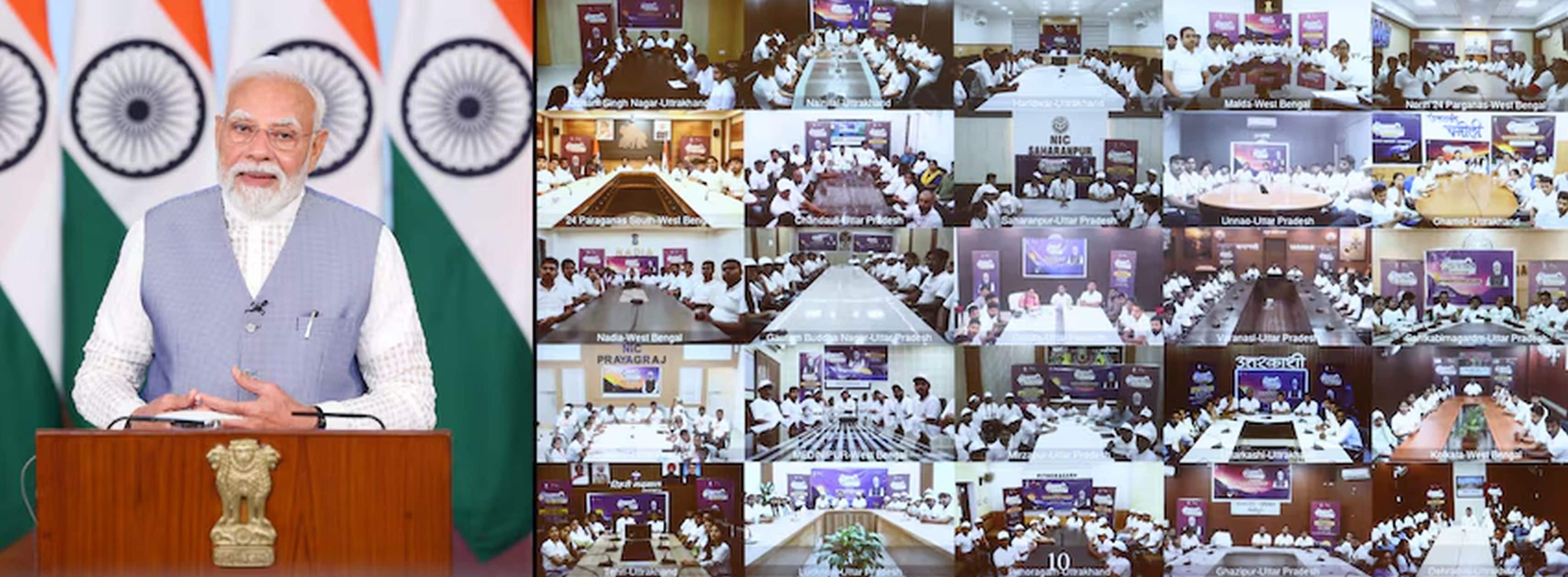
The following is the first part of the interview with the Prime Minister.
The Assam Tribune: As you have been visiting the North East for years, we presume that you are quite aware of the problems and challenges facing the region. Which of the problems you could solve in your ten-year tenure as the Prime Minister of India?
Prime Minister: For decades after Independence, the Northeastern states were relegated to the margins. Successive Congress governments gave step-motherly treatment to the people of the Northeast because for them the potential electoral gains in the region were too little. For them, the Northeast was too distant and working for its development was also difficult.
When we formed the government, it was my firm commitment to change the status quo in the Northeast. We replaced the policy of isolation and ig norance with a policy of integration. In the last 10 years, it is visible how we have ended the Northeast’s isolation and developed it as Bharat’s gateway to the East. I have visited the Northeast nearly 70 times, which is probably more than the total number of visits made by all the Prime Ministers before me. Since 2015, Union Ministers have visited the North east more than 680 times. We have changed the perception that the Northeast is far by taking govern ance at the doorstep of people. Aaj Northeast Na Delhi se Door Hai Aur Na Dil se Door Hai!
Today, the Northeast has emerged as New India’s greatest success story. It has shown the world: Jab Neeyat sahi hoti hai, to Nateeje bhi sahi hote hai.
In the last five years, the investments we made towards the development of the region are nearly four times more than the funds allocated by the Con gress government or any other previ ous government in the past. The infrastructural development that has taken place in the last decade has con nected the region with the rest of the country and the world like never before.
We fulfilled long-awaited critical con nectivity projects such as Bogibeel Bridge and Bhupen Hazarika Setu that have eased people’s lives. Recently, I had the opportunity to inaugurate the Sela Tunnel, which has been built at a height of 13,000 ft. It will provide all-weather connectivity to the border areas.
It was our government that had laid its foundation stone in 2019. So, you can see the speed and scale of our work.
I have trust in the Yuva Shakti of Northeast, their talent, their skill and their energy. We have opened the doors for them in education, sports, entre preneurship and many other areas.
Since 2014, more than Rs 14,000 crore has been spent to promote higher education in the Northeast.
The country’s first Sports University has been opened in Manipur. We are building more than 200 Khelo India centres across the 8 states.
More than 4,000 startups have emerged from this region in the last decade.
Agriculture is flourishing in the re gion, with the export of fruits, organ ic farming, and Mission Oil Palm bringing great prosperity.
Today, the Northeast is leading from the front in all sectors.

Prime Minister Narendra Modi with The Assam Tribune scribe R Dutta Choudhary
AT: Insurgency is one of the major problems facing the North East region and during your tenure as the Prime Minister, most of the insurgent groups of Assam and some in other states of the region have laid down arms. What steps are you taking to root out insurgency from the region?
PM: There was a long history of insurgencies, infiltration and institutional neglect.
Yes, we decided to deal with insurgency firmly but at the same time, we ensured that common people are embraced with great care and compassion.
As a result, while we have significantly controlled insurgency, we have also been able to win the trust of our people and ensure peace.
A total of 11 peace agreements have been signed in the last 10 years. This is unprecedented progress unseen under any previous government. More than 9,500 insurgents have surrendered since 2014 and joined the mainstream of the society. Due to the relentless efforts of our government, the entire Northeast is now witnessing a significant improvement in the security situation since 2014. Compared to 2014, there has been a 71 per cent reduction in insurgency incidents in 2023. Similarly, in this period, security force casualties have come down by 60 per cent and civilian deaths by 82 per cent. Due to the improved security situation, the AFSPA has been withdrawn from most parts of the Northeast. We have successfully negotiated Border Dispute Settlement Agreements between Assam and Arunachal Pradesh which has put an end to the longstanding dispute concerning 123 villages along the border. We have resolved the 50-year-old dispute between Assam and Meghalaya. Peace agreements like the Bodo Accord and the Bru-Reang Agreement have led to several insurgents and militants surrendering their arms and joining the mainstream. We have strengthened Autonomous Councils to accelerate the development process for the welfare of Scheduled Tribe (ST) communities through democratic decentralization of power through Constitutional amendment. We have launched schemes aimed at rehabilitating insurgents, facilitating their transition into mainstream society through financial support and comprehensive rehabilitation processes. We have put an end to the era of blockades in the Northeast which caused great inconvenience to everyone and hampered the region’s development. All the efforts we have made have ushered in an era of peace in the region.
AT: Communication bottleneck is one of the major problems for the Northeast region. What steps are you taking to deal with the issue?
PM: Given the Northeast’s strategic location, our vision is that the region should be developed as a base for India’s growing economic links while also ensuring that the aspirations of the people are fulfilled. Yes, there were problems. But we focused on the solutions. Today, the Northeast is seeing improved infrastructure connectivity, whether it is roadways or railways, airways or waterways. Even in the remotest corners of the region, 5G connectivity is being established. Border villages are now part of the Vibrant Villages Program, demonstrating how last-mile connectivity is reaching the unreached. We’ve transformed the Northeast from an ”abandoned region” to an “abundant region” with over Rs 5 lakh crore spent by Ministries of the Government of India over the last 10 years. In the last 10 years, many firsts have happened in the Northeast: Many parts of the Northeast are getting connected by rail service for the first time. Meghalaya came on India’s rail network after 67 years of Independence. Nagaland has now got its second railway station after 100 years. The first goods train reached Rani Gaidinliu railway station in Manipur. The Northeast got its first semi high-speed train. Sikkim got its first airport. Just imagine the scarcity created and the level of neglect by the previous governments. The number of airports has increased from 9 to 17, operationalizing 74 routes under the UDAN scheme. Before 2014 there was only one national waterway in the Northeast. Now 5 waterways are operational. Hundreds of towers are covering villages to improve mobile connectivity. You would be happy to know that Agartala has an International Internet Gateway (IIG). It is the third center in the country to have such a gate way after Mumbai and Chennai. The Northeast’s development is also integral to our Act East Policy. We have been consistently working on connecting South East Asia with the Northeast through major projects be it India-Myanmar-Thailand Trilateral Highway or Kaladan Multimodal Transit Transport Project. I firmly believe that the path to Viksit Bharat runs through the development of our Ashtalakshmi states of the Northeast.
AT: China has been claiming parts of Arunachal Pradesh for years and from time to time the Chinese raise the issue. Is Arunachal Pradesh safe? What steps are you taking to ensure that every inch of the state remains within India?
PM: I do not understand why The Assam Tribune should have any doubt about this. Arunachal Pradesh is, was and shall always be an integral part of Bharat. Today, the development works are reaching Arunachal and the Northeast like the first rays of the sun, faster than ever before. Last month, I visited Itanagar for Viksit Bharat, Viksit North East programme. I had the privilege to unveil Rs 55,000 crore worth of development projects that are providing guarantees for Viksit North East. Around 35,000 families in Arunachal Pradesh got their pucca houses, and 45,000 households benefited from the drinking water supply project. I inaugurated the Sela Tunnel which is a real strategic game-changer providing all-weather connectivity to Tawang. In 2022, we inaugurated the Donyi Polo Airport for enhanced air linkages to the rest of the nation. On the energy front, the Dibang Multipurpose Project will contribute to employment, energy and water resource management. We have commenced new road projects for about 125 villages and tourism and other infrastructure-related projects in 150 villages. The government has also launched a Rs 10,000 crore UNNATI scheme that will bring new possibilities for investment and jobs in the North Eastern Region.
AT: How do you rate the situation in Manipur and what steps are being proposed to ensure ethnic harmony in the state? You were criticized by the opposition for the Manipur issue. Would you like to comment on that?
PM: We believe that it is our collective responsibility to deal with the situation sensitively. I have already spoken about this in the Parliament. We’ve dedicated our best resources and administrative machinery to resolving the conflict. Because of the timely intervention of the Government of India and efforts made by the Government of Manipur, there has been a marked improvement in the situation of the State. Home Minister Amit Shah stayed in Manipur while the conflict was at its peak, holding 15-plus meetings with various stakeholders to help resolve the conflict. The Central Government has been consistently extending its support, as required by the State Government. The process of relief and rehabilitation is ongoing. Remedial measures undertaken include a financial package for the relief and rehabilitation of people living in shelter camps in the State.
AT: The framework agreement with NSCN(IM) was signed in your presence way back in 2015. When can we expect the final solution?
PM: As a result of initiatives taken by our Government, a Framework Agreement was signed with the NSCN/Isak Muivah Group of Naga land on August 3, 2015, for a permanent solution to decades-old Naga political problems. This agreement lays down broad principles within which the final agreement will be worked out. The Official Representative of the Government of India is holding talks with NSCN(IM) and other Naga groups. The Government of India is making all possible efforts to successfully conclude the peace talks with Naga groups at the earliest.
AT: Of late, Mizoram has been facing trouble because of infiltration from Myanmar. What steps is the Government taking in this regard?
PM: As you are aware, this influx of Myanmar nationals into India is largely due to the internal developments in Myanmar. We have been raising this issue with the Myanmar authorities as this directly impacts India, particularly our Northeastern states. To prevent infiltration and secure our borders, several steps have been taken by the Government. These steps include the decision to scrap the Free Movement Regime between India and Myanmar, increased and effective deployment of Border Guarding Forces on the Indo-Myanmar border, Close coordination amongst various security agencies, etc. The Government of India has started construction of fencing on feasible patches along the Indo-Myanmar Border. The Government of India has urged the Government of Mizoram to take up a campaign for the capture of biometric data of illegal migrants in the state. The Government of India has also been providing devices and necessary assistance to the state government to carry out a biometric capture plan. We are bringing about policy changes to adjust to the changing realities on the ground. We want to see peace and stability return to Myanmar at the earliest so that these people can return to their home country peacefully.
Following is the second part of the exclusive interview with the Prime Minister
The Assam Tribune: If you are re-elected as the Prime Minister, what will be your priority areas for the North East?
Prime Minister: Our mantra is Vik sit (developed) North East for Viksit Bharat. In the last 10 years, we have tried to correct numerous historical wrongs of the Congress-led governments. We have brought it to a point where the entire region is brimming with positivity and looking towards a bright future.
We want to ensure that North East becomes the sports hub of India.
We want to ensure that youths get enough opportunities for employment and education in their States.
We want to ensure that the agricultural produce of the North East travels far and wide.
We want to ensure that the North East becomes the trade and tourism hub of India.
In the last few years, the combined GDP of the Northeastern states has increased significantly.
Over Rs 5 lakh crore has been spent towards the development of the region by Ministries of the Central government. Bestowed with nature’s bounties and strategic location, the North East is going to be a key player in India’s Act East policy.
AT: The natural resources including the tourism potential of the North East are yet to be tapped properly. How can the Centre help the region in this regard?
PM: The North East is blessed with biodiversity, natural resources and immense talent. All it needed was a push. Today holistic development is taking place in the region which is helping it grow as one of India’s growth engines. We are promoting on a global scale the unique culture, food and art forms of the North East. Assam created a world record with more than ten thousand dancers and drummers performing Bihu dance recently or another example could be that of Nagaland’s Hornbill festival.
Source: The Assam Tribune