“Namo Bharat Train is defining the new journey of New India and its new resolutions.” Prime Minister Narendra Modi on launch of Namo Bharat Train.

Over two decades ago, on December 24, 2002, the then Prime Minister, Atal Bihari Vajpayee, inaugurated the first section of the Delhi Metro. The Red Line connected Shahdara and Tis Hazari, beginning a transformative journey. Today, the Delhi Metro boasts 288 stations, a network length of nearly 400 kilometres, and twelve lines, and is an artery for the National Capital Region (NCR) economy.

Fast forward to October 20, 2023, when history repeated itself. Prime Minister Narendra Modi inaugurated the priority section of the Delhi-Meerut Regional Rapid Transit System (RRTS), covering five stations across 17 kilometres. The inauguration will pave the way for further expansion, mirroring the growth of the Delhi Metro.

The RRTS, known as Namo Bharat, transcends a mere transportation project. Its implications extend beyond connectivity, promising to reshape the urban landscape and drive economic development in the National Capital Region (NCR). In its first phase, covering Meerut, Panipat, and Alwar, the RRTS will span over 8,000 square kilometres and eclipse the Delhi Metro's current coverage of around 3,500 square kilometres.

The subsequent phases will include the Delhi-Palwal, Delhi-Khurja, Delhi-Rohtak, Delhi-Baraut, and Ghaziabad-Hapur routes and will expand the coverage of RRTS to over 25,000 square kilometres. This ambitious RRTS project will give a huge boost to connectivity and even redefine the region's urban landscape and economic activity.

The RRTS will decongest the national capital, enhance and improve the commutation experience, and make distant areas in Uttar Pradesh, Haryana, and Rajasthan accessible to the NCR. It will also become an enabler of employment opportunities, particularly for women.

The economic consequences of the RRTS are manifold. It is poised to alleviate the real estate sector's inflation in the NCR as people gravitate towards suburbs, driven by concerns like air pollution, water scarcity, and traffic congestion. The RRTS coverage area presents an opportunity for local bodies, supported by state governments, to capitalize on real and commercial estate development, create special economic zones for industries, and establish tourist hubs. For instance, an RRTS station in Murthal in Haryana can transform into a significant tourist destination, capitalizing on its proximity to Delhi and renowned food joints.


Like the successful model of the Delhi Metro, monetization strategies will be a priority for the National Capital Region Transportation Corporation (NCRTC). Stations, coaches (RAPIDX), and surrounding spaces can be leveraged for revenue generation, turning the DMRC and NCRTC into transportation entities and real estate players.


The impact it will have on the region's economy and urban landscape will unfold in the coming years, solidifying its status as a pivotal infrastructure project of the decade.

As the RRTS takes its first step, it prompts a reevaluation of how governments approach urbanization at the center and state levels. In fact, the Modi government's focus has shifted from overcrowded cities to expanded suburbs, encompassing towns and smaller cities. Key economic hubs are expected to be retained as work destinations, fostering a balanced approach for sustainable economic growth, environmental preservation, and urban expansion.

Perhaps, as Namo Bharat's RRTS sets a precedent, other major cities like Mumbai and Bengaluru can also contemplate similar regional rapid transit systems. It is a timely consideration, aligning with the needs of the ambitious ten-trillion-dollar economy target by 2035. The success of the RRTS could serve as a blueprint for fostering sustainable urbanization and economic prosperity in rapidly growing regions across the country.

Since 2014, Modi has stressed improving the urban landscape and lifestyle. With projects like the Namo Bharat Trains, metros in cities, and, more recently, the Mumbai Trans-Harbour Link, the Modi government has been delivering on its promises, one project at a time. This ensures ease of living for millions of city residents and creates more suburban opportunities.

Explore More
શ્રી રામ જન્મભૂમિ મંદિર ધ્વજારોહણ ઉત્સવ દરમિયાન પ્રધાનમંત્રીના સંબોધનનો મૂળપાઠ

લોકપ્રિય ભાષણો

શ્રી રામ જન્મભૂમિ મંદિર ધ્વજારોહણ ઉત્સવ દરમિયાન પ્રધાનમંત્રીના સંબોધનનો મૂળપાઠ
Why The SHANTI Bill Makes Modi Government’s Nuclear Energy Push Truly Futuristic

Media Coverage

Why The SHANTI Bill Makes Modi Government’s Nuclear Energy Push Truly Futuristic
NM on the go

Nm on the go

Always be the first to hear from the PM. Get the App Now!
...
6 Years of Jal Jeevan Mission: Transforming Lives, One Tap at a Time
August 14, 2025
Jal Jeevan Mission has become a major development parameter to provide water to every household.” - PM Narendra Modi

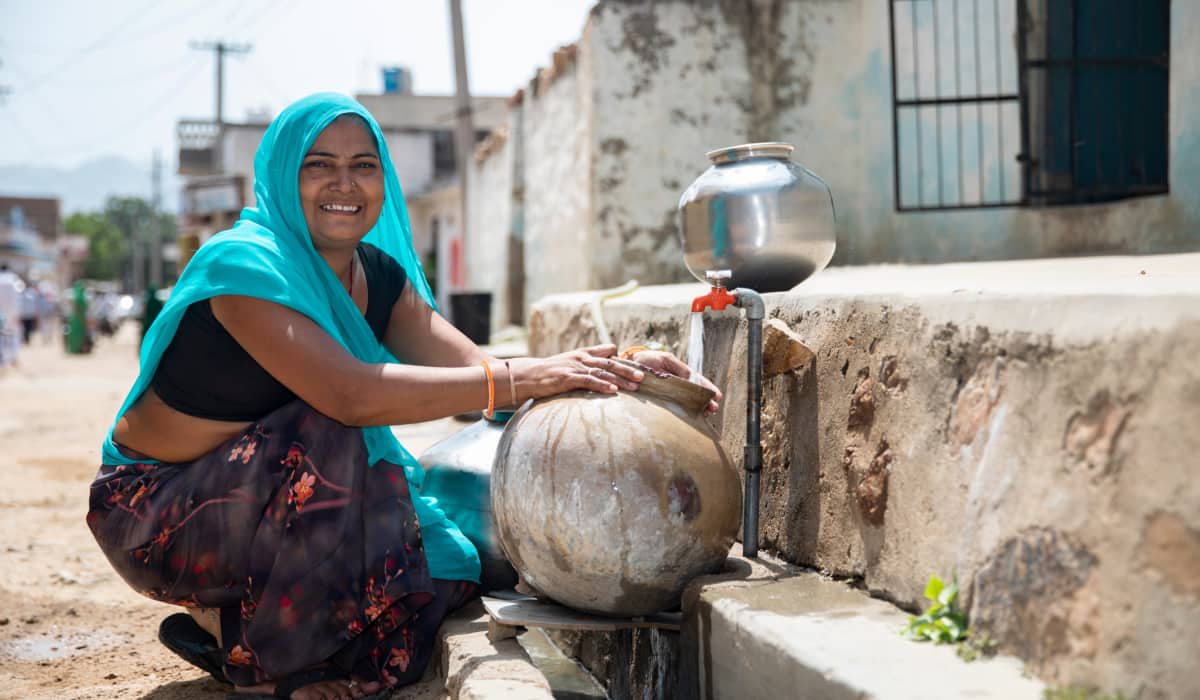
For generations, the sight of women carrying pots of water on their heads was an everyday scene in rural India. It was more than a chore, it was a necessity that was an integral part of their everyday life. The water was brought back, often just one or two pots which had to be stretched for drinking, cooking, cleaning, and washing. It was a routine that left little time for rest, education, or income-generating work, and the burden fell most heavily on women.

Before 2014 water scarcity, one of India’s most pressing problems, was met with little urgency or vision. Access to safe drinking water was fragmented, villages relied on distant sources, and nationwide household tap connections were seen as unrealistic.

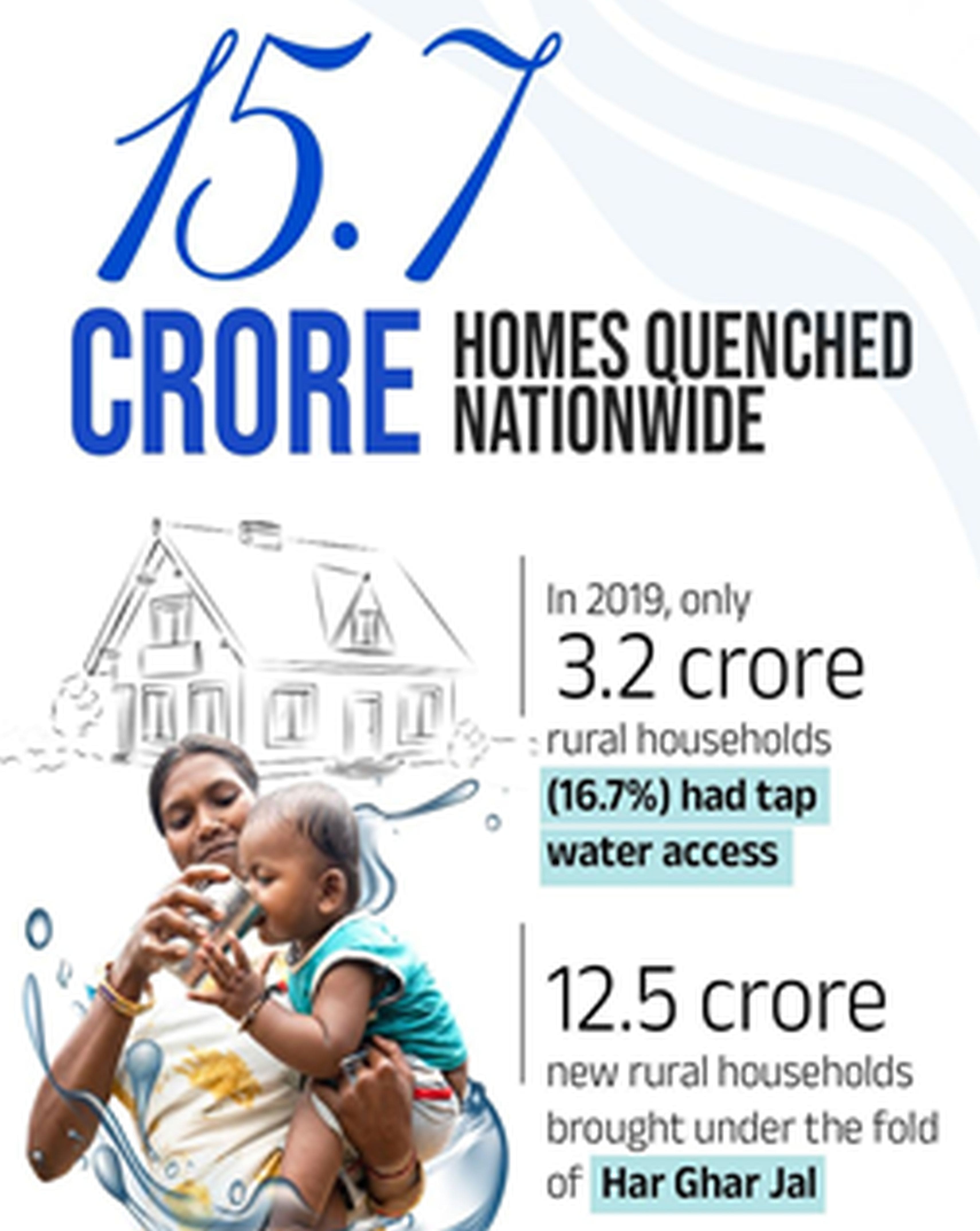
This reality began to shift in 2019, when the Government of India launched the Jal Jeevan Mission (JJM). A centrally sponsored initiative which aims at providing a Functional Household Tap Connection (FHTC) to every rural household. At that time, only 3.2 crore rural households, a modest 16.7% of the total, had tap water. The rest still depended on community sources, often far from home.

As of July 2025, the progress under the Har Ghar Jal program has been exceptional, with 12.5 crore additional rural households connected, bringing the total to over 15.7 crore. The program has achieved 100% tap water coverage in 200 districts and over 2.6 lakh villages, with 8 states and 3 union territories now fully covered. For millions, this means not just access to water at home, but saved time, improved health, and restored dignity. Nearly 80% of tap water coverage has been achieved in 112 aspirational districts, a significant rise from less than 8%. Additionally, 59 lakh households in LWE districts have gained tap water connections, ensuring development reaches every corner. Acknowledging both the significant progress and the road ahead, the Union Budget 2025–26 announced the program’s extension until 2028 with an increased budget.

The Jal Jeevan Mission, launched nationally in 2019, traces its origins to Gujarat, where Narendra Modi, as Chief Minister, tackled water scarcity in the arid state through the Sujalam Sufalam initiative. This effort formed a blueprint for a mission that would one day aim to provide tap water to every rural household in India.

Though drinking water is a State subject, the Government of India has taken on the role of a committed partner, providing technical and financial support while empowering States to plan and implement local solutions. To keep the Mission on track, a strong monitoring system links Aadhaar for targeting, geo-tags assets, conducts third-party inspections, and uses IoT devices to track village water flow.

The Jal Jeevan Mission’s objectives are as much about people as they are about pipes. By prioritizing underserved and water-stressed areas, ensuring that schools, Anganwadi centres, and health facilities have running water, and encouraging local communities to take ownership through contributions or shramdaan, the Mission aims to make safe water everyone’s responsibility..

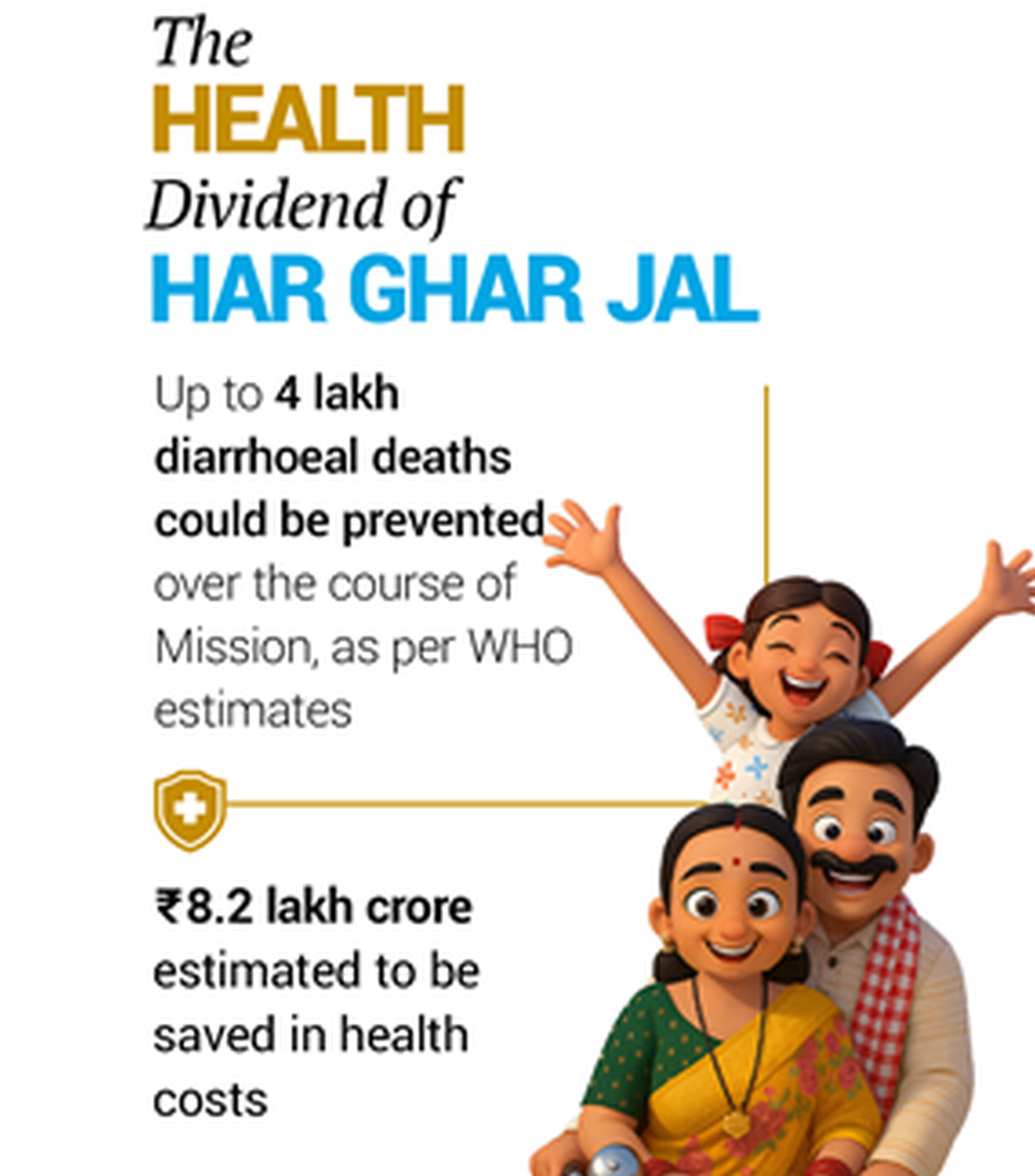
The impact reaches far beyond convenience. The World Health Organization estimates that achieving JJM’s targets could save over 5.5 crore hours each day, time that can now be spent on education, work, or family. 9 crore women no longer need to fetch water from outside. WHO also projects that safe water for all could prevent nearly 4 lakh deaths from diarrhoeal disease and save Rs. 8.2 lakh crores in health costs. Additionally, according to IIM Bangalore and the International Labour Organization, JJM has generated nearly 3 crore person-years of employment during its build-out, with nearly 25 lakh women are trained to use Field testing Kits.

From the quiet relief of a mother filling a glass of clean water in her kitchen, to the confidence of a school where children can drink without worry, the Jal Jeevan Mission is changing what it means to live in rural India.