Friends, Today is 11th September.
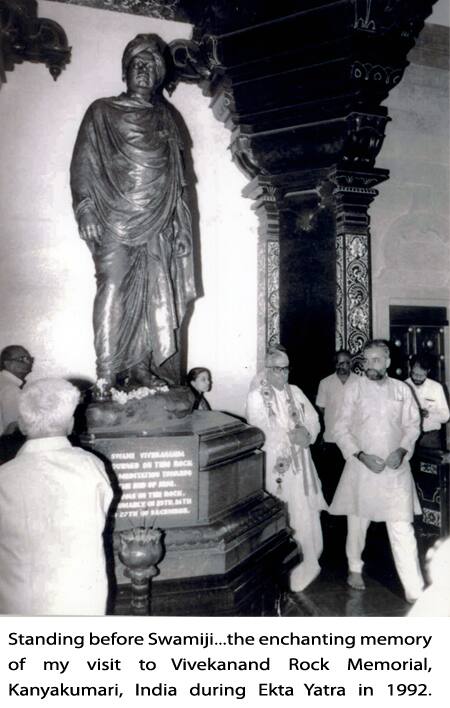
 This was the Day on which Swami Vivekananda gave the
world-famous speech in 1893 at Chicago in the World Parliament of Religions. We are celebrating it as "Digvijay Divas"; Swami Vivekananda conquered the world on this day with his spirituality in practice and that too at a time when India was not even independent. It was for the first time that the message of universal Brotherhood and its proper understanding was given to the western world. We all know that when Swami Vivekananda addressed the audience as ‘Sisters and Brothers of America’ it had an electrifying effect on them. Because it was not merely a form of address but behind those words was the great spiritual strength of India, which has always proclaimed and practised the universal brotherhood in her long history of more than 5000 years. Had the world followed the message of the universal brotherhood, possibly, 100 years later it wouldn’t have had to face the fatal day of the world trade center attack, September 11, 2001. But the irony is that such a uniquely great philosophy that can show the path to the world to handle the menace of terrorism itself is being termed as “
Saffron terrorism”. That too by none other than the home minister of this country. Guided by the agenda of petty Party Politics and appeasement, it seems he intends to root out all the possibilities of Peace and Development. In the face of this predicament, it becomes the duty of each and everyone to understand this message, to imbibe it in our life and to make it reach out the people. Swami Vivekananda worked for Strong India to guide the whole Humanity. Swamiji, in his lectures, gave a call for Universal Brotherhood. He said that the man on this earth has continued too long to be fanatic about insisting that his religion alone is true and other religions, being false, had no right to exist. He also stressed that as long as this situation persists there can be only bloodshed in the name of religion and no brotherhood which, the practice of religion should actually bring about, would be possible. How prophetic he was proved more than hundred years later by the WTC event of 11th September!
But how long the humanity would be drenched in the blood of fanaticism? At present though it appears that fanaticism and terrorism are engulfing the whole world, actually it is like the flame that flickers the brightest before getting extinguished. Swami Vivekananda had said that, “Sectarianism, bigotry, and its horrible descendants, fanaticism, have long possessed this beautiful earth. They have filled this earth with violence, drenched it often and often with human blood, destroyed civilisation and sent whole nations to despair. Had it not been for these possible demons, human society would be far more advanced than it is now? But their time has come…”
It is not that he just gave the call for Universal Brotherhood, but also pointed out that Universal Brotherhood is not possible without inclusive approach. Today humanity is facing three levels of challenges, mainly due to the lack of inclusive approach-
1. Co-existence of multiple faith and civilizations
2. Sustainable development of Science and Economics in harmony with nature
3. Geopolitical tolerance in warring and competing nationalities
 Strong Indian nation based on the values of out rich civilization is the only solution to all these challenges. ‘Good of all‘ -Sarve bhavantu sukhinah....,the philosophy preached by our rishis (sages) is the only way out. It is ‘sanatan’- beyond time. It is as relevant today; perhaps more, as it was in their time. But the question arises is it possible in today’s world. We are trying our best to make it possible in Gujarat and I am happy with the success of our efforts. “Gujarat model of inclusive development” is basically the Indian model of harmonised growth. After consistently following this model even in the mid of all types of hindrances today anyone can see how successful Gujarat is in combating above three challenges. If one tries to unveil the facts underneath the malicious lies, it can be clearly seen that the policy of “accomplishments and not appeasement” of Gujarat has created a peaceful environment for growth without discriminating on caste, creed or religion. Gujarat is truly wedded to the principle of sarva dharma sambhav. Not only the Co-existence of multiple faith but synergic development of all sections of the society regardless of caste or community. Time and again, those crafting calumny against Gujarat for meager vote bank politics are being slapped on their faces when Gujarat’s model of inclusive growth is praised by different people and in different forums. One such document is Justice Rajinder Sachar committee report that shows
Muslims are the happiest in Gujarat.
While people are busy deliberating on Sustainable development, Gujarat’s commitment has started showing results on quite a few fronts- whether it is Agricultural growth or Human development index or GDP.
Sustainable development calls for innovation, cooperation and the will power to make the changes that the world needs. Gujarat has shown it in all its initiatives like providing round the clock three phase electricity to all urban and rural hamlets, providing institutional deliveries through PPP route, linking the rivers, micro-irrigation, BRTS, riverfront, climate change initiative, evening courts and many more. In Gujarat, we are determined to have an economy and society that has low-carbon emissions and a prosperous and healthy future.
Gujarat has also taken initiatives like
Samras gram where a village is awarded if the local self government is formed unanimously. On the first day of the Golden Jubilee year of the State, all past and current MLAs and MPs of Gujarat during last 50 years were invited and a resolution was made to celebrate the Golden Jubilee, Swarnim Jayanti together without political differences. The mooting of compulsory voting bill too is an attempt to create a healthy democracy and competitive politics.
Today’s Bharat is the land of youth. And the young have both zeal and strength to do something for the country. They are empowered with advanced knowledge and technology. Be it our
Samay Daan Programme or the
CM FellowshipProgramme or the thousands of
email that I daily receive from the youth, the fresh vigor and enthusiasm in them, makes frees from the worries of India’s Future.
Swamiji’s 150th anniversay is approaching, Eleanor Stark of America in his book “The Gift Unopened” calls Swamiji to be the unique gift for the mankind still unopened. Come, let’s unite in taking a pledge on this occassion to open this gift by living the message of Swamiji. To commemorate “Digvijay Divas” we must follow Swamiji's message, we should do it with deeds and not words to usher in a better tomorrow. Let us honour this great man by trying to realize his dream of a Strong India by following in his footsteps.
It can be best concluded in the words of Swami Vivekananda, “Work out the salvation of this land and of the whole world, each of you thinking that the entire burden is on your shoulders. Carry the light and the life of the Vedanta to every door, and rouse up the divinity that is hidden within every soul. Then, whatever may be the measure of your success, you will have this satisfaction that you have lived, worked, and died for a great cause. In the success of this cause, howsoever brought about, is centered the salvation of humanity here and hereafter.”
Jay Jay Garvi Gujarat!
Jay Jay Swarnim Gujarat!
Vasudhaiva Kutumbakam ! The whole world is one family.
Yours