Cabinet approves Rithala-Kundli corridor of Delhi Metro Phase-IV project

Published By : Admin | December 6, 2024 | 20:08 IST

The Union Cabinet, chaired by the Prime Minister Shri Narendra Modi, has approved the Rithala - Narela -Nathupur (Kundli) corridor of Delhi Metro's Phase - IV project consisting of 26.463 kms which will further enhance connectivity between the national capital and neighbouring Haryana. The corridor is scheduled to be completed in 4 years from the date of its sanction.

The completion cost of the project is Rs.6,230 crore and is to be implemented Delhi Metro Rail Corporation Limited (DMRC) the existing 50:50 Special Purpose Vehicle (SPV) of the Government of India (GoI) and Government of National Capital Territory of Delhi (GNCTD) in four years.

This line will be an extension of the presently operational Shaheed Sthal (New Bus Adda) - Rithala (Red Line) corridor and will boost connectivity in the north western parts of the national capital in areas such as Narela, Bawana, parts of Rohini etc. This entire stretch will comprise of 21 stations. All the stations of this corridor will be elevated.

After completion, the Rithala - Narela - Nathupur corridor will also connect Shaheed Sthal New Bus Adda station in Ghaziabad, Uttar Pradesh with Nathupur in Haryana via Delhi, which will tremendously boost connectivity in the entire National Capital Region.

This new corridor of the phase - IV project will expand the reach of Delhi Metro network in the NCR thereby further boosting the economy. This extension of the Red Line will reduce congestion on the roads, thus, will help in reducing the pollution caused by motor vehicles.

This entire stretch will comprise of 21 stations. All the stations of this corridor will be elevated. The stations, which shall come up on this corridor are: Rithala, Rohini Sector 25, Rohini Sector 26, Rohini Sector 31, Rohini Sector 32, Rohini Sector 36, Barwala, Rohini Sector 35, Rohini Sector 34, Bawana Industrial Area - 1 Sector 3,4, Bawana Industrial Area - 1 Sector 1,2, Bawana JJ Colony, Sanoth, New Sanoth, Depot Station, Bhorgarh village, Anaj Mandi Narela, Narela DDA Sports Complex, Narela, Narela Sector 5, Kundli and Nathpur.

This corridor will be Delhi Metro's fourth extension into Haryana. Presently, the Delhi Metro operates up to Gurugram, Ballabhgarh, and Bahadurgarh in Haryana.

Construction of Phase-IV (3 Priority Corridors), consisting of 65.202 km and 45 stations, is underway, and as of today, more than 56% of construction has been completed. The Phase-IV (3 Priority) corridors are likely to be completed in stages by March 2026. In addition, two more corridors, comprising 20.762 kilometres, have also been approved and are in the pre-tendering stages.

Today, the Delhi Metro caters to on average of 64 lakh passenger journeys. The maximum passenger journey recorded so far is 78.67 lakh on 18.11.2024. Delhi Metro has become the lifeline of the city by setting the epitome of excellence in the core parameters of MRTS, i.e. punctuality, reliability, and safety.

A total of 12 metro lines of about 392 km with 288 stations are being operated by DMRC in Delhi and NCR at present. Today, Delhi Metro has the largest Metro network in India and is also one of the largest Metros in the world.

Explore More
Today, the entire country and entire world is filled with the spirit of Bhagwan Shri Ram: PM Modi at Dhwajarohan Utsav in Ayodhya

Popular Speeches

Today, the entire country and entire world is filled with the spirit of Bhagwan Shri Ram: PM Modi at Dhwajarohan Utsav in Ayodhya
Emerging cities see 42% growth in GCC jobs, outpacing metros: Report

Media Coverage

Emerging cities see 42% growth in GCC jobs, outpacing metros: Report
NM on the go

Nm on the go

Always be the first to hear from the PM. Get the App Now!
...
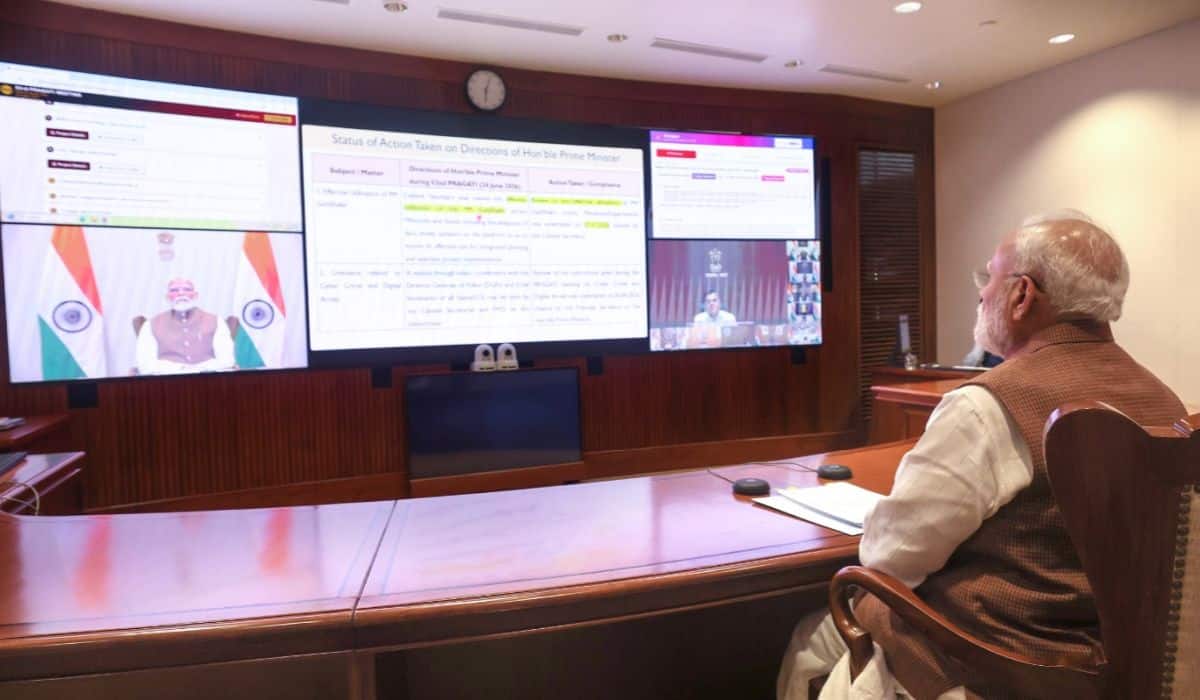
PM Modi chairs 51st PRAGATI Meeting
May 27, 2026
PM reviews seven critical infrastructure projects across the Railways, Power and Road sectors
Projects reviewed span across 9 States with cumulative investment of around ₹30,000 crore
PM also reviews Ken Betwa Link Project and Swachh Bharat Mission-Urban 2.0
PM says Ken-Betwa River Inter-linking Project should serve as a model for other States to resolve inter-State water issues amicably
PM asks States to expedite the completion of solid waste management-related infrastructure, including waste processing plants and GOBARdhan plants
PM calls for mission-mode rooftop solar coverage in urban areas
Acting upon the advice of PM, system of monthly review of social sector schemes at State level operationalised, starting with review of Swachh Bharat Mission

Prime Minister Shri Narendra Modi chaired the 51st meeting of PRAGATI, the ICT-enabled, multi-modal platform aimed at fostering Pro-Active Governance and Timely Implementation, by seamlessly integrating efforts of the Central and State governments, at Seva Teerth, earlier today.

During the meeting, the Prime Minister reviewed seven critical infrastructure projects across the Railways, Power and Road sectors covering nine States worth around ₹30,000 crore. These projects, pivotal to economic growth and public welfare, were reviewed with a focus on timelines, inter-agency coordination, and timely issue resolution. Prime Minister also reviewed Ken Betwa Link Project and Swachh Bharat Mission-Urban 2.0.

While reviewing power sector projects, Prime Minister emphasized the need to accelerate rooftop solar adoption across urban areas, with a special focus on cities, residential clusters and public institutions. He underlined that rooftop solar should be taken up in mission mode to reduce electricity costs, improve energy security and promote clean energy at the household and community level.

While reviewing road and port connectivity projects, it was emphasised that Vadhavan Port should be developed as a model of port-led, multi-modal development, where every major mode of transport is seamlessly integrated to create a future-ready logistics ecosystem. The project should not be seen merely as a port, but as a national gateway connected through coastal shipping, inland waterways, dedicated freight corridors, high-speed rail connectivity, highways and airport linkages.

Prime Minister emphasised the need for effective implementation of Swachh Bharat Mission 2.0 and underlined that the mission should move beyond infrastructure creation and ensure measurable outcomes through regular monitoring, citizen participation and convergence between various stakeholders. He asked States to expedite the completion of solid waste management-related infrastructure, including waste processing plants and GOBARdhan plants.

While reviewing Ken-Betwa River Inter-linking Project, Prime Minister observed that Ken-Betwa project should serve as a model for other States to resolve inter-State water issues through cooperation, timely clearances, technology-based monitoring and mission-mode execution. States were encouraged to identify similar opportunities where river-linking, water conservation, groundwater recharge and efficient irrigation can be taken up in an integrated manner to ensure long-term water security.

Prime Minister also underlined that the delay in the implementation of public projects leads not only to cost escalation but also deprives citizens of timely access to essential facilities and development benefits. He observed that every delay has a direct impact on people’s lives, regional growth and public resources. He stressed that Ministries, Departments and States must adopt a more proactive and time-bound approach to resolve pending issues, remove bottlenecks and ensure faster execution.

Prime Minister also emphasized that innovative use of canal networks should be explored, including installation of solar panels along canals and over canals for clean electricity generation. This would help optimize land use, reduce evaporation losses, generate renewable energy and create additional economic value from water infrastructure.

At the beginning of the meeting, the Cabinet Secretary informed that, in pursuance of the directions of the Prime Minister, a system of monthly review of social sector schemes at the State level has also been operationalised. This mechanism aims to ensure regular monitoring, faster resolution of implementation issues and greater accountability at the State and district levels. As part of this initiative, Swachh Bharat Mission has been taken up for review at the State level in the first instance.