New rail line in Kutch to boost tourism by connecting the Rann of Kutch, Dholavira, Koteshwar temple, Narayan Sarovar & Lakhpat fort
Transportation of coal, cement, clinker, fly-ash, steel, containers, fertilizers, agricultural & Petroleum products to get a boost as Railways add 565 route kms

The Union Cabinet, chaired by the Prime Minister Shri Narendra Modi approved Four projects of Ministry of Railways with totalcost of Rs. 12,328 Crore (approx.). These projects include: -

(1) Deshalpar – Hajipir – Luna and Vayor – Lakhpat New Line

(2) Secunderabad (Sanathnagar) – Wadi 3rd and 4th Line

(3) Bhagalpur – Jamalpur 3rd line

(4) Furkating – New Tinsukia Doubling

The above projects aim to ensure seamless and faster transportation of both passengers and goods. These initiatives will provide connectivity & improve travel convenience besides reducing logistic cost and decrease dependence on oil imports. Additionally, the projects will contribute to lower CO2 emissions, thereby supporting sustainable and efficient rail operations.The projects will also generate direct employment for about 251 (Two Hundred and Fifty-one) lakhhuman-days during its construction.

The proposed new line will provide connectivity to far-fetched area of Kutch region. It will add 145 route km & 164 track km to the existing railway network in Gujarat with an estimated cost of 2526 crore rupees. The completion timeline of the project is 3 years. Besides promoting the tourism in the state of Gujarat, the new rail line will help in transportation of salt, cement, coal, clinker & bentonite. The strategic importance of the project is that it will provide connectivity to Rann of Kutch. Harappan site Dholavira, Koteshwar temple, Narayan Sarovar &Lakhpat fort will also come under the rail network as 13 new railway stations will be added benefitting 866 villages and about 16 Lakh population.

In a major Connectivity boost, the approved Multi-tracking projects will enhance connectivity to approx. 3,108 villages and about 47.34 lakh population and One Aspirational District (Kalaburagi) benefitting the states of Karnataka, Telangana, Bihar & Assam. The completion timeline for 173 km long Secunderabad (Sanathnagar) – Wadi 3rd and 4th Line, spanning across Karnataka & Telangana, having cost of 5012 crores, is five years while for the 53 km long Bhagalpur – Jamalpur 3rd line in Bihar, it is three years, for which the cost is 1156 crore rupees. The work for 194 km long Furkating – New Tinsukia Doubling, having the cost of 3634 crore rupees, will be completed in four years.

The increased line capacity will significantly enhance mobility, resulting in improved operational efficiency and service reliability for Indian Railways. These multi-tracking proposals are poised to streamline operations and alleviate congestion. The projects are in line with Prime Minister Shri Narendra Modiji’s Vision of a New India which will make people of the region “Atmanirbhar” by way of comprehensive development in the area which will enhance their employment/ self-employment opportunities.

The projects are planned on PM-Gati Shakti National Master Plan with focused on enhancing multi-modal connectivity &logistic efficiency through integrated planning and stakeholder consultations. The four projects covering 13 Districts across the states of Gujarat, Karnataka, Telangana, Bihar and Assam will increase the existing network of Indian Railways by about 565 Kms.

These are essential routes for transportation of commodities such as coal, cement, clinker, flyash, steel, containers, fertilizers, agriculture commodities and Petroleum products etc. The capacity augmentation works will result in additional freight traffic of magnitude 68 MTPA (Million Tonnes Per Annum). The Railways being environment friendly and energy efficient mode of transportation, will help both in achieving climate goals and minimizing logistics cost of the country, reduce oil import (56 Crore Litres) and lower CO2 emissions (360 Crore Kg) which is equivalent to plantation of 14 Crore trees.

The proposed projects aim to enhance logistical efficiency by augmenting line capacity along critical routes for transportation of coal, containers, cement, agricultural commodities, Automobile, POL, Iron & Steel and other goods. These improvements are expected to optimize supply chains, thereby facilitating accelerated economic growth.

Explore More
Today, the entire country and entire world is filled with the spirit of Bhagwan Shri Ram: PM Modi at Dhwajarohan Utsav in Ayodhya

Popular Speeches

Today, the entire country and entire world is filled with the spirit of Bhagwan Shri Ram: PM Modi at Dhwajarohan Utsav in Ayodhya
How PLI schemes, design in India and manufacturing excellence are transforming the architectural lighting industry

Media Coverage

How PLI schemes, design in India and manufacturing excellence are transforming the architectural lighting industry
NM on the go

Nm on the go

Always be the first to hear from the PM. Get the App Now!
...
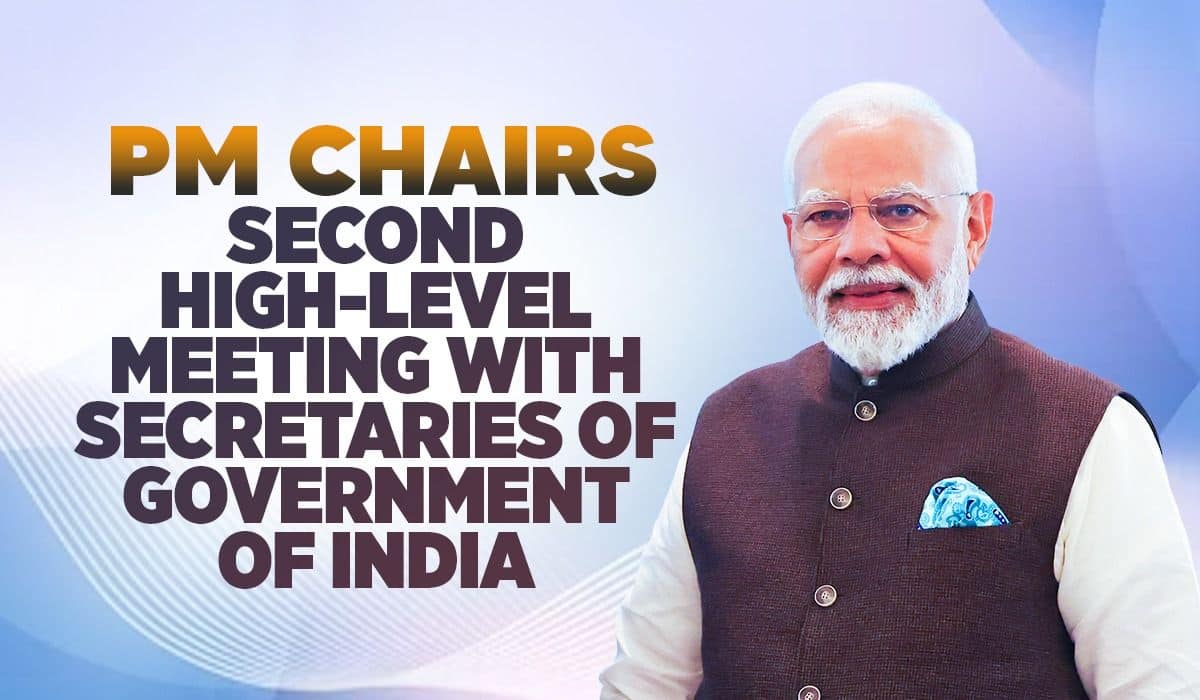
Prime Minister Narendra Modi Chairs Second High-Level Meeting with Secretaries of Government of India
July 28, 2026
Sectors discussed: Finance and Economy, Commerce and Industry, and Technology
PM emphasises the need to break both horizontal and vertical silos within the Government
PM emphasises the importance of technological self-reliance and building domestic capabilities in critical sectors
PM encourages greater participation of young innovators and entrepreneurs in cybersecurity ecosystem
PM Stresses Proactive Outreach on Strategic Sectors to Counter Misinformation
PM says Govt must always remain youthful, dynamic and forward-looking, continuously adapting to new challenges and opportunities with agility and innovation
Secretaries share experiences and perspectives on key initiatives, emerging opportunities and implementation challenges

Prime Minister Shri Narendra Modi chaired the second high-level meeting with Secretaries to the Government of India at his residence at 7, Lok Kalyan Marg earlier today. He reviewed the future action agenda of Ministries and Departments dealing with Finance and Economy, Commerce and Industry, and Technology sectors. The meeting focused on accelerating progress towards the goals of Viksit Bharat.

Prime Minister called for a strong focus on team building across Ministries and Departments, urging officers to work with a shared sense of purpose. He emphasised the need to break both horizontal and vertical silos within the Government so that departments function in close coordination and deliver integrated outcomes.

Highlighting the importance of citizen-centric governance, Prime Minister said that the people of India must remain at the centre of governance. He reminded that every decision and policy should be guided by the interests and aspirations of the common citizen.

Prime Minister stressed that while India is making significant investments in infrastructure, equal priority must be given to developing indigenous technologies. He underscored the importance of technological self-reliance and building domestic capabilities in critical sectors.

Prime Minister underlined that energy security is closely linked with national security, economic stability and citizens’ welfare. Prime Minister said India must achieve self-reliance in the energy sector through innovation, diversification and accelerated capacity creation.

Emphasising that reforms are not merely a fashionable term but a continuous necessity for effective governance, Prime Minister stressed the need to reform processes, improve work culture and strengthen institutional efficiency.

Prime Minister said that growing use of technology must be accompanied by a strong focus on cybersecurity to safeguard digital systems and infrastructure. He stressed the need for constant vigilance against emerging cyber threats. He called for encouraging greater participation of young innovators and entrepreneurs in the cybersecurity ecosystem and emphasised that it should evolve into a nationwide movement.

Prime Minister also emphasised the importance of proactive communication on strategic sectors where the country is undertaking major initiatives, to counter misinformation and unfounded fears surrounding such efforts.

Prime Minister says that new academic courses should be planned in partnership with industry to equip the workforce with skills required by emerging and future industries. He also observed that a government must always remain youthful, dynamic and forward-looking, continuously adapting to new challenges and opportunities with agility and innovation.

The meeting featured detailed discussions by Secretaries on the progress, priorities and implementation issues across their respective domains. The meeting was attended by the Cabinet Secretary, Secretaries of key Ministries and Departments, and senior officials from the Prime Minister’s Office.