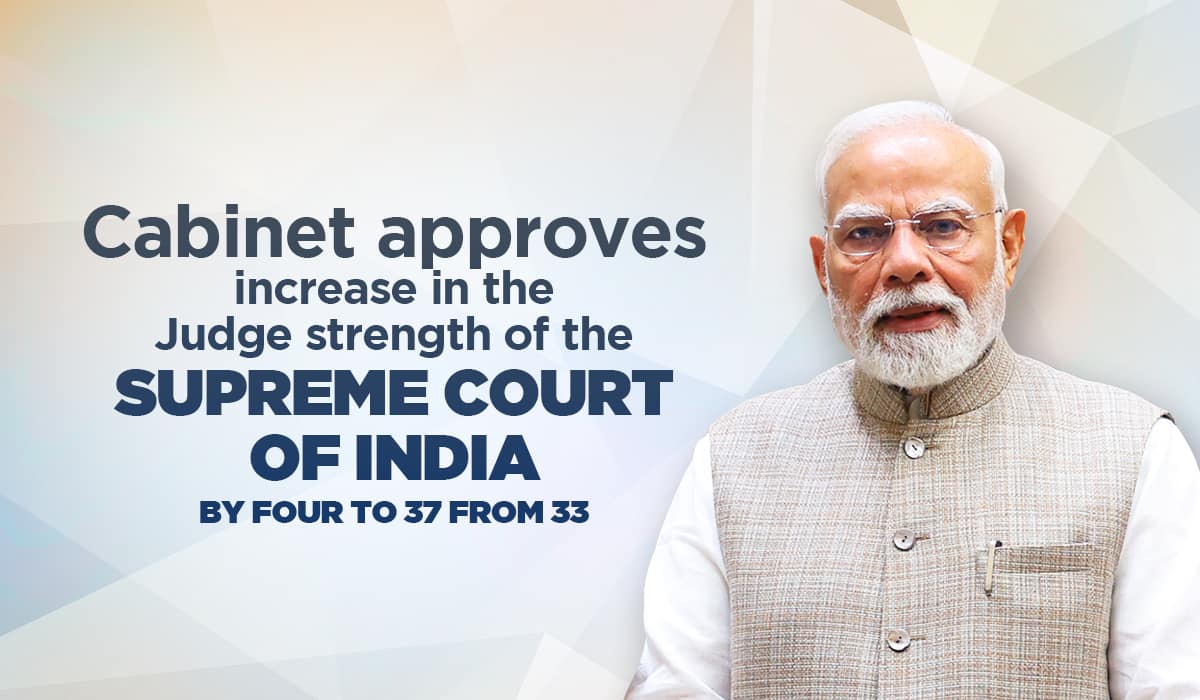
The Union Cabinet chaired by the Prime Minister Shri Narendra Modi today has approved the proposal for introducing The Supreme Court (Number of Judges) Amendment Bill, 2026 in Parliament to amend The Supreme Court (Number of Judges) Act, 1956 for increasing the number of Judges of the Supreme Court of India by 4 from the present 33 to 37 (excluding the Chief Justice of India).
Point-wise details:
Supreme Court (Number of Judges) Amendment Bill, 2026 provides for increasing the number of Judges of the Supreme Court by 04 i.e. from 33 to 37 (excluding the Chief Justice of India).
Major Impact:
The increase in the number of Judges will allow Supreme Court to function more efficiently and effectively ensuring speedy justice.
Expenditure:
The expenditure on salary of Judges and supporting staff and other facilities will be met from the Consolidated Fund of India.
Background:
Article 124 (1) in Constitution of India inter-alia provided “There shall be a Supreme Court of India consisting of a Chief Justice of India and, until Parliament by law prescribes a larger number, of not more than seven other Judges…”.
An act to increase the Judge strength of the Supreme Court of India was enacted in 1956 vide The Supreme Court (Number of Judges) Act 1956. Section 2 of the Act provided for the maximum number of Judges (excluding the Chief Justice of India) to be 10.
The Judge strength of the Supreme Court of India was increased to 13 by The Supreme Court (Number of Judges) Amendment Act, 1960, and to 17 by The Supreme Court (Number of Judges) Amendment Act, 1977. The working strength of the Supreme Court of India was, however, restricted to 15 Judges by the Cabinet, excluding the Chief Justice of India, till the end of 1979, when the restriction was withdrawn at the request of the Chief Justice of India.
The Supreme Court (Number of Judges) Amendment Act, 1986 further augmented the Judge strength of the Supreme Court of India, excluding the Chief Justice of India, from 17 to 25. Subsequently, The Supreme Court (Number of Judges) Amendment Act, 2008 further augmented the Judge strength of the Supreme Court of India from 25 to 30.
The Judge strength of the Supreme Court of India was last increased from 30 to 33 (excluding the Chief Justice of India) by further amending the original act vide The Supreme Court (Number of Judges) Amendment Act, 2019.