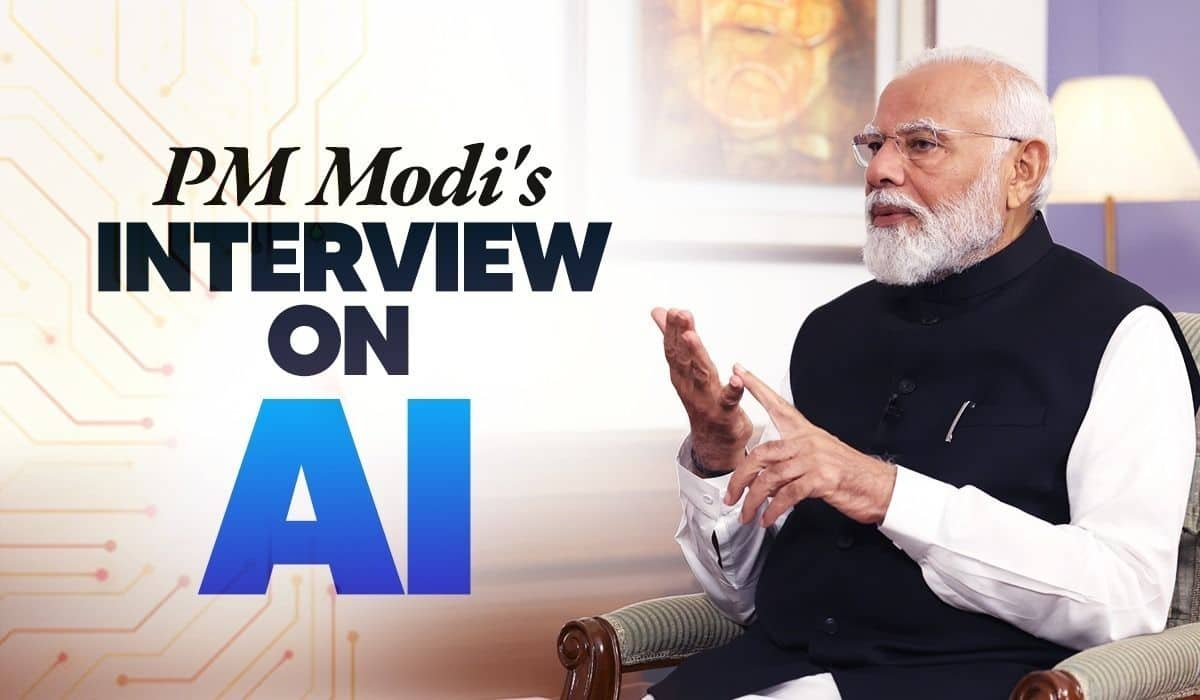
Shri Narendra Modi spoke to ABP News’ Special Programme – Ghoshana Patra – and put forth his views on various topics doing the rounds of the political discourse in the country.
Edited full excerpts from the interview -
Q Shazi Zaman (Group Editor, ABP News): According to the format of the show, first question we put up is that why should the country vote for you?
A (Narendra Modi): 2014 poll has brought hope. There is distrust, stagnancy and immense corruption around. On one hand people are hugely disappointed and on the other hand people are thinking whether there is a place where such dirty politics doesn’t exist? Will the country run with a squabble (tu main main). BJP with its track record has developed a trust among the people. This is on the basis of good governance and other is of development. The Country needs a change and even the poor people now realise it now. This election is not of arithmetic calculation but of the chemistry feeling of 125 crore people. 232 seats which have gone to polls has exposed the body language of Congress, you can see the kind of language they use. Due to these reasons, people will make BJP & NDA victorious.
Q SZ: Will NDA attain the majority? You may get seats but what if some parties refuse to give support, then your seat count would be reduced?
A: This is good arithmetic point of view. But this election is not of arithmetic calculations and is of chemistry. Prediction of lot of political pundits would go wrong this time. I have been directly involved with people in this poll; have travelled all over the country. I was a political science student. So I believe BJP will get the clear cut mandate and come to power. With NDA we will grow stronger. In India ‘perception politics’ happens. We have a pre poll alliance of 25 parties. First time in history it has happened.
Q Rajiv Khandekar (Editor – ABP Majha): You have good relation with Mamata, Jayalalithaa but you are making personal attacks on them which you didn’t in your initial campaigning. BJP didn’t have such confidence to attack then? There were talks in Maharashtra that you and Sharad Pawar are good friends and are coming together in this election?
A: If we used such kind of a language earlier then we would have been labelled of having an arrogant approach. It could have affected us. That’s why our strategy was placid and then there was a progressive enfoldment. In the next 10 days more of such will happen which is a part of our strategy.
Q RK: Yeda Bankar Peda Khao…
A: When I will go to Maharashtra I will talk about Sharad Pawar. When in Tamil Nadu I will talk about Jayalalithaa. In West Bengal will talk about Mamata. In Orissa about Naveen Patnaik. Whichever state I go for the first time I express my thoughts. It’s not that the situation changed so our strategy changed. In elections BJP should be clear cut in their thoughts portrayed to people. We do not want to create confusion or else confusion in masses will grow. Why this hypocrisy? In elections we are actually facing a challenge from Mamata and Patnaik. So why mislead the nation?
Q RK: Is there truth that you and Sharad Pawar had plans to come together?
A: No it’s not true. As far as friendship is concerned you will be surprised to know that I have friendly relations with Lalu Yadav (RJD chief). We are in a political life and due to our ideologies our stands are different. But we are all a big family and we are not enemies.
Q Suman De (Editor, ABP Ananda): When you were sure that Mamataji would not enter NDA you became strict, your softened approach turned into a strict Masterji?
A: We knew well in hand that Mamaji would not enter NDA. There were no doubts about it. I said the way the LEFT conditioned this state; Mamataji is taking a very long time to bring the state out of it. The symptoms are not to be seen. More than being angry I am disappointed with the condition of the state.
Q SZ: In your initial campaign your tone was not like this but now it has shifted to personal attacks, why?
A: See nobody wants to make personal attacks but during heat of election such attacks do happen. You call it personal or public. But you tell me if Wall Street Journal has published then is it personal? 2G scam happened, Raja had this role, PM had this role, and so would we call it personal? Some news traders are used by them to divert the issue. I remember during Mumbai attacks these news traders refrained us from commenting on Congress. There should be political satire in the country. Once in Parliament debate, Sharad Pawar gave a speech then Sushmaji also spoke. Sushmaji said she didn’t know if it’s Sharad Pawar speaking or Lalita Pawar. All enjoyed this in Parliament, so did Sharad Pawar. If it would have happened today then news traders would have taken this joke in a completely different direction. There has to be humour, happiness, satire.
Q SZ: You called Robert Vadra jijaji (brother-in-law)
A: We have to identify the person; he is related to a family. If I had another word for it, would have said that.
Q SZ: You are also in public life, personal attack on you also?
A: Country will decide if my allegations or allegations on me are true?
Q RK: Till when this allegation will continue you must have thought?
A: Until I don’t lose, until I am not defeated such allegations will continue. People who have been trying to defeat me for the past 12 years have been using all their strength. They couldn’t give me even a scratch. This is their ego problem.
Q RK: Ever thought such a debate and criticism you will have to face over your marital status?
A: I am not surprised about it. Talks also happen of things which are not related to me also. They don’t have anybody so what to do? They will keep on doing it.
Q SD: Mamata Banerjee is going to every district talking about your marital status on your affidavit. How do you feel?
A: I don’t feel anything about it. The ploy they have let them use it. Why should I think so much about the criticism? Let people judge.
Q SZ: There are lots of talks inside & outside BJP. Even about Murli Manohar Joshi issue. With your candidature do lots of people think doors are closed for them?
A: I never proposed my candidature for anything or for any post since I have been born. Decision of me is taken by BJP. I have never asked for my position, never snatched or done any kind of scheming. Whenever I have been bestowed a work, I do it with full dedication, hard work and have sacrificed my life for it.
Q RK: Is the RSS fighting election or the BJP? What’s your take on it?
A: Not any candidate, party or organisation is fighting elections. It’s being fought by people and the entire country.
Q SD: Do you think you have won if you become PM?
A: What is our aim, aim of the people is to eradicate this current government. That happens then the aim is fulfilled or else there is no win.
Q RK: You have been associated with RSS. Will reflection of RSS be seen in your future tasks if you become the PM?
A: I have to run the country. There is only one religion that is “India first” and we work according to the constitution. We have to take everyone together for development and that’s my only prayer.
Q RK: You and Mohan Bhagwat are both 1950 born. You have benefitted from him for what you are today?
A: His father has benefitted me a lot. His father was a pracharak in Gujarat. Lot of love I got from him.
Q SZ: Important question are Muslims scared of you? You look at people who support you and the one ones who don’t from the same lens. BJP leader Giriraj Singh said Modi’s critics should go to Pakistan. What do you have to say about that?
A: Nobody can agree to those (Giriraj) comments. My 2002 speech after winning polls would be in your library. After 2002 victory, in Maninagar that evening I thanked the electorate. I thanked people who voted, who didn’t. This government is for the people who voted, who didn’t and who voted against. My government’s mantra is abhayam, abhayam and abhayam. You can check the 2002 tape.
Q RK: In Bunch of thoughts it’s mentioned that minorities should accept culture of majority and it will then solve a lot of problems. What’s your say?
A: Programme of Bunch of thoughts book review should be organized. Experts should be called. The country would benefit we call these experts who are for and against it. It should be aired on ABP News.
Q: SZ: You are fighting on issue of development. But there is a communal stand on your Pink revolution comments. Your comments.
A: I don’t understand why communalism angle is infused into it. Somebody just make me understand. Ones who do cattle breeding should not lose their animals. The cattle which are not in good circumstances give 1.5 litre and not 4 litre. In many states and villages farmers are dying and their cattle is also destroyed. We need to worry about milk productivity. Need to think in a scientific manner. In India it is difficult for a person to undergo cataract operation. In my state cattle are undergoing cataract operations, dental treatment. I sent team of veterinary team of doctor to US. The cattle should not lose blood. Now with their study these doctors came and now these animals are undergoing laser operation technique. We cannot neglect them; it is unfortunate that people are calling it communal.
Q SZ: Lot of families are run due to slaughter houses. Another question is the meat export during NDA rule. Why didn’t your government do anything then?
A: I will see what problems they had then. I don’t have much initial detail of it, could be that cattle which didn’t produce milk were in huge number. Today the situation is more serious. It is not right to say that just one community is linked to it. My Jain brothers are in this profession as well. If due to environment businesses flop then we don’t look at religion involved in it right? We worry about environment; similarly we have to look at the rural economy. So country’s problem is not Modi but a “stagnated perverted mindset”. They want to take every issue to that one corner.
Q SD: When you talk of Delhi sultanat, Shehzada…people say it targets a specific community? You never say Rajkumar.
A: We used to read the word Shehzada in our history books. For Soniaji I used to call her Rajmata.
Q SZ: You have been questioned a lot about riots and taking responsibility for it, your court cases and puppy remark. My question is a little different, a person loses his/her life in a state, CM takes accountability for it, and do you take responsibility for it?
A: From Day 1 I have taken. In my State Assembly speeches, in all my interviews, everything is available.
Q SZ: It feels like you are trying to increase your rapport with the Muslim community.
A: My responsibility is to reach out to 6 crore Gujaratis in the state. I am trying my best to reach out to 100 cr. This is part of my responsibility and I must do it. Primary job is to reach out to every citizen from every state.
Q SZ: In that even the Muslim community is there?
A: I understand only one language that they are Indians and are my brothers. You can look at it from any colour. This kind of language what is being used has ruined the nation. I don’t care if I lose elections but will never own such kind of a mindset. I would request you to stop attacking me on my swatantrata.
Q: RK: Whenever 2002 question is put up, you say you have talked about it earlier.
A: Till 2007 I have responded to everyone to all questions asked. You can read it in print media, electronic media. Yes, in 2007 when UPA again tried to take all legal routes to drag me to court then I stopped talking as I didn’t want it to influence the issue because of Supreme Court ruling. Has any CM been grilled for 9 hours? SC has seen the tape as it ordered the questioning. I have been through all those hurdles and I am ready for it. Modi won’t surrender to such false political intentions.
Q RK: The demands that are asked to you are politically motivated?
A: That you decide whose agenda you have brought forward.
Q SZ: How will good days come? I have read your manifesto, lot of claims and promises are not mentioned in it, so how will it happen and when?
A: Everywhere is there an expiry date on it? Some tasks are there which are primary and some need to be addressed soon, some take 5 years. This manifesto is not for the entire century but is for a government’s 5 year tenure.
Q SZ: Will black money really come back to India? Are you raising a hope which would never be fulfilled?
A: There is a debate in the country that black money in foreign banks and no dispute about it. Lot of information channels which say there are hundreds of crores, some say thousands of crores. We will set up framework of legal team, with international relations and in accordance with international law.
Q SD: Inflation is the biggest problem which has been witnessed in our survey. How will your government control it and which sector you will give priority?
A: There are different set of problems. There is no real time data of our agriculture produce. We export pulses and then at four times the price we import pulses. Similarly we do it for sugar. In eight rupees we first export and in 80 rupees we import. This is a mess. If we have real time data we know how much wheat we have in stock, how much the requirement is? We can then analyse that if South India has started consuming wheat we should transfer then and in storage houses.
Q. SD But this is a longer term plan?
A: No this is not long term. This is done immediately. Secondly Food Corporation of India has failed miserably. They should be divided in three parts. One is farmers’ cultivation, second is storage. Our grains are being eaten by rats & gets damp. Third is distribution. In Railways marble is being loaded first and tomatoes are being ignored which get rotten. Agriculture has to be given priority. Farmer’s produce has to reach people in time. It’s about applying mind and then only can find a solution to it.
Q SZ: I heard you called us news trader.
A: Didn’t say to you
Q SZ: Ok, Thank You
A: You decide if you come in the news trader category or media. Why would I charge you?
Q SZ: If you form government, should media be afraid of you?
A: If any media org is scared of somebody then they should leave the industry itself. We don’t want a media which cornered by any force, we need media which is stronger & projects the truth. If someone is running away due to fear let me know, I will help.
Q RK: Media will be scared if a big leader in the country gives it a stamp of being a news trader.
A: Again verify. I only talk of news trader and not the media. I respect the media & it is your job to hunt such news traders. Media is the strength of democracy and should run in any kind of fear.
Q SZ: Your government will be of Ambani and Adani?
A: This is not your question. This is a myth spread by political parties which is being carried by you. We don’t expect this from you. Since 14 years people are talking about my government, that’s my identity. No middlemen roam in our corridor people say. My track record says. People say this government cannot be rushed or works under influence.
Q SZ: Rahul toffee remark. You haven’t responded to his Adani allegations?
A: I don’t have full details with me but want to tell you. Congress ruled between 1985-95 and at what price they gave away land is available. In 1997 Shankar Singh Vaghela government was there. Land was given is 25 paise and some land in 5 paise. We came and set parameters. SC has said other states should follow our policies in land issue. Its upto you to believe Rahul or SC. I request you should send a reporter to do research and then prove that this leader is lying.
Q SD: Rahul Gandhi, your political opponent, has said that if your government is formed, it will be a government of rich people. What is your response?
A: See, you should judge this in accordance with my track record. I hold a Vibrant Gujarat Summit every year to promote investment in my state, and it has been so successful that every state is doing it now. So in a way we have set a trend. But I do this only once in two years, for two days. But every year in June, on 13, 14 and 15, when the temperature in Gujarat is 45 degrees and it is next to impossible to step out of the house; the Chief Minister, with all the ministers, all IAS officers, all IPS officers and all officials of the forest service, all of us go to the villages, from house to house, sweating in the heat to get girls to go to school, and this is the reason that today my state has 100% enrolment. Thousands of cattle camps are organised at my place, and it is the result of this that milk production has increased 85-90%. There used to be minus agricultural growth in my state, we are not an agricultural state at all, there is no water source, but every year we have a month long agricultural festival every year, that too, before the rainy season. Meaning that in the heat of May and June, the 800 agricultural colleges of the university, nearly thousand progressive farmers of the state, the government’s whole agriculture department, irrigation department, animal husbandry department, and the ministers and chief minister himself, all of us go to the villages for a whole month. We sit with the farmers and discuss how old methods can be discarded and new ones adopted, what fertilizers and pesticides should be used, what shouldn’t be used. We are the first in India who started the soil health card. In India people don’t have health cards, but in our state farmers have a soil health card. The soil health card tells him what the deficiencies of his land for his crop are and what is needed. As a result, while the agricultural growth of India is not going beyond 2.5%, Gujarat, which has never been an agricultural state, has an average of over 10% of the last 10 years. Do you call all this work, the work of the rich?
Number 2, the growth of small and medium scale industries in our country is 19%, but in Gujarat it is 85%, do you call this the work of the riche?
When I came to power in Gujarat there were 11 universities, today there are 43, do you call this the work of the rich?
When I came to Gujarat there were 13 thousand engineering college seats, now there are 1 lakh 13 thousand, do you call this the work of the rich?
When I came to Gujarat, cotton growers used to produce 23 lakh bales, today it is 1 crore 23 lakh bales, is this the work of the rich?
This politics should end; these balloons of lies should end. The country will not accept these toffee sellers now.
Q SZ: A question about your image now. Those who like you, they like you so much that they wear masks of your face when they step out, while those who don’t like you say that your face itself is a mask. What do you say?
A: If god had given me the power to know and understand myself, then I could have scaled unknown heights, which is way God has probably not given me that power to understand myself. I try to understand myself through friends like you. Sometimes you like me, sometimes you don’t, but I respect them all. Weather it is bitter criticism or blind love, I respect them all. I try to turn the criticism and opposition to love, and show truth to those who blindly love. I will not live a double faced life, I will not face the nation like a mask, I will try to live as I am.
Q RK: Modi ji, the love for you has led to a new problem in Maharashtra. Raj Thackeray is supporting you, he says that he was the first one to say that you should be Prime Minister, but now the senior leaders of your party are calling him an uninvited guest and saying that if he wants to support then he should come in, or just leave. What is your response to all these exchanges?
A: When the results come on May 16, I am confident that we will not need any such support to form the government. But to run the country we will need everybody’s support, and I believe that in a democracy we need to rise above politics and take everyone’s cooperation to run the country. For running the government we won’t be needing any support, the people will give enough of it. But to run the country, everybody’s support should be taken. If Rahul Gandhi wins from Amethi, even though chances are slim, but if he does and sits as leader of Opposition, then his support should also be taken, that is my opinion. A country does not run like this, everybody has to be taken together to run the country. To run a government it is ok to take the verdict given by people.
Q SZ: There seems to be a difference of opinion within the party on whether action will be taken against Robert Vadra or not?
A: I think this is a very dirty question. On one hand, no one is above the law. Suppose there is an allegation against Narendra Modi, and suppose tomorrow Narendra Modi become the Prime Minister, then should the case against him be initiated or not; just because I became the Prime Minister everything be closed. It cannot be like that, right? I am not above anyone. But I am talking about myself here, not the person you asked about, don’t mix it up, I am sure you won’t play the news trader gimmick. I have 14 years to experience of running a government. I tell you, I have never opened anyone’s file ever. It is my opinion that I had gotten involved in all that then I would just have gotten more lost in it and would have been unable to do any good work. This is my personal opinion, I am not telling this as a government policy. I have separated myself from all this in 14 years and gave support only to new positive initiatives. I am not even aware of them, they are old things and must be in progress, the government knows it’s work. We come in for five years, if we start lugging this garbage around then when will we do some good work. So it is my opinion that my energies not be wasted in garbage. My energies should be directed towards good constructive work. Five years is very little time, if we get caught elsewhere then how will we do any good for the country. Rest the law should take its own course.
Q SZ: This question came up, and I asked this question, because voices within your party said that ‘the son-in-law will go to jail.’
A: See, you asked the wrong question. What is good or bad is not my issue. If you pick up things from every nook and cranny and demand answers from me, then aise kaam kaise chalega (how will we manage). Whatever my party’s official stand is, I will reflect that only.
Q SZ: Now an important national question. Is it true that you initiated a dialogue with a separatist leader?
A: I am just astounded since I heard. Where did this come from? Either way I haven’t kept track of the media today, but I think this had been cleared up, they have stated they are not Modi’s ambassadors. I don’t even know their names; these stories come on the news just like that.
Q SZ: Your party has accused UPA of having a weak stand over Pakistan. What is your definition of a tough stand towards Pakistan?
A: First of all, we want to run the country such, to make the country such, that koi hume aanken na dikhay, and hum bhi duniya kea age aanken dikha kar vyawahar nahi kar sakte hain. The world can neither function with glaring at each other, nor with keeping our eyes down. The conversations should be carried out looking into each other’s eyes, in international groupings; it is reciprocating and the best way.
Q: Did you take any initiative to talk to Kashmiri separatists as Geelani had claimed recently that two persons met him on his behalf?
A: I am surprised. Where did it come from? I do not even know their names...Now it seems it has been clarified by the persons concerned that they were not my representatives.
Q SZ: Another question related to this is, will you go to America if elected Prime Minister?
A: This is a very loaded question. The country’s people have selected me for doing the country’s work.
Q SZ: There is one aspect of your personality that we all see. The face that is visible here and on stage. But there must be another Narendra Modi as well. Once the official work ends, what does Narendra Modi do?
A: My work never ends. I am a workaholic. Other than sleeping and eating, I spend all my time working for the people. Even today, I have just come from the airport, the whole day I was in Chhattisgarh and Maharashtra. I held three meetings but when I left Jalgaon I found out that there is a huge storm. So started to check from there itself, what the condition is, if there were any casualties, if there had been any loss. This I why also got late in reaching here. So you see, I cannot sit still. To me I am a worshipper and the people are my god.
Q SD: Modi ji, the moment you stepped in here it was obvious that you are a bhakt of Swami Vivekananda, and he also figures in your speeches. We have heard that you are very attached to the Bellur Math and at one time you even went there to become a sadhu. Will you share that part of your life with us?
A: Swami Apasthanand is still there, he is very old now, but I had gone to see him and stayed with him for quite some time. But it is a different world, why get into it here.
Q SD: Do you miss those days now?
A: I am still much attached to them, but now since I am unable to go, it pains me to think of them. So I just stay busy with this work.
Q SD: Now a few questions about West Bengal. The TMC has accused you of trying to break the state, that for the one seat of Darjeeling, you have assured the people that you will view the demand for Gorkhaland with sympathy.
A: In a country this big, if you try to suppress regional expressions, then it will only inflame tensions. Their emotions should be viewed with sympathy and an effort should be made to understand them. Dialogue can open up a way; I thought I should say this publically so I did.
Q SD: So you will talk away the demand for Gorkhaland?
A: No, I am explaining the meaning of my speech, if someone has challenged it.
Q SZ: A question on your manifesto. Ram Mandir and Uniform Civil Code have been on your party’s agenda for a long time, but has never been fulfilled. You are known as a sharp leader, do you think you can fulfill these?
A: The country does not function with sharpness, it functions according to the constitution, and it will continue to function according to constitutional integrity. Sharpness is for elections only, not for running the country.
Q RK: Shiv Sena and MNS both are supporting you in Maharashtra. People believe that it will be good if their two leaders, Raj and Uddhav Thackeray, come together. So, have you ever tried to do something to bring the two together?
A: See, it is not right to weigh personal relations on a political scale. Which is why I have never crossed my limits. I kept things confined to friendship only and never taken an initiative in this issue; nor has anyone ever given me this task, so why should I get involved in such things.
Q SZ: Has Bollywood gotten divided over support to you?
A: I have very little familiarity with Bollywood, I don’t know that world. A few people have come to meet me since I became CM, but that too for business reasons. I don’t really know that world. Rest, people continue to take their personal positions.
Everyone has a right to their own opinions. Do we ever discuss weather there is a division in IITians or the media? 6 media in favour of Modi, 8 against, we never do a debate like that, do we
Q SZ: If you are given the option right now of watching whether an Aamir Khan movie or Salman Khan movie, which will you choose?
A: First of all pray that I get time to watch a movie. When I do, I’ll watch the first one I get. But watching both would not be possible.
Q RK: So you don’t watch movies at all?
A: I just don’t get the time, earlier I used to watch. Once I saw Paa on its launching with Amitabh ji, and once with Anupam ji I saw A Wednesday. These two films in the past 10 years, and a film on made on Swami Vivekanand on his 150 anniversary, that I saw because I also worked to make it successful.
Q RK: So how did u like the film on Vivekanand?
A: It was good. It is good for giving a message to the young generation, on an international level too. I liked that they did not show any miracles but kept it simple, the story of a social worker.
Q SZ: So Narendra Modi never relaxes?
A: My work is my relaxation, I don’t need anything extra.
Q When does your day start?
A: Usually I get up at 5, it’s a habit I have had since I was in the RSS. I don’t need much sleep, three hours is enough for me. My friends and my doctors complain that it is too less, but it is sufficient for me. You can see, I have worked all day but even now I am sitting here easily talking to you.
Q SD: The biggest issue in West Bengal right now is the Saradha scam. You raised this issue in your Siliguri rally too. So do you think there should be a CBI inquiry?
A: A lot of very poor people have lost money in this chit fund issue. Many even went to the extent of suicide. In such a situation, steps should be taken to reinforce people’s trust, it doesn’t matter what for it takes.
Courtesy: ABP News