In August this year, a group of farmers from Tamil Nadu met me and talked about how they were practising new agricultural techniques to boost sustainability and productivity. They invited me to a Summit on natural farming to be held in Coimbatore. I accepted their invite and promised them that I would be among them during the programme. Thus, a few weeks ago, on 19th November, I was in the lovely city of Coimbatore, attending the South India Natural Farming Summit 2025. A city known as an MSME backbone was hosting a big event on natural farming.

Natural farming, as we all know, draws from India’s traditional knowledge systems and modern ecological principles to cultivate crops without synthetic chemicals. It promotes diversified fields where plants, trees and livestock coexist to support natural biodiversity. The approach relies on recycling farm residues and enhancing soil health through mulching and aeration, rather than external inputs.

This Summit in Coimbatore will forever remain a part of my memory! It indicated a shift in mindset, imagination and confidence with which India’s farmers and agri-entrepreneurs are shaping the future of agriculture.

The programme included an interaction with farmers from Tamil Nadu, in which they showcased their efforts in natural farming and I was amazed!

I was struck by the fact that people from diverse backgrounds, including scientists, FPO leaders, first-generation graduates, traditional cultivators and notably people who had left high-paying corporate careers, decided to return to their roots and pursue natural farming.
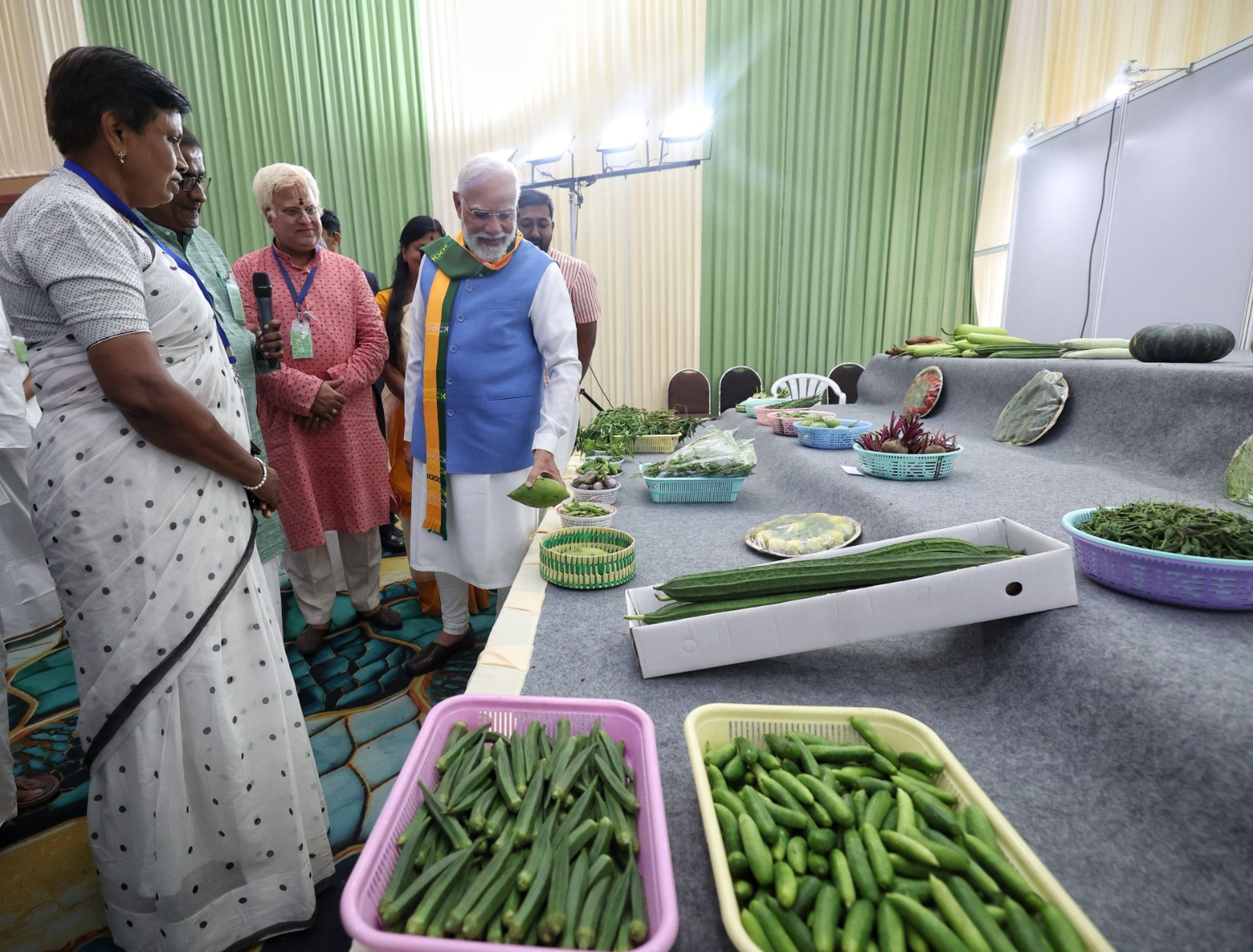
I met people whose life journeys and commitment to doing something new were noteworthy.

There was a farmer who managed nearly 10 acres of multi-layered agriculture with bananas, coconuts, papaya, pepper and turmeric. He maintains 60 desi cows, 400 goats and local poultry.

Another farmer has dedicated himself to preserving native rice varieties like Mapillai Samba and Karuppu Kavuni. He focuses on value-added products, creating health mixes, puffed rice, chocolates and protein bars.

There was a first-generation graduate who runs a 15-acre natural farm and has trained over 3,000 farmers, supplying nearly 30 tonnes of vegetables every month.

Some people who were running their own FPOs supported tapioca farmers and promoted tapioca-based products as a sustainable raw material for bioethanol and Compressed Biogas.

One of the agri-innovators was a biotechnology professional who built a seaweed-based biofertilizer enterprise employing 600 fishermen across coastal districts; another developed nutrient-enriched bioactive biochar that boosts soil health. They both showed how science and sustainability can blend seamlessly.

The people I met there belonged to different backgrounds, but there was one thing in common: a complete commitment to soil health, sustainability, community upliftment and a deep sense of enterprise.

At a larger level, India has made commendable progress in the field. Last year, the Government of India launched the National Mission on Natural Farming, which has already connected lakhs of farmers with sustainable practices. Across the nation, thousands of hectares are under natural farming. Efforts by the Government such as encouraging exports, institutional credit being expanded significantly through the Kisan Credit Card (including for livestock and fisheries) and PM-Kisan, have also helped farmers pursuing natural farming.
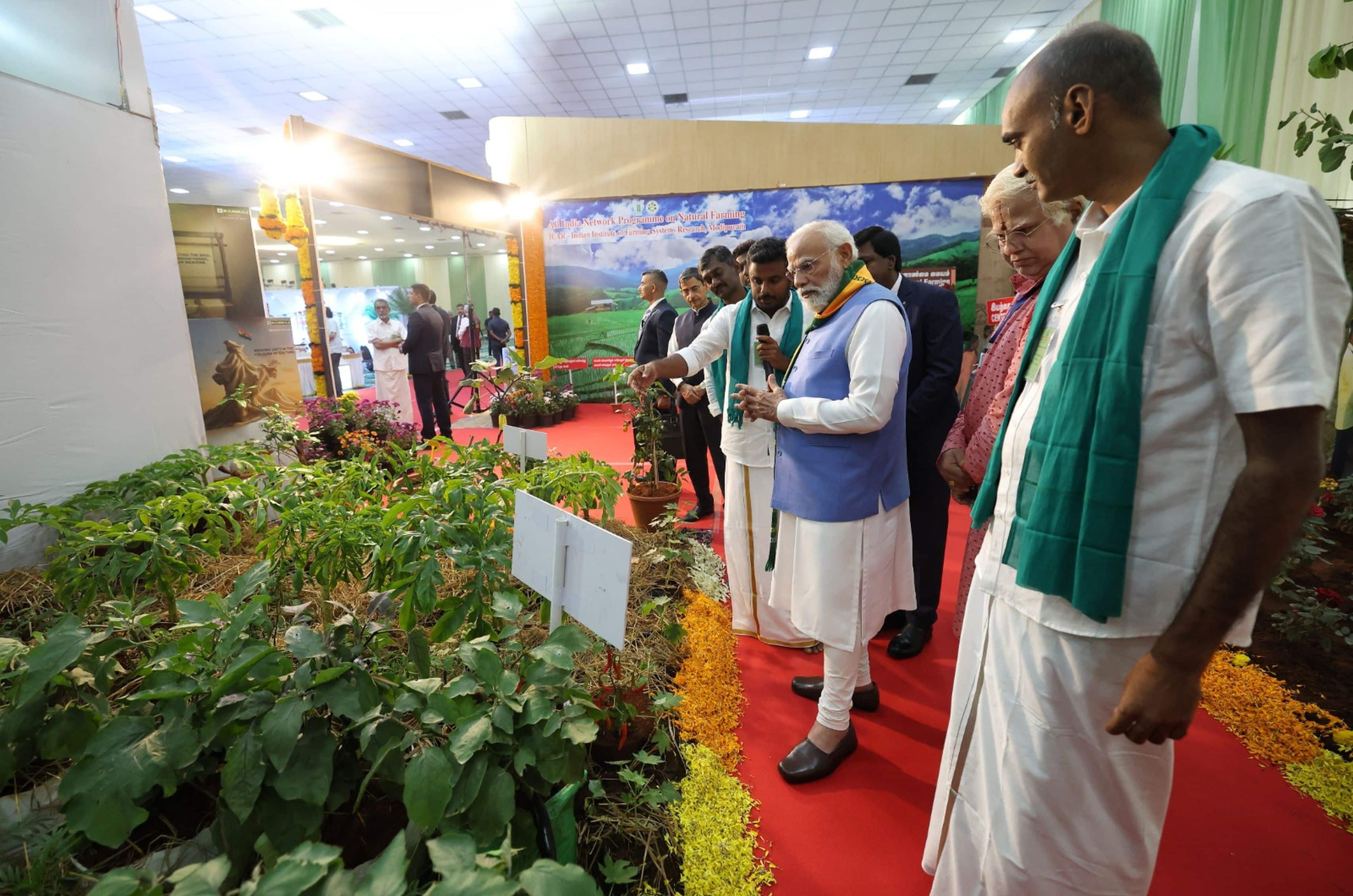
Natural farming is also closely linked to our efforts to promote Shri Anna or millets. What is also gladdening is the fact that women farmers are taking to natural farming in a big way.

Over the past few decades, the rising dependence on chemical fertilisers and pesticides has affected soil fertility, moisture and long-term sustainability. At the same time, farming costs have steadily increased. Natural farming directly addresses these challenges. The use of Panchagavya, Jeevamrit, Beejamrit, and mulching protects soil health, reduces chemical exposure, and lowers input costs while building strength against climate change and erratic weather patterns.

I encouraged farmers to begin with ‘one acre, one season.’ The outcomes from even a small plot can build confidence and inspire larger adoption. When traditional wisdom, scientific validation and institutional support come together, natural farming can become feasible and transformative.

I call upon all of you to think of pursuing natural farming. You can do this by being associated with FPOs, which are becoming strong platforms for collective empowerment. You can explore a StartUp relating to this area.

Seeing the convergence between farmers, science, entrepreneurship and collective action in Coimbatore was truly inspiring. And, I am sure we will together continue making our agriculture and allied sectors productive and sustainable. If you know of teams working on natural farming, do let me know too!

Explore More
শ্ৰী ৰাম জনমভূমি মন্দিৰৰ ধ্বজাৰোহণ উৎসৱত প্ৰধানমন্ত্ৰীৰ সম্বোধনৰ অসমীয়া অনুবাদ

Popular Speeches

শ্ৰী ৰাম জনমভূমি মন্দিৰৰ ধ্বজাৰোহণ উৎসৱত প্ৰধানমন্ত্ৰীৰ সম্বোধনৰ অসমীয়া অনুবাদ
India remains among best-performing major economies: S&P Global

Media Coverage

India remains among best-performing major economies: S&P Global
NM on the go

Nm on the go

Always be the first to hear from the PM. Get the App Now!
...
মহাত্মা জ্যোতিৰাও ফুলে: এক জ্যোতি যিয়ে এতিয়াও ভাৰতক পথ প্ৰদৰ্শন কৰে
April 11, 2026

Today, 11th April, is a deeply special day for all of us. It is the birth anniversary of Mahatma Jyotirao Phule, one of India’s greatest social reformers and a guiding light for generations. This year, the occasion carries even greater significance, as it marks the beginning of his 200th birth anniversary celebrations.

Mahatma Phule was a great reformer. In addition to that, his was a life of moral courage, restless enquiry and unshakable commitment to social good. Mahatma Phule is remembered for the institutions he built and the movements he led. At the same time, his contribution to our civilisational journey lies in the hope he aroused, the confidence he instilled and the strength his thoughts continue to give to millions of people across the nation.

Born in the great state of Maharashtra in 1827, Mahatma Phule emerged from modest beginnings. But his initial hardships never stood in the way of his learning, his courage or his commitment to society. This is a trait that remained with him forever: whatever the challenges may be, one must work hard, acquire knowledge and mitigate those challenges instead of doing nothing about it. From his school days, young Jyotirao was deeply curious and became a voracious reader, often reading books far beyond what children his age were expected to engage with. Years later, he said, “The more questions we generate, the more knowledge emerges from them.” Clearly, the spirit of enquiry he was blessed with since his childhood remained constant in his journey.

Throughout his life, learning and education became central to Mahatma Phule’s mission. He recognised with rare clarity that knowledge is not a privilege to be guarded, but a force to be shared. At a time when the joys of learning were denied to many, he opened pioneering schools for girls and for those kept out of formal education. He used to say, “Any improvement that comes in children through mothers is deeply valuable. Therefore, if schools are to be opened, they should first be opened for girls.” He worked to create a new social imagination in which the classroom became an instrument of justice and equality..

His vision for education inspires us greatly. Over the last decade, we have worked to make research and innovation a cornerstone for the youth of India. Efforts are being made to create an ecosystem where young minds are encouraged to question, explore and innovate. By investing in knowledge, skills and opportunity, India is empowering its youth to become problem-solvers and drivers of national progress.

Due to his knowledge and wisdom, Mahatma Phule developed a strong understanding of areas such as agriculture, healthcare and rural development. He often said that injustice towards our farmers and workers weakens our society. He saw how social inequalities manifested themselves in daily life, be it in the farms or in villages. Hence, he immersed himself in ensuring dignity for the poor, the downtrodden and the marginalised. At the same time, he made every possible effort to ensure social harmony was maintained.

Mahatma Phule opined, “जोपर्यंत समाजातील सर्वांना समान अधिकार मिळत नाहीत, तोपर्यंत खरे स्वातंत्र्य मिळत नाही” (True freedom cannot be achieved until everyone in society is granted equal rights). And for that, he built institutions that translated this vision into action, contributing to a just society. The Satyashodhak Samaj, founded by him, was one of the most important social reform movements in modern India. It was at the forefront of social reform, community service and furthering human dignity. It became an effective voice for women, youngsters and those living in villages. This movement reflected Mahatma Phule’s intrinsic belief that society could be strengthened by placing at its core justice, respect for every person and a spirit of collective progress.

His personal life, too, carried lessons in courage. Always working and being among the people took a toll on his health. But even the most serious health challenges did not dim his resolve. After suffering a debilitating stroke, he continued to work and fulfil his vision. Yes, his body had been tested, but his commitment to society had not yielded. For millions today, especially those who draw courage from struggle, this remains one of the most powerful dimensions of his life.

No remembrance of Mahatma Phule can be complete without a respectful mention of Savitribai Phule, who was herself one of the tallest reformers of our nation. As one of India’s pioneering women teachers, she played a defining role in advancing education for girls, thus giving them the opportunity to pursue their dreams. After Mahatma Phule’s passing, Savitribai carried forward that torch and, in 1897, during a plague outbreak, she served victims with such devotion that she herself contracted the disease and lost her own life.

Our land has been blessed, time and again, by great men and women who have strengthened society through thought, sacrifice and action. They did not wait for change to arrive from somewhere else. They became its source. For hundreds of years in our land, the clarion call for social betterment has often risen from within society itself, from those who could see suffering clearly and refused to accept it as fate. Mahatma Jyotirao Phule was one such voice.

I fondly recall my visit to Pune in 2022, when I had offered tributes to Mahatma Phule at his grand statue in the city. As we mark the beginning of his bicentenary year, the most fitting tribute to Mahatma Jyotirao Phule is about renewal. Renewal of our commitment to subjects close to his heart, such as education. Renewal of our sensitivity to injustice. Renewal of our faith that society can improve itself from within. His life tells us that the power of community can achieve miracles in India when joined with moral clarity and public purpose. That is why he still gives strength to millions. That is why his words and work still carry hope. And that is why, nearly two hundred years after his birth, Mahatma Jyotirao Phule remains not a figure of the past, but a guide for India’s future.