2011's Message: For Transformation, 'Sauno Saath-Sauno Vikas'!

Published By : Admin | December 30, 2011 | 10:39 IST

Dear Friends,

It is that time of the year when we bid farewell to what has gone by and welcome what lies ahead. As the joys and sorrows of 2011 pave way for the expectations and apprehensions of 2012, I felt it would be an appropriate exercise to go back in time and remember the year just gone by.

If there was one word that defined 2011, it was ‘protest’. Time Magazine summed up the essence of 2011 by naming ‘The Protestor’ as its Person of the Year. More than any individual, it was collective strength that defined the year gone by. Protests took place against Governments that were unable to live up to the aspirations of the people particularly the youth. Further, it was the cradles of human civilization that showed the way in challenging the status quo. If Egypt marked the rise of the Arab Spring, the Middle East saw protests aplenty while the people of Greece protested in the wake of economic downturn. Even America had its Occupy Wall Street Movement! When the forbearers of humankind become grounds of such protest it is nothing less than a call for introspection.

Talking about protest and 2011, it is impossible to forget events at home. We have been at the forefront of global protests in more ways than one. It is a matter of great pride to note that most of the protests across the World were non-violent! What can be a greater tribute to Mahatma Gandhi than the fact that even today, youngsters across the world are adopting his ways in order to make their voices heard! Be it the Independence Struggle in the first half of the 20th century, 1974 Navnirman Movement in Gujarat that challenged the might of an unhealthy status quo or 1975 Emergency when democracy came under severe strain, India continued to show the world the power of peaceful protest.

Protests in India took place as a distinct change of mood engulfed the nation. Bad economics, poor governance coupled with regular attacks on the federal structure of the country have made the people of this country impatient and disappointed. From corporate leaders to people on the street, there is near total talk of a ‘governance deficit’, a ‘policy paralysis’ covering the nation. This explains best the scores of protests across India against complacent Governments, be it in the states or at the Centre.

But, there remains a shining ray of hope in the midst of these otherwise difficult times. Rather than being disappointed or overtly critical we must view them as a ray of opportunity! During my recent trip to China, I spoke of how it is now for Asia to emerge as a growth engine of the world in the wake of the global financial crisis. The crisis of western capitalism is a unique opportunity for India to lead the world, accelerate her growth and pull out the millions of people from the clutches of poverty.

Friends, mass movements are not only about protests. I consider myself fortunate to be witnessing a mass movement that that is manifested in the spirit of Sauno Saath, Sauno Vikas (all together, growth for all), where inclusive growth with collective effort creates a unique mass movement for overall development. In Gujarat, we added a 4th S of Sadbhavana to our 3 S (Speed, Scale and Skill) model of progress. I am overwhelmed when I see so many people coming under one roof to show the world the power that drives Gujarat’s growth. Mass movements are as much created when the entire state administration including ministers and senior officials go out to the villages asking families to educate their girl child. When I read about a 16-year old specially abled girl breaking cricketing records in Khel Mahakumbh 2011 it was as much a mass movement suggesting large-scale inclusion! These instances inspire me to work harder so that the ocean of talent is recognized and is able to serve the country to the fullest.

Our democracy remains both young and strong. While we face numerous challenges from both within and outside, I am confident we will emerge stronger, like we have done in the past. In the coming year let us resolve to working towards taking India ahead. The Gujarat Government has declared 2012 as the ‘Year of Youth Power’ commemorating the 150th birth anniversary of Swami Vivekananda. No growth is compete till our youth is given an opportunity to shine and I am sure this will give a boost to youth talent and generate opportunities.

If there is one lasting message of 2011, it is that people power is necessary but not sufficient to transform nations. People power must be combined with good governance to bring about real, deep and lasting change. This combination can achieve almost everything from eliminating corruption to ending malnutrition and illiteracy. It can create a better future for ourselves and generations to come. In Gujarat, good governance coupled with development and harmony has amplified the power of 6 crore Gujaratis. I hope we can do the same as Indians for our nation. If 2011 unleashed the power of protest, let 2012 further demonstrate the power of Sauno Saath, Sauno Vikas!

I take this opportunity to wish you and your loved ones a very Happy 2012! With the blessings of Almighty, may the New Year bring both joy and success at your doorstep!

Explore More
Today, the entire country and entire world is filled with the spirit of Bhagwan Shri Ram: PM Modi at Dhwajarohan Utsav in Ayodhya

Popular Speeches

Today, the entire country and entire world is filled with the spirit of Bhagwan Shri Ram: PM Modi at Dhwajarohan Utsav in Ayodhya
India's food services market to reach USD 150 billion by FY31, online share to rise to 18%: Report

Media Coverage

India's food services market to reach USD 150 billion by FY31, online share to rise to 18%: Report
NM on the go

Nm on the go

Always be the first to hear from the PM. Get the App Now!
...
A life devoted to India’s unity and progress
July 06, 2026

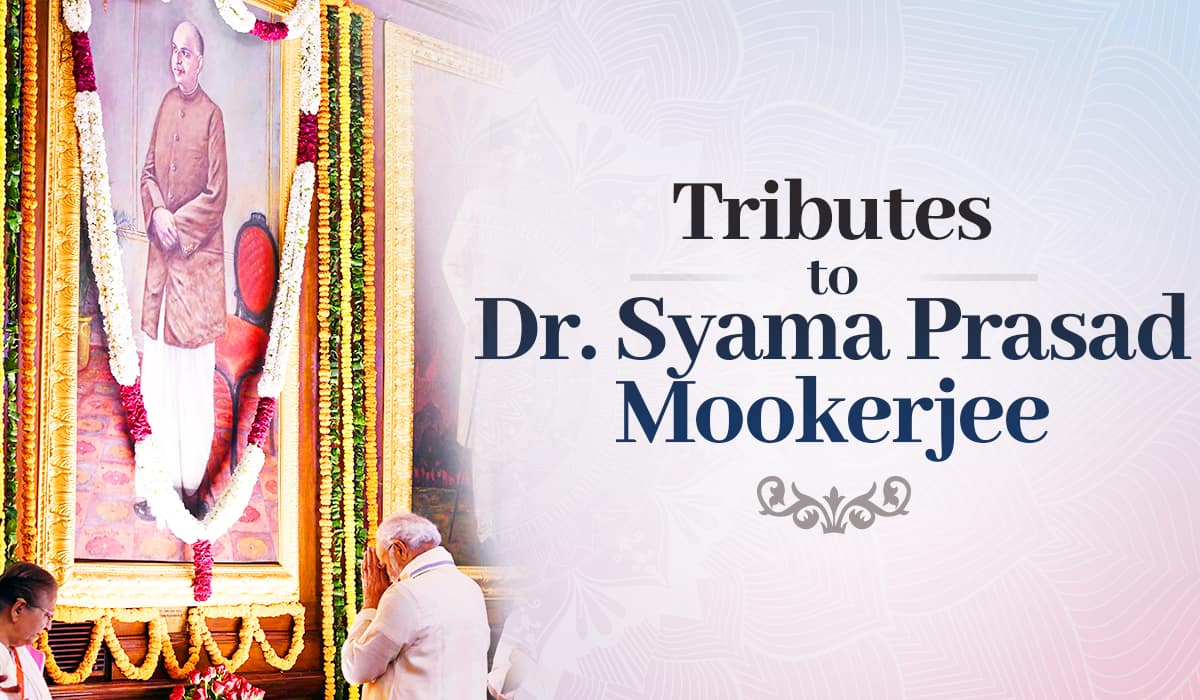
Today, 6th July, is a special day for countless people who cherish the ideals of nationalism and selfless service. We commemorate the 125th birth anniversary of Dr. Syama Prasad Mookerjee, whose life remains a timeless example of courage and unwavering commitment to Maa Bharti. Few leaders in modern India embodied the seamless confluence of intellect, public service and moral conviction as profoundly as Dr. Syama Prasad Mookerjee.

The young Syama Prasad was born into circumstances that could easily have assured him a protected and comfortable life. His father, Sir Ashutosh Mookerjee, was among the foremost educationists and intellectuals of his age. Yet, while destiny placed before him a path of privilege, his conscience led him towards one of sacrifice and national service. He was convinced that he could not remain a mute spectator to the turbulence of his times, be it fighting colonialism, communalism, humanitarian challenges and more. Along this journey, he endured profound personal tragedies, including the loss of an infant child and, later, his wife. Yet, these tragedies only deepened his resolve and strengthened his unwavering commitment to serve.

If there was one ideal that defined Dr. Syama Prasad Mookerjee’s public life above all else, it was the indivisibility of India. He stood firm during the upheaval of Partition to ensure that West Bengal remained an integral part of India. A few years later, that very conviction drew him to Jammu and Kashmir. Imprisonment did not deter him and isolation did not diminish him. His life came to an abrupt end in detention, far from the countless people whose cause he had made his own. There are moments in history when an individual’s final sacrifice transcends politics and enters the realm of national memory. Dr. Mookerjee’s last journey remains one such moment. Acharya Vinoba Bhave said that Dr. Mookerjee sacrificed himself for a cause in which he had faith. Years later, the revocation of Articles 370 and 35(A) in 2019 was the most fitting tribute to his martyrdom.

Dr. Mookerjee put India First and Indian values first. And he did it by building institutions and nurturing systems that defied conventional mindsets of those times. He became the youngest Vice Chancellor of the University of Calcutta. In his unique style, he brought positive changes that were patriotic and futuristic. Addressing a conference of educators, Dr. Mookerjee put it wonderfully when he said, “It is incorrect to look upon educational institutions as factories to produce potential clerks and low-paid staff. We have to turn out students who are capable of providing leadership to our self-governing institutions, such as municipal corporations, provincial and central legislatures and also of directing the affairs in various fields of life such as financial, commercial and industrial ones.”

Under his leadership, Calcutta University undertook unique efforts such as improving library infrastructure, boosting research in sciences, encouraging the study of artefacts and establishing courses in agriculture, to name a few. He drew attention to areas such as sports, teacher training and student welfare. To instil a sense of pride among students and alumni, he began a practice of marking 24th January as the foundation day of the University. He requested none other than Gurudev Tagore to compose a song for the University.

Yet another example of this spirit can be seen in the later part of his life, when he decided to form the Bharatiya Jana Sangh. At a time when the Congress Party was omnipresent, he felt that there was all the more reason for an alternative voice to speak up for India’s progress while staying attached to our cultural roots. It was perhaps fitting that the party’s symbol was the Diya, the earthen lamp. A single lamp may appear modest, yet it possesses the power to dispel darkness far beyond itself. It is exactly what the Jana Sangh did both during the years it was active and beyond.

Dr. Syama Prasad Mookerjee’s tenure as India’s first Minister for Industry and Supply reveals a statesman whose conception of development was remarkably comprehensive and humane. He viewed industry as a means of restoring dignity, opportunity and confidence to a newly independent nation. He respected wealth creation and value addition. While laying the foundations of modern industrial India through pioneering initiatives such as the Damodar Valley Corporation, the Sindri Fertiliser Plant and a robust industrial policy, he simultaneously ensured that India’s traditional strengths were not neglected. Handlooms, cottage industries, artisans and textile workers found in him an equally committed champion.

Here, I would like to share a personal experience. The Sindri plant, which Dr. Mookerjee worked to establish with a clear vision of self-reliance, was ignored by those who ran the nation for several decades. I feel honoured that our Government had the opportunity to contribute to its revival. It was indeed among the most special moments to have been there for that programme.

India’s civilisational tradition has long celebrated dialogue and discussions. Dr. Mookerjee embodied this democratic spirit. He joined Pandit Nehru’s Cabinet, believing that the task of nation-building in the early years transcended political differences. He served with sincerity and a constructive spirit. But when he felt that questions of national importance demanded a different course, he relinquished office with dignity and devoted himself wholeheartedly to the political work he believed the nation required.

75 years ago, Pandit Nehru brought the First Amendment, which was a direct assault on free speech. Dr. Mookerjee was among its staunchest critics. He understood fully what the Congress was capable of doing. And he was proven right. Those who brought the First Amendment 75 years ago imposed the Emergency in 1975 and 50 years ago, brought in the 42nd Amendment Act, which again struck at the core of liberal democratic values.

Dr. Mookerjee also stood out for his humanitarian efforts. When the most tragic famine struck Bengal in 1943, Dr. Mookerjee immersed himself in serving those affected. He ensured that several canteens and relief centres were opened to feed people. On one hand, he was deeply shaken by the plight of his people while on the other, he was repulsed by the insensitivity of the colonial rulers. He even wrote a book, Panchasher Manwantar, in which he expressed his angst. When a super cyclone hit Medinipur in 1942, his efforts to restore normalcy were widely lauded.

Speaking at a college in Kolkata, Dr. Mookerjee urged the youth, “Whatever work you undertake, do it seriously, thoroughly and well; never leave it half-done or undone, never feel yourself satisfied unless and until you have given it your very best.” As India advances towards the goal of a Viksit Bharat, the finest tribute we can pay him is to strive every day to build the strong, united, self-confident and compassionate India that he so deeply believed in. And knowing today’s youth, I am certain they will rise to the occasion and do exactly that.