Unleashing India’s Entrepreneurial Energy

Published By : Admin | January 1, 2016 | 01:03 IST

I strongly believe that India has a lot of latent entrepreneurial energy, which needs to be harnessed so that we become a nation of job givers, more than job seekers.  


-Narendra Modi

The NDA Government is focused on giving a boost to entrepreneurship. The ‘Make in India’ initiative is based on four pillars to boost entrepreneurship in India, not only in manufacturing but also in other sectors.

New Processes: ‘Make in India’ recognizes ‘ease of doing business’ as the single most important factor to promote entrepreneurship.

New Infrastructure: Availability of modern and facilitating infrastructure is a very important requirement for the growth of industry. Government intends to develop industrial corridors and smart cities to provide infrastructure based on state-of-the-art technology with modern high-speed communication and integrated logistic arrangements.

New Sectors: ‘Make in India’ has identified 25 sectors in manufacturing, infrastructure and service activities and detailed information is being shared on them with all stakeholders.

New Mindset: Industry is accustomed to see Government as a regulator. ‘Make in India’ intends to change this by bringing a paradigm shift in how Government interacts with industry. The Government’s approach will be that of a facilitator and not that of a regulator.

The Government is adopting a three pronged strategy to boost entrepreneurship. This is a 3 C Model being worked upon: Compliances, Capital & Contract Enforcement.                          

Compliances

India made rapid strides in the ‘Ease of Doing Business’ rankings by the Worls Bank rising to 130th rank. Today, starting a new business is easier than ever before. Unnecessary compliances have been removed and a lot of permissions can be obtained online.                                                                        

Process of applying for Industrial License (IL) and Industrial Entrepreneur Memorandum (IEM) has been made online and this service is now available to entrepreneurs on 24x7 basis. Around 20 services are integrated & will function as a single window portal for obtaining clearances from various governments and government agencies.

Government of India with support from World Bank group and KPMG carried out an assessment of implementation of business reforms by State Govts.  These rankings will  allow States  to  learn  from  one  another  and replicate success  stories,  thereby rapidly  improving  the  regulatory  environment  for  business  nationwide.

The Government also liberalized India’s FDI rules across multiple sectors to facilitate investment in India.

Capital

Around 58 million non-corporate enterprises provided one 128 million jobs in India.  60% of them were in rural areas.  Over 40% were owned by people from the Backward Classes and 15% by Scheduled Castes and Tribes.  But bank credit accounted for a tiny share of their financing.  Most of them never get any bank credit.  In other words   the most employment-intensive sector  of the economy  gets the least credit. To change this scenario, the Govt launched the Pradhan Mantri Mudra Yojana & the MUDRA Bank.

It has been started with the aim of availing collateral-free cheap credit to the small scale entrepreneurs who often have to pay exorbitant interest rates. In the brief period since its launch, it has already sanctioned about 1.18 crore loans amounting to almost 65,000 crores. The number of people getting a loan below Rs 50,000 registered a growth of 555% in April- September 2015 over the corresponding period of the previous year.


Contract Enforcement

To achieve better contract enforceability, the Arbitration Law has been changed to make arbitrations cheaper & faster. The law would impose deadlines to resolve cases & empower tribunals to enforce decisions.

The Government has also come up with a modern bankruptcy code, which will make exiting business easier.

Explore More
Today, the entire country and entire world is filled with the spirit of Bhagwan Shri Ram: PM Modi at Dhwajarohan Utsav in Ayodhya

Popular Speeches

Today, the entire country and entire world is filled with the spirit of Bhagwan Shri Ram: PM Modi at Dhwajarohan Utsav in Ayodhya
India’s PC exports double in a year, US among top buyers

Media Coverage

India’s PC exports double in a year, US among top buyers
NM on the go

Nm on the go

Always be the first to hear from the PM. Get the App Now!
...
6 Years of Jal Jeevan Mission: Transforming Lives, One Tap at a Time
August 14, 2025
Jal Jeevan Mission has become a major development parameter to provide water to every household.” - PM Narendra Modi

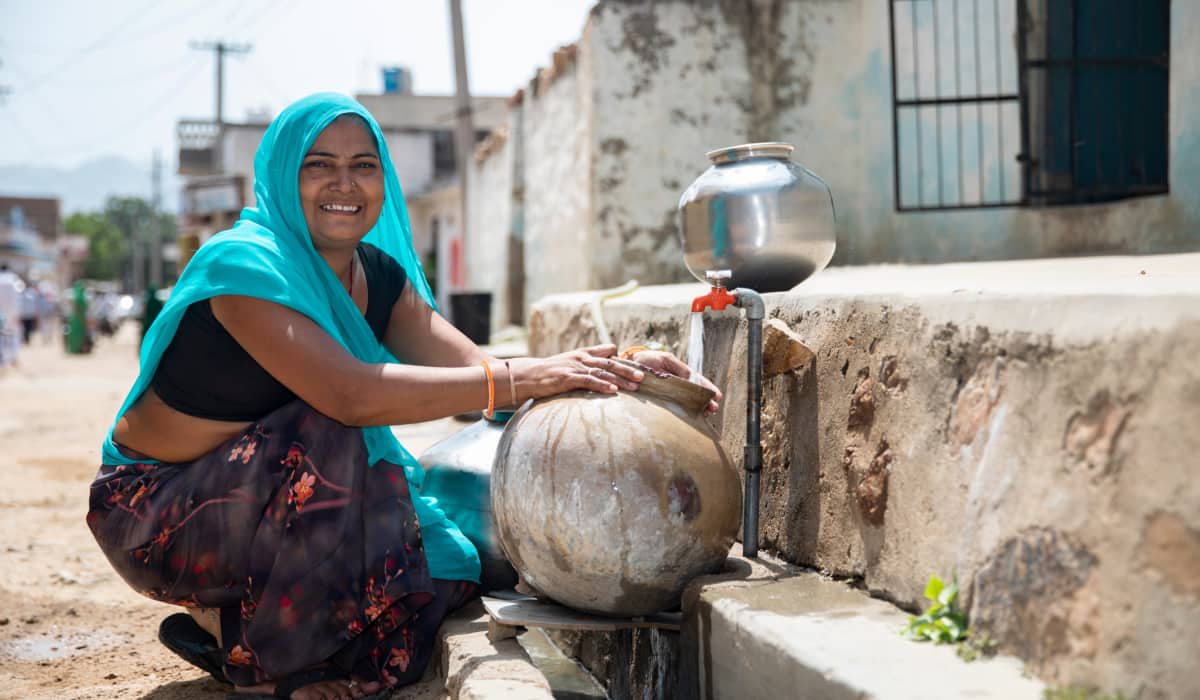
For generations, the sight of women carrying pots of water on their heads was an everyday scene in rural India. It was more than a chore, it was a necessity that was an integral part of their everyday life. The water was brought back, often just one or two pots which had to be stretched for drinking, cooking, cleaning, and washing. It was a routine that left little time for rest, education, or income-generating work, and the burden fell most heavily on women.

Before 2014 water scarcity, one of India’s most pressing problems, was met with little urgency or vision. Access to safe drinking water was fragmented, villages relied on distant sources, and nationwide household tap connections were seen as unrealistic.

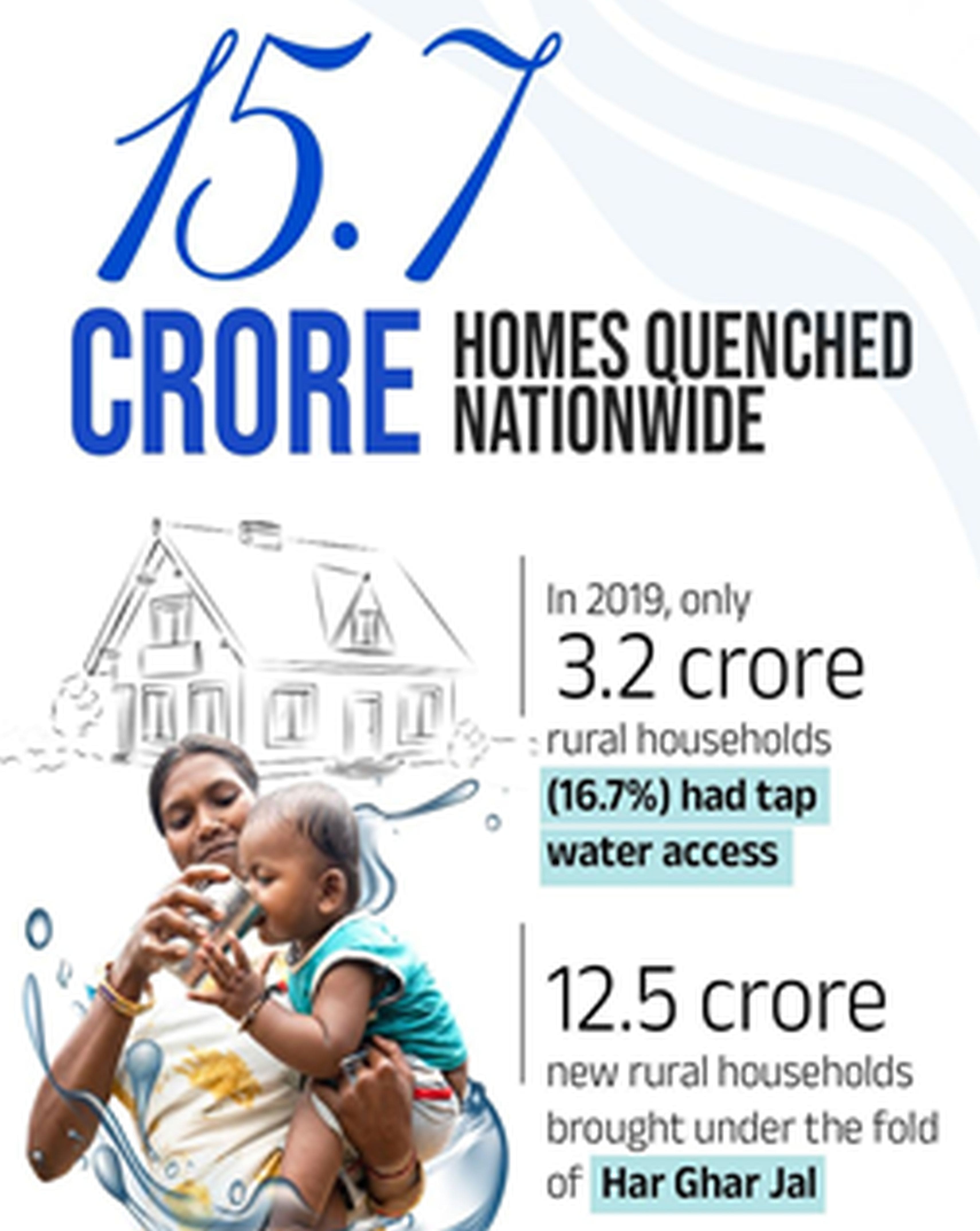
This reality began to shift in 2019, when the Government of India launched the Jal Jeevan Mission (JJM). A centrally sponsored initiative which aims at providing a Functional Household Tap Connection (FHTC) to every rural household. At that time, only 3.2 crore rural households, a modest 16.7% of the total, had tap water. The rest still depended on community sources, often far from home.

As of July 2025, the progress under the Har Ghar Jal program has been exceptional, with 12.5 crore additional rural households connected, bringing the total to over 15.7 crore. The program has achieved 100% tap water coverage in 200 districts and over 2.6 lakh villages, with 8 states and 3 union territories now fully covered. For millions, this means not just access to water at home, but saved time, improved health, and restored dignity. Nearly 80% of tap water coverage has been achieved in 112 aspirational districts, a significant rise from less than 8%. Additionally, 59 lakh households in LWE districts have gained tap water connections, ensuring development reaches every corner. Acknowledging both the significant progress and the road ahead, the Union Budget 2025–26 announced the program’s extension until 2028 with an increased budget.

The Jal Jeevan Mission, launched nationally in 2019, traces its origins to Gujarat, where Narendra Modi, as Chief Minister, tackled water scarcity in the arid state through the Sujalam Sufalam initiative. This effort formed a blueprint for a mission that would one day aim to provide tap water to every rural household in India.

Though drinking water is a State subject, the Government of India has taken on the role of a committed partner, providing technical and financial support while empowering States to plan and implement local solutions. To keep the Mission on track, a strong monitoring system links Aadhaar for targeting, geo-tags assets, conducts third-party inspections, and uses IoT devices to track village water flow.

The Jal Jeevan Mission’s objectives are as much about people as they are about pipes. By prioritizing underserved and water-stressed areas, ensuring that schools, Anganwadi centres, and health facilities have running water, and encouraging local communities to take ownership through contributions or shramdaan, the Mission aims to make safe water everyone’s responsibility..

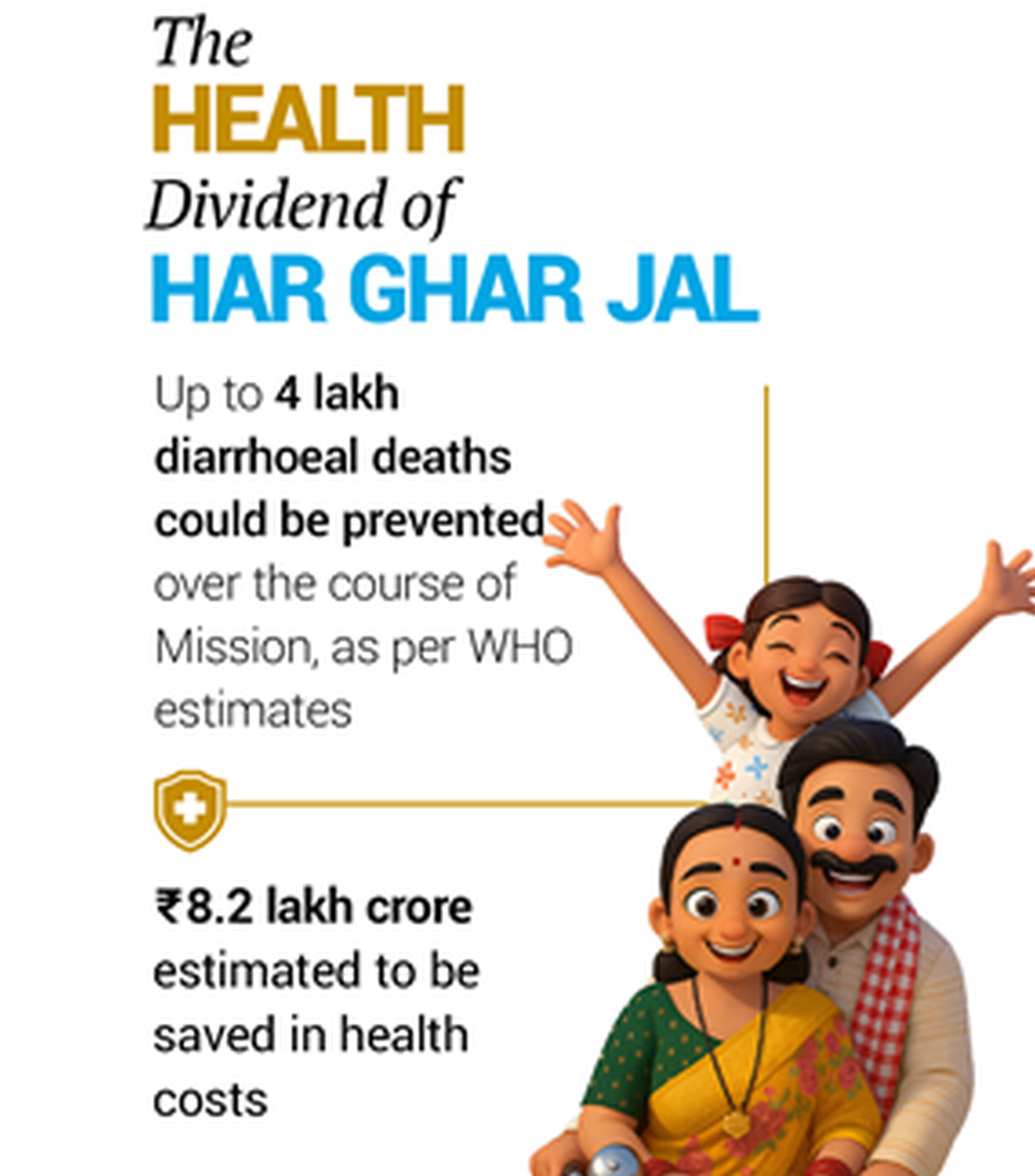
The impact reaches far beyond convenience. The World Health Organization estimates that achieving JJM’s targets could save over 5.5 crore hours each day, time that can now be spent on education, work, or family. 9 crore women no longer need to fetch water from outside. WHO also projects that safe water for all could prevent nearly 4 lakh deaths from diarrhoeal disease and save Rs. 8.2 lakh crores in health costs. Additionally, according to IIM Bangalore and the International Labour Organization, JJM has generated nearly 3 crore person-years of employment during its build-out, with nearly 25 lakh women are trained to use Field testing Kits.

From the quiet relief of a mother filling a glass of clean water in her kitchen, to the confidence of a school where children can drink without worry, the Jal Jeevan Mission is changing what it means to live in rural India.