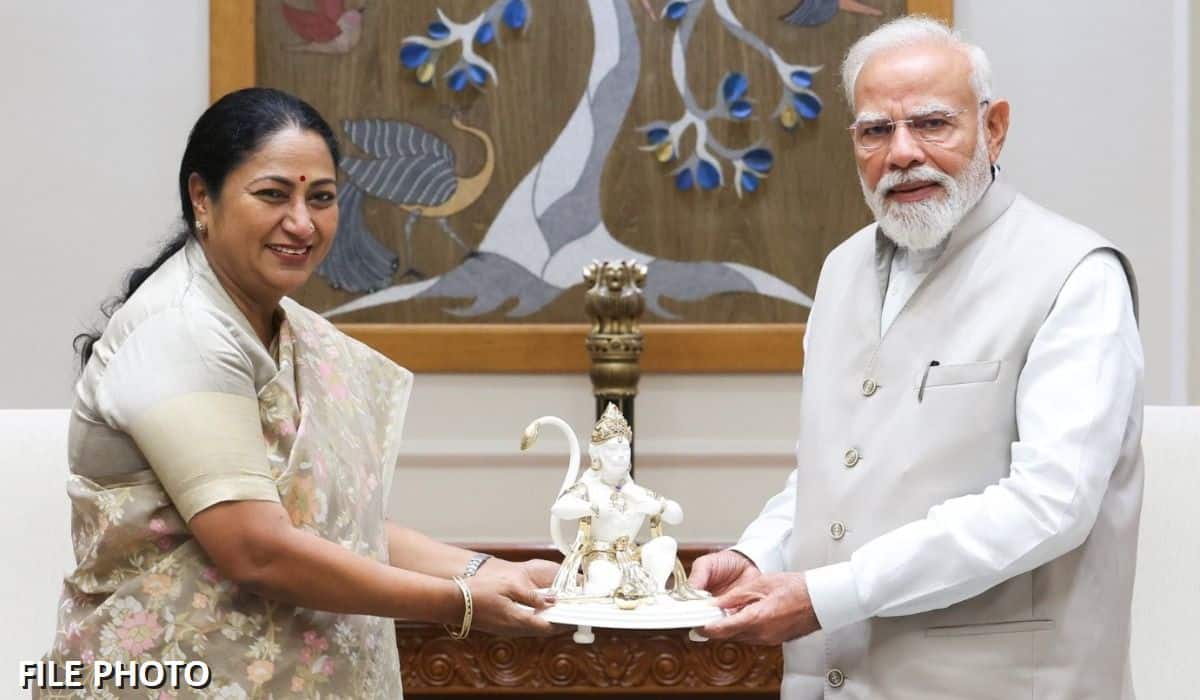
‘Unique leadership, special charisma’

Published By : Admin | September 17, 2025 | 15:53 IST

Sept 17 is significant in history for a number of reasons. On this day, artisans and workers across the country joyfully celebrate Vishwakarma Jayanti. Hyderabad was liberated from the cruel Nizam and Razakars on Sept 17. And, on this day was born a statesman who has dedicated his entire life to the service of the nation and its people - our Prime Minister Narendra Modi. This birthday is even more significant, as it marks his 75th year. On behalf of 140 crore Indians, I extend my heartfelt greetings to Modi-ji and pray to the Almighty to bless him with long life, energy and good health to achieve greatness for India.

Having worked alongside PM Modi for decades, I have deeply felt that his personality is beyond that of a politician - it embodies a mission-driven leader dedicated to the nation's welfare. For him, India's rise and Indians' well-being are not just ideals but guiding principles. What makes his leadership unique is his constant focus on ensuring the all-inclusive model of governance. His policies and their implementation always emphasise that no individual or community is left behind in the development journey. For him, governance is not a tool of power but a medium of service. Under his leadership, numerous welfare schemes for the poor have not only been launched but have also achieved their intended goals.

We can see that the Jan Dhan Yojana brought over 50 crore people into the banking system, scripting a glorious episode of financial inclusion; the Ujjwala Yojana freed millions of households from smoke and gave them a life of dignity; Ayushman Bharat provided healthcare security to the poor; and the Pradhan Mantri Awas Yojana helped economically weaker sections realise the dream of owning a home. Whenever I look into the eyes of a beneficiary and see contentment and trust, I understand how Modi-ji's governance is truly bringing the vision of public welfare to life.

As an RSS pracharak, he travelled across the nation and engaged with all sections of society. He not only closely witnessed the soul of India but also experienced its inner strength. This later reflected in his governance, through his empathy for the poor and the marginalised. It was also as a pracharak that Modi-ji learnt the art of organisation. Later, while recasting BJP's organisation, he introduced innovative reforms that transformed the party's functional dynamics. I am fortunate that, as BJP's national president, I had the opportunity to implement his vision and organisational insights at the national level.


The hallmark of strong leadership lies in the ability to take decisions in difficult circumstances. Judged by this criterion, Modi-ji's leadership is exceptional. I have witnessed him maintain extraordinary patience and clarity of vision, even in the most challenging situations. Since 2014, there have been several occasions when the nation needed bold and decisive steps. He firmly upheld the principles of leadership and made decisions in the nation's interest. Demonetisation and GST opened new chapters in our economic reforms. Abrogation of Article 370 will be remembered as a decision that demonstrated not only political courage but also his unwavering commitment to national unity and integrity. The erasing of the social evil of triple talaq was a bold step to protect the dignity and rights of women.

None of these decisions were easy. Many of them faced opposition, but Modi-ji never wavered. He held firm the belief that the nation's interest must be pursued, regardless of resistance or criticism.


When Covid shook the whole world, he not only reassured the public but also led the country's industries, scientists and youth towards self-reliance. The world was anxious about India during the pandemic. But it was because of our astute leadership that not only were vaccines manufactured in the country in record time, but through the technology-driven free vaccination campaign, we presented an exemplary model of Covid management to the world.

Under PM's leadership, India has repeatedly proved that national security and self-respect are sacrosanct for our national life. The surgical strike after the Uri attack showed the world that India will no longer remain a silent spectator to terrorism. The Balakot airstrike after the Pulwama incident further strengthened this resolve. Recently, 'Operation Sindoor' conducted on May 7, 2025 in response to the Pahalgam attack decisively established the policy that whenever the country's identity and the safety of citizens are messed with, India will respond with courage and determination.

These actions not only strengthened the sense of confidence and pride among the people of India but also gave the message to the world that new India is ready to face every situation to protect its national well-being.

Modi-ji's strategy is unique in the field of foreign policy as well. Today, when he stands on an international platform and confidently puts forth India's stand, a wave of pride runs through all of us. While India was often seen as an emerging nation in the past, under his leadership, India is moving towards taking the role of a global leader. Be it the Paris Climate Agreement, the G20 Conference, or the address given at the United Nations – everywhere his confidence has been a symbol of India's growing power and pride.

From what I know about Modi-ji, I can say that his personality is not limited to policies and programmes. He has a special charisma, which connects him directly with the public. His speech has the flair of spontaneity and simplicity, which makes him reach the hearts of the public. During his conversations in the 'Mann Ki Baat' programme, crores of people feel that PM is directly communicating with them. Be it a farmer from a village or a student from the city or a housewife, everyone starts feeling a sense of affinity with him. This is no common attribute.


Looking back, I see that Modi-ji has empowered India not merely in economic and political terms, but also mental and cultural terms. He has the right understanding of India's internal strength, and has a vision that in 2047, when India completes 100 years of independence, our country should restore its stature as 'Atmanirbhar Bharat' and a great country, and to achieve this, he is advancing the country in this direction rapidly with his visionary policies.

He has instilled the belief in every Indian that we are second to none in this world. In the last 11 years, under his leadership, the country has touched new heights in self-respect, self-reliance and self-confidence, which in my view is both historic and unique.
In fact, true leadership is that which dedicates every moment to the nation, with a vision that looks far beyond the present into the future. Today, this personality of Modi-ji is the biggest strength of India.


Explore More
Today, the entire country and entire world is filled with the spirit of Bhagwan Shri Ram: PM Modi at Dhwajarohan Utsav in Ayodhya

Popular Speeches

Today, the entire country and entire world is filled with the spirit of Bhagwan Shri Ram: PM Modi at Dhwajarohan Utsav in Ayodhya
India car sales to hit 4.7 million in FY26 despite bumps

Media Coverage

India car sales to hit 4.7 million in FY26 despite bumps
NM on the go

Nm on the go

Always be the first to hear from the PM. Get the App Now!
...
Narendra Modi is a leader beyond ceremony
February 28, 2026

Force of habit, maybe. Or just the low-grade anxiety that comes with handing something to the prime minister of 1.4 billion people and hoping it works. I scribbled a quick line on the corner of my notepad, confirmed the ink was flowing, and handed it over.

He took it without looking at the pen. He was looking at me.

That was the first thing I noticed about Narendra Modi up close. The eye contact. Steady, unhurried, the kind that makes you feel like the meeting isn’t scheduled. He greeted me standing, which I hadn’t expected, and when he shook my hand, the grip was firm, and it lasted a beat longer than these things usually do. Just deliberate. Like he wanted you to know he meant it.

He apologized for the wait. The Israeli security detail outside his King David suite had put me through more checks than I care to describe. At one point, I was fairly certain I was going to be turned away despite holding a personal invitation from the man himself, which would have made for an interesting column but a frustrating afternoon.

Modi had heard about the delay and said sorry before anything else. I told him it was the Israeli side causing the trouble, not his team. He smiled. The room loosened slightly.

Then he picked up the special front page we had published for his visit, looked at it for a moment, and wrote in Hindi, standing, without sitting down or making any ceremony out of it. Two lines: “Humanity will remain supreme. Democracy will remain eternal.”

He signed his name and dated it February 26, 2026. The whole thing took maybe 45 seconds. He handed the page back with both hands.

I’ve interviewed a lot of people while in this job. Politicians, presidents, religious leaders, celebrities. There is a type of public figure who has spent so many years being watched that everything they do has become a kind of performance. The handshake, the pause, the practiced sincerity. Modi wasn’t that. Whatever he was doing in that suite, he was just there, fully, in a way that is rarer than it sounds.

Through a translator, you could still hear the rhythm of how he thinks. Complete thoughts. Real pauses, not to buy time, but because he’s actually considering what you said.

At one point, I told him his Knesset speech – delivered the day before, the first ever by an Indian prime minister to Israel’s parliament – felt historic. He received it simply, without deflecting or inflating it, and then said something that stayed with me: “Our nations and religions are a lot more similar than what people think.”

He had spent the previous day making exactly that case. Not as a diplomatic courtesy. As a philosophical argument.

Most leaders who come to Jerusalem talk about security, trade, and technology. Modi did that, too, and then he went somewhere else entirely. He gave what I can only describe as a civilizational speech, one that asked a genuinely interesting question: What happens when two of the world’s oldest living cultures finally look at each other carefully and recognize something familiar?

Tikkun Olam and Vasudhaiva Kutumbakam

HIS ANSWER was built on a comparison that sounds simple until you think about it. He placed Tikkun Olam (the Jewish concept of repairing and healing the world) next to Vasudhaiva Kutumbakam (the ancient Sanskrit declaration that the world is one family). He compared Halacha (Jewish law as the living framework for daily ethical conduct) to dharma (the Hindu concept of moral order and personal duty).

What he was pointing at is that both civilizations solved the same problem in remarkably similar ways. How do you build a society where ethics isn’t a sermon delivered on a holy day but a practice embedded in the texture of ordinary life? Both Judaism and Hinduism answered: Through law, through duty, through the 10,000 small decisions that make up a day.

This is not a coincidence that gets discovered at diplomatic summits. It is a structural similarity, centuries deep.

For a reader of hassidic thought, this lands with particular force. Hassidism (Hassidut, or hassidic teaching and philosophy) calls this avodah (literally “work,” meaning inner spiritual intention expressed through practical deeds).

The Baal Shem Tov, the 18th-century founder of Hassidut, taught that the divine is found not in retreat from the world but in full engagement with it, in the marketplace, at the table, in the way you treat the person standing in front of you. Modi, without using that language, was honoring exactly that tradition and pointing out that India built its civilization on the same foundation.

He connected Hanukkah and Diwali (the Hindu festival of lights, celebrating the victory of light over darkness), and the pairing is more than poetic.

Both festivals reject the passive response to darkness. In the Hanukkah story, the rabbis made a specific decision: The mitzvah (religious commandment) is not to light a large fire but to add one small candle each night, incrementally, publicly, stubbornly. That is a philosophy of historical action. Darkness is not defeated all at once. It is pushed back by accumulated small acts of light.

Diwali carries the same logic, rows of diyas (small clay oil lamps) lit across millions of homes, each one a separate act that adds to a larger illumination.

He paired Purim with Holi (the Hindu spring festival, marking the triumph of good over evil), and here, too, the intellectual connection runs even deeper. Both holidays are built on the experience of hiddenness suddenly reversed.

In the Purim story, God’s name never appears in the Book of Esther. The miracle is concealed inside what looks like ordinary palace politics and human decision-making. Hassidic thought reads this as the deepest kind of truth: that providence (hashgacha pratit, divine guidance in the details of individual lives) often looks, from the outside, like coincidence or history. You only see the pattern when you’re willing to look for it.

Modi’s insistence on ancient connections between India and Israel, on trade routes and shared texts, and a Persian queen named Esther, whose Hebrew name connects to the Hebrew word for “hidden,” carries the same idea. Some relationships are written into history long before the diplomats arrive to formalize them.

HE SPOKE about terrorism plainly, without softening the language. He linked the October 7 massacre to the Mumbai attacks, India’s own wound, still felt. He said no cause justifies the murder of civilians. He said terrorism anywhere threatens peace everywhere. He said it the way people say things they’ve believed for a long time and have stopped needing to rehearse.

Then he did something that moved the room more than any of the formal declarations. He singled out the Indian workers and caregivers who were in Israel on October 7, 2023. People who stayed. Who helped. Who didn’t run. He quoted the Talmud: Whoever saves one life saves an entire world.

In hassidic terms, this was the speech’s most important moment. Hassidut puts enormous weight on the deed that looks small but carries cosmic significance, the nitzotz (spark of holiness) hidden inside the ordinary act, waiting to be elevated by the person who chooses to do it anyway.

He took foreign workers in a war zone and made them the moral center of the relationship between two nations. That is not rhetoric. That is a worldview that knows where to look for what matters.

He also said something that Israel’s friends don’t always say out loud. Jewish communities lived in India for centuries, he told the Knesset, without persecution, without fear, without having to hide who they were. They preserved their faith and participated fully in society. He called it a source of pride for India.

He was right to call it that, and he was right to say it in Jerusalem in 2026, when the question of where in the world Jewish life can be lived openly has rarely felt more urgent.

Back in the suite, the conversation was warm. He has the quality of making a scheduled meeting feel like an actual conversation. When I told him the Knesset speech felt historic, he returned to the same idea he’d opened with: that the two civilizations are more similar than most people realize. He said it like someone reporting back from a conclusion he’d reached a long time ago and finally found the right room to say it in.

Our Wednesday cover had already been moving fast across social media before I walked into that suite. Modi reposted it to his enormous following on X/Twitter. Indian media picked it up. A front page can travel like that now, faster than anything you write underneath it.

The two handwritten lines are something else. They sit on paper, in a hotel room in Jerusalem, written standing up by a man who didn’t need to write anything and chose to write that. Humanity first. Democracy is permanent. One Hanukkah candle, one diya, same dark night, same instinct to keep adding light to it one careful flame at a time.

I tested the pen before I gave it to him.

Turns out he didn’t need my help.

(Mr. Zvika Klein is the Jerusalem Post Editor-in-Chief. The views expressed are personal.)

Source: The Jerusalem Post