Published By : Admin |
February 28, 2011 | 04:47 IST
Share
Gandhinagar, Monday:Gujarat Chief Minister Narendra Modi today described the UPA Government Union Budget 2011-12 as an attempt to conceal its all round failures and directionless governance, to divert the people's attention from the burning issues like scams, corruption and inflation.
Commenting on the budget proposals, he said there seems to be no political will to provide the public any relief from the skyrocketing food prices, particularly the urban middle class and poor.
The budget blatantly shows favours to West Bengal, Kerala and Tamil Nadu in the guise of distributing largesses higher education in view of the coming elections to these states in the coming months. There is no mention of a word about a number of world class path-breaking universities started by Gujarat. The budget exposes the Union Government's favours to its allies ruling the States. It does not reflect any schemes for the poor.
The Centre has totally failed to provide jobs or upgrade their skills to the youth to make them employable. Instead of raising increasing agricultural production essential for an agrarian country, he said, the government is increasing subsidies.
The Centre has failed to take any concrete steps to bring back black money in the country. Instead of providing 9incentive, it has imposed more taxes on the jewelry industry knowing well that diamond and textiles are Gujarat's strength.
On the other hand, Mr. Modi said that Gujarat Government in its budget earmarked Rs.5,000-crore on just one project Mission Mangalam for women's empowerment.
However, he said, the Centre did the right thing in taking up the cues from Gujarat in broadband connectivity to villages, increasing salary of crche centre workers, scholarship to SC/ST students.
Cabinet approves two railway projects in Uttar Pradesh and Andhra Pradesh worth Rs 24,815 crore
April 18, 2026
Share
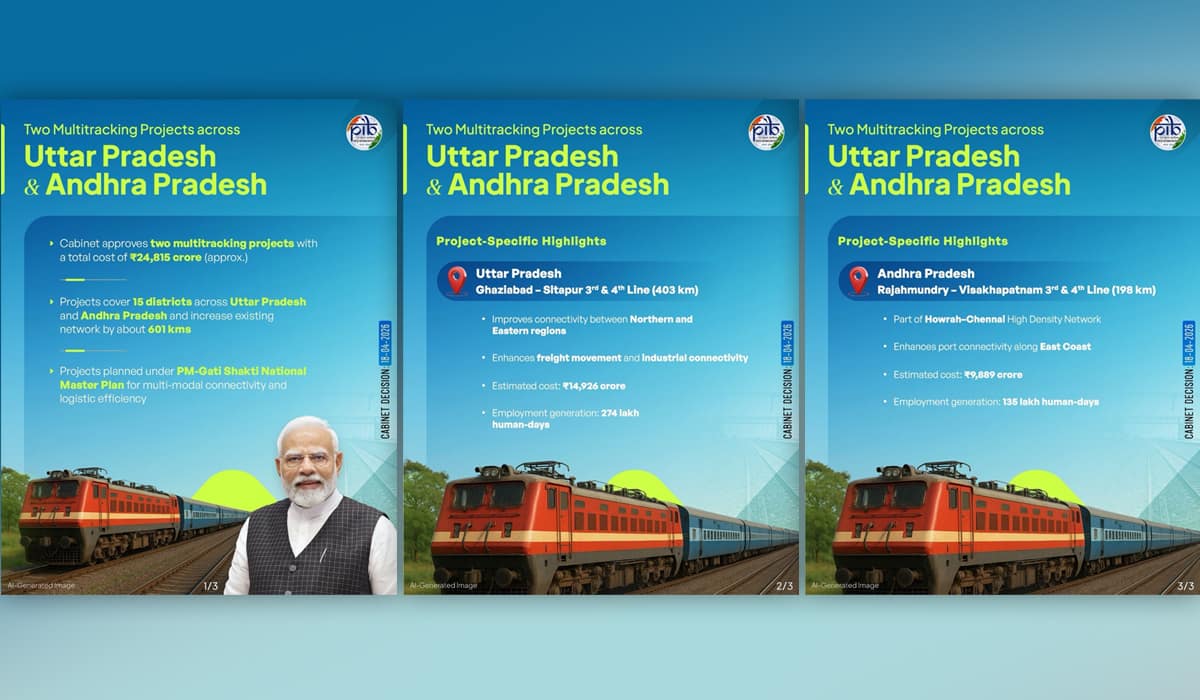
The Cabinet Committee on Economic Affairs, chaired by the Prime Minister Shri Narendra Modi, today has approved 02 (Two) projects of Ministry of Railways with total cost of Rs. 24,815 crore (approx.). These projects include:
Name of Project
Route Length (in km)
Track Length (in km)
Completion Cost (Rs.inCr.)
Ghaziabad – Sitapur 3rd and 4th Line
403
859
14,926
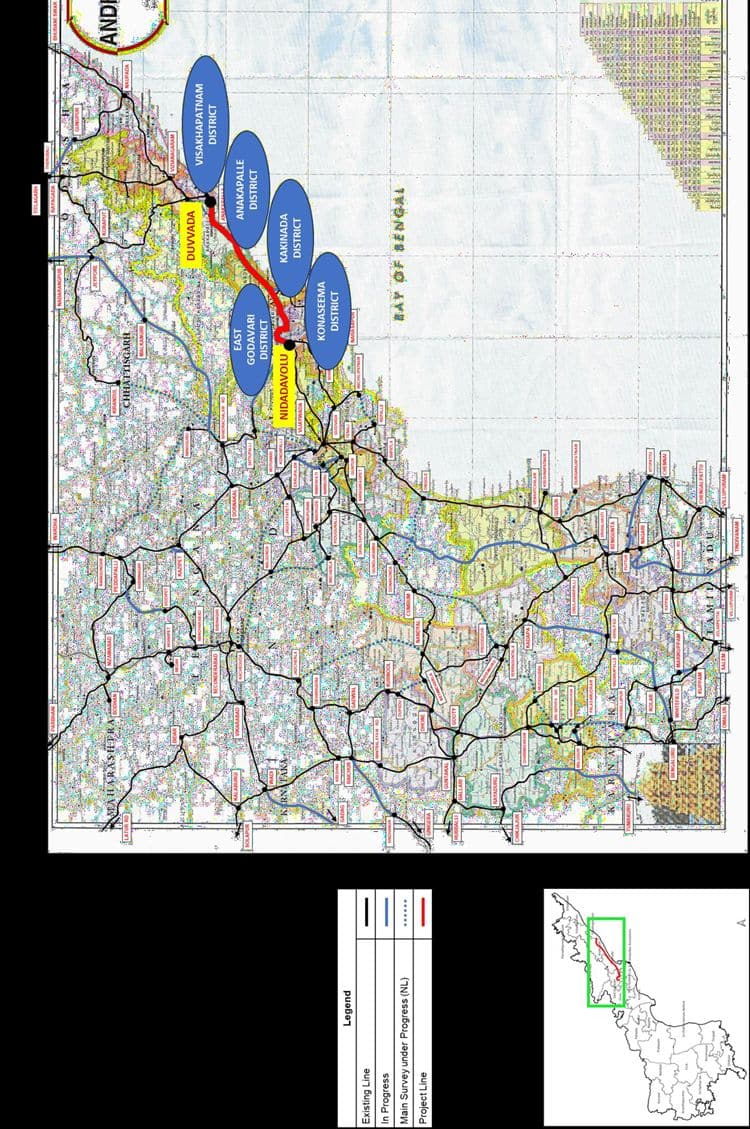
Rajahmundry (Nidadavolu) – Visakhapatnam (Duvvada) 3rd and 4th Line
198
458
9,889
Total
601
1,317
24,815
The increased line capacity will significantly enhance mobility, resulting in improved operational efficiency and service reliability for Indian Railways. These multi-tracking proposals are poised to streamline operations and alleviate congestion. The projects are in line with the Prime Minister Shri Narendra Modiji’s Vision of a New India which will make people of the region “Atmanirbhar” by way of comprehensive development in the area which will enhance their employment/ self-employment opportunities.
The projects are planned on PM-Gati Shakti National Master Plan with focus on enhancing multi-modal connectivity & logistic efficiency through integrated planning and stakeholder consultations. These projects will provide seamless connectivity for movement of people, goods, and services.
The 02 (Two) projects covering 15 Districts across the states of Uttar Pradesh and Andhra Pradesh will increase the existing network of Indian Railways by about 601 Kms.
The proposed capacity enhancement will improve rail connectivity to several prominent tourist destinations across the country, including Dudheshwarnath Temple, Garhmukteshwar Ganga Ghat, Dargah Shah Wilayat Jama Masjid (Amroha), Naimisharanya (Sitapur), Annavaram, Antarvedi, Draksharamam, etc.
The proposed projects are essential routes for transportation of commodities such as coal, foodgrains, cement, POL, iron and steel, container, fertilizers, sugar, chemical salts, limestone, etc. The Railways being environment friendly and energy efficient mode of transportation, will help both in achieving climate goals and minimizing logistics cost of the country lowering CO2 emissions (180.31Crore Kg) which is equivalent to plantation of 7.33 Crore trees.
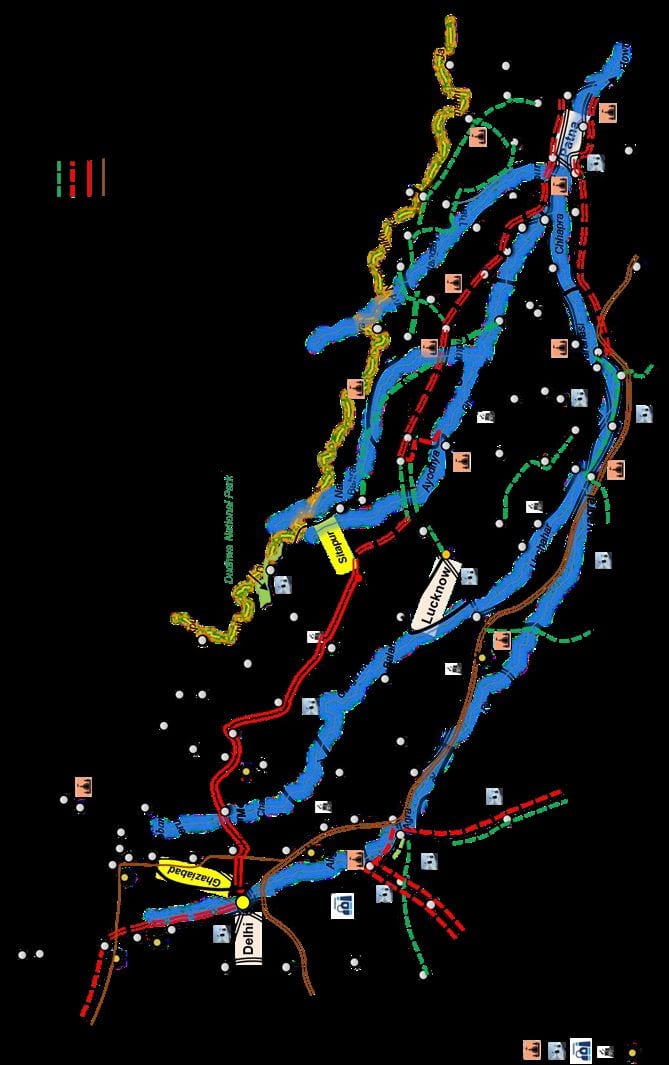
Ghaziabad – Sitapur 3rd and 4th Line (403 Km)
Ghaziabad – Sitapur is an existing double line section forming a key part of Delhi- Guwahati High Density Network (HDN 4).
The project is crucial for improving connectivity between the Northern and Eastern region of the country.
The existing line capacity utilization of the section is up to 168% and is projected to be up to 207% in case the project is not taken up.
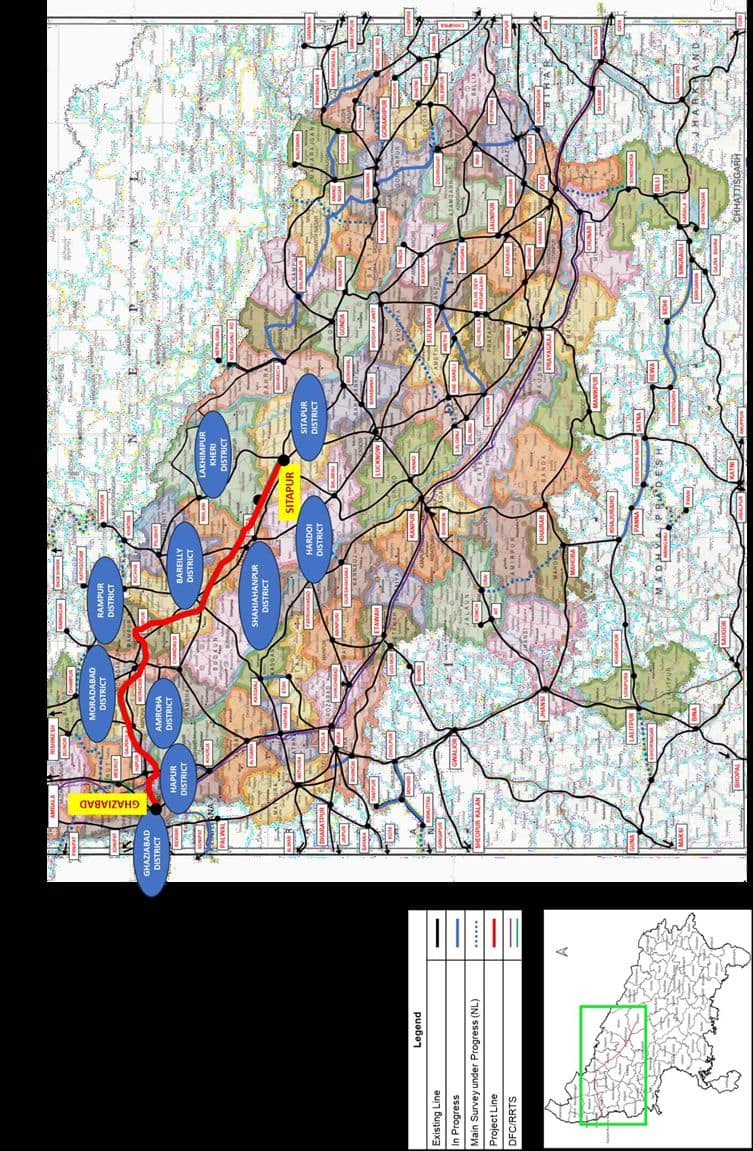
Transverses through Ghaziabad, Hapur, Amroha, Moradabad, Rampur, Bareilly, Sahjahanpur, Lakhimpur Kheri and Sitapur districts of Uttar Pradesh.
The project route passes through major industrial centres - Ghaziabad (machinery, electronics, pharmaceuticals), Moradabad (brassware and handicrafts), Bareilly (furniture, textiles, engineering), Shahjahanpur (carpets and cement-related industries), and Roza (thermal power plant).
For seamless transportation, the project alignment is planned to bypass congested stations of Hapur, Simbhaoli, Moradabad, Rampur, Bareilly, Shahjahanpur, and Sitapur and accordingly, six new stations are proposed on the bypassing sections.
Key tourist/religious places along/near to the project section are Dudheshwarnath Temple, Garhmukteshwar Ganga Ghat, Dargah Shah Wilayat Jama Masjid (Amroha), and Naimisharanya (Sitapur) among others.
Anticipated additional freight traffic of 35.72 MTPA consisting of Coal, Foodgrains, Chemical Manures, Finished Steel, etc.
Estimated Cost: Rs.14,926 crore (approx.)
Employment generation: 274 lakh human-days.
CO2 emissions saved: About 128.77 crore Kg CO2 equivalent to 5.15 Cr trees.
Logistic cost saving: Rs. 2,877.46 crore every year vis-a vis road transportation.
Ghaziabad – Sitapur 3rd and 4th Line (403 Km)
Rajahmundry (Nidadavolu) – Visakhapatnam (Duvvada) 3rd and 4th Line (198 Km)
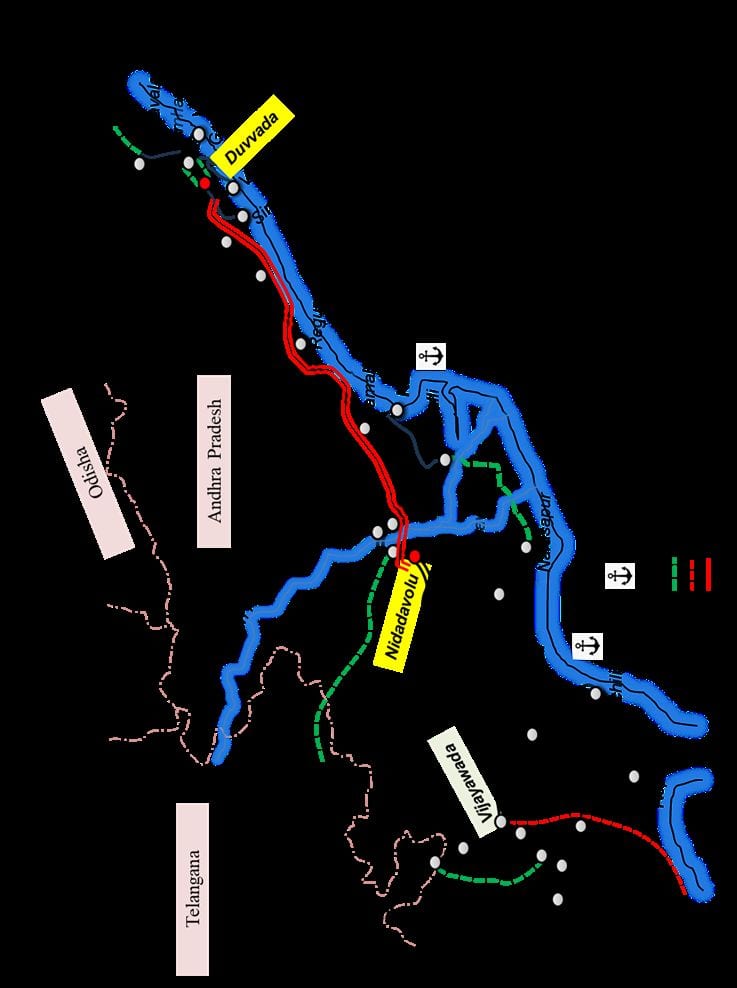
Rajahmundry (Nidadavolu) – Visakhapatnam (Duvvada) section forms part of the Howrah – Chennai High Density Network (HDN).
The proposed project is part of quadrupling initiative of Howrah – Chennai High Density Network (HDN) route.
The project traverses through East Godavari, Konaseema, Kakinada, Anakapalle and Vishakapatnam districts of Andhra Pradesh.
Visakhapatnam is identified as an Aspirational District in the Aspirational Districts Programme.
It provides connectivity to major ports along the East Coast such as Visakhapatnam, Gangavaram, Machilipatnam and Kakinada.
The project route runs along the eastern coastline and is among the busiest, predominantly freight-oriented sections of the East Coast Rail Corridor.
The line capacity utilization of the section has already reached up to 130%, leading to frequent congestion and operational delays. The line capacity is expected to increase further due to proposed expansion of ports and industries in the region.
Project section includes 4.3 km rail bridge over Godavari River, 2.67 km viaduct, 3 bypasses and the new alignment is around 8 km shorter than the existing route, improving connectivity and operational efficiency.
The proposed section will also boost tourism by improving access to key destinations such as Annavaram, Antarvedi and Draksharamam etc.
Anticipated additional freight traffic of 29.04 MTPA consisting of Coal, Cement, Chemical Manures, Iron and Steel, Foodgrains, Containers, Bauxite, Gypsum, Limestone, etc.
Estimated Cost: Rs.9,889 crore (approx.)
Employment generation: 135 lakh human-days.
CO2 emissions saved: About 51.49 crore Kg CO2 equivalent to 2.06 Cr trees.
Logistic cost saving: Rs. 1,150.56 crore every year vis-a vis road transportation.
आर्थिक सशक्तिकरण:
Aspirational districts - Visakhapatnam district will get improved connectivity
Additional economic opportunities in the region through tourism & industries.
Better healthcare and education for the citizens due to enhanced rail connectivity.
Rajahmundry (Nidadavolu) – Visakhapatnam (Duvvada) 3rd and 4th Line (198 Km)
Prime Minister’s focus on railways:
Record budget allocation of Rs. 2,65,000 crore for FY 26-27.
Manufacturing more than 1600 locomotives- surpassed US and Europe in manufacturing of locomotive production
In FY 26, Indian Railways is expected to rank among the top three freight carriers globally, moving 1.6 billion tonnes of cargo.
India starts exporting metro coaches to Australia and bogie to United Kingdom, Saudi Arabia, France and Australia.