“Meditating together gives effective results. This feeling of solidarity and power of unity is a major basis of Viksit Bharat”
“A perfect example of ‘One Life, One Mission’, Acharya Goenka had only one mission – Vipassana”
“Vipassana is the path of self-transformation through self-observation”
“Vipassana has become even more important in today’s challenging times when the youth has become victims of stress due to work life balance, lifestyle and other problems.”
“Bharat needs to take the lead in making Vipassana more acceptable”

Namaskar!

The celebrations marking the birth centenary of Acharya Shri S. N. Goenka Ji commenced a year ago. Over this period, while celebrating the 'Azadi Ka Amrit Mahotsav,' the nation reflected upon the principles advocated by Kalyanmitra Goenka Ji. As we approach the conclusion of his centenary festivities today, the nation is swiftly progressing towards the realization of a developed Bharat. In this journey, we can apply the teachings derived from the thoughts of S. N. Goenka Ji and his commitment to society. Guruji often reiterated Lord Buddha's mantra – "Samagga-nam Taposukho," signifying the powerful results obtained when people meditate together. This spirit of unity is a fundamental cornerstone for making Bharat a developed nation. Throughout this centenary celebration, all of you have propagated this mantra, and I extend my heartfelt wishes to everyone.

Friends,

My association with Acharya S. N. Goenka Ji goes back a long way. I initially met him at the World Religion Conference at the UN. Subsequently, we crossed paths several times in Gujarat. It is my good fortune that I had the opportunity to meet him one last time. Our relationship had a unique closeness, and I had the privilege of observing him closely. I witnessed how deeply he embraced Vipassana—no personal aspirations, absolutely tranquil and serious, his persona resembled clear water. Like a silent servant, he would emanate a virtuous atmosphere wherever he went. As an embodiment of 'One Life, One Mission,' his singular goal was Vipassana. He shared the benefits of his Vipassana knowledge with everyone, contributing to humanity and the entire world.

Friends,

Goenka Ji's life serves as a profound source of inspiration for all of us. Vipassana, a remarkable gift from the ancient Indian way of life to the entire world, had been forgotten within our heritage. In Bharat, there was an extended period during which the art of teaching and learning Vipassana gradually faded away. Goenka Ji, after 14 years of penance in Myanmar, took the initiative to bring back this ancient glory to Bharat. Vipassana, the path of self-transformation through self-observation, held significance even when it originated thousands of years ago, and its relevance has grown in today's life. Vipassana possesses the significant power to address the challenges the world faces today. Thanks to Guruji's efforts, over 80 countries worldwide have recognized the importance of meditation and embraced it. Acharya Shri Goenka Ji stands among those remarkable individuals who have reinstated a global identity for Vipassana. Today, Bharat is vigorously expanding this resolve. We had made a proposal to the United Nations to establish International Yoga Day which received the support of more than 190 countries. Yoga has now become a part of life globally.

Friends,

Our ancestors researched yoga practices like Vipassana. Ironically, subsequent generations forgot its importance and use. Vipassana, meditation, and dharana were considered matters of renunciation, and their real roles were forgotten. Eminent personalities like Acharya Shri SN Goenka Ji corrected this public misconception. Guruji used to say, "A healthy life is a major responsibility towards ourselves." Today, Vipassana has become an effective medium for everything, from shaping behaviour to building personality. The challenges of modern times have increased the importance of Vipassana. Stress and distress have become common, affecting both the youth and elderly due to work-life imbalances and lifestyle-related issues. Vipassana could be a solution for them. Similarly, due to micro-family and nuclear families, elderly parents at home also remain under a lot of stress. We are also trying to connect as many elderly people as possible with it who have crossed the retirement age.

Friends,

SN Goenka Ji's every endeavour was driven by the aspiration for every person to lead a happy life, possess a peaceful mind, and contribute to global harmony. His effort aimed to ensure that the benefits of his campaign continue flowing to future generations. Therefore, he expanded his knowledge. Besides spreading Vipassana, he also assumed the responsibility of developing skilled teachers in the practice. Vipassana, a journey into the soul, is a profound way to delve deep within oneself. It is not merely a practice; it is also a science. While we are familiar with the results of this science, the need of the hour is to present its evidence on modern standards and in the language of modern science. Today, we take pride in the ongoing global efforts in this direction. However, Bharat must take the lead and carry it forward because we possess the heritage as well as an understanding of modern science. New research will enhance its acceptance and bring greater welfare to the world.

Friends,

This year of the birth centenary celebrations of Acharya SN Goenka ji has been an inspiring time for all of us. We should persist in advancing his initiatives for human service. Once again, best wishes to all of you. Thank you very much!

Explore More
Today, the entire country and entire world is filled with the spirit of Bhagwan Shri Ram: PM Modi at Dhwajarohan Utsav in Ayodhya

Popular Speeches

Today, the entire country and entire world is filled with the spirit of Bhagwan Shri Ram: PM Modi at Dhwajarohan Utsav in Ayodhya
UPI — an eventful journey

Media Coverage

UPI — an eventful journey
NM on the go

Nm on the go

Always be the first to hear from the PM. Get the App Now!
...
PM chairs 53rd PRAGATI Meeting
August 25, 2026
PM reviews six key infrastructure projects across the Railway, Road and Power sectors
Projects reviewed span across 9 States with cumulative investment of more than ₹30,000 crore
PM says Infrastructure projects should be viewed as an integrated whole, rather than as individual sections or packages
PM calls for continuous reforms across all stages of project implementation and a proactive work culture across Ministries and States
PM says Speed must go hand-in-hand with quality
While reviewing AgriStack, PM emphasises the need to leverage the latest digital technologies including AI to derive greater value from agricultural data
On cyber fraud and ‘digital arrest’, PM stresses training, public awareness, cyber-safety education and coordinated action

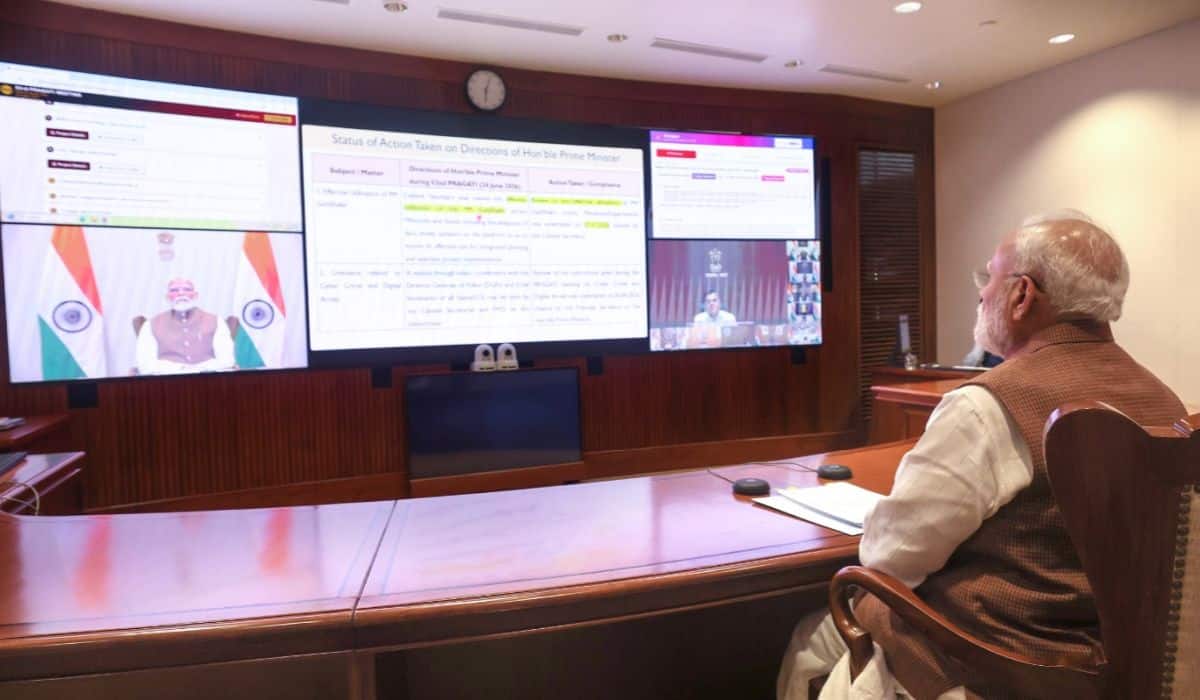
Prime Minister Shri Narendra Modi chaired the 53rd meeting of PRAGATI, the ICT-enabled, multi-modal platform for Pro-Active Governance and Timely Implementation, at Seva Teerth earlier today.

During the meeting, Prime Minister reviewed six key infrastructure projects across the Railway, Road and Power sectors, spanning nine States with a cumulative cost of more than ₹30,000 crore. The projects, significant for strengthening connectivity, supporting industrial and economic activity and improving public services, were reviewed with particular emphasis on adherence to timelines, inter-agency coordination, resolution of pending issues and expeditious completion.

Prime Minister emphasised that delays in infrastructure projects have consequences beyond cost escalation, as they also postpone the benefits intended for citizens, businesses and the economy. He said that infrastructure projects should be viewed and monitored as an integrated whole, rather than as isolated sections, stretches or packages. He noted that progress in individual packages should ultimately translate into timely completion and operationalisation of the entire project. Ministries and States were therefore asked to adopt an end-to-end approach, and address critical gaps that could delay the overall commissioning and delivery of benefits. He called for fostering a proactive work culture across Ministries and State Governments, with greater ownership at every level of project implementation.

Prime Minister stressed the need to explore common utility corridors for infrastructure services, wherever feasible, particularly while planning major transport and infrastructure projects. He called upon Ministries and States to examine such integrated approaches at the planning stage itself, keeping in view their technical and economic feasibility.

Prime Minister said that speed of execution must be accompanied by uncompromising quality. He called upon Ministries, States and implementing agencies to adopt modern technologies and strengthen quality assurance and supervision at every stage.

While reviewing AgriStack under the Digital Agriculture Mission, Prime Minister emphasised the need to leverage the latest digital technologies, including Artificial Intelligence, to derive greater value from agricultural data. He stressed that the data ecosystem should be effectively utilised across the agricultural value chain, from input planning to processing, enabling more informed interventions, better targeting and data-driven decision-making. He appreciated the efforts of the States and the Central Government in building the AgriStack ecosystem and called for further strengthening its use for delivering better outcomes for farmers.

During the review of cyber fraud cases, including incidents of digital arrest, Prime Minister said that prevention must be strengthened through a sustained focus on training, awareness and education. He stressed the need for continuous and targeted public-awareness campaigns, particularly for senior citizens, youth and other vulnerable sections, to familiarise them with common fraud techniques, warning signs and safe digital practices. He also called for regular capacity-building of personnel involved so that emerging modes of cyber fraud are identified and acted upon swiftly.