“Meditating together gives effective results. This feeling of solidarity and power of unity is a major basis of Viksit Bharat”
“A perfect example of ‘One Life, One Mission’, Acharya Goenka had only one mission – Vipassana”
“Vipassana is the path of self-transformation through self-observation”
“Vipassana has become even more important in today’s challenging times when the youth has become victims of stress due to work life balance, lifestyle and other problems.”
“Bharat needs to take the lead in making Vipassana more acceptable”

Namaskar!

The celebrations marking the birth centenary of Acharya Shri S. N. Goenka Ji commenced a year ago. Over this period, while celebrating the 'Azadi Ka Amrit Mahotsav,' the nation reflected upon the principles advocated by Kalyanmitra Goenka Ji. As we approach the conclusion of his centenary festivities today, the nation is swiftly progressing towards the realization of a developed Bharat. In this journey, we can apply the teachings derived from the thoughts of S. N. Goenka Ji and his commitment to society. Guruji often reiterated Lord Buddha's mantra – "Samagga-nam Taposukho," signifying the powerful results obtained when people meditate together. This spirit of unity is a fundamental cornerstone for making Bharat a developed nation. Throughout this centenary celebration, all of you have propagated this mantra, and I extend my heartfelt wishes to everyone.

Friends,

My association with Acharya S. N. Goenka Ji goes back a long way. I initially met him at the World Religion Conference at the UN. Subsequently, we crossed paths several times in Gujarat. It is my good fortune that I had the opportunity to meet him one last time. Our relationship had a unique closeness, and I had the privilege of observing him closely. I witnessed how deeply he embraced Vipassana—no personal aspirations, absolutely tranquil and serious, his persona resembled clear water. Like a silent servant, he would emanate a virtuous atmosphere wherever he went. As an embodiment of 'One Life, One Mission,' his singular goal was Vipassana. He shared the benefits of his Vipassana knowledge with everyone, contributing to humanity and the entire world.

Friends,

Goenka Ji's life serves as a profound source of inspiration for all of us. Vipassana, a remarkable gift from the ancient Indian way of life to the entire world, had been forgotten within our heritage. In Bharat, there was an extended period during which the art of teaching and learning Vipassana gradually faded away. Goenka Ji, after 14 years of penance in Myanmar, took the initiative to bring back this ancient glory to Bharat. Vipassana, the path of self-transformation through self-observation, held significance even when it originated thousands of years ago, and its relevance has grown in today's life. Vipassana possesses the significant power to address the challenges the world faces today. Thanks to Guruji's efforts, over 80 countries worldwide have recognized the importance of meditation and embraced it. Acharya Shri Goenka Ji stands among those remarkable individuals who have reinstated a global identity for Vipassana. Today, Bharat is vigorously expanding this resolve. We had made a proposal to the United Nations to establish International Yoga Day which received the support of more than 190 countries. Yoga has now become a part of life globally.

Friends,

Our ancestors researched yoga practices like Vipassana. Ironically, subsequent generations forgot its importance and use. Vipassana, meditation, and dharana were considered matters of renunciation, and their real roles were forgotten. Eminent personalities like Acharya Shri SN Goenka Ji corrected this public misconception. Guruji used to say, "A healthy life is a major responsibility towards ourselves." Today, Vipassana has become an effective medium for everything, from shaping behaviour to building personality. The challenges of modern times have increased the importance of Vipassana. Stress and distress have become common, affecting both the youth and elderly due to work-life imbalances and lifestyle-related issues. Vipassana could be a solution for them. Similarly, due to micro-family and nuclear families, elderly parents at home also remain under a lot of stress. We are also trying to connect as many elderly people as possible with it who have crossed the retirement age.

Friends,

SN Goenka Ji's every endeavour was driven by the aspiration for every person to lead a happy life, possess a peaceful mind, and contribute to global harmony. His effort aimed to ensure that the benefits of his campaign continue flowing to future generations. Therefore, he expanded his knowledge. Besides spreading Vipassana, he also assumed the responsibility of developing skilled teachers in the practice. Vipassana, a journey into the soul, is a profound way to delve deep within oneself. It is not merely a practice; it is also a science. While we are familiar with the results of this science, the need of the hour is to present its evidence on modern standards and in the language of modern science. Today, we take pride in the ongoing global efforts in this direction. However, Bharat must take the lead and carry it forward because we possess the heritage as well as an understanding of modern science. New research will enhance its acceptance and bring greater welfare to the world.

Friends,

This year of the birth centenary celebrations of Acharya SN Goenka ji has been an inspiring time for all of us. We should persist in advancing his initiatives for human service. Once again, best wishes to all of you. Thank you very much!

Explore More
శ్రీరామ జన్మభూమి ఆలయ ధ్వజారోహణ ఉత్సవం సందర్భంగా ప్రధానమంత్రి ప్రసంగం

ప్రముఖ ప్రసంగాలు

శ్రీరామ జన్మభూమి ఆలయ ధ్వజారోహణ ఉత్సవం సందర్భంగా ప్రధానమంత్రి ప్రసంగం
Emerging cities see 42% growth in GCC jobs, outpacing metros: Report

Media Coverage

Emerging cities see 42% growth in GCC jobs, outpacing metros: Report
NM on the go

Nm on the go

Always be the first to hear from the PM. Get the App Now!
...
PM Modi chairs 51st PRAGATI Meeting
May 27, 2026
PM reviews seven critical infrastructure projects across the Railways, Power and Road sectors
Projects reviewed span across 9 States with cumulative investment of around ₹30,000 crore
PM also reviews Ken Betwa Link Project and Swachh Bharat Mission-Urban 2.0
PM says Ken-Betwa River Inter-linking Project should serve as a model for other States to resolve inter-State water issues amicably
PM asks States to expedite the completion of solid waste management-related infrastructure, including waste processing plants and GOBARdhan plants
PM calls for mission-mode rooftop solar coverage in urban areas
Acting upon the advice of PM, system of monthly review of social sector schemes at State level operationalised, starting with review of Swachh Bharat Mission

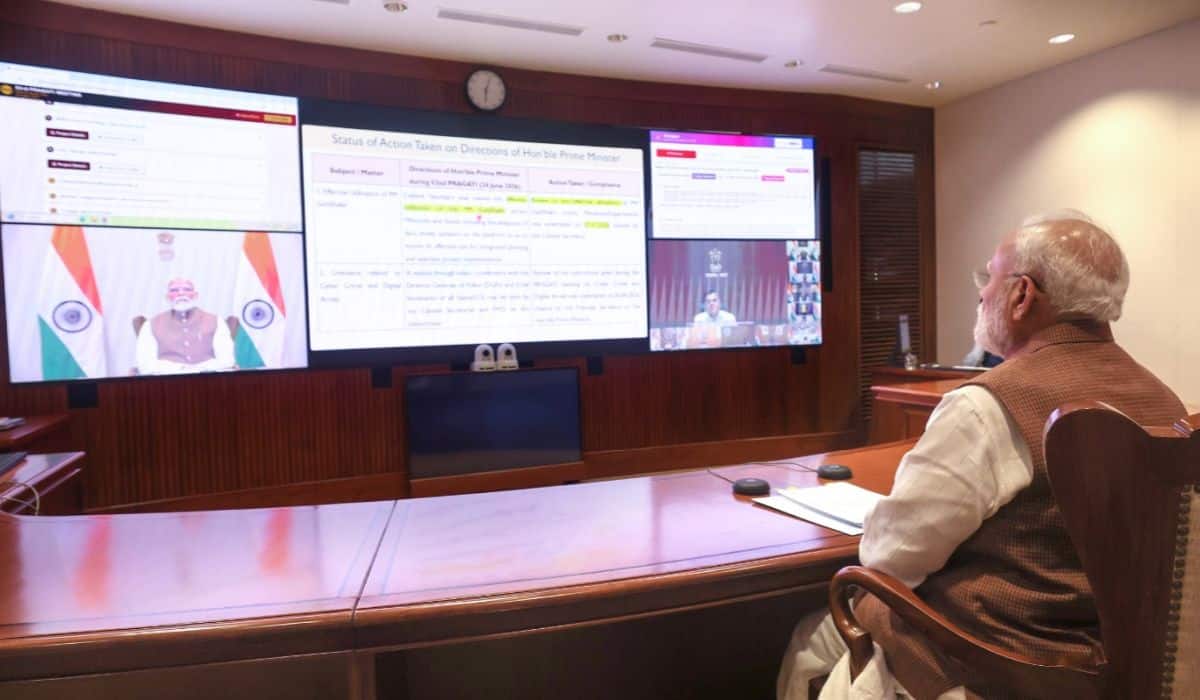
Prime Minister Shri Narendra Modi chaired the 51st meeting of PRAGATI, the ICT-enabled, multi-modal platform aimed at fostering Pro-Active Governance and Timely Implementation, by seamlessly integrating efforts of the Central and State governments, at Seva Teerth, earlier today.

During the meeting, the Prime Minister reviewed seven critical infrastructure projects across the Railways, Power and Road sectors covering nine States worth around ₹30,000 crore. These projects, pivotal to economic growth and public welfare, were reviewed with a focus on timelines, inter-agency coordination, and timely issue resolution. Prime Minister also reviewed Ken Betwa Link Project and Swachh Bharat Mission-Urban 2.0.

While reviewing power sector projects, Prime Minister emphasized the need to accelerate rooftop solar adoption across urban areas, with a special focus on cities, residential clusters and public institutions. He underlined that rooftop solar should be taken up in mission mode to reduce electricity costs, improve energy security and promote clean energy at the household and community level.

While reviewing road and port connectivity projects, it was emphasised that Vadhavan Port should be developed as a model of port-led, multi-modal development, where every major mode of transport is seamlessly integrated to create a future-ready logistics ecosystem. The project should not be seen merely as a port, but as a national gateway connected through coastal shipping, inland waterways, dedicated freight corridors, high-speed rail connectivity, highways and airport linkages.

Prime Minister emphasised the need for effective implementation of Swachh Bharat Mission 2.0 and underlined that the mission should move beyond infrastructure creation and ensure measurable outcomes through regular monitoring, citizen participation and convergence between various stakeholders. He asked States to expedite the completion of solid waste management-related infrastructure, including waste processing plants and GOBARdhan plants.

While reviewing Ken-Betwa River Inter-linking Project, Prime Minister observed that Ken-Betwa project should serve as a model for other States to resolve inter-State water issues through cooperation, timely clearances, technology-based monitoring and mission-mode execution. States were encouraged to identify similar opportunities where river-linking, water conservation, groundwater recharge and efficient irrigation can be taken up in an integrated manner to ensure long-term water security.

Prime Minister also underlined that the delay in the implementation of public projects leads not only to cost escalation but also deprives citizens of timely access to essential facilities and development benefits. He observed that every delay has a direct impact on people’s lives, regional growth and public resources. He stressed that Ministries, Departments and States must adopt a more proactive and time-bound approach to resolve pending issues, remove bottlenecks and ensure faster execution.

Prime Minister also emphasized that innovative use of canal networks should be explored, including installation of solar panels along canals and over canals for clean electricity generation. This would help optimize land use, reduce evaporation losses, generate renewable energy and create additional economic value from water infrastructure.

At the beginning of the meeting, the Cabinet Secretary informed that, in pursuance of the directions of the Prime Minister, a system of monthly review of social sector schemes at the State level has also been operationalised. This mechanism aims to ensure regular monitoring, faster resolution of implementation issues and greater accountability at the State and district levels. As part of this initiative, Swachh Bharat Mission has been taken up for review at the State level in the first instance.