Education Minister of the country, Shri Dharmendra Pradhan ji, the Vice Chancellor of DU, Shri Yogesh Singh ji, all the professors, teachers, and all my young friends present at this golden ceremony of Delhi University. When you extended this invitation to me, I had already decided that I must come here. And coming here feels like coming among loved ones.
We were watching this hundred years old documentary to understand everything about Delhi University. Just by seeing these stalwarts, one can understand the contributions made by Delhi University. There are some people sitting in front of me whom I have known since my student days, but now they have become very important personalities. And I had a feeling that if I come today, I will definitely get the opportunity to meet all these old friends, and I am meeting them.

Friends,
For any student of DU, whether the college fest is in his college or in another college, the most important thing is to somehow become a part of that fest. For me too, this is such an opportunity. I'm glad that I have the opportunity to be among all of you in this festive atmosphere as Delhi University celebrates its 100 years today. And my friends, the joy of coming to the campus is truly experienced when you come with your colleagues. When two friends come together, they keep on walking and chatting, discussing things from around the world, from Israel to the Moon and leaving nothing behind. Which movie did you watch...that series on OTT is good...did you watch that particular reel or not... there is an endless ocean of conversation! That's why, just like you, I also arrived here from the Delhi Metro chatting with my young friends. In those conversations, I discovered some stories and also came across several interesting pieces of information.
Friends,
Today's occasion is special for another reason as well. DU has completed its 100 years at a time when the country is celebrating the Amrit Mahotsav on the completion of 75 years of its independence. Regardless of any country, its universities and educational institutions are the true reflection of its achievements. There have been many historical milestones in the journey of DU in these 100 years. The lives of so many professors, students and many other people have been involved in this. In a way, Delhi University has not just been a university but a movement. This university has lived every moment. This university has put life into every moment. On this historic occasion, I extend heartfelt congratulations to all the professors and staff of the university, all the students and alumni.

Friends,
Today, new and old students are also getting together through this event. Naturally, there will be some evergreen discussions as well. For the people of North Campus, there will be memories associated with Kamla Nagar, Hudson Lane and Mukherjee Nagar. For those from South Campus, there will be stories from Satya Niketan. No matter which year you graduated, two DU alumni can spend hours talking about these places! Amidst all this, I believe that if DU has kept its passions alive in these 100 years, it has also kept its values alive. The motto of the university "Nishtha Dhriti Satyam" is like a guiding lamp in the life of every student.
Friends,
It is often said in our country:
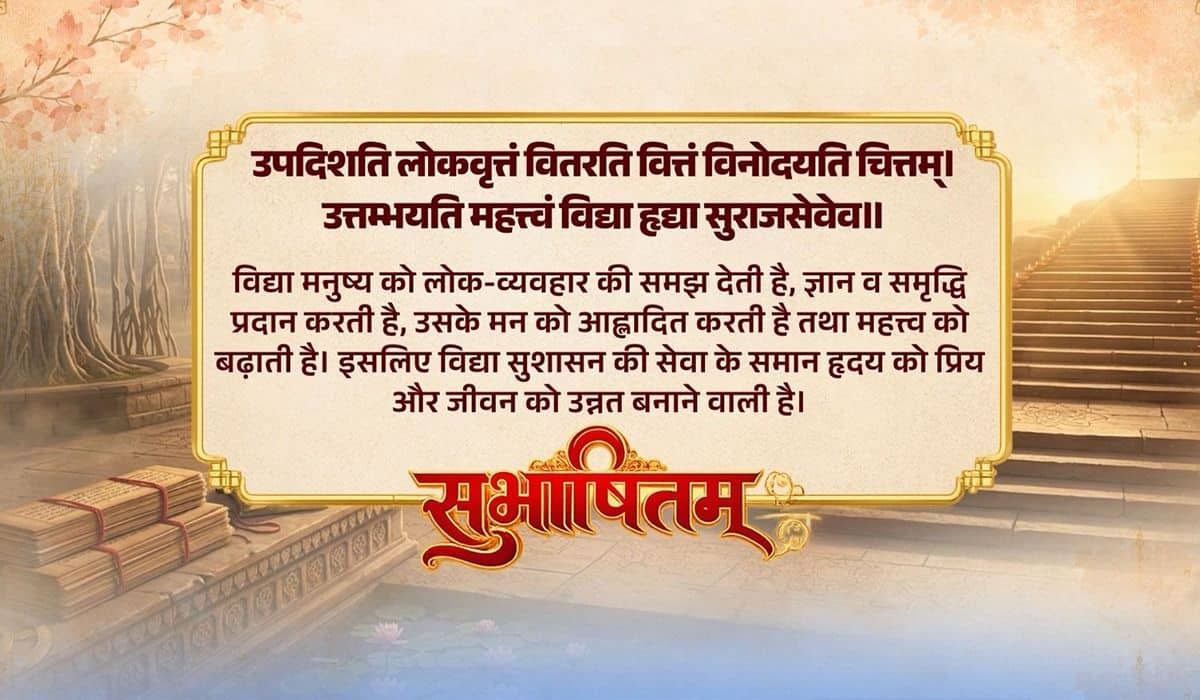
ज्ञान-वानेन सुखवान्, ज्ञान-वानेव जीवति।
ज्ञान-वानेव बलवान्, तस्मात् ज्ञान-मयो भव॥
It means one who possesses knowledge is the one who is happy, who is powerful. And in reality, it is the one with knowledge who truly triumphs. Therefore, when India had universities like Nalanda, India was at the pinnacle of happiness and prosperity. When India had institutions like Taxila, India guided the world in the field of science. India's prosperous education system was the carrier of India's prosperity.
This was the time when India had a significant share in the world's GDP. However, the period of hundreds of years of slavery destroyed our education centers which were the temples of education. And when India's intellectual flow came to a halt, India's growth also stagnated.
The country gained independence after a long period of slavery. During this time, Indian universities played a significant role in giving a concrete shape to the emotional tide of freedom. As a result, a young generation emerged that could challenge the contemporary world of that time. Delhi University was also a major center of this movement. All students of DU, regardless of their course, would be familiar with the roots of their institution. Understanding the past shapes our existence, underpins ideals and broadens visions of the future.

Friends,
Whether it's an individual or an institution, when their aspirations are aligned with the nation's resolves, their success becomes intertwined with the nation's achievements. Once Delhi University had only three colleges, today there are more than 90 colleges. Once India's economy was in a shambles, today it is among the top five economies in the world. Today, the number of female students studying in DU has surpassed that of male students. Similarly, there has been significant improvement in gender equality in the country. This means that the deeper the roots of an educational institution, the higher it reaches the branches of the nation. Therefore, there should be alignment and interconnection between the university and the nation's aspirations for the future.
When the country completes 100 years of its independence after 25 years, Delhi University will celebrate its 125th anniversary. While the objective was India's freedom back then, our goal now is to build a developed India by 2047. If we look back at the history of the previous century, the third decade of the previous century gave new momentum to the freedom struggle. Now, this third decade of the current century will give a new pace to India's journey of development. Today, universities and colleges are being established in large numbers across the country. In recent years, there has been a consistent increase in the number of institutions like IITs, IIMs, NITs, and AIIMS. All these institutes are becoming building blocks of New India.

Friends,
Education is not just a process of teaching, but it is also a process of learning. For a long time, the focus of education remained on what should be taught to students. However, we have shifted the focus to what students want to learn. A new National Education Policy has been formulated with the collective efforts of all of you. Now, students have the great convenience of choosing their preferred subjects based on their interests.
We are continuously working to improve the quality of educational institutions. We have introduced the National Institutional Ranking Framework to make these institutes competitive. This is providing motivation to institutions across the country. We have also linked the autonomy of institutions with the quality of education. The better the performance of institutions, the more autonomy they are granted.

Friends,
The result of futuristic policies and decisions in education is that today Indian universities are gaining global recognition. In 2014, only 12 Indian universities were listed in the QS World Rankings, but today this number has increased to 45.
Our educational institutes are making their distinct mark in the world. Our institutions are rapidly improving in terms of quality education, student-faculty ratio and reputation. And my friends, do you know what is the biggest guiding force behind all of this? The guiding force is the youth power of India, the potential of my youth sitting in this hall.
Friends,
There was a time when students used to prioritize placements before taking admission to any institute. It meant that admission was synonymous with a degree, and a degree meant a job. Education was limited to this extent. However, today's youth does not want to confine their lives to this notion. They want to do something new; they want to carve their own path.
India had only a few hundred start-ups before 2014. Today, the number of start-ups in India has crossed the one lakh mark. In comparison to 2014-15, more than 40 percent of the patents are now being filed. The number of patents being granted has also increased fivefold. In the Global Innovation Index, where India was ranked 81st, we have now moved up to the 46th position. Today we have achieved this position.
I have just returned from a trip to the United States just a few days back. You must have noticed how much India's respect and pride have increased today. What is the reason behind India's increased glory today? The answer is the same. It is because India's capabilities have grown, and the world has gained confidence in India's youth. During this visit, India and the United States have struck a deal called the Initiative on Critical and Emerging Technology (iCET). With this agreement, new opportunities are being created for our youth in various fields, ranging from the earth to space, from semiconductors to AI.
Technologies that were once beyond the reach of India are now accessible to our youth. Their skill development will be enhanced. Companies like Micron, Google and Applied Materials from the United States have decided to make significant investments in India. And my friends, it is evident that the future holds great opportunities for you and how it is knocking at your door.
Friends,
The revolution of Industry 4.0 has also arrived at our doorstep. What we used to see in science-fiction movies about AI and AR/VR is now becoming a part of our real-life experiences. From driving to surgery, robotics is becoming the new normal. All these sectors are creating new avenues for the young generation of India, for our students. In recent years, India has opened up its space sector, its defence sector, and brought about significant changes in drone-related policies. All these decisions have provided opportunities for a large number of youth in the country to progress and move forward.
Friends,
One more aspect of India's journey of development is how thousands of youth and our students are benefiting from it. Today, people from around the world are eager to know about India, its identity, and its culture. During the Corona pandemic, every country in the world was struggling with its own needs. However, India not only fulfilled its own needs but also extended help to other countries.
Therefore, a curiosity has arisen in the world as to what are the values of India that inspire service even in times of crisis. India's growing capabilities, its G-20 presidency, all contribute to increasing curiosity about India. This has created numerous new opportunities for our students in the field of humanities. Our science like yoga, culture, festivals, literature, history, heritage, traditions, and cuisine are now being discussed by everyone. They are becoming attractions for people from all walks of life. Hence, there is an increasing demand for Indian youth who can introduce the world to India, disseminate our creations globally. Today, Indian values such as democracy, equality, and mutual respect are becoming universally relevant. From government forums to diplomacy, new opportunities are constantly being created for Indian youth in many fields. The areas related to history, heritage, and culture within the country have also opened up immense possibilities for the youth.
Today, tribal museums are being set up in different states of the country. The development journey of independent India is visible through the PM-Museum. You will be pleased to know that Delhi is going to have the world's largest heritage museum called "Yuge Yugeen Bharat". For the youth involved in art, culture, and history, there are now so many opportunities to turn their passion into a profession. Similarly, Indian teachers have made a distinct identity for themselves in the world today. Whenever I have the opportunity to meet global leaders, many of them share stories and speak with great pride about their connection to an Indian teacher.
The soft power of India can create success stories for Indian youth. For all this, our universities and institutions need to be prepared, and we need to prepare our mindset. Every university needs to create a roadmap for itself, and determine its goals.
When you celebrate 125 years of this institution, may your count be among the top-ranked universities in the world. Therefore, step up your efforts to achieve this. You will have to work consistently so that future-making innovations should happen here and the world's best ideas and leaders should emerge from here.
But amidst all these changes, don't change completely, my friends. Leave some things as they are. The tea of Patel Chest in the North Campus...noodles...the momos of Chanakya in the South Campus… You have to ensure that their taste does not change.
Friends,
When we set a goal in our lives, we first need to prepare our mind and heart for it. The responsibility of preparing the mind and heart of a nation lies with its education institutes. It is only through the vision and mission of educational institutions that our new generation can become future-ready, possessing the temperament to accept and face challenges.
I believe that Delhi University will definitely fulfil these resolutions as it progresses on its journey. And the way you have taken this journey of the centenary year forward, may you continue to move forward with even greater capabilities, in a more magnificent manner, carrying more dreams and resolutions, and achieving success. May accomplishments continue to touch your footsteps, and may the nation progress with your abilities. With these wishes, I extend my heartfelt congratulations to all of you.
Thanks!