Namaskar friends,

It is the winter session, and the atmosphere will also remain cool. We are in the final phase of 2024, and the country is enthusiastically preparing to welcome 2025 with great energy and excitement.

Friends,

This session of Parliament is special in many ways, with the most significant aspect being the 75-year journey of our Constitution, as it steps into its 75th year. This is a momentous occasion for democracy. Tomorrow, we will collectively begin the celebration of the 75th year of our Constitution in the Constitution Hall. The Constitution framers debated every point in great detail while drafting the Constitution, resulting in this excellent document. A significant pillar of this is our Parliament and its members. It is essential for Parliament to engage in healthy discussions where as many people as possible contribute. Unfortunately, some individuals rejected by the people are continuously attempting to control Parliament through disruptive tactics for their political gains. Their primary goal of halting parliamentary proceedings rarely succeeds, and the people take note of their actions, often punishing them when the time comes.

The most troubling aspect, however, is that such behaviour stifles the rights of new MPs—those who bring fresh ideas and energy from all parties. These new members are often denied opportunities to speak in the House. In a democratic tradition, every generation has the responsibility to prepare the next generations. But those who have been repeatedly rejected by the people —80, 90 times—neither allow discussions in Parliament nor respect democratic principles or the aspirations of the people. They don’t realise their responsibility towards the people. As a result, they consistently fail to meet public expectations, leading to repeated rejection by the electorate.

Friends,

This House is a testament to democracy. After the 2024 Parliamentary elections, the people of the country have had opportunities in their respective states to express their thoughts, views, and expectations. The results of these elections in the states have further strengthened the outcomes of the 2024 Lok Sabha elections, broadening the support base and increasing trust in democratic processes. In democracy, it is imperative for us to respect the sentiments of the people and work tirelessly to meet their hopes and expectations. I have repeatedly urged the Opposition, and some opposition members act very responsibly. They also desire smooth functioning of the House. However, those rejected by the people suppress even their colleagues’ voices, disrespect their feelings, and undermine the spirit of democracy.

I hope our new members, from all parties, get opportunities. They bring fresh ideas and innovative visions to advance Bharat. Today, the world looks at Bharat with great hope. As Members of Parliament, we must use our time to further enhance Bharat’s global respect and attraction. Opportunities like the one Bharat has today are rare on the world stage. The message from Bharat’s Parliament should reflect the voters' dedication to democracy, their commitment to the Constitution, and their trust in parliamentary practices. We, as their representatives, must live up to these sentiments. It is time to reflect on the time we have lost so far and resolve to compensate by thoroughly debating various issues in the House. Future generations will read and draw inspiration from these discussions. I hope this session will be highly productive, enhance the prestige of the Constitution’s 75th year, strengthen Bharat’s global stature, provide opportunities to new MPs, and welcome new ideas. With this spirit, I once again invite and welcome all esteemed Members of Parliament to approach this session with enthusiasm and vigour. Thank you all very much.

Namaskar!

Explore More
Today, the entire country and entire world is filled with the spirit of Bhagwan Shri Ram: PM Modi at Dhwajarohan Utsav in Ayodhya

Popular Speeches

Today, the entire country and entire world is filled with the spirit of Bhagwan Shri Ram: PM Modi at Dhwajarohan Utsav in Ayodhya
UPI — an eventful journey

Media Coverage

UPI — an eventful journey
NM on the go

Nm on the go

Always be the first to hear from the PM. Get the App Now!
...
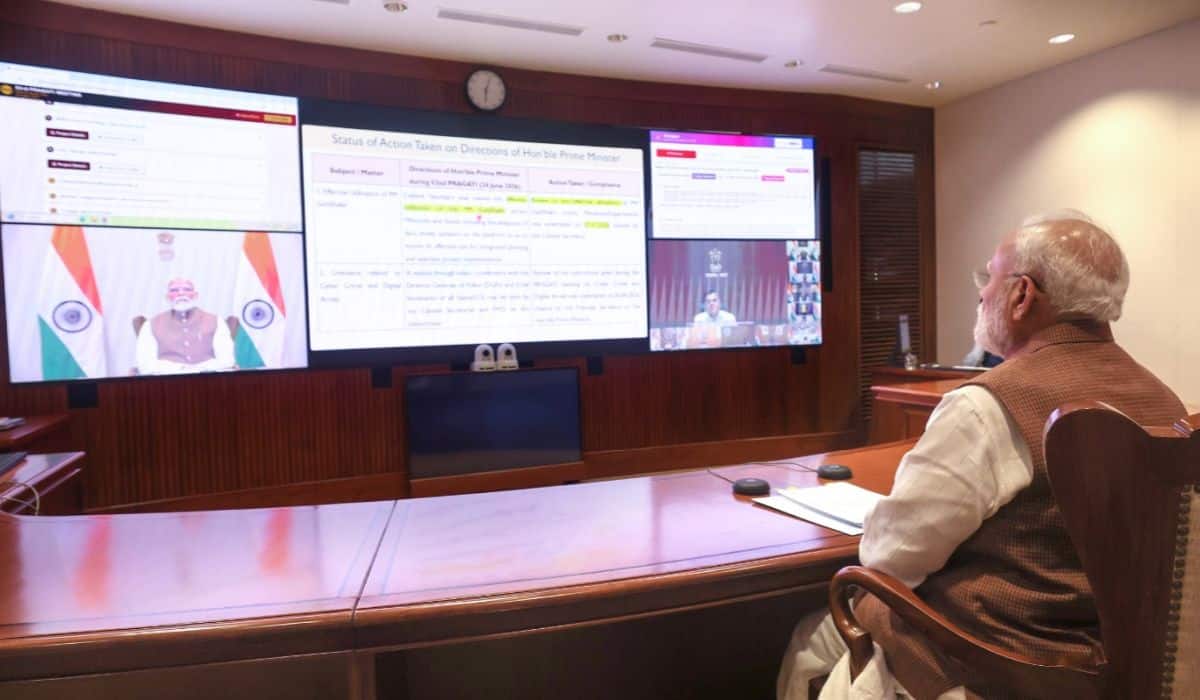
PM chairs 53rd PRAGATI Meeting
August 25, 2026
PM reviews six key infrastructure projects across the Railway, Road and Power sectors
Projects reviewed span across 9 States with cumulative investment of more than ₹30,000 crore
PM says Infrastructure projects should be viewed as an integrated whole, rather than as individual sections or packages
PM calls for continuous reforms across all stages of project implementation and a proactive work culture across Ministries and States
PM says Speed must go hand-in-hand with quality
While reviewing AgriStack, PM emphasises the need to leverage the latest digital technologies including AI to derive greater value from agricultural data
On cyber fraud and ‘digital arrest’, PM stresses training, public awareness, cyber-safety education and coordinated action

Prime Minister Shri Narendra Modi chaired the 53rd meeting of PRAGATI, the ICT-enabled, multi-modal platform for Pro-Active Governance and Timely Implementation, at Seva Teerth earlier today.

During the meeting, Prime Minister reviewed six key infrastructure projects across the Railway, Road and Power sectors, spanning nine States with a cumulative cost of more than ₹30,000 crore. The projects, significant for strengthening connectivity, supporting industrial and economic activity and improving public services, were reviewed with particular emphasis on adherence to timelines, inter-agency coordination, resolution of pending issues and expeditious completion.

Prime Minister emphasised that delays in infrastructure projects have consequences beyond cost escalation, as they also postpone the benefits intended for citizens, businesses and the economy. He said that infrastructure projects should be viewed and monitored as an integrated whole, rather than as isolated sections, stretches or packages. He noted that progress in individual packages should ultimately translate into timely completion and operationalisation of the entire project. Ministries and States were therefore asked to adopt an end-to-end approach, and address critical gaps that could delay the overall commissioning and delivery of benefits. He called for fostering a proactive work culture across Ministries and State Governments, with greater ownership at every level of project implementation.

Prime Minister stressed the need to explore common utility corridors for infrastructure services, wherever feasible, particularly while planning major transport and infrastructure projects. He called upon Ministries and States to examine such integrated approaches at the planning stage itself, keeping in view their technical and economic feasibility.

Prime Minister said that speed of execution must be accompanied by uncompromising quality. He called upon Ministries, States and implementing agencies to adopt modern technologies and strengthen quality assurance and supervision at every stage.

While reviewing AgriStack under the Digital Agriculture Mission, Prime Minister emphasised the need to leverage the latest digital technologies, including Artificial Intelligence, to derive greater value from agricultural data. He stressed that the data ecosystem should be effectively utilised across the agricultural value chain, from input planning to processing, enabling more informed interventions, better targeting and data-driven decision-making. He appreciated the efforts of the States and the Central Government in building the AgriStack ecosystem and called for further strengthening its use for delivering better outcomes for farmers.

During the review of cyber fraud cases, including incidents of digital arrest, Prime Minister said that prevention must be strengthened through a sustained focus on training, awareness and education. He stressed the need for continuous and targeted public-awareness campaigns, particularly for senior citizens, youth and other vulnerable sections, to familiarise them with common fraud techniques, warning signs and safe digital practices. He also called for regular capacity-building of personnel involved so that emerging modes of cyber fraud are identified and acted upon swiftly.