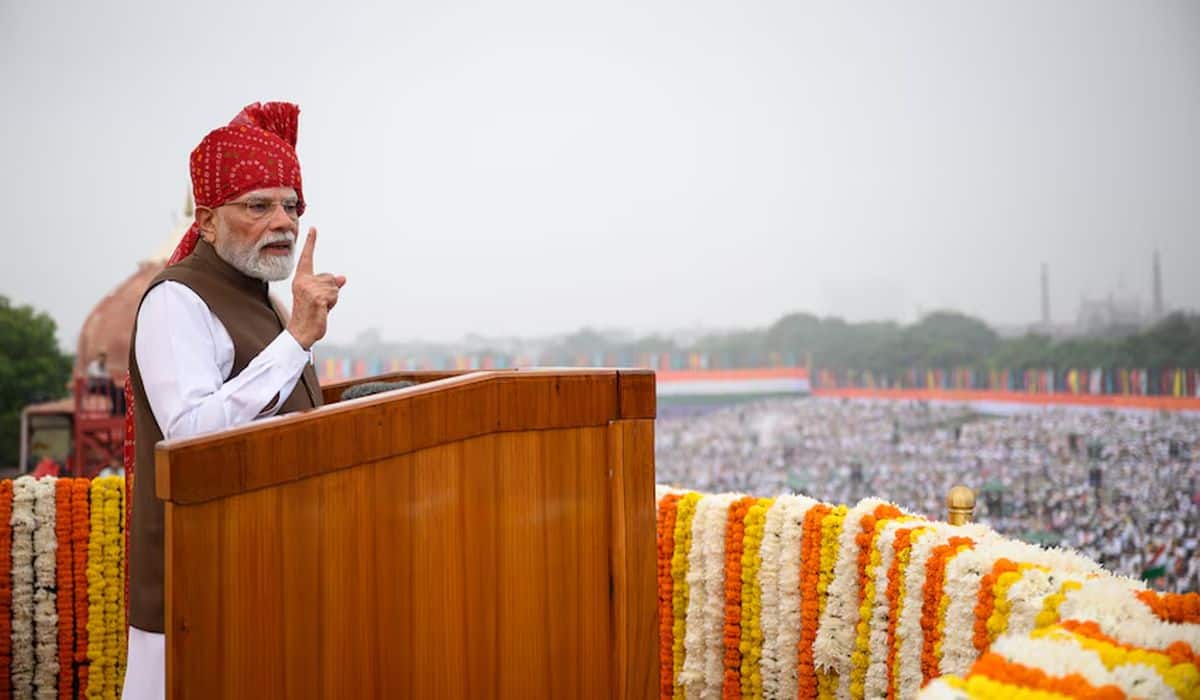
Bharat Mata Ki Jai!
Bharat Mata Ki Jai!
I extend warm greetings to all the people of Bundelkhand, the land of heroes. I also greet the Honourable Governor of Madhya Pradesh, Shri Mangubhai Patel; the diligent Chief Minister of this region, Bhai Mohan Yadav Ji; Union Ministers Bhai Shivraj Singh Ji, Virendra Kumar Ji, and CR Paatil Ji; Deputy Chief Minister Jagdish Devda Ji; Rajendra Shukla Ji; other ministers, MPs, MLAs, other dignitaries, revered sages, and my dear brothers and sisters of Madhya Pradesh.
Today, the entire world is celebrating Christmas. I warmly extend my Christmas greetings to the Christian community across the nation and the globe. Additionally, the BJP government, under the leadership of Mohan Yadav, has successfully completed one year. I extend my heartfelt congratulations to the people of Madhya Pradesh and the dedicated BJP workers. Over the past year, Madhya Pradesh has witnessed a new wave of development. Even today, projects worth thousands of crores of rupees have been inaugurated. Notably, the foundation stone for the historic Daudhan Dam of the Ken-Betwa Link Project has been laid, and the Omkareshwar Floating Solar Plant—the first of its kind in Madhya Pradesh—has been inaugurated. My heartiest congratulations to the people of Madhya Pradesh on these significant achievements.

Friends,
Today is a deeply inspiring day for all of us. It is the birth anniversary of our revered Atal Ji. This day marks the centenary of Bharat Ratna Atal Ji's birth. The celebration of Atal Ji’s birth anniversary is a festival of inspiration for good governance and dedicated service. Earlier today, as I released a commemorative postage stamp and coin in his memory, I was overwhelmed by a flood of cherished memories. For years, Atal Ji mentored and nurtured many individuals like me. His invaluable contributions to the nation's development will forever remain etched in our memories.
Moreover, the construction of over 1,100 Atal Gram Seva Sadans in Madhya Pradesh is commencing today, and the first instalment for these has already been released. These Atal Gram Seva Sadans will play a pivotal role in accelerating the development of our villages.
Friends,
For us, Good Governance Day is not merely a one-day observance; it is a way of life and the hallmark of BJP governments. The people of this nation have chosen the BJP-led government at the Centre for the third consecutive term. In Madhya Pradesh, you have consistently placed your trust in the BJP. This enduring faith in good governance is the cornerstone of our success.
I urge the intellectuals and analysts of this country, those adept at evaluating governance through written records, to conduct a review as we mark 75 years of independence. Let us identify 100–200 parameters related to development, public welfare, and good governance. Then, let us assess what has been achieved in regions where Congress ruled, where the Left or communist parties held power, where family-driven political parties governed, and where coalition governments were in charge. Most importantly, let us evaluate the regions where the BJP was given the opportunity to serve.
I can confidently assert that wherever the BJP has been in power, we have surpassed all previous records in public welfare, developmental initiatives, and service to the nation. If these parameters are objectively evaluated, the nation will see the unwavering dedication of BJP governments to the common man. We work tirelessly to fulfil the dreams of our freedom fighters. Those who sacrificed their lives for this country deserve to have their visions realised. We are committed to nurturing those dreams with our relentless efforts.
Good governance is not just about formulating excellent schemes; it is about their effective and transparent implementation. The real measure of governance lies in how much benefit reaches the people. In the past, Congress governments were known for announcements and optics—laying foundation stones, cutting ribbons, lighting ceremonial lamps, and getting their photographs published. Their responsibility ended there, leaving the people without the promised benefits.
After becoming the Prime Minister, I reviewed old projects through the PRAGATI programme. I was shocked to discover that work on projects initiated 35–40 years ago had not progressed even an inch. This reflects the lack of intent and seriousness in implementing schemes during Congress rule.

Today, we are witnessing the tangible benefits of schemes like the PM Kisan Samman Nidhi. Farmers in Madhya Pradesh are now receiving Rs 12,000 annually under this scheme, something made possible only because Jan Dhan bank accounts were opened. In Madhya Pradesh, the Ladli Behna Yojana is transforming lives. Without the opening of bank accounts for women and linking them with Aadhaar and mobile numbers, such schemes would have been impossible to implement.
Previously, schemes like subsidised ration existed, but the poor often struggled to access their entitlements. Today, with the introduction of technology, we see transparency and efficiency in ration distribution. The poor now receive free rations without any hassle. This transformation was only possible because of initiatives like "One Nation, One Ration Card," which have eliminated fraud and ensured nationwide access to essential services.
Friends,
Good governance means that a citizen should not have to plead with the government for their rights or run from one government office to another. Our policy of "saturation" ensures that 100% of beneficiaries receive 100% of the benefits. This mantra of good governance is what distinguishes BJP governments from others. Today, the entire country recognises this, which is why the BJP is repeatedly chosen to lead.
Friends,
Wherever there is good governance, not only are current challenges addressed, but future challenges are also anticipated and planned for. Unfortunately, Congress ruled the country for decades but failed to deliver governance. Congress has always treated being in government as its birthright, yet governance has remained a distant concept for them. Governance and Congress simply cannot coexist. The people of Bundelkhand have suffered the consequences of this negligence for generations. Farmers, mothers, and sisters here have struggled for every single drop of water. Why did such a situation arise? Because Congress never considered finding a permanent solution to the water crisis.

Friends,
I was among the first to recognise the importance of river water for Bharat's development. You may be surprised when I ask: after independence, who first thought about "Jal Shakti," the power of water? Who made visionary plans for Bharat's water resources? Who worked on these issues? Even my journalist friends would struggle to answer this question because the truth was deliberately suppressed. In their obsession with crediting one individual, the real visionary was forgotten. Today, I want to tell you that after independence, the vision for Bharat's water resources, the idea of constructing dams, and the concept of Jal Shakti were pioneered by none other than Dr. Baba Saheb Ambedkar.
The large river valley projects in Bharat were born out of Dr. Ambedkar’s vision. The Central Water Commission, which exists today, is also a result of his efforts. Yet Congress never acknowledged his contributions to water conservation and the construction of major dams. His contributions were hidden from public knowledge. Congress never gave Baba Saheb the recognition he deserved.
Even today, after seven decades, disputes over water persist between many states in the country. When Congress held power from the Panchayat level to Parliament, these disputes could have been resolved. But Congress’s intentions were flawed, and it never made any serious or concrete efforts to address these issues.
Friends,
When Atal Ji's government was formed, he began addressing the country’s water-related challenges with great seriousness. However, after 2004, when Atal Ji's government was replaced, Congress shelved all those plans, dreams, and efforts. Today, our government is accelerating the national campaign to link rivers. The dream of the Ken-Betwa Link Project is now on the verge of becoming a reality. This project will open new avenues of prosperity and happiness in the Bundelkhand region. Ten districts of Madhya Pradesh, including Chhatarpur, Tikamgarh, Niwari, Panna, Damoh, and Sagar, will benefit from improved irrigation facilities.
As I walked onto the stage, I had the opportunity to meet farmers from various districts. Their happiness and the joy on their faces were evident. They expressed that this project has secured the future of their coming generations.
Friends,
Districts like Banda, Mahoba, Lalitpur, and Jhansi in Uttar Pradesh’s Bundelkhand region will also gain from this initiative.

Friends,
Madhya Pradesh has become the first state in the country to initiate two projects under the grand campaign to link rivers. I was in Rajasthan a few days ago, where Mohan Ji elaborated on this. Plans are in place to connect multiple rivers through the Parvati-Kalisindh-Chambal and Ken-Betwa link projects. Madhya Pradesh is poised to reap significant benefits from this agreement.
Friends,
Water security is one of the greatest challenges of the 21st century. In this century, only those countries and regions that have ample water and effective water management will thrive. Agriculture and livestock will flourish with water; industries and businesses will thrive with water.
I come from Gujarat, a state where drought used to be a common occurrence for large part of the year. However, the blessings of Maa Narmada, which originates in Madhya Pradesh, transformed Gujarat's destiny. I see it as my responsibility to free the drought-affected areas of Madhya Pradesh from the water crisis. This is why I made a promise to the sisters of Bundelkhand and the farmers here—to work tirelessly and sincerely to alleviate your struggles.
Under this vision, we developed a plan worth approximately Rs 45,000 crore to address Bundelkhand’s water issues. We consistently encouraged the BJP governments in Madhya Pradesh and Uttar Pradesh to act on this vision. Today, as part of the Ken-Betwa Link Project, the foundation stone of the Daudhan Dam has been laid. This dam will give rise to hundreds of kilometres of canals, and its water will irrigate approximately 11 lakh hectares of land.

Friends,
The last decade will be remembered in Bharat's history as an extraordinary period of progress in water security and conservation. In previous governments, responsibilities related to water were scattered across various departments. To address this, we established the Jal Shakti Ministry. For the first time, a national mission was launched to provide tap water to every household. In the seven decades after independence, only three crore rural families had access to tap water. Over the last five years, we have provided tap water connections to 12 crore additional families. So far, more than Rs 3.5 lakh crore has been invested in this scheme.
Another crucial aspect of the Jal Jeevan Mission, which is not often discussed, is the focus on water quality testing. Across the country, 2,100 water quality laboratories have been set up. In villages, 25 lakh women have been trained to test drinking water. As a result, thousands of villages are now free from the compulsion of consuming contaminated water. Imagine the significance of this effort in safeguarding children and communities from waterborne diseases.
Friends,
Before 2014, there were about 100 large irrigation projects in the country that had remained incomplete for decades. We are investing thousands of crores of rupees to complete these long-pending projects. Additionally, we are promoting modern methods of irrigation. Over the past decade, nearly one crore hectares of land have been brought under micro-irrigation facilities. In Madhya Pradesh alone, about five lakh hectares of land have been equipped with micro-irrigation in the same period. Efforts to make optimal use of every drop of water continue unabated.
On the occasion of Bharat completing 75 years of independence, we launched a campaign to construct 75 Amrit Sarovars in every district. So far, over 60,000 Amrit Sarovars have been built across the country. We have also rolled out the Jal Shakti Abhiyan: Catch the Rain initiative nationwide. More than three lakh recharge wells are currently under construction. The most remarkable aspect of these initiatives is the active participation of people from all walks of life—urban and rural alike—who are driving these campaigns with immense enthusiasm.
In regions where groundwater levels are critically low, including Madhya Pradesh, we are implementing the Atal Bhujal Yojana to address these challenges.
Friends,
Madhya Pradesh has always been a leading state in tourism. And how could I come to Khajuraho without mentioning tourism? Tourism is a sector that not only generates employment for the youth but also strengthens the national economy. As Bharat is poised to become the third-largest economic power in the world, global curiosity about Bharat is growing. People across the world are eager to learn about and understand our country, and Madhya Pradesh stands to benefit significantly from this interest.
Recently, a report in an American newspaper highlighted Madhya Pradesh as one of the ten most attractive tourist destinations in the world. This recognition has been widely reported in Madhya Pradesh’s newspapers as well. Imagine the pride and joy for every resident of Madhya Pradesh! Does this not enhance your sense of identity and respect? Will it not boost tourism in the region? Will it not provide jobs to even the poorest citizens?

Friends,
The central government is consistently working to enhance facilities for tourists from both Bharat and abroad, ensuring easier access to travel destinations. We have introduced initiatives like the e-visa to simplify travel for international visitors. Heritage and wildlife tourism in India are being expanded, and Madhya Pradesh holds unparalleled potential in this regard. Take the Khajuraho region, for instance—it boasts invaluable treasures of history and devotion. Places such as Kandariya Mahadev, Laxman Temple, and Chausath Yogini Temple are significant pilgrim sites. To promote tourism, we organised G-20 meetings across India, including one here in Khajuraho. For this purpose, a state-of-the-art international conference centre was built in Khajuraho.
Friends,
Under the central government's Swadesh Darshan Yojana, Madhya Pradesh has been allocated hundreds of crores of rupees to develop eco-tourism facilities and introduce new attractions for tourists. Today, sites like Sanchi and other Buddhist locations are being connected through the Buddhist circuit. Eco circuits now include Gandhisagar, Omkareshwar Dam, Indira Sagar Dam, Bheda Ghat, and Bansagar Dam. Similarly, heritage circuits are linking places like Khajuraho, Gwalior, Orchha, Chanderi, and Mandu, while Panna National Park has been integrated into the wildlife circuit.
Last year alone, approximately 2.5 lakh tourists visited the Panna Tiger Reserve. I am pleased to share that the link canal being constructed here will also take care of the wildlife at Panna Tiger Reserve.
Friends,
These efforts to boost tourism significantly impact the local economy. Tourists contribute by purchasing local goods, and businesses ranging from auto and taxi services to hotels, dhabas, homestays, and guest houses thrive. Even farmers benefit, as they secure better prices for produce such as milk, curd, fruits, and vegetables.

Friends,
Over the past two decades, Madhya Pradesh has excelled on many fronts. In the years ahead, the state is poised to become one of the top economies in the country. Bundelkhand will play a vital role in this transformation, contributing significantly to making Madhya Pradesh a developed state for a developed Bharat.
I assure you that the double-engine government will continue its sincere efforts to achieve this vision. Once again, my heartfelt best wishes to all of you.
Today's programme is truly monumental, and I deeply understand its significance. The presence of such a large gathering, especially of mothers and sisters, underscores the importance of water. Water is life, and your blessings for our work in this area inspire us to continue. Together, let us pledge to move forward. Say it with me:
Bharat Mata Ki Jai!
Bharat Mata Ki Jai!
Bharat Mata Ki Jai!