“In India, nature and its ways have been regular sources of learning”
“Climate Action must follow ‘Antyodaya’ which means ensuring the rise and development of the last person in the society”
“India has set a target of attaining ‘Net Zero’ by 2070”
“70 percent of the world’s tigers are found in India today as a result of Project Tiger”
“India’s initiatives are powered by people’s participation”
“Mission LiFE as a global mass movement will nudge individual and collective action to protect and preserve the environment”
“Mother Nature prefers ‘Vasudhaiva Kutumbakam’ - One Earth, One Family, One Future”

Excellencies,

Ladies, and Gentlemen,

Namaskar!

Vanakkam!

I welcome you all to Chennai, a city rich in history and culture! I hope you will get some time to explore the UNESCO World Heritage site of Mamallapuram. With its inspiring stone carvings and great beauty, it is a "must visit" destination.

Friends,

Let me begin by quoting from Thirukural, written about two thousand years ago. The great Saint Thiruvalluvar says:“नेडुंकडलुम तन्नीर मै कुंडृम तडिन्तेडिली तान नल्गा तागि विडिन”. It means, “Even the oceans will shrink, if the cloud that has drawn its waters up, does not give it back in the form of rain”. In India, nature and its ways have been regular sources of learning. These are found in several scriptures as well as oral traditions. We have learnt,पिबन्ति नद्य: स्वयमेव नाम्भ:, स्वयं न खादन्ति फलानि वृक्षा:। नादन्ति सस्यं खलु वारिवाहा:, परोपकाराय सतां विभूतय:।।

That is, “Neither Rivers drink their own water nor Trees eat their own fruits. Clouds also don't consume grains produced by their water”. Nature provides for us. We must also provide for nature. Protecting and caring for Mother Earth is our fundamental responsibility. Today, it has taken the shape of “Climate Action” because this duty was ignored by many for a very long time. Based on India’s traditional knowledge, I would emphasize that Climate Action must follow “Antyodaya”. That is, we must ensure the rise and development of the last person in the society. Countries of the Global South are particularly impacted by Climate Change and environmental issues. We need enhanced action on commitments under the “UN Climate Convention” and the “Paris Agreement”. This will be crucial in helping the Global South fulfill its developmental aspirations in a climate friendly way.

Friends,

I am proud to say that India has led the way through its ambitious “Nationally Determined Contributions”. India achieved its installed electric capacity from non-fossil fuel sources, nine years ahead of the target of 2030. And, we have set the bar even higher through our updated targets. Today, India is one of the top 5 countries in the world, in terms of installed renewable energy capacity. We have also set a target of attaining “Net Zero” by 2070. We continue to collaborate with our partners through alliances including International Solar Alliance, CDRI, and the “Leadership Group for Industry Transition”.

Friends,

India is a mega-diverse country. We have consistently been at the forefront in taking action on biodiversity conservation, protection, restoration and enrichment. I am happy that through the “Gandhinagar Implementation Roadmap and Platform”, you are recognizing restoration in priority landscapes impacted by forest fires and mining. India has recently launched the “International Big Cat Alliance” for conservation of seven big cats of our planet. It is based on our learnings from Project Tiger, a pioneering conservation initiative. As a result of Project Tiger, 70% of the world’s tigers today are found in India. We are also working on Project Lion and Project Dolphin.

Friends,

India’s initiatives are powered by people’s participation. “Mission Amrit Sarovar” is a unique water conservation initiative. Under this mission, more than sixty three thousand water bodies have been developed in just about one year. This mission is implemented entirely through community participation, and aided by technology. Our “Catch the Rain” campaign has also shown excellent results. To conserve water, more than two hundred and eighty thousand water harvesting structures have been constructed through this campaign. In addition, nearly two hundred and fifty thousand re-use and recharge structures have also been constructed. All this was achieved through people's participation and focused on local soil and water conditions. We have also effectively utilized community participation in the “Namami Gange Mission” for cleaning the river Ganga. This has led to a major achievement in the reappearance of the Gangetic Dolphin in many stretches of the river. Our efforts in wetland conservation have also borne fruit. With seventy five wetlands designated as Ramsar sites, India has the largest network of Ramsar sites in Asia.

Friends,

Our oceans support the livelihoods of over three billion people across the globe. They are a crucial economic resource, especially for the “Small Island States”, whom I prefer to call “Large Ocean Countries”. They are also home to extensive biodiversity. Therefore, responsible use and management of ocean resources is of vital importance. I look forward to the adoption of “G20 High Level Principles for a Sustainable and Resilient Blue and Ocean-based Economy”. In this context, I also call on the G20 to work constructively for an effective international legally-binding instrument to end plastic pollution.

Friends,

Last year, along with the UN Secretary General, I launched Mission LiFE – Lifestyle for Environment. Mission LiFE, as a global mass movement, will nudge individual and collective action to protect and preserve the environment. In India, environment-friendly actions by any person, company or a local body will not go unnoticed. It can now earn them green credits under the recently announced “Green Credit Programme”. This will mean that activities like tree plantation, water conservation, and sustainable agriculture can now generate revenue for individuals, local bodies and others.

Friends,

As I conclude, let me reiterate that we should not forget our duties towards mother nature. Mother nature does not favour a fragmented approach. She prefers “Vasudhaiva Kutumbakam” - One Earth, One Family, One Future. I wish you all a productive and successful meeting. Thank you.

Namaskar!

Explore More
Today, the entire country and entire world is filled with the spirit of Bhagwan Shri Ram: PM Modi at Dhwajarohan Utsav in Ayodhya

Popular Speeches

Today, the entire country and entire world is filled with the spirit of Bhagwan Shri Ram: PM Modi at Dhwajarohan Utsav in Ayodhya
Emerging cities see 42% growth in GCC jobs, outpacing metros: Report

Media Coverage

Emerging cities see 42% growth in GCC jobs, outpacing metros: Report
NM on the go

Nm on the go

Always be the first to hear from the PM. Get the App Now!
...
PM Modi chairs 51st PRAGATI Meeting
May 27, 2026
PM reviews seven critical infrastructure projects across the Railways, Power and Road sectors
Projects reviewed span across 9 States with cumulative investment of around ₹30,000 crore
PM also reviews Ken Betwa Link Project and Swachh Bharat Mission-Urban 2.0
PM says Ken-Betwa River Inter-linking Project should serve as a model for other States to resolve inter-State water issues amicably
PM asks States to expedite the completion of solid waste management-related infrastructure, including waste processing plants and GOBARdhan plants
PM calls for mission-mode rooftop solar coverage in urban areas
Acting upon the advice of PM, system of monthly review of social sector schemes at State level operationalised, starting with review of Swachh Bharat Mission

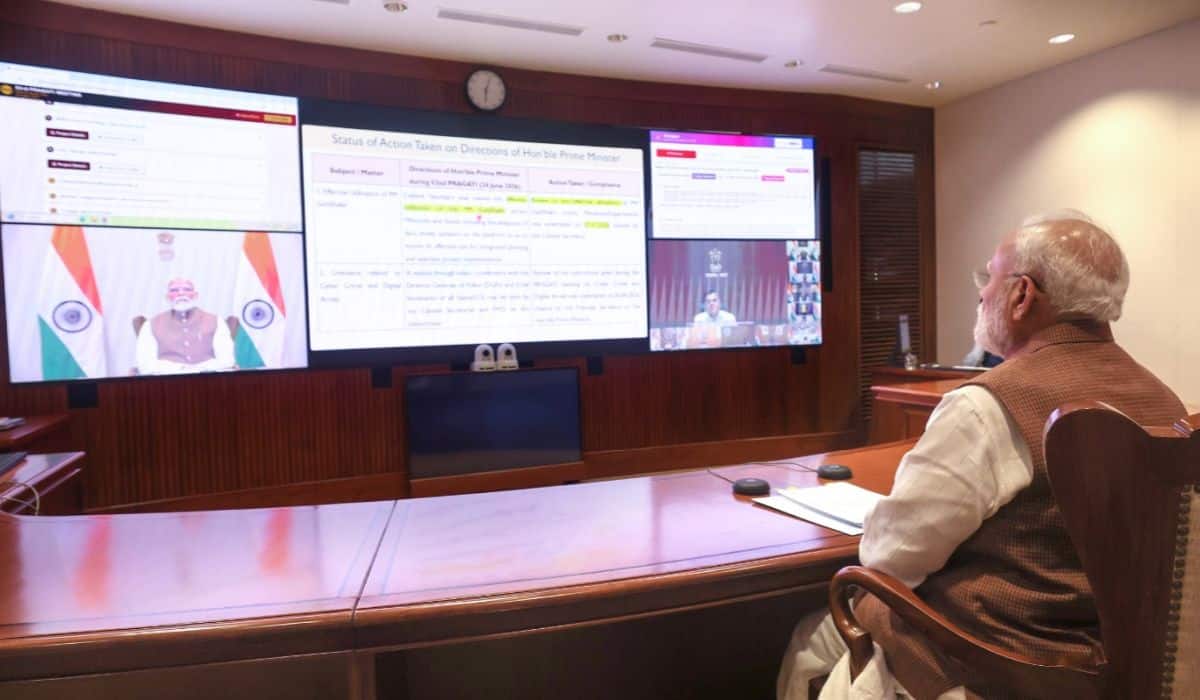
Prime Minister Shri Narendra Modi chaired the 51st meeting of PRAGATI, the ICT-enabled, multi-modal platform aimed at fostering Pro-Active Governance and Timely Implementation, by seamlessly integrating efforts of the Central and State governments, at Seva Teerth, earlier today.

During the meeting, the Prime Minister reviewed seven critical infrastructure projects across the Railways, Power and Road sectors covering nine States worth around ₹30,000 crore. These projects, pivotal to economic growth and public welfare, were reviewed with a focus on timelines, inter-agency coordination, and timely issue resolution. Prime Minister also reviewed Ken Betwa Link Project and Swachh Bharat Mission-Urban 2.0.

While reviewing power sector projects, Prime Minister emphasized the need to accelerate rooftop solar adoption across urban areas, with a special focus on cities, residential clusters and public institutions. He underlined that rooftop solar should be taken up in mission mode to reduce electricity costs, improve energy security and promote clean energy at the household and community level.

While reviewing road and port connectivity projects, it was emphasised that Vadhavan Port should be developed as a model of port-led, multi-modal development, where every major mode of transport is seamlessly integrated to create a future-ready logistics ecosystem. The project should not be seen merely as a port, but as a national gateway connected through coastal shipping, inland waterways, dedicated freight corridors, high-speed rail connectivity, highways and airport linkages.

Prime Minister emphasised the need for effective implementation of Swachh Bharat Mission 2.0 and underlined that the mission should move beyond infrastructure creation and ensure measurable outcomes through regular monitoring, citizen participation and convergence between various stakeholders. He asked States to expedite the completion of solid waste management-related infrastructure, including waste processing plants and GOBARdhan plants.

While reviewing Ken-Betwa River Inter-linking Project, Prime Minister observed that Ken-Betwa project should serve as a model for other States to resolve inter-State water issues through cooperation, timely clearances, technology-based monitoring and mission-mode execution. States were encouraged to identify similar opportunities where river-linking, water conservation, groundwater recharge and efficient irrigation can be taken up in an integrated manner to ensure long-term water security.

Prime Minister also underlined that the delay in the implementation of public projects leads not only to cost escalation but also deprives citizens of timely access to essential facilities and development benefits. He observed that every delay has a direct impact on people’s lives, regional growth and public resources. He stressed that Ministries, Departments and States must adopt a more proactive and time-bound approach to resolve pending issues, remove bottlenecks and ensure faster execution.

Prime Minister also emphasized that innovative use of canal networks should be explored, including installation of solar panels along canals and over canals for clean electricity generation. This would help optimize land use, reduce evaporation losses, generate renewable energy and create additional economic value from water infrastructure.

At the beginning of the meeting, the Cabinet Secretary informed that, in pursuance of the directions of the Prime Minister, a system of monthly review of social sector schemes at the State level has also been operationalised. This mechanism aims to ensure regular monitoring, faster resolution of implementation issues and greater accountability at the State and district levels. As part of this initiative, Swachh Bharat Mission has been taken up for review at the State level in the first instance.