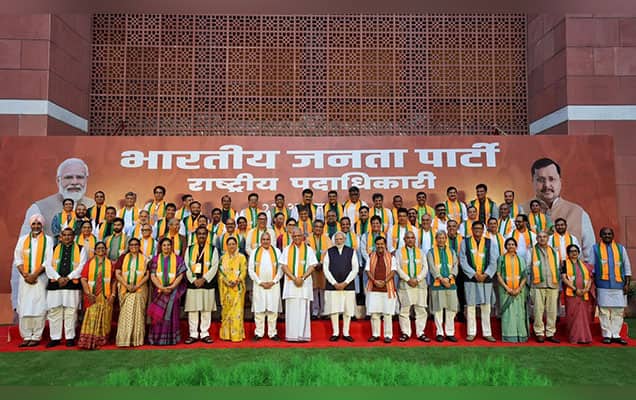
Releasing the BJP Sankalp Patra at Party headquarters today, PM Modi stated, "The entire nation eagerly awaits the BJP's manifesto. There is a significant reason for this. Over the past 10 years, the BJP has implemented every point of its manifesto as a guarantee. The BJP has once again demonstrated the integrity of its manifesto. Our Sankalp Patra empowers 4 strong pillars of developed India - Youth, women, poor and farmers.”
“Our focus is on the dignity and quality of life. Our focus is on investment leading to employment. This manifesto emphasizes both the quantity and quality of opportunities. On one hand, we have discussed creating employment through numerous infrastructure projects. On the other hand, we are also focusing on promoting high-value services by boosting startups and global centers. Our Sankalp Patra is a reflection of the young aspirations of Yuva Bharat,” he added.

Emphasizing the efforts in poverty alleviation, PM Modi stated, “The BJP government has demonstrated lifting 25 crore people out of poverty over the past 10 years. However, they continually need stability, or else there is a risk of falling back into poverty. With this mindset, the BJP has also committed to expanding several poverty alleviation schemes. Modi guarantees that the free ration scheme will continue for the next 5 years. We will ensure that the meal on a poor person's plate is nutritious, satisfying, and affordable.”
Talking about the BJP’s Sankalp Patra, the PM said, “Modi guarantees that affordable medicines with an 80 percent discount will continue to be available at Jan Aushadhi centers. Modi assures that free treatment under Ayushman Bharat, up to ₹5 lakh, will remain accessible. The biggest concern of the elderlies is that how will they afford treatment of their ailments. This concern is even more serious for the middle class. BJP has now taken the 'Sankalp' that every individual above 70 years of age will be brought within the purview of Ayushman Bharat Yojana."
Speaking about those who have been overlooked, PM Modi said, "He worships those who have not been asked. This embodies the spirit of ‘Sabka Saath, Sabka Vikas’ and reflects the essence of the BJP's manifesto. Over the past 10 years, we have provided numerous facilities for divyang individuals. Priority will be given to them in the PM Awas Yojana, ensuring housing according to their specific needs. Transgender individuals have also been neglected in the past. The BJP has now decided to include transgenders in the ambit of the Ayushman Bharat scheme.”

PM Modi highlighted India's leadership in Women-Led Development, emphasizing the efforts made over the past decade to empower women and provide them with opportunities. He remarked, “With 10 crore women joining self-help groups, they will now receive training in various sectors like IT, education, health, retail, and tourism. Additionally, Modi aims to increase the number of Lakhpati didis from 1 crore to 3 crore. Through the 'Namo Drone Didi' scheme, women in every village will become drone pilots, supported by the government with drone provisions.”
Recognizing the contributions of the tribal society, PM Modi said, We decided to celebrate Janjatiya Gaurav Divas in the country. Next year, in 2025, we will commemorate the 150th birth anniversary of Bhagwan Birsa Munda at the national level, further accelerating the Janjatiya Gaurav Campaign. Additionally, we will establish a Digital Janjatiya Kala Academy and promote forest-based startups and self-help groups. The goal of constructing over 700 Ekalavya schools will also be swiftly pursued.”
Firmly believing in the mantra of development as well as heritage, PM Modi iterated, “The BJP pledges to promote India's legacy. We will construct Thiruvallur cultural centres across the globe. Tamil, the world's oldest language, is our pride, and the BJP will spare no effort to enhance its global prestige. The untapped potential of tourism in our country remains vast, and the BJP is committed to unlocking it. We will connect global tourists with our heritage and integrate this heritage into the World Heritage framework.”

PM Modi emphasized the BJP's focus on strengthening India's foundation for the 21st century through three types of infrastructure: social, physical, and digital. This includes building new educational institutes, upgrading transportation networks, and expanding digital connectivity. This comprehensive approach reflects the BJP's top priority.
Stressing the BJP Sankalp Patra's aim to lead the country towards self-reliance, PM Modi said, “Whether it's the defence sector, edible oil, or energy imports, how long will India depend on other countries? Today, the BJP's major focus is on green energy and energy self-sufficiency. This involves blending ethanol in petrol, green hydrogen, renewable energy, gobardhan, biofuels, and accelerating progress in all sectors. It will generate a large number of green jobs in the country. We are also witnessing a rapid increase in the market for electric vehicles in the country.”
PM Modi outlined BJP's commitment to making India a global hub for every emerging sector. He envisioned a future where India will be the hub for - Green Energy, Pharma, Electronics, Automobile, Semiconductor, Innovation, Legal, Insurance, Contracting, and Commercial sectors.

Addressing the BJP karyakartas at party HQ, PM Modi stated, “In a world overshadowed by uncertainty, the clouds of war loom large. In such times of crisis, the safety of the Indians living in these areas is our top priority. It becomes increasingly imperative to have a stable government in India with a strong majority in such times. Such a government would not only ensure the country's security but also its economic prosperity.”
Citing the Bharatiya Janata Party known for its bold and decisive decisions in the interest of the nation, PM Modi reiterated, “For us, the country is greater than the party itself. The Women's Reservation Bill has now become law. BJP abolished Article 370 and brought in the Citizenship Amendment Act (CAA).”

“Continuing on the mantra of Reform, Perform, Transform, we will progress even faster. Necessary infrastructure and systems will be developed in the country for Good Governance, Digital Governance, and Data Governance. We will also advance the idea of One Nation-One Election. The BJP also considers a Uniform Civil Code essential for the nation's welfare,” he added.
PM Modi highlighted the BJP government's strong stance against corruption over the past decade, emphasizing how corruption deprives the rights of the poor and the middle class. “Now, the poor are getting their due, and those who loot the poor are going to jail. There will continue to be relentless action against corrupt individuals - this is Modi's guarantee,” the PM said.

In his concluding remarks, PM Modi said, “After June 4, work will swiftly commence on the BJP's Sankalp Patra. The government is already working on a 100-day action plan. We have witnessed the success of Chandrayaan, now we will experience the glory of Gaganyaan. We welcomed the world to India at the G-20 summit. Now we are fully committed to hosting the Olympics. This New India has gained momentum. Now, stopping it is impossible.”
Click here to read full text speech
ये संकल्प पत्र विकसित भारत के 4 मज़बूत स्तंभ- युवा शक्ति, नारीशक्ति, किसान और गरीब, सभी को सशक्त करता है: PM @narendramodi pic.twitter.com/0bVeUVUtZO
— narendramodi_in (@narendramodi_in) April 14, 2024
इस संकल्प पत्र में Quantity of Opportunities और Quality of Opportunities दोनों पर बहुत जोर दिया गया है: PM @narendramodi pic.twitter.com/B6UBUv8Zju
— narendramodi_in (@narendramodi_in) April 14, 2024
मोदी की गारंटी है कि मुफ्त राशन की योजना आने वाले 5 साल तक जारी रहेगी: PM @narendramodi pic.twitter.com/NZoAwp2m3J
— narendramodi_in (@narendramodi_in) April 14, 2024
भाजपा ने संकल्प लिया है कि 70 वर्ष की आयु से ऊपर के हर बुजुर्ग को आयुष्मान योजना के दायरे में लाया जाएगा: PM @narendramodi pic.twitter.com/1XPyBqpHmi
— narendramodi_in (@narendramodi_in) April 14, 2024
जिनको किसी ने नहीं पूछा, उनको मोदी पूजता है: PM @narendramodi pic.twitter.com/nZe51J2p7L
— narendramodi_in (@narendramodi_in) April 14, 2024
पिछले 10 वर्ष, नारी गरिमा, नारी को नए अवसरों को समर्पित रहे हैं।
— narendramodi_in (@narendramodi_in) April 14, 2024
आने वाले 5 वर्ष नारीशक्ति की नई भागीदारी के होंगे: PM @narendramodi pic.twitter.com/YAZSotuZzu
भाजपा का संकल्प, भारत को फूड प्रोसेसिंग हब बनाने का है। pic.twitter.com/xL5tlaWq5Z
— narendramodi_in (@narendramodi_in) April 14, 2024
भाजपा, विकास भी और विरासत भी के मंत्र पर विश्वास करती है। pic.twitter.com/P77cldkoot
— narendramodi_in (@narendramodi_in) April 14, 2024
भाजपा द्वारा विश्व प्रवासी-ग्लोबल टूरिस्ट्स को हमारी विरासत से जोड़ा जाएगा, और इस विरासत को हम वर्ल्ड हेरिटेज से जोड़ेंगे। pic.twitter.com/r0mhEQ23aL
— narendramodi_in (@narendramodi_in) April 14, 2024
21वीं सदी के भारत की बुनियाद, भाजपा तीन तरह के इंफ्रास्ट्रक्चर से मजबूत कर रही है। pic.twitter.com/GFEehAcmB5
— narendramodi_in (@narendramodi_in) April 14, 2024
हमारे देश में अर्बनाइजेशन को पहले की सरकारें चुनौती माना करती थीं।
— narendramodi_in (@narendramodi_in) April 14, 2024
भाजपा इसे अवसर के रूप में देखती है: PM @narendramodi pic.twitter.com/IUifeJaB5e
भारतीय जनता पार्टी देशहित में बड़े और कड़े निर्णय लेने से कभी पीछे नहीं हटती।
— narendramodi_in (@narendramodi_in) April 14, 2024
हमारे लिए दल से बड़ा देश है: PM @narendramodi pic.twitter.com/MgPfjriKuR