



PM Modi addressed and interacted with various students, during the Pariskha pe Charcha, 2024. While interacting with students, he also addressed how students must balance the use of technology in academic preparation. He also advocated that excessive technology and social media use may create secrecy, leading to a trust deficit. A student also should inform his/her parents of the need to use mobile phones for various educational purposes so that the parents are aware, he added.
PM Modi emphasised the need for discipline in the use of gadgets, as this increases a student's productivity. He added that properly using technology will allow us to overcome its influence. He remarked that parents can also monitor and understand the tech needs of the student for their academic pursuit, aiding a better use of technology and imparting transparency in the student-parent relationship.
PM Modi elaborated on the need for apps that can caution us against the indiscriminate use of mobile phones. He added that teachers should also explain the positive impacts of mobile phones and other technology. He said that smart tech should enable smart study, imparting transparency in relationships.
Published By : Admin |
January 29, 2024 | 18:02 IST
-
Share
-

-

-


Login or Register to add your comment
Explore More

பிரபலமான பேச்சுகள்
Today, the entire country and entire world is filled with the spirit of Bhagwan Shri Ram: PM Modi at Dhwajarohan Utsav in Ayodhya

Nm on the go
Always be the first to hear from the PM. Get the App Now!

PM to Visit Gujarat and Maharashtra on 8th September
September 07, 2026
-
Share
-
-
-
PM to Lay Foundation Stones, Inaugurate and Dedicate to the Nation Development Projects Worth More Than ₹35,000 Crore in Vadodara
PM to Dedicate Three Key Sections of Western Dedicated Freight Corridor to the Nation, Marking Completion of the Project
PM to Lay Foundation Stone for three Railway Projects and three Highway Projects
PM to Inaugurate Global Fintech Fest 2026 in Mumbai
Theme of GFF 2026: “Potential to Impact: Agentic AI, Tokenisation, Quantum - Trusted, Connected, Global Systems for Inclusive Finance”
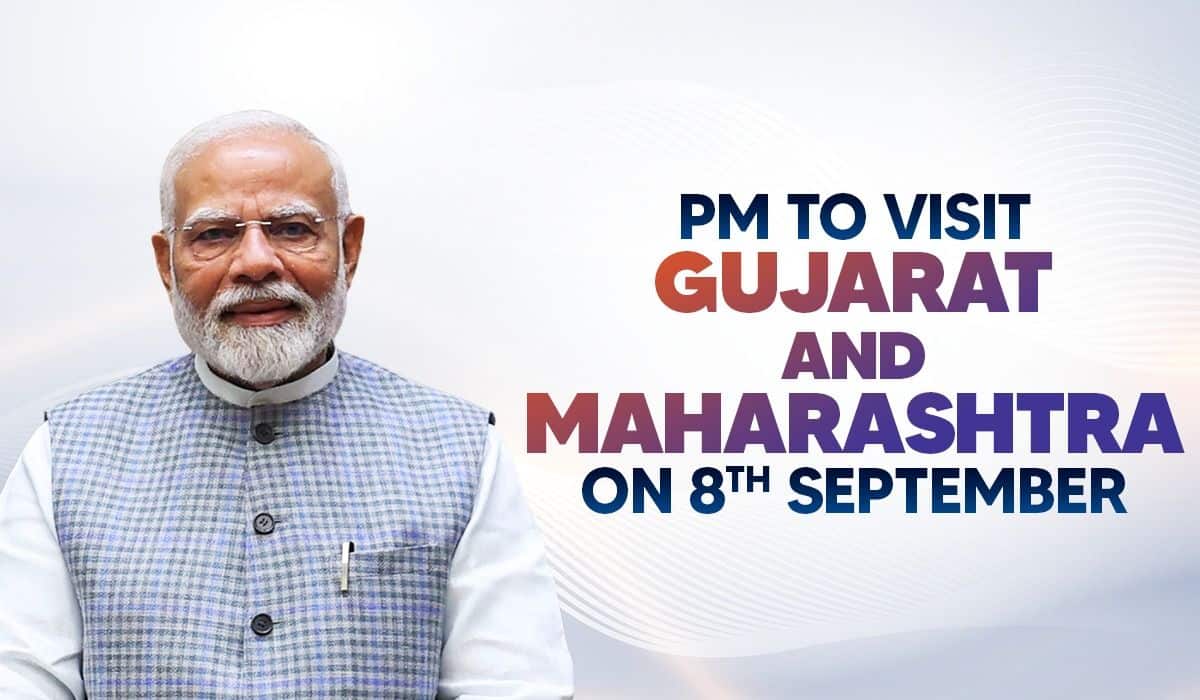
Prime Minister Shri Narendra Modi will visit Gujarat and Maharashtra on 8th September 2026. At around 12 noon, Prime Minister will lay the foundation stones, inaugurate and dedicate to the nation various development projects worth more than ₹35,000 crore in Vadodara. He will also address the gathering on the occasion.
At around 5:45 PM, Prime Minister will inaugurate Global Fintech Fest (GFF) 2026 in Mumbai and address the gathering as well.
PM in Vadodara
Prime Minister will dedicate to the nation three important sections of the Western Dedicated Freight Corridor (WDFC), covering 326 route kilometres and developed at a cost of more than ₹20,700 crore. These include the New Sanand (N)- New Makarpura, New Umbergaon-New Saphale and New Saphale- New JNPT sections.
The direct connectivity of Jawaharlal Nehru Port Authority (JNPA) will facilitate faster movement of EXIM cargo, strengthen connectivity between industrial centres and ports, reduce logistics costs and help decongest Mumbai’s railway network.
With the commissioning of these sections, the Dedicated Freight Corridor (DFC) network will stand fully operational across its entire length. The dedicated freight infrastructure will further strengthen the country’s logistics ecosystem by improving multimodal connectivity, reducing transit time and facilitating seamless movement of cargo across different regions.
Prime Minister will also flag off freight train services from New Sanand (North), New Makarpura, New Umbergaon and New JNPT, Mumbai. In addition, he will flag off a new passenger train service between Tanda Road and Vadodara (Pratapnagar).
Prime Minister will dedicate to the nation the Jobat–Tanda Road new rail line, developed as part of the Chhota Udepur–Dhar project. The new rail line will connect remote and tribal areas of Alirajpur with the national rail network.
Prime Minister will lay the foundation stone for three railway projects spanning 329 kilometres and costing more than ₹9,700 crore. These include the Vadodara-Ratlam third and fourth lines, Miyagam Karjan-Choranda–Malsar gauge conversion and the Vishwamitri-Dabhoi doubling project. The projects will enhance passenger and freight capacity, ease congestion and strengthen connectivity between Gujarat and Madhya Pradesh.
Prime Minister will lay the foundation stone for three National Highway projects costing around ₹1,780 crore. These include six-laning of the Kamrej-Chalthan section of NH-48; construction of additional structures, including major bridges over the Tapi and Narmada, on the Vadodara-Surat section of NH-48; and grade-separated structures at Abhava, Mindhola and Khajod junctions on NH-53.
Prime Minister will also lay the foundation stone for and inaugurate various Government of Gujarat projects worth around ₹2,600 crore. Major projects for which the foundation stone will be laid include Vadodara Urban Development Authority Ring Road Phase II and a 110 MW floating solar project at Kadana Dam, construction of new office of Vadodara Municipal Corporation, among others. Projects to be inaugurated include housing projects under the Pradhan Mantri Awas Yojana (PMAY) and a water-supply project for 11 villages in eastern Vadodara, among others.
PM in Mumbai
Prime Minister will inaugurate Global Fintech Fest (GFF) 2026, one of the world’s largest and most influential annual fintech conferences.
The seventh edition of the Global Fintech Fest is being held from 8th to 11th September 2026 in Mumbai. Since 2020, GFF has emerged as an international thought leadership platform bringing together policymakers, regulators, central banks, financial institutions, fintechs, technology companies, investors, academia and other global stakeholders to deliberate on shaping the future of finance.
The theme of GFF 2026 is “Potential to Impact: Agentic AI, Tokenisation, Quantum - Trusted, Connected, Global Systems for Inclusive Finance.”
GFF 2026 has been designed as a convergence point for policy, regulation, technology, capital and industry on a common platform. It seeks to build on India’s leadership in digital payments and financial inclusion and move from potential to impact. The discussions will focus on how Agentic AI, programmable finance, quantum technologies and other critical and emerging technologies can create trusted, inclusive and measurable outcomes for citizens, enterprises and economies globally.
- Tags

- Vadodara
- Gujarat
- Mumbai
- Maharashtra
- Foundation
- Inauguration
- Development
- Infrastructure
- Connectivity
- Dedicated Freight Corridor
- Indian Railways
- Highway
- Global Fintech Fest
- Artificial Intelligence
- Technology
- Finance
- Cargo Transportation
- Ports
- Logistic
- Sanand
- Ratlam
- Madhya Pradesh
- Urban Development
- Pradhan Mantri Awas Yojana
- Investment


Posted via www.narendramodi.in