Your Excellency President Xi Jinping,
Your Excellency President Jacob Zuma,
Your Excellency President Michel Temer,
Your Excellency President Vladimir Putin,
Distinguished Delegates,
I join 1.25 billion Indians in once again extending a very warm welcome to all of you in Goa for the eighth (8th) BRICS Summit.
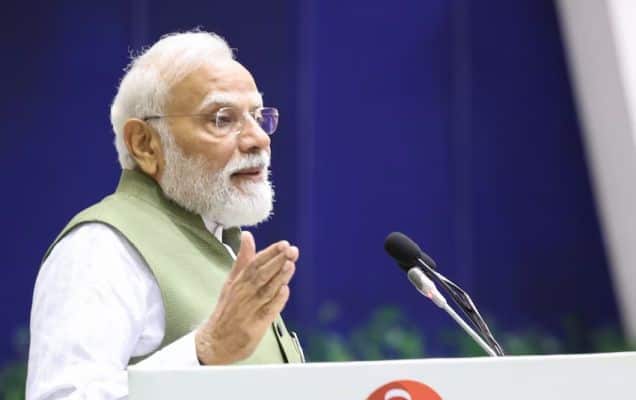
I am honoured to chair the BRICS Leaders’ Plenary Meeting. Our exchanges earlier during the day were productive.
This session should build on them and deliberate on a pro-active agenda of action for BRICS.
The footprint of intra-BRICS engagement has expanded over time to include large areas of economic activity.
The scope of our partnership today stretches from agriculture to industry and innovation; trade to tourism; environment to energy; films to football; skill development to smart cities; and from fighting corruption and money laundering to securing our societies.
This year, we have taken BRICS to our cities and provinces and linked it directly to our people from different walks of life.

Excellencies,
We are celebrating 10 years of our partnership under BRICS. A decade of collaboration has produced strong benefits of cooperation.
We are entitled to take pride in our initiatives and achievements.
The establishment of New Development Bank and the Contingency Reserve Arrangement are indeed signature achievements.
In a world of new security challenges and continuing economic uncertainties, BRICS stands as a beacon of peace potential and promise.
Our work holds much meaning for the developing world.
In the past year, BRICS have played an active role in shaping the global agenda for change and development.
Our association with Agenda 2030, the Paris Climate Agreement, and the Addis Ababa Action Agenda on Financing for Development has been purposeful and productive.
And, we remain at the forefront of pushing change in the global governance architectures.
Excellencies,
While our achievements have been substantial, we need to sustain the positive direction and strong momentum of intra-BRICS engagement.
We also need to add more content to it.
Let me offer some thoughts for your consideration.
First, the process of institution building in BRICS must continue to remain a focus area.
The institutions that we build must support the development of our countries and regions.
They should enable greater flexibility and freedom, and offer wider choices in responding to our developmental priorities.
We look forward to translating into reality the idea of a BRICS Credit Rating Agency.
We must also speed up the work on setting up BRICS Agriculture Research Centre, BRICS Railway Research Network, and BRICS Sports Council.
There is also a clear need to build norms, create structures and pool our capacities to stop tax evasion, and fight against black money and corruption.
Our agencies must also build mechanisms of information sharing to bring to justice the tax offenders and money launderers.
BRICS should push for empowering the global governance institutions to reflect today's reality.
Second, transform the quantum and quality of trade and investment linkages among BRICS.
In 2015, intra-BRICS trade stood at about 250 billion US Dollars.
We should set ourselves a target to double this number to US Dollars five hundred billion by 2020.
This requires businesses and industry in all five countries to scale up their engagement.
And, for governments to facilitate this process to the fullest. Our agreement on a tax and custom cooperation framework is a good start.
The BRICS Trade Fair and Exhibition just concluded in New Delhi should become a regular platform for business exchanges.
And, the BRICS New Development Bank must play an active role to support this objective.
It can also help integrate our SMEs into global value chains. We must also coordinate closely to preserve the central role of the Doha Development Round and the WTO.
Alongside, we should increase our cooperation and convergence at the G-20, WTO and other fora.
India has tabled a draft of the Trade Facilitation Agreement for Services at the WTO.
It seeks to maximize the benefits of services liberalization and trade to the developing countries.
A strong BRICS support to this proposal will be in our collective economic interest.
Third, focus on key priorities of our economic transformations.
Urbanization, infrastructure and innovation represent the key focus areas for BRICS economies.
Under India’s Chairmanship, we have placed emphasis on digital- technology, smart-cities, urbanization, and cooperation between our cities.
The next billion internet users will come from emerging markets.
Our cooperation must grab this opportunity to transform the basic structure of our economies.
Fourth, secure our societies.
In the world we inhabit today, security and counter-terrorism cooperation is necessary if we are to secure the lives of our citizens.
Terrorism casts a long shadow on our development and economic prosperity.
Its reach is now global. It has grown more lethal and adept at the use of technology.
Our response to terrorism must, therefore, be nothing less than comprehensive.
And, we need to act both individually and collectively. Selective approaches to terrorist individuals and organizations will not only be futile but also counter-productive.
There must be no distinction based on artificial and self-serving grounds.
Criminality should be the only basis for punitive action against the individuals and organizations responsible for carrying out terrorist acts.
Terrorist funding, their weapons supply, training and political support must be systematically cut off.
In this respect, we need to deepen the security cooperation between our National Security Advisors.
Early adoption of the draft Comprehensive Convention on International Terrorism will be an expression of our resolve to fight this menace.
Fifth, thriving people-to-people exchanges is the lifeblood of BRICS.
It brings vibrancy and richness to our partnership.
We have chosen to highlight this dimension this year.
The BRICS Films Festival, Trade Fair, Tourism Convention, Sports Council, Football Tournament and other related activities will help in creating millions of young stakeholders that will ultimately carry our partnership forward.
Excellencies,
I am eager to hear from my fellow BRICS leaders on their vision for a stronger, deeper and vibrant BRICS community.
I thank you for your attention.
Thank you.
Opening up a new space for the emerging world. Inside the BRICS Dome, the Plenary session of @BRICS2016 commences pic.twitter.com/EbwOajNvpz
— Vikas Swarup (@MEAIndia) October 16, 2016
PM begins statement at @BRICS2016 Plenary: The footprint of intra-BRICS engagement has expanded to include large areas of eco activity pic.twitter.com/qevNMXVbjD
— Vikas Swarup (@MEAIndia) October 16, 2016
PM: In a world of new security challenges and continuing economic uncertainties, BRICS stands as a beacon of peace, potential and promise. pic.twitter.com/7ZxxTnpK0I
— Vikas Swarup (@MEAIndia) October 16, 2016
#FiveGoalsfromGoa: PM @narendramodi outlines his thoughts for positive direction and strong momentum of intra-BRICS engagement. pic.twitter.com/wUf2GZtsy5
— Vikas Swarup (@MEAIndia) October 16, 2016
PM: First, The process of institution building in BRICS must continue to remain a focus area, enabling flexibility & freedom #5GoalsfromGoa
— Vikas Swarup (@MEAIndia) October 16, 2016
PM: We look forward to a BRICS Credit Rating Agency, and speeding up Agriculture Research Centre, Railway Research Network, & Sports Council pic.twitter.com/FP1ku6FNqm
— Vikas Swarup (@MEAIndia) October 16, 2016
PM: Second, transform the quantum and quality of trade and investment linkages among BRICS. #5GoalsfromGoa pic.twitter.com/f0xNWsfBLO
— Vikas Swarup (@MEAIndia) October 16, 2016
PM: We should set ourselves a target to double intra-BRICS to US Dollars five hundred billion by 2020.
— Vikas Swarup (@MEAIndia) October 16, 2016
PM @narendramodi: Third, focus on key priorities of our economic transformations #5GoalsfromGoa pic.twitter.com/EeypoeXPim
— Vikas Swarup (@MEAIndia) October 16, 2016
PM: Fourth, secure our societies. In the world we inhabit today, security & counter-terrorism coop'n are essential #5GoalsfromGoa
— Vikas Swarup (@MEAIndia) October 16, 2016
PM @narendramodi: Terrorism casts a long shadow on our development and economic prosperity. pic.twitter.com/c073fqRQVg
— Vikas Swarup (@MEAIndia) October 16, 2016
PM concludes: Fifth, thriving people-to-people exchanges is the lifeblood of BRICS. #5GoalsfromGoa pic.twitter.com/Hiid5zEuQa
— Vikas Swarup (@MEAIndia) October 16, 2016
Here's the full text of Intervention by PM @narendramodi at #BRICS Business Council Meeting
— BRICS 2016 (@BRICS2016) October 16, 2016
Click: https://t.co/b7y2pWqp9W pic.twitter.com/a9sgREQERu
PM wraps up plenary: Combating terrorism, including cross-border terrorism and its supporters will be a key BRICS priority. pic.twitter.com/uYeZP7yb1Z
— Vikas Swarup (@MEAIndia) October 16, 2016