Honouring India’s Greats

Published By : Admin | March 22, 2019 | 14:13 IST

It was a momentous occasion when on the banks of river Thames, during his visit to U.K., Prime Minister Narendra Modi unveiled the statue of the highly revered saint, Bhagwan Basaveshwara, in 2015. The icon from India's rich tradition of social reform movements, Bhagwan Basaveshwara from Karnataka has been hailed by PM Modi for his efforts to uphold the values of democracy, social consciousness and women empowerment as long back as the 12th century, much before the rest of the world.

It was a clear departure from the past, wherein members of only one family were given prominence while other national icons were sidelined and systematically pushed out of national consciousness.

Since his coming to power, Prime Minister Narendra Modi has undone the years of neglect and brought the legacy of our legends to the forefront. This is line with the government’s motto of keeping ‘India First’ over any party, ideology or family. The Modi government has ensured institutional support to the cause so that it does not get overturned with the change in government.

The Architect of Constitution of India: Dr. B.R. Ambedkar:

Dr. B.R. Ambedkar was one of the builders of Modern India. His contribution to India’s political thought has been unparalleled. However, he was not given his due with his legacy being completely abandoned by successive Congress governments. Correcting the historical wrongs, the Modi government took the historic decision of developing places of historical importance that were closely related to Dr. Ambedkar’s life as ‘Pancha Teerthas’:

• His birthplace in Mhow
• Place in London where he stayed while studying in the UK
• Deeksha Bhoomi in Nagpur
• Mahaparinirvan Sthal in Delhi
• Chaitya Bhoomi in Mumbai

This was the first of the many steps taken to create institutions fully dedicated to keep the legacy of Babasaheb alive for generations to come. In April 2018,

Prime Minister Narendra Modi inaugurated Dr Ambedkar National Memorial at Delhi’s Mahaparinirvan Sthal spread over nearly 2 acres. On November 19, 2015, the government declared 26th November as the ‘Constitution Day’, in the honour of Dr Ambedkar.


Reviving Netaji’s Legacy

Netaji’s fiery slogans “Give me blood and I will give you freedom” is embedded in every Indian’s consciousness. In order to commemorate the 75th anniversary of the formation of ‘Azad Hind Government’ by Netaji Subhas Chandra Bose, Prime Minister Narendra Modi, hoisted the tricolour at the Red Fort in Delhi. It was a moment of pride for the entire nation seeing the legacy of the great hero of India’s freedom movement finally being honoured since independence. In a first, the four members of Azad Hind Fauj took part in the Republic Day parade in 2019.

The Modi Government also fulfilled the long pending demand of Netaji’s family, by declassifying most of the confidential files related to Netaji Subhas Chandra Bose. During his September 2014 visit to Japan, PM Modi met Saichiro Misumi, Netaji’s oldest living associate in Japan.

The Man Who United India: Sardar Patel

As a glowing tribute to the legend who integrated India, PM Modi unveiled the ‘Statue of Unity’ as nation’s tribute to the ‘Iron Man’ Sardar Vallabh Bhai Patel. The 600 feet tall sculpture is the tallest statue in the world. The foundation for this statue was laid in 2013 when Shri Narendra Modi was the Chief Minister of Gujarat.

Sardar Vallabh Bhai Patel was the first Home Minister of India. However, he was continuously relegated to the lost pages of history by Congress. He is finally being given his due recognition for his unparalleled contribution to our motherland.

Veer Savarkar: The Son of the Soil

The man who was renowned for his bravery and his spirited fight against the British, Veer Savarkar was treated as a pariah by the successive Congress governments. It was a great injustice to the memory of the giant. He spent his youth serving the harshest punishment in a small cell in the Cellular Jail, Andaman & Nicobar Islands.

Prime Minister Narendra Modi paid homage to the freedom fighter by visiting the cell where Veer Savarkar was lodged and spent some time inside remembering the sacrifices of the great soul.

Similarly, PM Modi has revived the legacy of Chhatrapati Shivaji Maharaj, Birsa Munda, Deenbandhu Sir Chhotu Ram and many other such legends all across the country. A new narrative has been set by the Modi government by honouring the memories of Indian heroes and freeing their legacy from the narrow political considerations. These legends lived, fought and died for the nation. Their legacy is the very essence of Indian thought process and so any injustice to their memories in an injustice to the very soul of the nation.

Explore More
Today, the entire country and entire world is filled with the spirit of Bhagwan Shri Ram: PM Modi at Dhwajarohan Utsav in Ayodhya

பிரபலமான பேச்சுகள்

Today, the entire country and entire world is filled with the spirit of Bhagwan Shri Ram: PM Modi at Dhwajarohan Utsav in Ayodhya
Rabi acreage tops normal levels for most crops till January 9, shows data

Media Coverage

Rabi acreage tops normal levels for most crops till January 9, shows data
NM on the go

Nm on the go

Always be the first to hear from the PM. Get the App Now!
...
6 Years of Jal Jeevan Mission: Transforming Lives, One Tap at a Time
August 14, 2025
Jal Jeevan Mission has become a major development parameter to provide water to every household.” - PM Narendra Modi

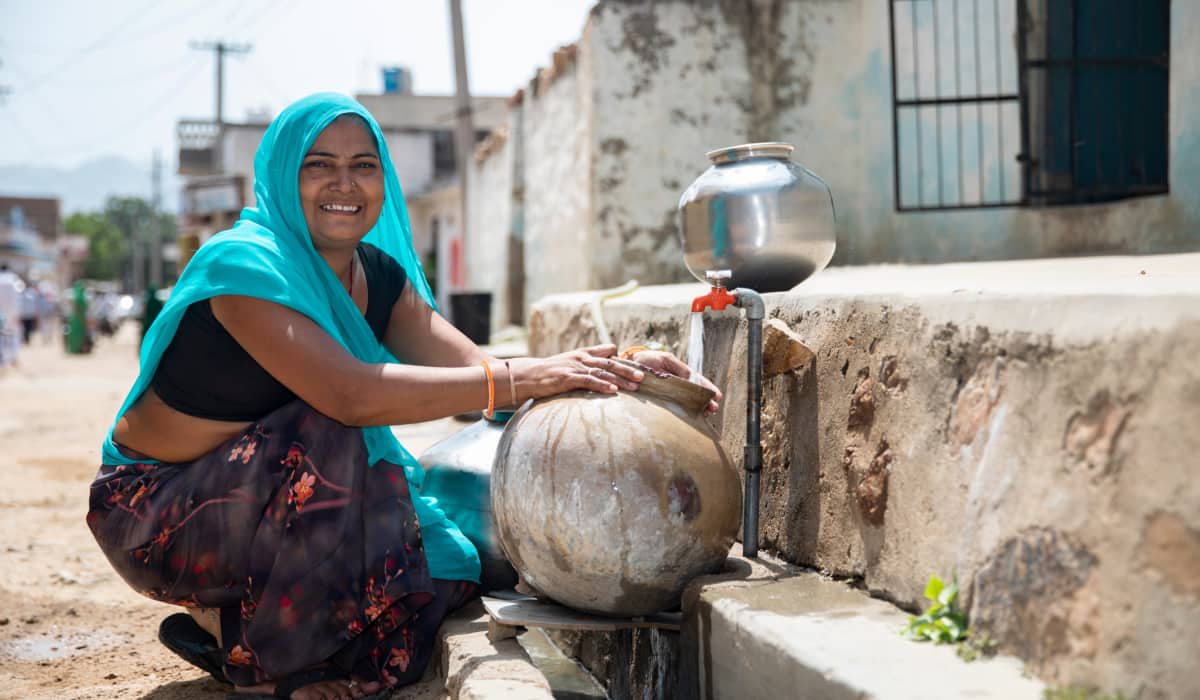
For generations, the sight of women carrying pots of water on their heads was an everyday scene in rural India. It was more than a chore, it was a necessity that was an integral part of their everyday life. The water was brought back, often just one or two pots which had to be stretched for drinking, cooking, cleaning, and washing. It was a routine that left little time for rest, education, or income-generating work, and the burden fell most heavily on women.

Before 2014 water scarcity, one of India’s most pressing problems, was met with little urgency or vision. Access to safe drinking water was fragmented, villages relied on distant sources, and nationwide household tap connections were seen as unrealistic.

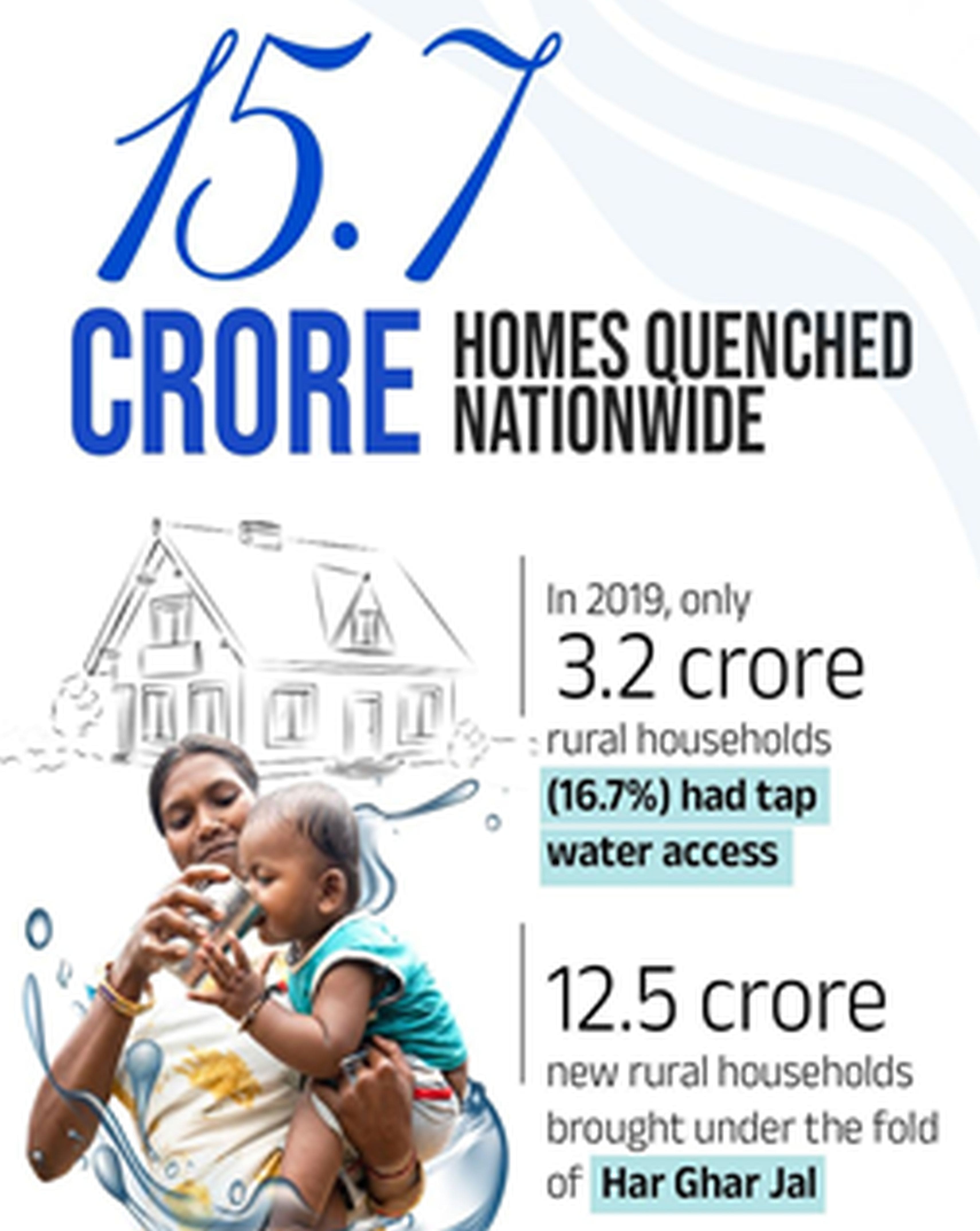
This reality began to shift in 2019, when the Government of India launched the Jal Jeevan Mission (JJM). A centrally sponsored initiative which aims at providing a Functional Household Tap Connection (FHTC) to every rural household. At that time, only 3.2 crore rural households, a modest 16.7% of the total, had tap water. The rest still depended on community sources, often far from home.

As of July 2025, the progress under the Har Ghar Jal program has been exceptional, with 12.5 crore additional rural households connected, bringing the total to over 15.7 crore. The program has achieved 100% tap water coverage in 200 districts and over 2.6 lakh villages, with 8 states and 3 union territories now fully covered. For millions, this means not just access to water at home, but saved time, improved health, and restored dignity. Nearly 80% of tap water coverage has been achieved in 112 aspirational districts, a significant rise from less than 8%. Additionally, 59 lakh households in LWE districts have gained tap water connections, ensuring development reaches every corner. Acknowledging both the significant progress and the road ahead, the Union Budget 2025–26 announced the program’s extension until 2028 with an increased budget.

The Jal Jeevan Mission, launched nationally in 2019, traces its origins to Gujarat, where Narendra Modi, as Chief Minister, tackled water scarcity in the arid state through the Sujalam Sufalam initiative. This effort formed a blueprint for a mission that would one day aim to provide tap water to every rural household in India.

Though drinking water is a State subject, the Government of India has taken on the role of a committed partner, providing technical and financial support while empowering States to plan and implement local solutions. To keep the Mission on track, a strong monitoring system links Aadhaar for targeting, geo-tags assets, conducts third-party inspections, and uses IoT devices to track village water flow.

The Jal Jeevan Mission’s objectives are as much about people as they are about pipes. By prioritizing underserved and water-stressed areas, ensuring that schools, Anganwadi centres, and health facilities have running water, and encouraging local communities to take ownership through contributions or shramdaan, the Mission aims to make safe water everyone’s responsibility..

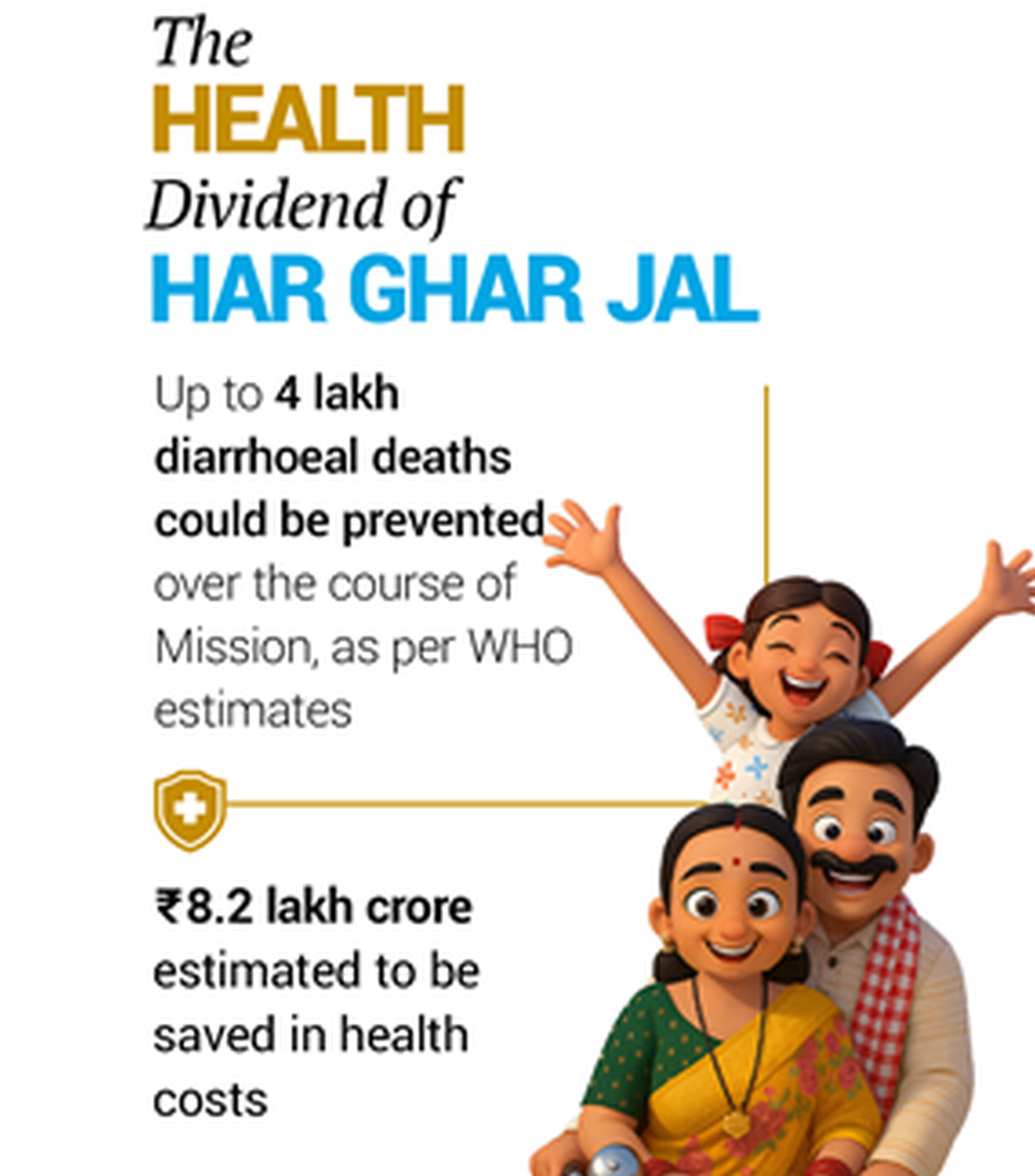
The impact reaches far beyond convenience. The World Health Organization estimates that achieving JJM’s targets could save over 5.5 crore hours each day, time that can now be spent on education, work, or family. 9 crore women no longer need to fetch water from outside. WHO also projects that safe water for all could prevent nearly 4 lakh deaths from diarrhoeal disease and save Rs. 8.2 lakh crores in health costs. Additionally, according to IIM Bangalore and the International Labour Organization, JJM has generated nearly 3 crore person-years of employment during its build-out, with nearly 25 lakh women are trained to use Field testing Kits.

From the quiet relief of a mother filling a glass of clean water in her kitchen, to the confidence of a school where children can drink without worry, the Jal Jeevan Mission is changing what it means to live in rural India.