On 11th December, the Honourable Supreme Court of India delivered a historic judgment on the abrogation of Articles 370 and 35(A). Through its judgment, the Court has upheld the sovereignty and integrity of India, something that is cherished by every Indian. The Supreme Court rightly observed that the decision taken on 5th August 2019 was done with the purpose of enhancing constitutional integration and not disintegration. The Court has also recognised the fact that Article 370 was not permanent in nature.
Jammu, Kashmir and Ladakh’s breathtaking landscapes, serene valleys, and majestic mountains have captivated the hearts of poets, artists and adventurers for generations. It is a place where the sublime meets the extraordinary, where the Himalayas reach for the sky, and where the pristine waters of its lakes and rivers mirror the heavens. But, for the last seven decades, these places have witnessed the worst form of violence and instability, something which the wonderful people never deserved.
Unfortunately, due to centuries of colonisation, most notably economic and mental subjugation, we became a confused society of sorts. Rather than taking a clear position on very basic things, we allowed duality, leading to confusion. Sadly, Jammu and Kashmir became a big victim of such a mindset. At the time of independence, we had a choice of making a fresh start for national integration. Instead, we decided to continue with the confused society approach even if it meant ignoring the long-term national interests.
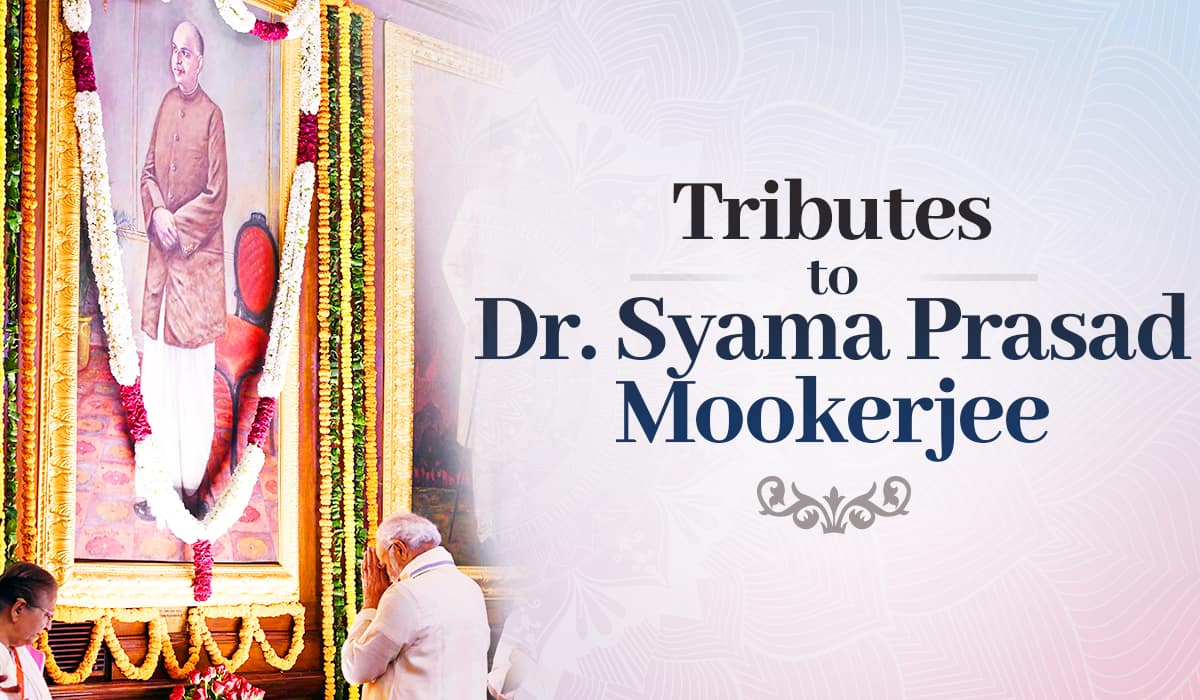
I have had the opportunity of being connected with the Jammu and Kashmir Andolan from a very early part of my life. I belong to an ideological framework where Jammu and Kashmir was not merely a political issue. But, it was about addressing the aspirations of society. Dr. Syama Prasad Mookerjee held an important portfolio in the Nehru Cabinet and could have remained in government for a long time. Yet, he quit the Cabinet over the Kashmir issue and preferred the tough road ahead, even if it meant paying with his life. His efforts and sacrifice led to crores of Indians becoming emotionally attached with the Kashmir issue. Years later, Atal Ji, at a public meeting in Srinagar gave the powerful message of 'Insaniyat', 'Jamhooriyat' and ‘Kashmiriyat’, which has also always been a source of great inspiration.
It was always my firm belief that what had happened in Jammu and Kashmir was a great betrayal- to our nation and to the people living there. It was also my strong desire to do whatever I can to remove this blot, this injustice done to the people. I have always wanted to work to alleviate the suffering of the people of Jammu and Kashmir.
In very basic words- Articles 370 and 35 (A) were like major obstacles. It seemed like an unbreakable wall and the sufferers were the poor and downtrodden. Articles 370 and 35(A) ensured that the people of Jammu and Kashmir never got the rights and development that the rest of their fellow Indians got. Due to these Articles, a distance was created between people belonging to the same nation. Due to this distance, many people from our nation who wanted to work to solve the problems of Jammu and Kashmir were unable to do so even if they clearly felt the pain of the people there.
As a Karyakarta who has seen the issue closely over the last several decades, I had a nuanced understanding of the specifics and the complexities of the issue. Yet, I was crystal clear about one thing- that the people of Jammu and Kashmir want development and they want to contribute to the development of India based on their strengths and skills. They also want a better quality of life of their children, a life free from violence and uncertainty.
Thus, while serving the people of Jammu and Kashmir, we gave primacy to three pillars- understanding of the citizens' concerns, building trust through supportive actions, and prioritising development, development and more development.
In 2014, just after we assumed office, deadly floods struck Jammu and Kashmir, with a lot of damage in the Kashmir valley. In September 2014, I went to Srinagar to assess the situation and also announced Rs. 1000 crore as a special assistance for rehabilitation, signalling our government's commitment to supporting the people during crises. I had the opportunity to meet people from different walks of life and there was one common thread in these interactions- the people not only wanted development but they also wanted freedom from the rampant corruption prevailing for decades. The same year, I decided not to mark Diwali in remembrance of those we lost in Jammu and Kashmir. I also decided to be in Jammu and Kashmir on Diwali day.
In order to further strengthen Jammu and Kashmir’s development journey, we decided that our Government ministers would frequently go there and interact with people directly. These frequent visits also played a crucial role in building goodwill in Jammu and Kashmir. From May 2014 to March 2019, over 150 ministerial visits took place. This is a record in itself. The special package of 2015 was a significant step in addressing the developmental needs of Jammu and Kashmir. It contained initiatives for infrastructure development, job creation, tourism promotion and support to the handicraft industry.
We harnessed the power of sports in Jammu and Kashmir, recognising its potential to ignite the dreams of the youth. Through sporting initiatives, we witnessed the transformational impact of athletic pursuits on their aspirations and futures. Sporting venues were upgraded, training programmes were organised and coaches were made available. One of the most unique things was to encourage the setting of local football clubs. The results were outstanding. The name of the talented footballer Afshan Ashiq comes to my mind- in December 2014 she was a part of a stone pelting group in Srinagar but with the right encouragement she turned to football, she was sent for training and excelled in the game. I recall interacting with her in one of the Fit India Dialogues where I said its time to move over ‘Bend it like Beckham’ because it is now ‘Ace it like Afshan.’ Other youngsters began to shine in kickboxing, Karate and more.
The Panchayat polls were also a watershed moment in the region’s quest for all-round development. Once again, we were faced with a choice of either remaining in power or standing by our principles- the choice was never tough and we let go of a Government but preferred that that ideals that we stand for, the aspirations of the people of Jammu and Kashmir are given top priority. The success of Panchayat polls indicated the democratic nature of the people of Jammu and Kashmir. My mind went back to an interaction I had with Pradhans from the villages. Among other issues, I made a request to them- that at no point must schools be burnt and that must be ensured. I was delighted to see that this was adhered to. After all, if schools are burnt the biggest sufferers are the small children.
The historical day of 5th August is etched in the hearts and minds of every Indian. Our Parliament passed the historic decision to abrogate Article 370. Since then, much has changed in Jammu, Kashmir and Ladakh. The judicial court verdict came in December 2023 but seeing the wave of development across Jammu, Kashmir and Ladakh, the people’s court have given a resounding thumbs up to the Parliament’s decision of abolishing Articles 370 and 35(A) for four years now.
At a political level, the last 4 years have been marked with a renewed faith in grassroots democracy. The women, tribals, SC, ST and marginalised sections of society were not getting their due. At the same time, the aspirations of Ladakh were totally ignored. 5th August 2019 changed all that. All Central laws now apply without fear or favour Representation has also got more widespread- a three tier Panchayati Raj System is in place, BDC elections have been held, and refugee communities who were all but forgotten have begun to enjoy the fruits of development.
Key Central Government scheme have attained saturation levels, thus covering all sections of society. These include Saubhagya, Ujwala and Ujjwala schemes. Strides have been made in housing, tap water connection and financial inclusion. Healthcare, otherwise a major challenge for the people has witnessed an upgradation of infrastructure. All the villages achieved ODF Plus stats. Government vacancies, which were otherwise a den of corruption and favouritism have been filled in a transparent and process driven manner. Other indicators like IMR have shown betterment. The boost to infrastructure and tourism has been for everyone to see. The credit for this naturally goes to the resilience of the people of Jammu and Kashmir, who have shown time and again that they want only development and are willing to be drivers of this positive change. Earlier, there was a question mark on the status of Jammu, Kashmir and Ladakh. Now, there are only exclamation marks about record growth, record development, record tourist inflow.
In its verdict on 11th December, the Supreme Court has strengthened the spirit of ‘Ek Bharat, Shreshtha Bharat’ - it has reminded us that what defines us is the bonds of unity and a shared commitment to good governance. Today, every child born in Jammu, Kashmir and Ladakh is born with a clean canvas, where he or she can paint a future full of vibrant aspirations. Today, the dreams of the people are no longer prisoners of the past but are possibilities of the future. After all, Development, democracy and dignity have replaced disillusionment, disappointment and despondency.