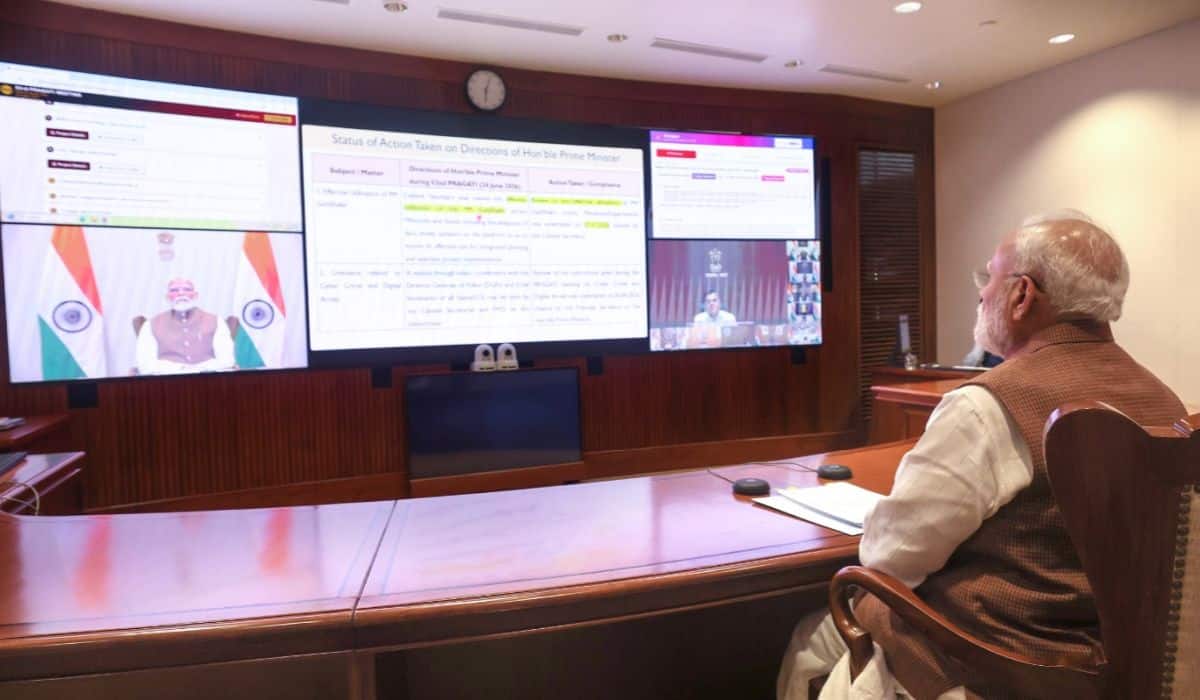
The Prime Minister, Shri Narendra Modi lauded the Union Budget 2024-25 presented by the Union Minister for Finance, Smt Nirmala Sitharamanin in the Lok Sabha today.
Remarking on the Union Budget 2024-25, the Prime Minister congratulated all citizens for this year’s Budget which is bound to take the nation to new heights of development. He said that Union Finance Minister, Smt Nirmala Sitharaman and her entire team are worthy of congratulations.
“Union Budget 2024-25 will empower every section of society”, the Prime Minister said, “It will take the poor farmers from villages on the path to prosperity.” Noting the emergence of a neo-middle class after 25 crore people were lifted out of poverty, the Prime Minister said that this budget adds continuity to their empowerment and provides countless employment opportunities. “This Budget brings a new scale to education and skill development”, he said. PM Modi underlined that the budget with its new schemes is aimed at strengthening the lives of the middle class, tribal section, dalits and backward classes. He further emphasized that this year’s Budget would ensure economic partnerships of women while also laying down a new path for small businesses and MSMEs. “The Union Budget gives a fillip to manufacturing as well as infrastructure”, PM Modi said underlining that it would give new strength to economic growth while maintaining continuity.
Reiterating the government’s commitment to employment and self-employment, the Prime Minister noted the success of the PLI scheme and highlighted the Employment Linked Incentive scheme which will create crores of jobs. Under the scheme, the first salary of the first job of a youth will be borne by the government. He also mentioned provisions for higher education and the scheme for internships for 1 crore youth. “Working in the top companies under the scheme, the young interns will find new avenues of possibilities”, the Prime Minister said.
Emphasizing the commitment to creating entrepreneurs in every city, every village and every household, the Prime Minister talked about raising the limit of collateral-free loans under the Mudra Loan from Rs 10 lakhs to 20 lakhs which will greatly benefit small businessmen, women, dalits, backwards and deprived.
Asserting the commitment to make India the manufacturing hub of the world, the Prime Minister emphasized the links of MSME with the middle class of the country and its employment potential for the poor segment. To create big strength for small industries, the Prime Minister informed about the new scheme announced in the Budget that will increase the ease of credit for MSMEs. “The announcements in the Budget will take manufacturing and exports to every district”, he said, “e-Commerce, export hubs and food quality testing will give new momentum to One District-One Product programme.”
The Prime Minister underlined that the Union Budget 2024-25 brings numerous opportunities for India’s startup and innovation ecosystem. He gave examples of a one thousand crore rupees corpus fund to vitalize the space economy and the abolition of the angel tax.
“Record high capex will become a driving force of the economy”, the Prime Minister said, mentioning the development plans for 12 new industrial nodes, new satellite towns and transit plans for 14 big cities. He said that it would enable the development of new economic hubs in the country and create numerous jobs.
Highlighting the record defence exports, the Prime Minister mentioned that this year’s Budget consists of numerous provisions to create an ‘aatmanirbhar’ defence sector. He said that the world’s attraction towards India is constantly on the rise thereby, opening up new avenues for the tourism industry. He underlined the emphasis on tourism in this year’s Budget and said that the tourism industry brings numerous opportunities for the poor and the middle-class
PM Modi said that in the last 10 years, the government has ensured tax relief for the poor and the middle class, while decisions were made in this year’s budget to reduce income tax, hike standard deduction and simplify TDS rules. He said that these reforms would allow taxpayers to save more money.
The Prime Minister stated that the overall development of the eastern region of India will get new momentum and energy through the ‘Purvodaya’ vision. “New impetus would be given to the development of important infrastructures like highways, water projects and power projects in eastern India”, he added.
The Prime Minister said, “A big focus of this Budget is the nation's farmers”. After the world’s biggest grain storage scheme now Vegetable Production Clusters are being introduced which will help both the farmers and the middle class. He further emphasized, “It is the need of the hour for India to become self-reliant in the agricultural sector. Therefore, measures have been announced to help farmers increase the production of pulses and oilseeds.”
Touching upon the major schemes regarding poverty alleviation and empowerment of the poor, the Prime Minister informed about 3 crore houses for the poor and Janjatiya Unnat Gram Abhiyan which will link 5 crore tribal families to basic facilities with a saturation approach. Furthermore, Gram Sadak Yojna will connect 25 thousand new rural areas with all-weather roads, benefitting all states.
The Prime Minister asserted that “today's budget has brought new opportunities, new energy, new employment and self-employment opportunities. It has brought better growth and a bright future.” The Prime Minister concluded by underlining the Budget’s potential for being a catalyst for making India the third largest economy in the world and for laying the strong foundation for the Viksit Bharat.
Click here to read full text speech
#BudgetForViksitBharat benefits every segment of society. pic.twitter.com/IlKhCb2HMq
— PMO India (@PMOIndia) July 23, 2024
इस बजट में सरकार ने Employment Linked Incentive scheme की घोषणा की है।
— PMO India (@PMOIndia) July 23, 2024
इससे देश में करोड़ों नए रोजगार बनेंगे। #BudgetForViksitBharat pic.twitter.com/cWAnnt3I5h
#BudgetForViksitBharat opens up new avenues for StartUps and innovation ecosystem. pic.twitter.com/N5aFatddxd
— PMO India (@PMOIndia) July 23, 2024
इस बजट में भी income tax में कटौती और standard deduction में वृद्धि का बहुत बड़ा फैसला लिया गया है। #BudgetForViksitBharat pic.twitter.com/ki6qSsqqPU
— PMO India (@PMOIndia) July 23, 2024
#BudgetForViksitBharat focuses on welfare of farmers. pic.twitter.com/jnwiY76vsV
— PMO India (@PMOIndia) July 23, 2024