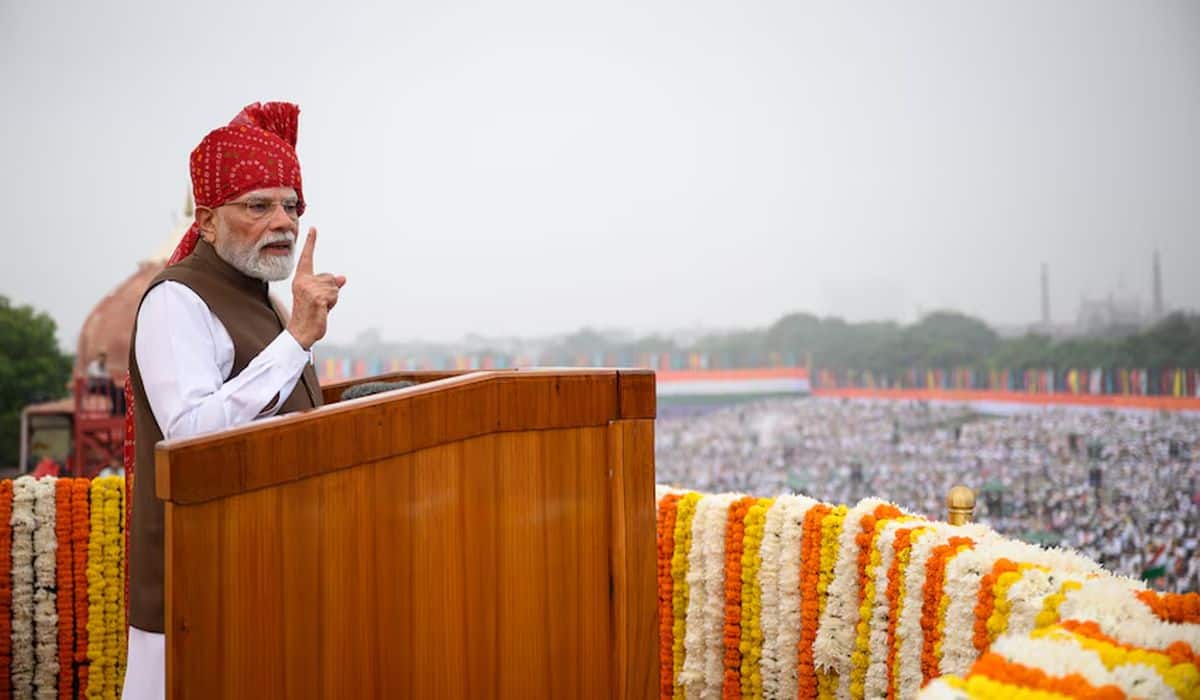
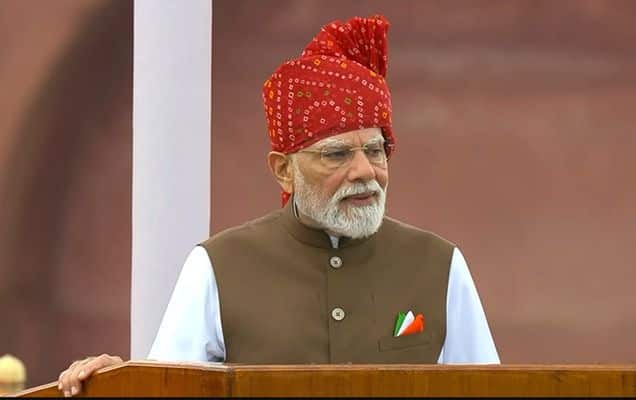
The Prime Minister, Shri Narendra Modi visited Vikram Sarabhai Space Center (VSSC) at Thiruvananthapuram, Kerala and inaugurated three important space infrastructure projects worth around Rs 1800 crores. The projects include the SLV Integration Facility (PIF) at the Satish Dhawan Space Centre, Sriharikota; the new ‘Semi-cryogenics Integrated Engine and Stage Test facility’ at ISRO Propulsion Complex at Mahendragiri; and ‘Trisonic Wind Tunnel’ at VSSC, Thiruvananthapuram. Shri Modi also reviewed the progress of the Gaganyaan Mission and bestowed ‘astronaut wings’ to the four astronaut-designates. The astronaut-designates are Group Captain Prashanth Balakrishnan Nair, Group Captain Ajit Krishnan, Group Captain Angad Pratap and Wing Commander Shubhanshu Shukla.

Addressing the gathering, the Prime Minister started by calling for a standing ovation for the astronaut-designates as the hall reverberated with the chants of Bharat Mata ki Jai.
Underlining that every nation’s development journey has its special moments that define not just the present but the future generations, the Prime Minister said that today is such an occasion for India when the present generation can take pride in the historic achievements of the nation in land, air, water and space. Recalling his statement about the beginning of a new ‘kaal chakra’ made from Ayodhya, Prime Minister Modi said that India is continuously expanding its space in the global order and its glimpses can be seen in the country’s space program.
The Prime Minister recalled India’s Chandrayaan success as India became the first nation to land on the South Pole of the Moon. “Today Shiv-Shakti Point is introducing the entire world to Indian prowess”, he said. He called the introduction of the four Gaganyaan passengers, astronaut-designates, as a historic occasion. “They are not just four names or individuals, they are four ‘Shakti’ of carrying the aspirations of 140 crore Indians into space”, the Prime Minister said. He further said “An Indian is going into space after 40 years. However, now, the time, the countdown as well as the rocket belong to us.” Expressing delight in meeting and introducing the astronaut-designates to the nation, the Prime Minister wished them on behalf of the entire nation.

Referring to the astronaut-designates, the Prime Minister said that their names have been conjoined with India’s success and they symbolize the trust, courage, valor and discipline of today’s India. He lauded their dedication and spirit towards training and said that they are the representatives of India’s Amrit generation that never gives up and shows the strength to challenge all adversities. Highlighting the need for a healthy body and a healthy mind for this mission, the Prime Minister noted the role of Yoga as part of the training module. “The country’s wishes and blessings are upon you”, PM Modi said. He also conveyed his best wishes to all the staff trainers from ISRO associated with the Gaganyaan project.
The Prime Minister also conveyed some concerns about the celebrity attention to the four astronaut-designates which can create disturbance in their training. He appealed for cooperation with the astronaut-designates and their families so that they continue their training without distraction.

The Prime Minister was briefed about Gaganyaan. He expressed happiness that most of the equipment in Gaganyaan is Made in India. He noted the happy coincidence of Gaganyaan’s preparation with India’s upcoming entry into the top 3 economies of the world. He said that projects that were dedicated today will lead to new jobs and will raise India’s profile.
Praising the role of Nari Shakti in India’s space programme, the Prime Minister said “Whether it is Chandrayaan or the Gaganyaan, no such project can be imagined without women scientists”. He informed that more than 500 women are in leadership positions in ISRO.
Underlining that India’s space sector’s major contribution is sowing the seeds of scientific temperament among the young generations, the Prime Minister observed that the success achieved by ISRO plants the idea of growing up to become a scientist in the children of today. “The countdown of the rocket inspires lakhs of children in India, and those making paper planes today dream of becoming scientists like you”, an elated Prime Minister said, directing his address to the scientists. He remarked that the willpower of youth makes for the wealth of a nation. He said that the time of landing of Chandrayaan 2 was a learning experience for every child in the country, while the successful landing of Chandrayaan 3 on Aug 23 last year filled the youth with new energy. “This day is now celebrated as Space Day”, he informed, highlighting the various records made by the country in the space sector. He mentioned the country’s achievements of reaching Mars in the first attempt, launching more than 100 satellites in a single mission, and the successful insertion of Aditya L1 solar probe in its orbit 15 lakh kilometers from Earth, the Prime Minister said that very few nations have achieved such feats. He also mentioned the recent successes of EXPO-SAT and INSAT-3DS in the first few weeks of 2024.

“All of you are opening new doors of future possibilities”, PM Modi told the ISRO team. The Prime Minister said that as per estimates, India’s space economy will grow five-fold and touch 44 billion dollars in next 10 years. He said that India is becoming a global commercial hub in the field of space. In the coming days, India will once again go to the Moon. He also informed about the new ambition of retrieving samples from the surface of the Moon. He said Venus is also on the radar. He also stated that by 2035 India will have its own space station. Furthermore, PM Modi said, “ In this Amrit Kaal, an Indian astronaut will land on the Moon in an Indian rocket”.
Drawing comparisons about India’s recent achievements in the space sector in the last 10 years with the decade before 2014, the Prime Minister mentioned the nation launching around 400 satellites compared to only 33, and the growth in the number of youth-driven space startups to more than 200 from two or three. Acknowledging their presence today, the Prime Minister lauded their vision, talent and their entrepreneurship. PM Modi also touched upon space reforms providing impetus to the sector and mentioned the recently approved FDI policy of 100 percent foreign investment in the space sector. With this reform, the Prime Minister said, the world's biggest space institutes can now establish themselves in India and provide an opportunity for the youth to showcase their skills.

Referring to India’s resolution to become Viksit, the Prime Minister highlighted the role of the space sector. PM Modi said, “Space science is not just rocket science, but it is also the biggest social science. Society benefits the most from space technology.” He mentioned agricultural, weather-related, calamity warning, irrigation-related, navigation maps and other uses like the NAVIC system for fishermen. He continued and touched upon other uses of space science such as border safety, education, health and many more. “All of you, ISRO and the entire space sector have a huge role in building a Viksit Bharat”, the Prime Minister concluded.
Governor of Kerala, Shri Arif Mohammad Khan, Chief Minister of Kerala, Shri Pinrayii Vijayan, Union Minister of State, V. Muraleedharan and Secretary, Department of Space and Chairman ISRO, Shri S Somnath were present on the occasion among others.

Background
The Prime Minister’s vision to reform the country’s space sector to realize its full potential and his commitment to enhancing technical and R&D capability in the sector gets a boost as three important space infrastructure projects are being inaugurated during his visit to Vikram Sarabhai Space Centre, Thiruvananthapuram. The projects include the PSLV Integration Facility (PIF) at the Satish Dhawan Space Centre, Sriharikota; the new ‘Semi-cryogenics Integrated Engine and Stage Test facility’ at ISRO Propulsion Complex at Mahendragiri; and ‘Trisonic Wind Tunnel’ at VSSC, Thiruvananthapuram. These three projects providing world-class technical facilities for the space sector have been developed at a cumulative cost of about Rs. 1800 crore.

The PSLV Integration Facility (PIF) at the Satish Dhawan Space Centre, Sriharikota will help in boosting the frequency of PSLV launches from 6 to 15 per year. This state-of-the-art facility can also cater to the launches of SSLV and other small launch vehicles designed by private space companies.
The new ‘Semi-cryogenics Integrated Engine and Stage Test facility’ at IPRC Mahendragiri will enable the development of semi-cryogenic engines and stages which will increase the payload capability of the present launch vehicles. The facility is equipped with liquid Oxygen and kerosene supply systems to test engines up to 200 tons of thrust.
Wind tunnels are essential for aerodynamic testing for the characterisation of rockets and aircraft during flight in the atmospheric regime. The “Trisonic Wind Tunnel” at VSSC being inaugurated is a complex technological system which will serve our future technology development needs.
During his visit, the Prime Minister also reviewed the progress of the Gaganyaan Mission and bestowed ‘astronaut wings’ to the astronaut-designates. The Gaganyaan Mission is India’s first human space flight program for which extensive preparations are underway at various ISRO centers.
नए कालचक्र में, Global order में भारत अपना space लगातार बड़ा बना रहा है।
— PMO India (@PMOIndia) February 27, 2024
और ये हमारे space programme में भी साफ दिखाई दे रहा है: PM @narendramodi pic.twitter.com/NqMlcS4AVT
We are witnessing another historic journey at Vikram Sarabhai Space Centre: PM @narendramodi pic.twitter.com/lVObF7AFHJ
— PMO India (@PMOIndia) February 27, 2024
40 वर्ष के बाद कोई भारतीय अंतरिक्ष में जाने वाला है।
— PMO India (@PMOIndia) February 27, 2024
लेकिन इस बार Time भी हमारा है, countdown भी हमारा है और Rocket भी हमारा है: PM @narendramodi pic.twitter.com/2UHtGx9H8p
As India is set to become the top-3 economy of the world, at the same time the country's Gaganyaan is also going to take our space sector to a new heights. pic.twitter.com/wPYizjMeJ7
— PMO India (@PMOIndia) February 27, 2024
India's Nari Shakti is playing pivotal role in the space sector. pic.twitter.com/eeQrGAbJWc
— PMO India (@PMOIndia) February 27, 2024
India's success in the space sector is sowing the seeds of scientific temperament in the country's young generation. pic.twitter.com/tN4Tm5MzLG
— PMO India (@PMOIndia) February 27, 2024
21वीं सदी का भारत, विकसित होता हुआ भारत, आज दुनिया को अपने सामर्थ्य से चौंका रहा है। pic.twitter.com/LgfnMdtty9
— PMO India (@PMOIndia) February 27, 2024