Maharaj’s Works Offer Spiritual Solutions for Humanity’s Challenges: PM
Youth Power Driving Developed India While Strengthening Cultural Roots: PM
PM Modi Reiterates Nine Resolutions for Society and Nation

Prime Minister Shri Narendra Modi delivered his remarks during the release of Shrimad Vijayaratna Sunder Surishwarji Maharaj’s 500th book via video message today. Addressing the gathering, Shri Modi remarked that on this sacred occasion he first bows at the feet of revered Bhuwanbhanusurishwar Ji Maharaj, and paid respects to Prasantmurti Suvishal Gachchadhipati Pujya Shrimad Vijay Rajendrasurishwar Ji Maharaj, Pujya Gachchadhipati Shri Kalpatarusurishwar Ji Maharaj, Saraswati Kripapatra Param Pujya Acharya Bhagwant Shrimad Vijayaratnasundarsurishwar Ji Maharaj, and all the saints and sadhvis present at the ceremony. He acknowledged and congratulated all members of the Urja Mahotsav Committee.

The Prime Minister highlighted that today all are blessed to witness the release of the 500th book of Shrimad Vijayaratna Sundar Surishwar Ji Maharaj, who has not confined knowledge to scriptures but has demonstrated it in life. He emphasized that Maharaj’s personality is a unique blend of restraint, simplicity, and clarity, that when he writes his words carry depth of experience, when he speaks his voice carries the power of compassion, and even in silence he provides guidance. He noted that the subject of Maharaj’s 500th book, “Premnu Vishva, Vishvano Prem,” speaks volumes in itself, and expressed confidence that society, youth, and humanity will benefit from this creation. He stated that this special occasion and the Urja Mahotsav will infuse new energy of thought among people, and extended congratulations to all.

The Prime Minister remarked that Maharaj’s 500 works are like a vast ocean containing countless gems of thought, offering simple and spiritual solutions to humanity’s problems. He underlined that depending on time and circumstances, these different texts will serve as guiding lights. He highlighted that teachings of non-violence, non-possessiveness, and many-sidedness, along with love, tolerance, and harmony, as imparted by the Tirthankaras and earlier Acharyas, can be seen in modern and contemporary form in these writings. He stressed that especially today, when the world struggles with division and conflict, “Premnu Vishva, Vishvano Prem” is needed more than ever. He emphasized that this is not just a book but a mantra, introducing the power of love and showing the path to the peace and harmony the world seeks.

Shri Modi remarked that the Jain philosophy’s guiding principle is “Parasparopagraho Jivanam,” meaning every life is connected to another. He highlighted that when this principle is understood, our vision shifts from the individual to the collective, rising above personal aspirations to think of the goals of society, the nation, and humanity. He recalled that with this same spirit he had joined the Navkar Mantra Day, where all four sects had come together, and on that historic occasion he had made nine appeals, nine resolutions. He reiterated them today: the first resolution to save water, the second being Ek Ped Maa ke Naam, the third to pursue the mission of cleanliness, the fourth to be vocal for local, the fifth to embrace Bharat Darshan, the sixth to adopt natural farming, the seventh to follow a healthy lifestyle, the eighth to bring yoga and sports into life, and the ninth to commit to helping the poor.

“India today is among the youngest nations in the world, with its youth building a developed India while also strengthening cultural roots”, emphasised Shri Modi. He underlined that in this transformation, the guidance of saints like Maharaj Sahib, his literature, and his words play a vital role. The Prime Minister concluded by expressing gratitude once again and extended best wishes for Maharaj Sahib’s 500th book, stating his confidence that Maharaj’s thoughts will continue to illuminate India’s intellectual, moral, and human journey.

Click here to read full text speech

Explore More
Today, the entire country and entire world is filled with the spirit of Bhagwan Shri Ram: PM Modi at Dhwajarohan Utsav in Ayodhya

Popular Speeches

Today, the entire country and entire world is filled with the spirit of Bhagwan Shri Ram: PM Modi at Dhwajarohan Utsav in Ayodhya
UPI — an eventful journey

Media Coverage

UPI — an eventful journey
NM on the go

Nm on the go

Always be the first to hear from the PM. Get the App Now!
...
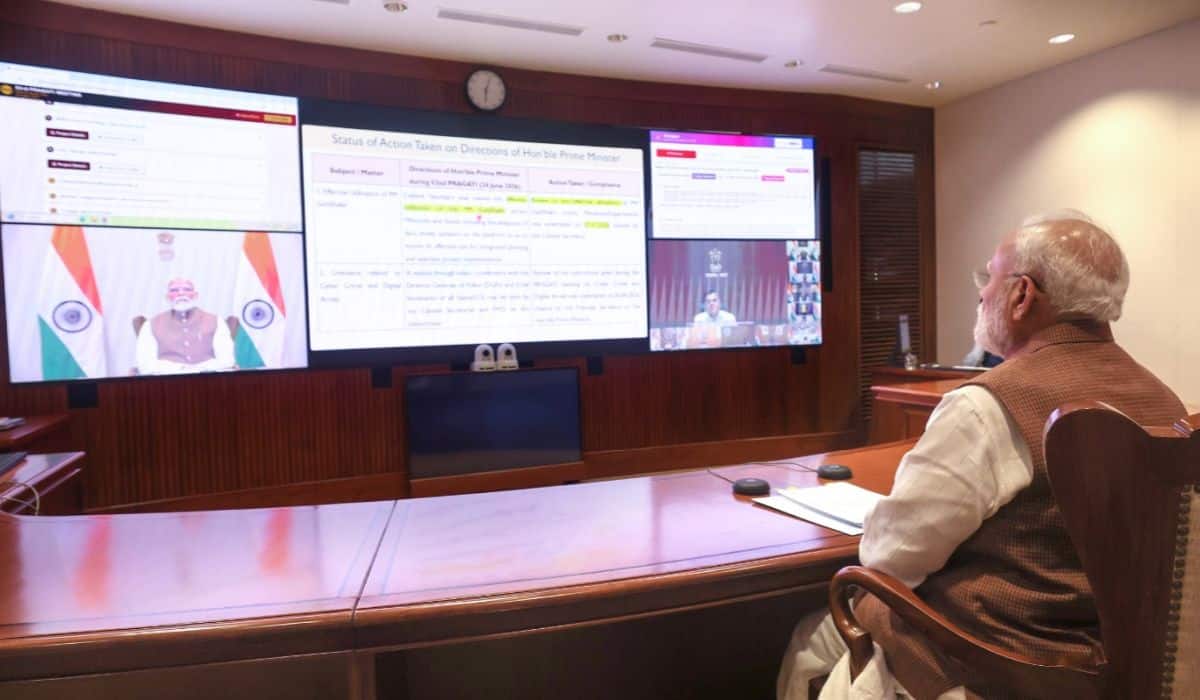
PM chairs 53rd PRAGATI Meeting
August 25, 2026
PM reviews six key infrastructure projects across the Railway, Road and Power sectors
Projects reviewed span across 9 States with cumulative investment of more than ₹30,000 crore
PM says Infrastructure projects should be viewed as an integrated whole, rather than as individual sections or packages
PM calls for continuous reforms across all stages of project implementation and a proactive work culture across Ministries and States
PM says Speed must go hand-in-hand with quality
While reviewing AgriStack, PM emphasises the need to leverage the latest digital technologies including AI to derive greater value from agricultural data
On cyber fraud and ‘digital arrest’, PM stresses training, public awareness, cyber-safety education and coordinated action

Prime Minister Shri Narendra Modi chaired the 53rd meeting of PRAGATI, the ICT-enabled, multi-modal platform for Pro-Active Governance and Timely Implementation, at Seva Teerth earlier today.

During the meeting, Prime Minister reviewed six key infrastructure projects across the Railway, Road and Power sectors, spanning nine States with a cumulative cost of more than ₹30,000 crore. The projects, significant for strengthening connectivity, supporting industrial and economic activity and improving public services, were reviewed with particular emphasis on adherence to timelines, inter-agency coordination, resolution of pending issues and expeditious completion.

Prime Minister emphasised that delays in infrastructure projects have consequences beyond cost escalation, as they also postpone the benefits intended for citizens, businesses and the economy. He said that infrastructure projects should be viewed and monitored as an integrated whole, rather than as isolated sections, stretches or packages. He noted that progress in individual packages should ultimately translate into timely completion and operationalisation of the entire project. Ministries and States were therefore asked to adopt an end-to-end approach, and address critical gaps that could delay the overall commissioning and delivery of benefits. He called for fostering a proactive work culture across Ministries and State Governments, with greater ownership at every level of project implementation.

Prime Minister stressed the need to explore common utility corridors for infrastructure services, wherever feasible, particularly while planning major transport and infrastructure projects. He called upon Ministries and States to examine such integrated approaches at the planning stage itself, keeping in view their technical and economic feasibility.

Prime Minister said that speed of execution must be accompanied by uncompromising quality. He called upon Ministries, States and implementing agencies to adopt modern technologies and strengthen quality assurance and supervision at every stage.

While reviewing AgriStack under the Digital Agriculture Mission, Prime Minister emphasised the need to leverage the latest digital technologies, including Artificial Intelligence, to derive greater value from agricultural data. He stressed that the data ecosystem should be effectively utilised across the agricultural value chain, from input planning to processing, enabling more informed interventions, better targeting and data-driven decision-making. He appreciated the efforts of the States and the Central Government in building the AgriStack ecosystem and called for further strengthening its use for delivering better outcomes for farmers.

During the review of cyber fraud cases, including incidents of digital arrest, Prime Minister said that prevention must be strengthened through a sustained focus on training, awareness and education. He stressed the need for continuous and targeted public-awareness campaigns, particularly for senior citizens, youth and other vulnerable sections, to familiarise them with common fraud techniques, warning signs and safe digital practices. He also called for regular capacity-building of personnel involved so that emerging modes of cyber fraud are identified and acted upon swiftly.