

Your Excellency, Honorable मिसेस अज़ारेल अर्नेस्टा,
Speaker of the National Assembly, Honorable मिसेस सिल्वान लेमियेल,
Leader of Government Business,
Honorable मिस्टर बैनॉ जॉर्ज, Leader of Opposition,
Honourable Members of the National Assembly,
And my dear sisters and brothers,
Namaskar!
Bonn apremidi!
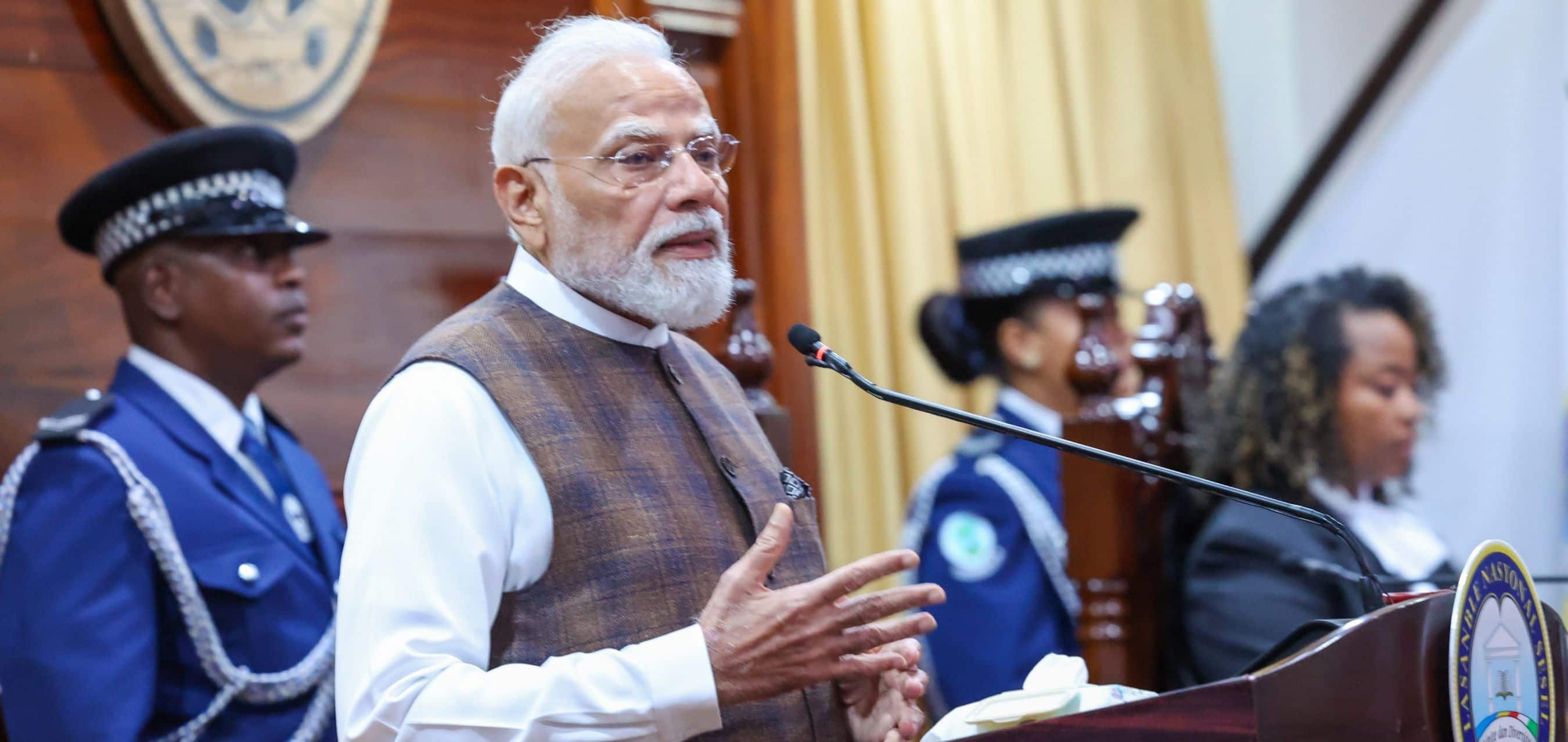
It is a special honour to stand before you as the first Indian Prime Minister to address this National Assembly. I thank you, Madam Speaker, for your warm words.
I also thank President एर्मिनी and the people of Seychelles for honouring me with the “Guardian of the Blue Horizon earlier today. It will encourage all those who are making sustained efforts for environment conservation. I bring with me the warm greetings and best wishes of 1.4 billion people of India.
The first country in the Indian Ocean region that I visited as Prime Minister was Seychelles in 2015. It was also my first visit to Africa as Prime Minister. I came here because I believed that Seychelles occupies a special place in India's vision for the Indian Ocean. Today, as I return here after a decade, that conviction is stronger than ever.
And I am delighted to join you as you celebrate fifty years of your independence. Congratulations to you and the people of Seychelles on this special occasion.
Honourable Members,
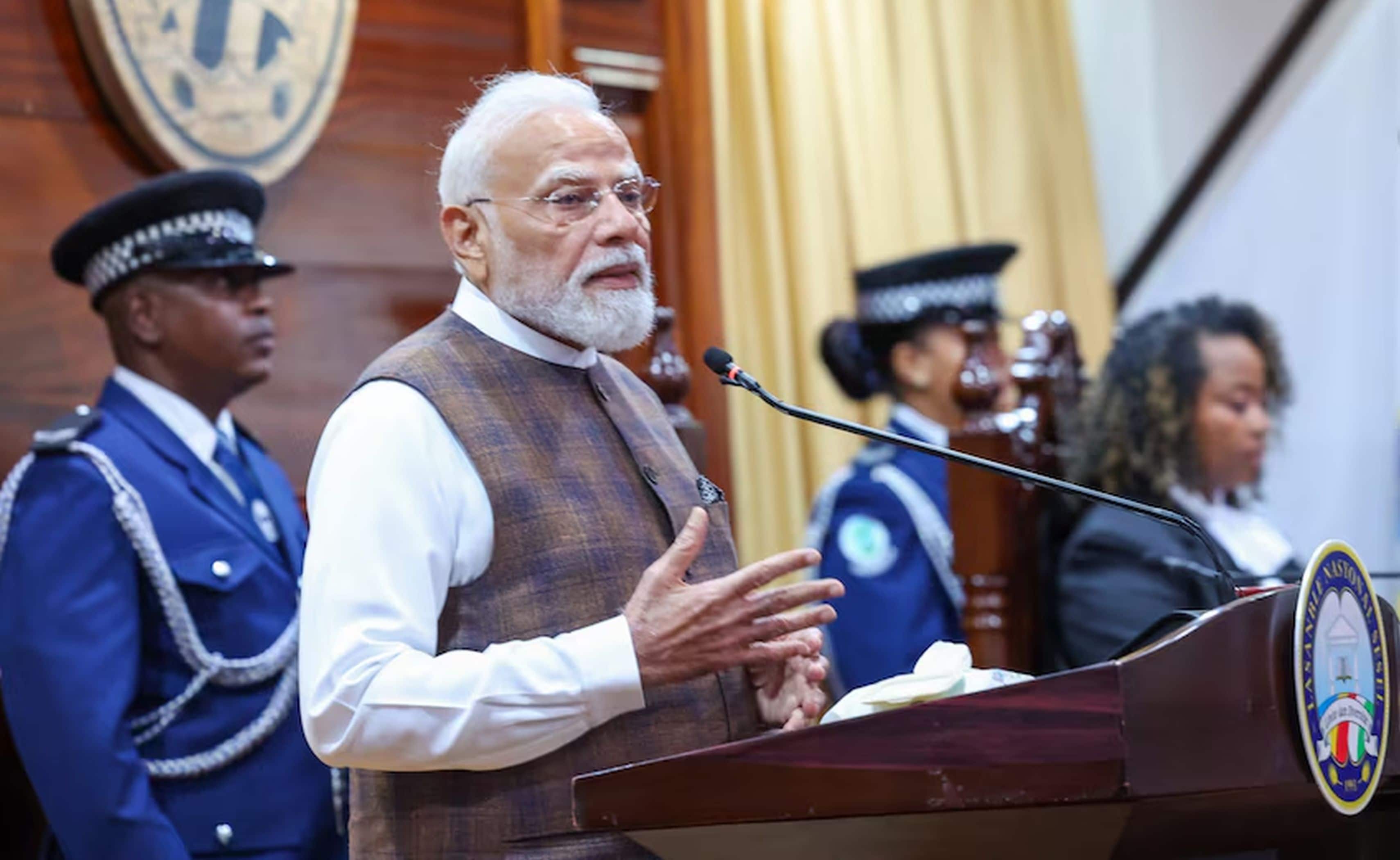
To address this National Assembly is a rare privilege. Thank you for this special honour. I take this opportunity to congratulate the newly-elected members of this Eighth National Assembly. I also extend my felicitations to you, Madam Speaker, on becoming the first woman Speaker of this august House.
Honourable Members,
It is important to recall today that our friendship did not begin fifty years ago with the establishment of our diplomatic relations. It began much earlier. In August 1770, there were five Indians among those who arrived on board the ship Thelemaque at Saint Anne Island. That voyage showed the path to many more who followed. Over time, their stories became part of the story of modern Seychelles.
It reminds us that the bonds between us were not created by governments. They were built by people, nurtured by families, and sustained by generations. The Indian Ocean made this possible. The Indian Ocean does not separate India and Seychelles. It connects us. That is why we meet not as strangers. We meet as old friends.
Honourable Members,
The greatest strength of Seychelles is its people. Over generations, people from all parts of the world arrived here. They brought with them different languages, customs, beliefs and traditions. And together, they built a shared identity that is proudly Seychellois.
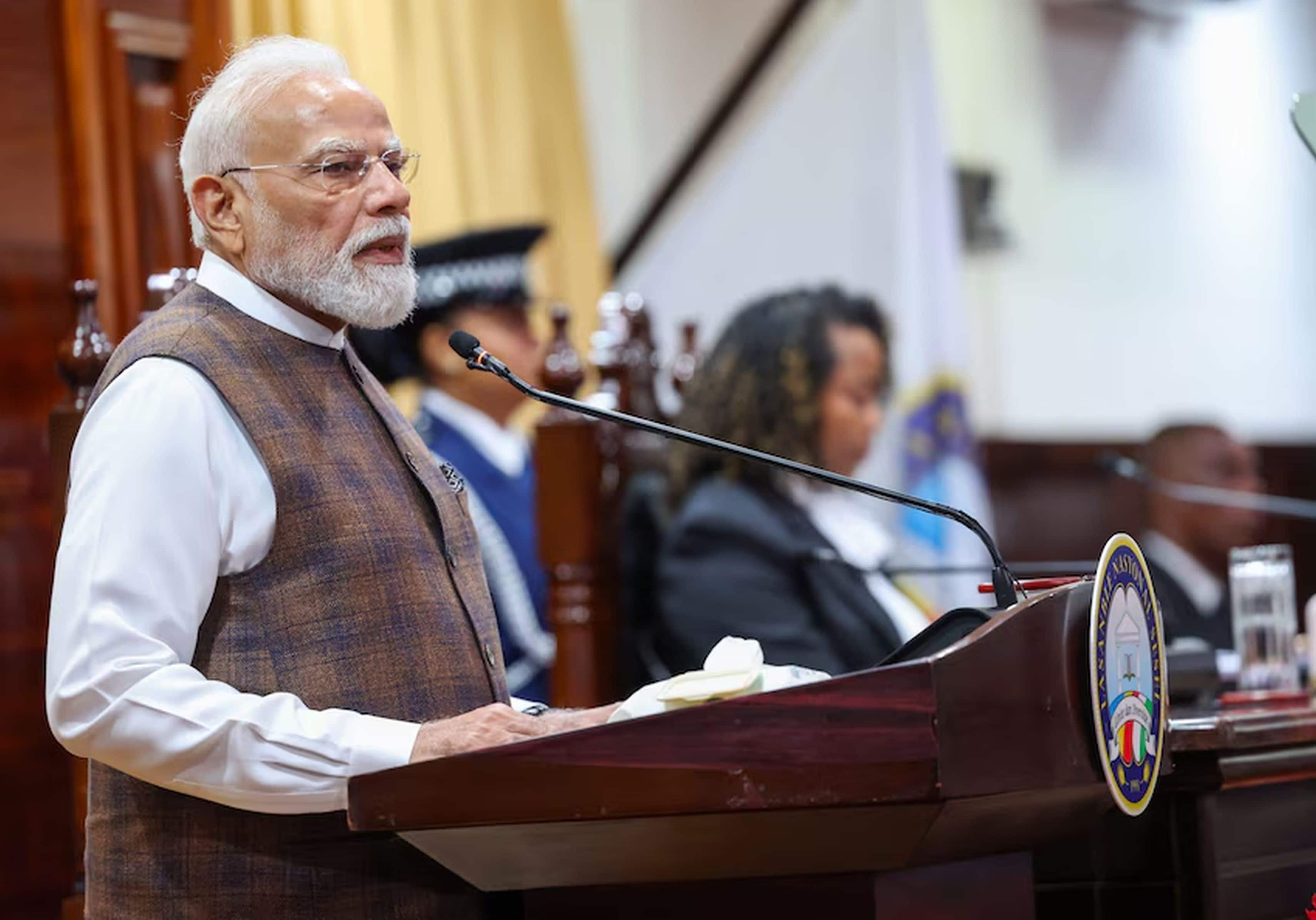
As the motto of this National Assembly says - Unity in Diversity. It can be heard in the melodies of Creole music. It can be seen in the rhythm of the Moutya dance. It can be experienced during Festival Kreol.
When the nation celebrates the richness of its heritage, the connections between our cultures are also visible in everyday life. They can be felt in the flavours of Kari Koko, Samossa, and Chutney. They can be found in the celebrations of Deepavali, Thai Pongal, and the Garba dance during Navratri. This is the Creole spirit that gives us great confidence in the future of our friendship.
Honourable Members,
As maritime neighbours, we recognise that the security of one adds to the security of the other. The prosperity of one contributes to the prosperity of the other. And the stability of the region benefits us all.
This year offers a powerful reminder of the depth of our partnership. Fifty years ago, at the dawn of your independence, an Indian naval ship, INS Nilgiri, was present in Port Victoria as a mark of friendship and solidarity. And today, INS Tarkash and INS Ikshak are docked at Port Victoria to celebrate the Golden Jubilee with you.
The passage of fifty years has changed many things. But it has not changed our commitment to one another. For decades, our defence forces, coast guards, and maritime agencies have trained and worked closely together. India deeply values the professionalism and dedication of the Seychelles Defence Forces and the Seychelles Coast Guard. They play a vital role in safeguarding your own vast maritime domain, as well as the wider Indian Ocean region. Our cooperation in maritime security, capacity building, hydrography, and maritime domain awareness reflects our shared commitment to a safer and more secure region.
I met President Herminie - Ton Pat - this morning and reviewed the remarkable progress achieved in our partnership. We also discussed our shared vision for the future. Our vision is captured in the idea of MAHASAGAR - Mutual and Holistic Advancement for Security and Growth Across Regions.
This vision recognises that our futures are inter-connected and inter-dependent. And, we will continue to work together for a safer and more secure Indian Ocean region.
Honourable Members,
When people look at a map, they may see Seychelles as a group of islands in the Indian Ocean. But we see something much greater. We see a nation whose horizons stretch far beyond its shores. Your maritime domain extends across nearly 1.4 million square kilometres.
This makes Seychelles not a small island state - but a Large Ocean Country. Long before the Blue Economy became a part of global discussions, Seychelles was already leading the way. Whether in protecting marine ecosystems or in advancing innovations like Blue Bonds, your country has helped shape important global conversations. Together, we can build partnerships in fisheries, marine science, coastal management, renewable energy, and sustainable tourism.
Yesterday, I had the honour of planting a sapling of the iconic Coco de Mer tree. Much like Seychelles itself - it is unique, precious, and occupies a special place in the world. The efforts being made by you to protect and preserve this natural wonder reflect a larger philosophy - that humanity must live in harmony with nature.
This sentiment resonates deeply in India as well. Let us work together to ensure that future generations inherit oceans that are healthier, safer, and more abundant than those we enjoy today.
Honourable Members,
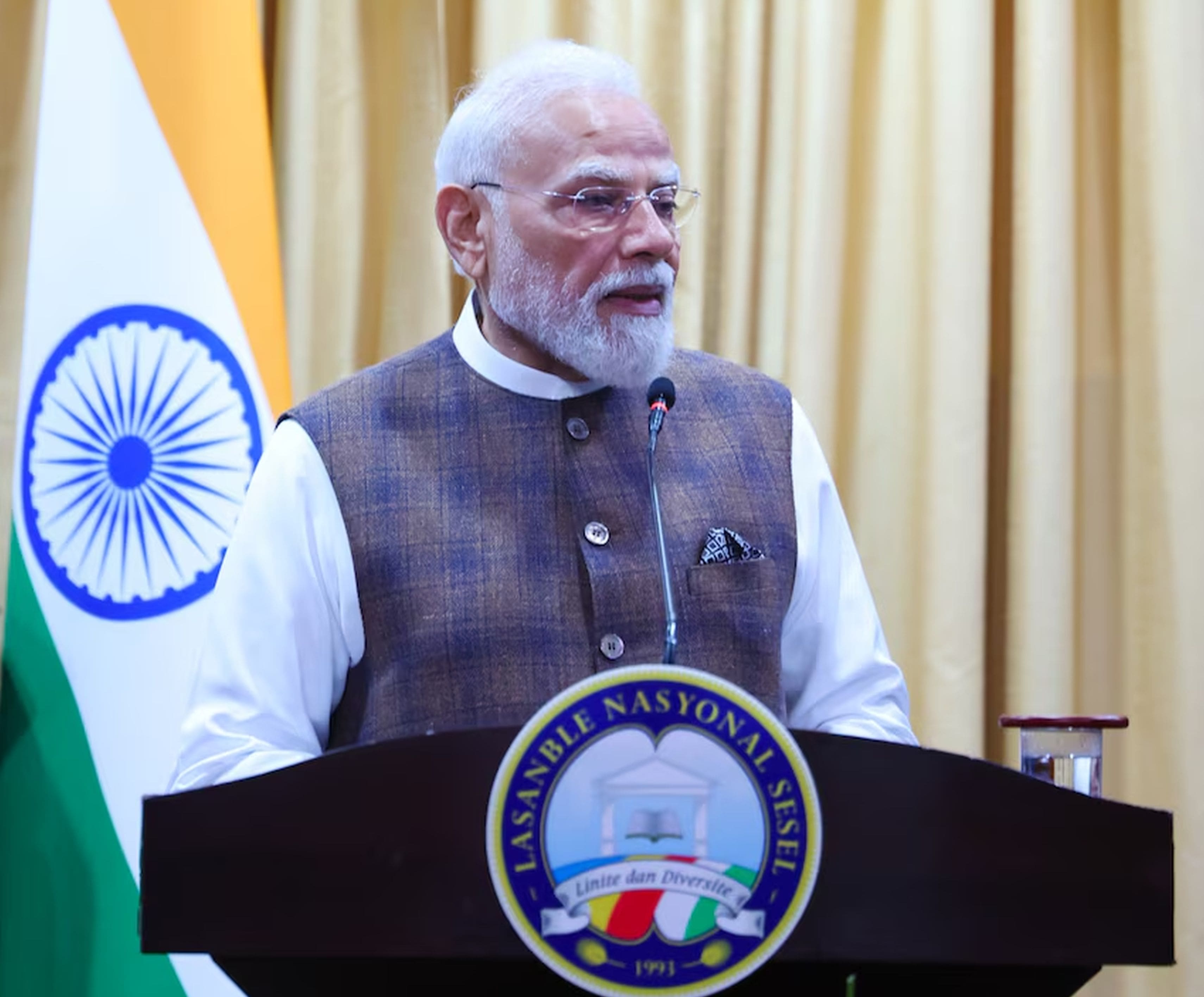
The Global South, and especially the island nations, are the most impacted by Climate Change. Its effects are already visible on our coastlines, in the marine ecosystems, in weather patterns, and in our communities. We both firmly believe that those who have contributed the least to climate change should not bear the greatest burden of its consequences.
Climate action must be guided by fairness, responsibility, and equity. This is the essence of climate justice.
India has sought to lead by example. Over the last decade, we have undertaken one of the world's largest expansions of renewable energy. We have championed sustainable lifestyles through Mission LiFE - Lifestyle for Environment. Through our initiatives like International Solar Alliance, Coalition for Disaster Resilient Infrastructure, Global Biofuels Alliance, and Ek Ped Maa Ke Naam - a tree for mother - we have worked with partner countries to boost the green transition.
And India is committed to continue working with Seychelles to ensure that the concerns of Small Island Developing States receive the attention they deserve.
Honourable Members,
Seychelles and India both seek a world where development is more inclusive. We both seek a world where international institutions reflect contemporary realities. We believe that our shared future must be shaped collectively, inclusively, and fairly.
This belief guided India's efforts during our G20 Presidency. It was in this spirit that we worked to place the priorities of the Global South at the centre of international discussions. And it was in this spirit that we welcomed the African Union as a permanent member of the G20. This is the spirit that unites the Global South. And this is the vision that India and Seychelles will continue to advance together.
Honourable Members,
As we celebrate the achievements of the past fifty years, we must also look ahead. The future of Seychelles will be shaped by its youth. We are proud that students, professionals, officials, and security forces of Seychelles have trained and studied in India for decades.
In fact, it is said that one in every fifty people in Seychelles has undergone some training in India. They have returned home with skills, friendships, and experiences that continue to strengthen our partnership today.
I was delighted to learn about your IGNITE initiative to provide internships for the youth. It is an excellent framework, and we can explore new avenues for cooperation in this sector.
A key focus area for such cooperation can be in digital innovation. India's Digital Public Infrastructure (DPI) has demonstrated how technology can expand opportunity, improve governance, boost financial inclusion, and deliver services for hundreds of millions of people.
We would be happy to share our experiences and expertise as you pursue your own digital transformation. I am confident that the young people of Seychelles will embrace these opportunities with the same determination that guided the first fifty years of independence.
Honourable Members,
Today, as I stand before you in this historic Golden Jubilee year, our people are celebrating a friendship that stretches back more than two and a half centuries. Few partnerships are built on foundations as deep. And few partnerships have grown with such warmth, trust, and goodwill.
As we look ahead, let us continue to build upon these foundations. India will remain your trusted partner. We will celebrate your achievements. We will support your aspirations. And we will stand beside you as friends.
The last fifty years have been remarkable. But I firmly believe that the best chapters of the Seychelles story are yet to be written. And the best of our friendship is yet to come.
I thank President Herminie and the people of Seychelles for honouring me with the "Guardian of the Blue Horizon" earlier today.
— PMO India (@PMOIndia) June 28, 2026
It will encourage all those who are making sustained efforts for environment conservation: PM @narendramodi pic.twitter.com/asg6XyT9WU
The Indian Ocean does not separate India and Seychelles.
— PMO India (@PMOIndia) June 28, 2026
It connects us: PM @narendramodi pic.twitter.com/AQOLHocbOp
When people look at a map, they may see Seychelles as a group of islands in the Indian Ocean.
— PMO India (@PMOIndia) June 28, 2026
But we see something much greater.
We see a nation whose horizons stretch far beyond its shores: PM @narendramodi pic.twitter.com/RHCsBrShWV
Climate action must be guided by fairness, responsibility and equity.
— PMO India (@PMOIndia) June 28, 2026
This is the essence of climate justice: PM @narendramodi pic.twitter.com/XfcnhJZOvk
Seychelles and India both seek a world where development is more inclusive.
— PMO India (@PMOIndia) June 28, 2026
We both seek a world where international institutions reflect contemporary realities: PM @narendramodi pic.twitter.com/CgXvFNFL0t
India's Digital Public Infrastructure has demonstrated how technology can expand opportunity, improve governance, boost financial inclusion and deliver services for hundreds of millions of people: PM @narendramodi pic.twitter.com/O62QQbgLH7
— PMO India (@PMOIndia) June 28, 2026