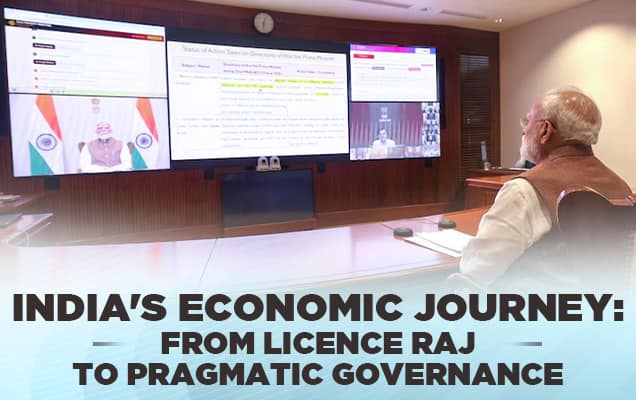
The Prime Minister, Shri Narendra Modi participated in the programme marking the culmination of Meri Maati Mera Desh campaign’s Amrit Kalash Yatra at Kartavya Path in New Delhi today. The programme also marks the closing ceremony of Azadi Ka Amrit Mahotsav. During the program, the Prime Minister laid the foundation stone of Amrit Vatika and Amrit Mahotsav Memorial and launched ‘Mera Yuva Bharat’ - MY Bharat platform for youth of the country.

Shri Modi also presented the Azadi Ka Amrit Mahotsav Awards to the top 3 performing States or Union Territories as well as Ministries or Departments. The top 3 performing states or union territories are Jammu and Kashmir, Gujarat and Haryana, while the top 3 performing ministries are Ministry of External Affairs, Ministry of Defence, and Ministry of Railways and Ministry of Education for the joint third position.
Addressing the gathering, the Prime Minister remarked that Kartavya Path is witnessing the Mahayagya on the occasion of Sardar Saheb’s birth anniversary. Recalling 12th March 2021 when the initiation of Azadi Ka Amrit Mahotsav was inspired by Mahatma Gandhi’s Dandi Yatra, the Prime Minister observed the conclusion of Azadi Ka Amrit Mahotsav on 31st October 2023, the birth anniversary of Sardar Patel. Drawing an analogy to the Dandi March Yatra which saw the participation of every Indian, the Prime Minister drew attention to the Azadi Ka Amrit Mahotsav creating a new record of people’s participation. “Dandi March reignited the flame of independence while Amrit Kaal is turning out to be the resolution of the 75-year-old journey of India’s development journey”, Shri Modi emphasized. He underlined that the 2 year long celebrations of Azadi Ka Amrit Mahotsav are coming to a conclusion with the ‘Meri Maati Mera Desh’ Abhiyan. He also noted the foundation stone laying of Smarak which will remind the future generations of today’s historic organization. He also congratulated the states, union territories and ministries that were recipients of the best-performing awards.

He pointed out that as we bid goodbye to a grand celebration, we are initiating a new resolution with MY Bharat. “MY Bharat organization is going to play a big role in nation-building in the 21st century”, PM Modi said.
Pointing to the collective strength of Indian youth, the Prime Minister said “Meri Mati Mera Desh Abhiyan is a live example of how the youth of India can organize and achieve every goal.” PM Modi highlighted the countless youth participation from every nook and corner of the country and said that 8500 Amrit Kalash have reached the Kartavya Path from all over the country and crores have Indians have taken Panch Pran pledge and have uploaded selfies on the campaign website.
Explaining why soil was used as an element for the culmination of Azadi Ka Amrit Mahotsav, the Prime Minister cited the words of a poet and said that it is the soil of the land where civilizations have flourished, humans have progressed and it holds the imprint of eons. “India’s soil has consciousness. It has a life form that has prevented the downfall of civilization”, Shri Modi said, noting how a multitude of civilizations have collapsed while India still stands strong. “The soil of India creates an affinity for the soul towards spirituality”, he said as he highlighted the numerous sagas of India’s valor and touched upon the contributions of Shaheed Bhagat Singh. Highlighting how every citizen is deeply rooted to the soil of the motherland, the Prime Minister said, “What is life if it is not repaying the debts of the soil of India.” He underlined that soil from the thousands of ‘Amrit Kalash’ that have arrived in Delhi will remind everyone of the sentiment of Kartavya or duty and inspire each one to accomplish the resolve of a Viksit Bharat. He urged everyone to contribute towards nation-building.

The Prime Minister said that the Amrit Vatika which will be established with saplings from all over the country will teach the coming generation about ‘Ek Bharat Shreshtha Bharat’. The Prime Minister told the audience about the artwork Jan, Janani, Janambhoomi in the New Parliament Building which has been made by 75 women artists from the soil of all the states.
The Prime Minister said that the most positive impact of the Azadi Ka Amrit Mahotsav (AKAM) which ran for about 1000 days has been on the young generation of India. He said that today's generation has not experienced slavery and he is also the first Prime Minister born in free India. He said that AKAM has reminded the people that there was not a single moment during the foreign rule when there was no movement for freedom and no section or region was untouched by these movements.

The Prime Minister said, “Amrit Mahotsav has, in a way, added the missing pages of history for future generations.” He said the people of India made Amrit Mohotsav a people’s movement. He said the success of Har Ghar Tiranga is the success of every Indian. People came to know about the contribution of their families and villages in the freedom struggle. He said that a district-wise database of the freedom fighters has been created.
The Prime Minister highlighted India’s achievements during AKAM and mentioned India's rise to the top 5 economies in the world, the successful landing of Chandrayaan 3, the organization of G20 Summit, historic record of bagging more than 100 medals at the Asian Games and Asian Para Games, inauguration of New Parliament building, passage of Nari Shakti Vandan Adhiniyam, new records in exports, agricultural produce, expansion of the Vande Bharat train network, initiation of Amrit Bharat Station campaign, country’s first Regional Rapid train Namo Bharat, creation of more than 65,000 Amrit Sarovars, launch and expansion of made in India 5G, and launch of PM Gatishakit Masterplan to improve connectivity.
The Prime Minister emphasized, “During the Azadi Ka Amrit Mahotsav, the country completed the journey from Rajpath to Kartavya Path. We also removed many symbols of slavery.” He mentioned Netaji Subhash Bose’s statue at the India Gate, New insignia of the Navy, inspiring names for the islands of Andaman and Nicobar, the declaration of Janjatiya Gaurav Diwas, Veer Baal Diwas in the memory of Sahibzaade and the decision to commemorate Vibhajan Vibhishika Diwas on 14 August every year.

“The end of something always signifies the beginning of something new”, the Prime Minister said, explaining a Sankrit Shlok. He noted the launch of MY Bharat with the conclusion of Amrit Mahotsav and said, “MY Bharat is a proclamation of the youth power of India.” He underlined that it will become a great medium to bring every youth of the country on one platform and ensure greater participation towards nation-building. He informed about the launch of MY Bharat website and said that the various programs that are being run for the youth will be included on the platform. Prime Minister Modi urged the youth to connect with it as much as possible, fill India with new energy, and take the country forward.
Concluding the address, the Prime Minister said that India's independence is the fulfillment of the common resolutions of every citizen and urged to protect it with unity. Noting the resolve to make India a developed country by 2047, he said that this special day will be remembered by the nation upon the completion of 100 years of independence. “We will have to fulfill the resolve we took, the promises we made to the coming generation”, the Prime Minister said urging to intensify the efforts. “The contribution of every Indian is important to achieve the goal of being a developed country. Come, let us start a new journey of the Amrit Kaal of Viksit Bharat through Amrit Mahotsav”, he concluded.
Union Minister for Home Affairs, Shri Amit Shah, Union Minister for Information & Broadcasting, Shri Anurag Singh Thakur and Union Minister for Culture, Shri G Kishan Reddy were present on the occasion among others.
Background
Meri Maati Mera Desh
Meri Maati Mera Desh campaign is a tribute to the Veers and Veeranganas who have made the supreme sacrifice for the country. In the spirit of Jan Bhagidari, the campaign comprises many activities and ceremonies conducted across the country at Panchayat/Village, Block, Urban Local Body, State and National levels. The activities included building of Shilaphalakam (Memorial) to express heartfelt gratitude to all the bravehearts who have made the supreme sacrifice; ‘Panch Pran’ pledge taking by the people at Shilaphalakam; planting of saplings of indigenous species and developing ‘Amrit Vatika’ (Vasudha Vandhan) and felicitation ceremonies for honoring the freedom fighters and the families of deceased freedom fighters (Veeron ka Vandan), among others.
The campaign became a massive success, with over 2.3 lakh Shilaphalakams built in 36 States/UTs; nearly 4 crore Panch Pran pledge selfies uploaded; 2 Lakh plus ‘Veeron ka Vandan’ programs nationwide; more than 2.36 crore indigenous saplings have been planted; and 2.63 lakh Amrit Vatikas created under the Vasudha Vandan theme across the country.
‘Meri Maati Mera Desh’ campaign also includes the Amrit Kalash Yatra, which comprises a collection of mitti (soil) and rice grains from over 6 lakh villages in rural areas and from wards in urban areas, which is sent to block level (where mitti of all villages in the block is mixed) and then to the state capital. The mitti from the state level is sent to the National Capital, accompanied by thousands of Amrit Kalash Yatris.

Yesterday, the Amrit Kalash Yatra witnessed all the states and UTs represented by their respective blocks and Urban Local bodies putting mitti from their Kalash in one giant Amrit Kalash in the spirit of ‘Ek Bharat Shreshtha Bharat’. The Amrit Vatika and Amrit Mahotsav Memorial, whose foundation stone was laid by the Prime Minister, will be built from the soil collected from every part of the country.
Meri Maati Mera Desh campaign was envisaged as a culminating event of 'Azadi Ka Amrit Mahotsav'. Azadi Ka Amrit Mahotsav began on 12th March 2021 to celebrate 75 years of India's independence. It has since witnessed more than two lakh programmes organized throughout the country with enthusiastic public participation.

MY Bharat
‘Mera Yuva Bharat’ - MY Bharat is being established as an autonomous body to serve as a one-stop whole-of-government platform for the youth of the country. In line with the Prime Minister’s vision to provide equitable opportunities to every youth of the country, MY Bharat will leverage technology to provide an enabling mechanism across the entire spectrum of the Government so that they can realize their aspirations and contribute to the building of ‘Viksit Bharat’. The aim of MY Bharat is to inspire youth to become community change agents and nation builders and enable them to act as the ‘Yuva Setu’ between the Government and the citizens. In this sense, ‘MY Bharat’ will provide a major boost to ‘Youth Led development’ in the country.
जैसे दांडी यात्रा शुरू होने के बाद देशवासी उससे जुड़ते गए, वैसे ही आजादी के अमृत महोत्सव ने जनभागीदारी का ऐसा हुजूम देखा कि नया इतिहास बन गया: PM @narendramodi pic.twitter.com/P4roHSTh7Y
— PMO India (@PMOIndia) October 31, 2023
21वीं सदी में राष्ट्रनिर्माण के लिए मेरा युवा भारत संगठन, बहुत बड़ी भूमिका निभाने वाला है: PM @narendramodi pic.twitter.com/WSVjxgaIuO
— PMO India (@PMOIndia) October 31, 2023
बड़ी-बड़ी महान सभ्यताएं समाप्त हो गईं लेकिन भारत की मिट्टी में वो चेतना है जिसने इस राष्ट्र को अनादिकाल से आज तक बचा कर रखा है: PM @narendramodi pic.twitter.com/pGJjGhm97j
— PMO India (@PMOIndia) October 31, 2023
The sacred soil will serve as a wellspring of motivation, propelling us to redouble our efforts toward realising our vision of a 'Viksit Bharat'. pic.twitter.com/wTT9Ihc5XH
— PMO India (@PMOIndia) October 31, 2023
अमृत महोत्सव ने एक प्रकार से इतिहास के छूटे हुए पृष्ठ को भविष्य की पीढ़ियों के लिए जोड़ दिया है। pic.twitter.com/Cb2wGALG0E
— PMO India (@PMOIndia) October 31, 2023
MY भारत संगठन, भारत की युवा शक्ति का उद्घोष है। pic.twitter.com/uUXpgD0fpE
— PMO India (@PMOIndia) October 31, 2023