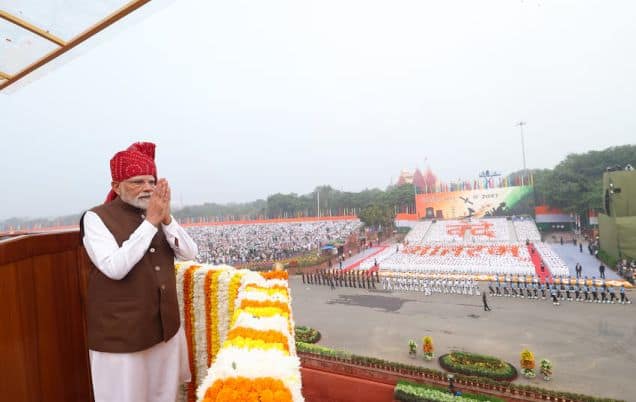
Marathi being recognised as a Classical Language is a moment of pride for everyone: PM
Along with Marathi, Bengali, Pali, Prakrit and Assamese languages ​​have also been given the status of classical languages, I also congratulate the people associated with these languages: PM
The history of Marathi language has been very rich: PM
Many revolutionary leaders and thinkers of Maharashtra used Marathi language as a medium to make people aware and united: PM
Language is not just a medium of communication, it is deeply connected with culture, history, tradition and literature: PM

Addressing the gathering, the Prime Minister remarked that the Marathi language has officially been granted the status of a classical language by the Central Government. Shri Modi emphasized the significance of this moment, describing it as a golden milestone in the history of the Marathi language as he acknowledged the long-standing aspirations of Marathi-speaking people and expressed delight in contributing towards fulfilling Maharashtra's dream. The Prime Minister also congratulated the people of Maharashtra and expressed his pride in being part of this historic achievement. Additionally, the Prime Minister announced that Bengali, Pali, Prakrit, and Assamese have also been granted the status of classical languages and extended his congratulations to the people associated with these languages.

The Prime Minister emphasized that the history of Marathi language has been very rich and the streams of knowledge that emerged from this language have guided many generations, and they continue to guide us even today. He added that using Marathi, Sant Dnyaneshwar connected people with the discussion of Vedanta and Dnyaneshwari reawakened the spiritual wisdom of India with the knowledge of Geeta. Shri Modi also highlighted that Sant Namdev strengthened the consciousness of the path of devotion using Marathi, likewise, SantTukaram launched a religious awareness campaign in Marathi language and Sant Chokhamela empowered the movements for social change. “I bow down to the great Saints of Maharashtra and Marathi language”, said Shri Modi. He added that the classical status accorded to Marathi language meant that the entire country honors Chhatrapati Shivaji Maharaj during his 350th year of coronation.

The Prime Minister highlighted the invaluable contribution of the Marathi language in India's fight for independence and noted how several revolutionary leaders and thinkers from Maharashtra used Marathi as a medium to create awareness and unite the masses. He said that Lokmanya Tilak shook the very foundations of foreign rule with his Marathi newspaper, Kesari and his speeches in Marathi ignited the desire for Swaraj in the hearts of every Indian. He underlined that Marathi language played an important role in advancing the fight for justice and equality and recalled the contributions of other luminaries, such as Gopal Ganesh Agarkar, who through his Marathi newspaper Sudharak led a campaign for social reforms, reaching every household. Gopal Krishna Gokhale was another stalwart who relied on Marathi to steer the freedom struggle towards its goal.

Shri Modi emphasized that Marathi literature is India’s priceless heritage preserving the stories of our civilization’s growth and cultural progress. He noted that Marathi literature played a vital role in spreading the ideals of Swaraj, Swadeshi, mother tongue and cultural pride. He highlighted that during the freedom movement, initiatives like the Ganesh Utsav and Shiv Jayanti celebrations, the revolutionary thoughts of Veer Savarkar, the social equality movement led by Babasaheb Ambedkar, the women's empowerment campaign of Maharshi Karve, as well as efforts in industrialization and agricultural reforms in Maharashtra, all found their strength in the Marathi language. He said the cultural diversity of our country becomes further enriched by connecting with the Marathi language.

“Language is not just a medium of communication, but is deeply connected with culture, history, tradition and literature”, exclaimed the Prime Minister. Talking about the folk song Povada, Shri Modi remarked that the tales of bravery of Chhatrapati Shivaji Maharaj and other heroes have reached us even after several centuries. He added that Povada was a wonderful gift of Marathi language to today's generation. The Prime Minister underlined that today when we worship Ganpati, the words ‘Ganpati Bappa Morya’ naturally resonate in our mind and it is not just a combination of a few words, but an endless flow of devotion. He added that this devotion connects the entire country with Marathi language. Shri Modi also underlined that similarly, those who listen to Shri Vitthal's Abhang also automatically connect with Marathi.

Highlighting the contributions and efforts by Marathi litterateurs, writers, poets and innumerable Marathi lovers to Marathi language, Shri Modi remarked that the recognition of classical status to the language was a result of the service of many talented litterateurs. He added that the contribution of personalities like Balshastri Jambhekar, Mahatma Jyotiba Phule, Savitribai Phule, Krishnaji Prabhakar Khadilkar, Keshavsut, Shripad Mahadev Mate, Acharya Atre, Anna Bhau Sathe, Shantabai Shelke, Gajanan Digambar Madgulkar, Kusumagraj is incomparable. The Prime Minister remarked that the tradition of Marathi literature is not only ancient but also multifaceted. He added that many personalities like Vinoba Bhave, Shripad Amrit Dange, Durgabai Bhagwat, Baba Amte, Dalit litterateur Daya Pawar, Babasaheb Purandare have made significant contributions to Marathi literature. Shri Modi also remembered the contribution of all the litterateurs who served Marathi, including Purushottam Laxman Deshpande, Dr. Aruna Dhere, Dr. Sadanand More, Mahesh Elkunchwar, Sahitya Akademi Award winner Namdev Kamble. He added that many stalwarts like Asha Bage, Vijaya Rajadhyaksha, Dr. Sharankumar Limbale, theatre director Chandrakant Kulkarni had dreamt of classical language status for Marathi for years.

The Prime Minister lauded the contribution of Marathi cinema, literature, and culture, noting that legends like V. Shantaram and Dadasaheb Phalke laid the foundation of Indian cinema. He praised Marathi theatre for giving a voice to the oppressed and celebrated Marathi music traditions, acknowledging icons like Bal Gandharva, Bhimsen Joshi, and Lata Mangeshkar for their contributions.

Shri Modi shared a personal memory from Ahmedabad where a Marathi family helped him learn the language. The Prime Minister highlighted that Marathi being recognized as a classical language will promote language research in universities across India and also promote the literary collection. This decision, Shri Modi said, will provide a significant boost to organizations, individuals, and students working for the development of the Marathi language. He expressed optimism that this initiative will open new avenues in education and research, fostering employment opportunities in these sectors.

Emphasizing that the country has a government that prioritizes education in regional languages for the first time since independence, the Prime Minister highlighted the possibility of studying medical and engineering courses in Marathi under the New National Education Policy. He noted that the availability of books in Marathi across various subjects like science, economics and arts is growing and stressed making Marathi a vehicle of ideas so that it remains vibrant. He encouraged the efforts to bring Marathi literature to a global audience and also touched upon the Bhashini app which helps break language barriers through its translation feature.

The Prime Minister reminded everyone that celebrations of this historic occasion also bring responsibility. He underlined that every Marathi speaker must contribute to the growth of this language. Shri Modi urged that efforts should be made to expand the reach of Marathi, instilling a sense of pride in future generations. He concluded by extending congratulations to everyone on the recognition of Marathi as a classical language.

Click here to read full text speech

Explore More
Today, the entire country and entire world is filled with the spirit of Bhagwan Shri Ram: PM Modi at Dhwajarohan Utsav in Ayodhya

Popular Speeches

Today, the entire country and entire world is filled with the spirit of Bhagwan Shri Ram: PM Modi at Dhwajarohan Utsav in Ayodhya
Modi’s West Asia tour marks India’s quiet reordering of regional security partnerships

Media Coverage

Modi’s West Asia tour marks India’s quiet reordering of regional security partnerships
NM on the go

Nm on the go

Always be the first to hear from the PM. Get the App Now!
...
PM chairs 50th meeting of PRAGATI
December 31, 2025
In last decade, PRAGATI led ecosystem has helped accelerate projects worth more than ₹85 lakh crore: PM
PM’s Mantra for the Next Phase of PRAGATI: Reform to Simplify, Perform to Deliver, Transform to Impact
PM says PRAGATI is essential to sustain reform momentum and ensure delivery
PM says Long-Pending Projects have been Completed in National Interest
PRAGATI exemplifies Cooperative Federalism and breaks Silo-Based Functioning: PM
PM encourages States to institutionalise PRAGATI-like mechanisms especially for the social sector at the level of Chief Secretary
In the 50th meeting, PM reviews five critical infrastructure projects spanning five states with a cumulative cost of more than ₹40,000 crore
Efforts must be made for making PM SHRI schools benchmark for other schools of state governments: PM

Prime Minister Shri Narendra Modi chaired the 50th meeting of PRAGATI - the ICT-enabled multi-modal platform for Pro-Active Governance and Timely Implementation - earlier today, marking a significant milestone in a decade-long journey of cooperative, outcome-driven governance under the leadership of Prime Minister Shri Narendra Modi. The milestone underscores how technology-enabled leadership, real-time monitoring and sustained Centre-State collaboration have translated national priorities into measurable outcomes on the ground.

Review undertaken in 50th PRAGATI

During the meeting, Prime Minister reviewed five critical infrastructure projects across sectors, including Road, Railways, Power, Water Resources, and Coal. These projects span 5 States, with a cumulative cost of more than ₹40,000 crore.

During a review of PM SHRI scheme, Prime Minister emphasized that the PM SHRI scheme must become a national benchmark for holistic and future ready school education and said that implementation should be outcome oriented rather than infrastructure centric. He asked all the Chief Secretaries to closely monitor the PM SHRI scheme. He further emphasized that efforts must be made for making PM SHRI schools benchmark for other schools of state government. He also suggested that Senior officers of the government should undertake field visits to evaluate the performance of PM SHRI schools.

On this special occasion, Prime Minister Shri Narendra Modi described the milestone as a symbol of the deep transformation India has witnessed in the culture of governance over the last decade. Prime Minister underlined that when decisions are timely, coordination is effective, and accountability is fixed, the speed of government functioning naturally increases and its impact becomes visible directly in citizens’ lives.

Genesis of PRAGATI

Recalling the origin of the approach, the Prime Minister said that as Chief Minister of Gujarat he had launched the technology-enabled SWAGAT platform (State Wide Attention on Grievances by Application of Technology) to understand and resolve public grievances with discipline, transparency, and time-bound action.

Building on that experience, after assuming office at the Centre, he expanded the same spirit nationally through PRAGATI bringing large projects, major programmes and grievance redressal onto one integrated platform for review, resolution, and follow-up.

Scale and Impact

Prime Minister noted that over the years the PRAGATI led ecosystem has helped accelerate projects worth more than 85 lakh crore rupees and supported the on-ground implementation of major welfare programmes at scale.

Since 2014, 377 projects have been reviewed under PRAGATI, and across these projects, 2,958 out of 3,162 identified issues - i.e. around 94 percent - have been resolved, significantly reducing delays, cost overruns and coordination failures.

Prime Minister said that as India moves at a faster pace, the relevance of PRAGATI has grown further. He noted that PRAGATI is essential to sustain reform momentum and ensure delivery.

Unlocking Long-Pending Projects

Prime Minister said that since 2014, the government has worked to institutionalise delivery and accountability creating a system where work is pursued with consistent follow-up and completed within timelines and budgets. He said projects that were started earlier but left incomplete or forgotten have been revived and completed in national interest.

Several projects that had remained stalled for decades were completed or decisively unlocked after being taken up under the PRAGATI platform. These include the Bogibeel rail-cum-road bridge in Assam, first conceived in 1997; the Jammu-Udhampur-Srinagar-Baramulla rail link, where work began in 1995; the Navi Mumbai International Airport, conceptualised in 1997; the modernisation and expansion of the Bhilai Steel Plant, approved in 2007; and the Gadarwara and LARA Super Thermal Power Projects, sanctioned in 2008 and 2009 respectively. These outcomes demonstrate the impact of sustained high-level monitoring and inter-governmental coordination.

From silos to Team India

Prime Minister pointed out that projects do not fail due to lack of intent alone—many fail due to lack of coordination and silo-based functioning. He said PRAGATI has helped address this by bringing all stakeholders onto one platform, aligned to one shared outcome.

He described PRAGATI as an effective model of cooperative federalism, where the Centre and States work as one team, and ministries and departments look beyond silos to solve problems. Prime Minister said that since its inception, around 500 Secretaries of Government of India and Chief Secretaries of States have participated in PRAGATI meetings. He thanked them for their participation, commitment, and ground-level understanding, which has helped PRAGATI evolve from a review forum into a genuine problem-solving platform.

Prime Minister said that the government has ensured adequate resources for national priorities, with sustained investments across sectors. He called upon every Ministry and State to strengthen the entire chain from planning to execution, minimise delays from tendering to ground delivery.

Reform, Perform, Transform

On the occasion, the Prime Minister shared clear expectations for the next phase, outlining his vision of Reform, Perform and Transform saying “Reform to simplify, Perform to deliver, Transform to impact.”

He said Reform must mean moving from process to solutions, simplifying procedures and making systems more friendly for Ease of Living and Ease of Doing Business.

He said Perform must mean to focus equally on time, cost, and quality. He added that outcome-driven governance has strengthened through PRAGATI and must now go deeper.

He further said that Transform must be measured by what citizens actually feel about timely services, faster grievance resolution, and improved ease of living.

PRAGATI and the journey to Viksit Bharat @ 2047

Prime Minister said Viksit Bharat @ 2047 is both a national resolve and a time-bound target, and PRAGATI is a powerful accelerator to achieve it. He encouraged States to institutionalise similar PRAGATI-like mechanisms especially for the social sector at the level of Chief Secretary.

To take PRAGATI to the next level, Prime Minister emphasised the use of technology in each and every phase of the project life cycle.

Prime Minister concluded by stating that PRAGATI@50 is not merely a milestone it is a commitment. PRAGATI must be strengthened further in the years ahead to ensure faster execution, higher quality, and measurable outcomes for citizens.

Presentation by Cabinet Secretary

On the occasion of the 50th PRAGATI milestone, the Cabinet Secretary made a brief presentation highlighting PRAGATI’s key achievements and outlining how it has reshaped India’s monitoring and coordination ecosystem, strengthening inter-ministerial and Centre-State follow-through, and reinforcing a culture of time-bound closure, which resulted in faster implementation of projects, improved last-mile delivery of Schemes and Programmes and quality resolution of public grievances.