PM monitors MPox situation

Published By : Admin | August 18, 2024 | 19:42 IST
Dr. P.K. Mishra, Principal Secretary to Prime Minister chairs high level meeting to review preparedness of Mpox
Advises enhanced surveillance for prompt detection
Testing Labs to be in state of readiness
Awareness campaign to be taken up regarding preventive public health measures against the disease

Prime Minister Shri Narendra Modi has been continuously monitoring the MPox situation.

As advised by the Prime Minister Shri Narendra Modi, Dr. P. K. Mishra, Principal Secretary to Prime Minister, chaired a high-level meeting to review the status of preparedness for Mpox in the country and related public health measures.

It may be noted that the World Health Organization (WHO) has again declared Mpox Public Health Emergency of International Concern (PHEIC) on 14th August 2024 in view of its prevalence and spread across many parts of Africa. As per an earlier statement from WHO, globally since 2022 from 116 countries, 99,176 cases and 208 deaths had been reported due to Mpox. Subsequently, they have reported that Mpox cases have been steadily increasing in the Democratic Republic of Congo. Last year, the reported cases increased significantly, and already the number of cases reported so far this year has exceeded last year’s total, with more than 15, 600 cases and 537 deaths. Since the 2022 declaration of Public Health Emergency of International Concern by WHO, 30 cases were reported in India. The last case of Mpox was detected in March 2024.

The high-level meeting was briefed that as of now, there is no reported case of Mpox in the country. As per the present assessment, the risk of a large outbreak with sustained transmission is low.

Principal Secretary to Prime Minister was informed that Mpox infections are generally self-limiting lasting between 2-4 weeks; Mpox patients usually recover with supportive medical care and management. Mpox transmission happens through prolonged and close contact with an infected patient. It happens largely through the sexual route, direct contact with body/lesion fluid of the patient, or through the contaminated clothing/linen of an infected person.

It was informed by the Health Secretary that the following steps have already been taken in the last one week:

A meeting of experts was convened by the National Centre for Disease Control (NCDC) on 12th August, 2024 to assess the risk for India.

A Communicable Disease (CD) Alert on Mpox issued earlier by the NCDC is being updated to capture the newer developments.

Sensitization of the health teams at International Airports (Ports of Entry) has been undertaken.

It was also informed that today morning, a Video Conference was convened by the Director General Health Services (DGHS) with more than 200 participants. The health authorities at state level including the Integrated Disease Surveillance Programme (IDSP) units in the States and at the Ports of Entry etc. were sensitized in this regard.

Principal Secretary to Prime Minister, Dr. P. K. Mishra directed that surveillance be enhanced and effective measures be taken for prompt detection of cases. He further directed that the testing laboratories network should be geared up for early diagnosis. Presently 32 labs are equipped for testing.

Dr P.K. Mishra directed that the protocols for prevention and treatment of the disease may be disseminated on a large scale. He further emphasised an awareness campaign amongst the healthcare providers regarding the signs and symptoms of the disease and the need for timely notification to the surveillance system.

The meeting was attended by Dr. V.K. Paul, Member NITI, Shri Apurva Chandra, Secretary (Health & Family Welfare), Dr Rajiv Bahl, Secretary (Health Research), Shri Krishna S Vatsa, Member Secretary (National Disaster Management Authority), Shri Sanjay Jaju, Secretary (Information & Broadcasting) and Shri Govind Mohan, Home Secretary designate, along with officers of other ministries.

Explore More
Today, the entire country and entire world is filled with the spirit of Bhagwan Shri Ram: PM Modi at Dhwajarohan Utsav in Ayodhya

Popular Speeches

Today, the entire country and entire world is filled with the spirit of Bhagwan Shri Ram: PM Modi at Dhwajarohan Utsav in Ayodhya
UPI — an eventful journey

Media Coverage

UPI — an eventful journey
NM on the go

Nm on the go

Always be the first to hear from the PM. Get the App Now!
...
PM chairs 53rd PRAGATI Meeting
August 25, 2026
PM reviews six key infrastructure projects across the Railway, Road and Power sectors
Projects reviewed span across 9 States with cumulative investment of more than ₹30,000 crore
PM says Infrastructure projects should be viewed as an integrated whole, rather than as individual sections or packages
PM calls for continuous reforms across all stages of project implementation and a proactive work culture across Ministries and States
PM says Speed must go hand-in-hand with quality
While reviewing AgriStack, PM emphasises the need to leverage the latest digital technologies including AI to derive greater value from agricultural data
On cyber fraud and ‘digital arrest’, PM stresses training, public awareness, cyber-safety education and coordinated action

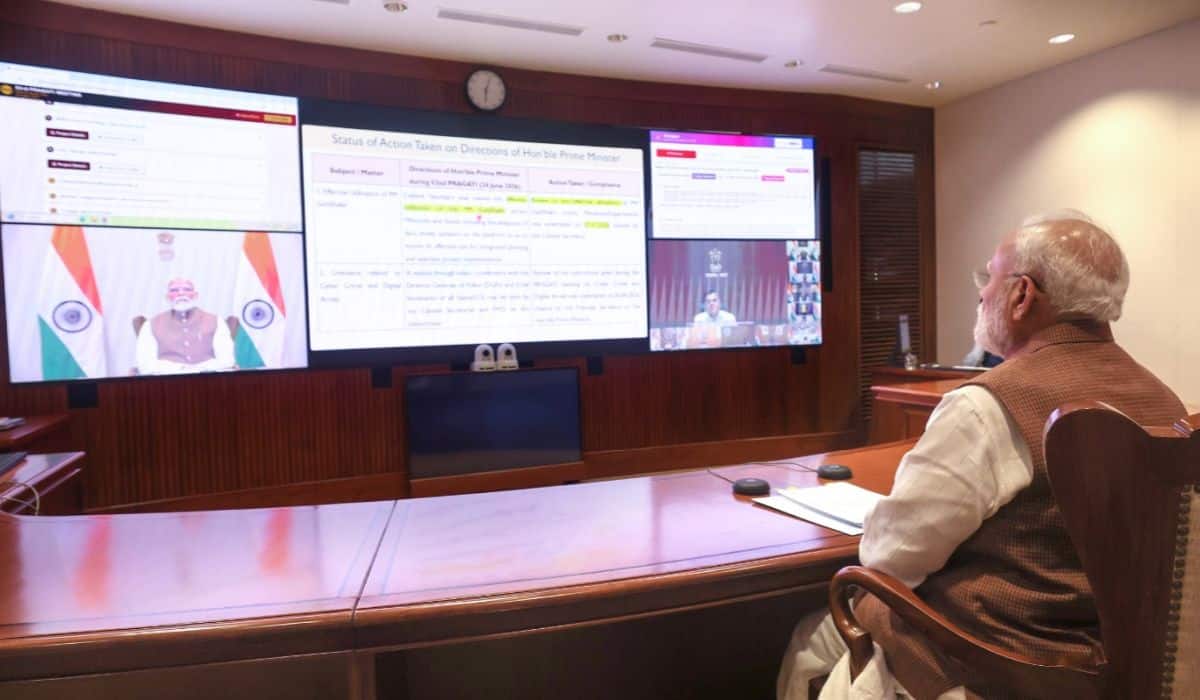
Prime Minister Shri Narendra Modi chaired the 53rd meeting of PRAGATI, the ICT-enabled, multi-modal platform for Pro-Active Governance and Timely Implementation, at Seva Teerth earlier today.

During the meeting, Prime Minister reviewed six key infrastructure projects across the Railway, Road and Power sectors, spanning nine States with a cumulative cost of more than ₹30,000 crore. The projects, significant for strengthening connectivity, supporting industrial and economic activity and improving public services, were reviewed with particular emphasis on adherence to timelines, inter-agency coordination, resolution of pending issues and expeditious completion.

Prime Minister emphasised that delays in infrastructure projects have consequences beyond cost escalation, as they also postpone the benefits intended for citizens, businesses and the economy. He said that infrastructure projects should be viewed and monitored as an integrated whole, rather than as isolated sections, stretches or packages. He noted that progress in individual packages should ultimately translate into timely completion and operationalisation of the entire project. Ministries and States were therefore asked to adopt an end-to-end approach, and address critical gaps that could delay the overall commissioning and delivery of benefits. He called for fostering a proactive work culture across Ministries and State Governments, with greater ownership at every level of project implementation.

Prime Minister stressed the need to explore common utility corridors for infrastructure services, wherever feasible, particularly while planning major transport and infrastructure projects. He called upon Ministries and States to examine such integrated approaches at the planning stage itself, keeping in view their technical and economic feasibility.

Prime Minister said that speed of execution must be accompanied by uncompromising quality. He called upon Ministries, States and implementing agencies to adopt modern technologies and strengthen quality assurance and supervision at every stage.

While reviewing AgriStack under the Digital Agriculture Mission, Prime Minister emphasised the need to leverage the latest digital technologies, including Artificial Intelligence, to derive greater value from agricultural data. He stressed that the data ecosystem should be effectively utilised across the agricultural value chain, from input planning to processing, enabling more informed interventions, better targeting and data-driven decision-making. He appreciated the efforts of the States and the Central Government in building the AgriStack ecosystem and called for further strengthening its use for delivering better outcomes for farmers.

During the review of cyber fraud cases, including incidents of digital arrest, Prime Minister said that prevention must be strengthened through a sustained focus on training, awareness and education. He stressed the need for continuous and targeted public-awareness campaigns, particularly for senior citizens, youth and other vulnerable sections, to familiarise them with common fraud techniques, warning signs and safe digital practices. He also called for regular capacity-building of personnel involved so that emerging modes of cyber fraud are identified and acted upon swiftly.