The inauguration of Micron’s semiconductor facility marks a milestone in India’s journey towards technology leadership: PM
India, long known for its software strength, is now firmly establishing its identity in the hardware sector as well: PM
Today, India is rapidly becoming an integral part of the global semiconductor value chain: PM
This century belongs to the AI revolution: PM
If oil was the regulator of the last century, microchips will be the regulator of this century: PM
India has just one message for investors around the world, India is ready, India is Reliable, India Delivers: PM
The message has reached the world loud and clear: India is Capable, India is Competitive, India is Committed: PM

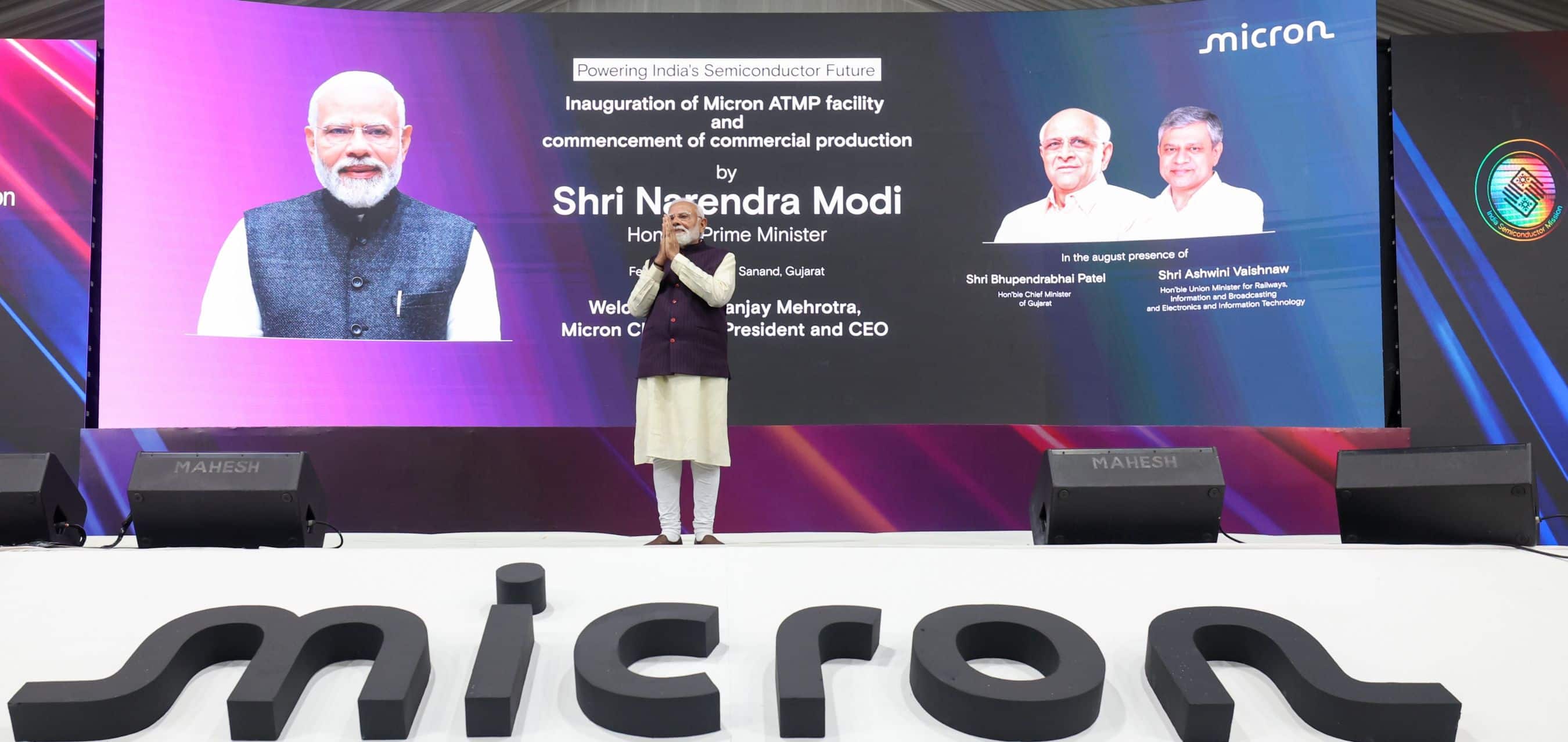
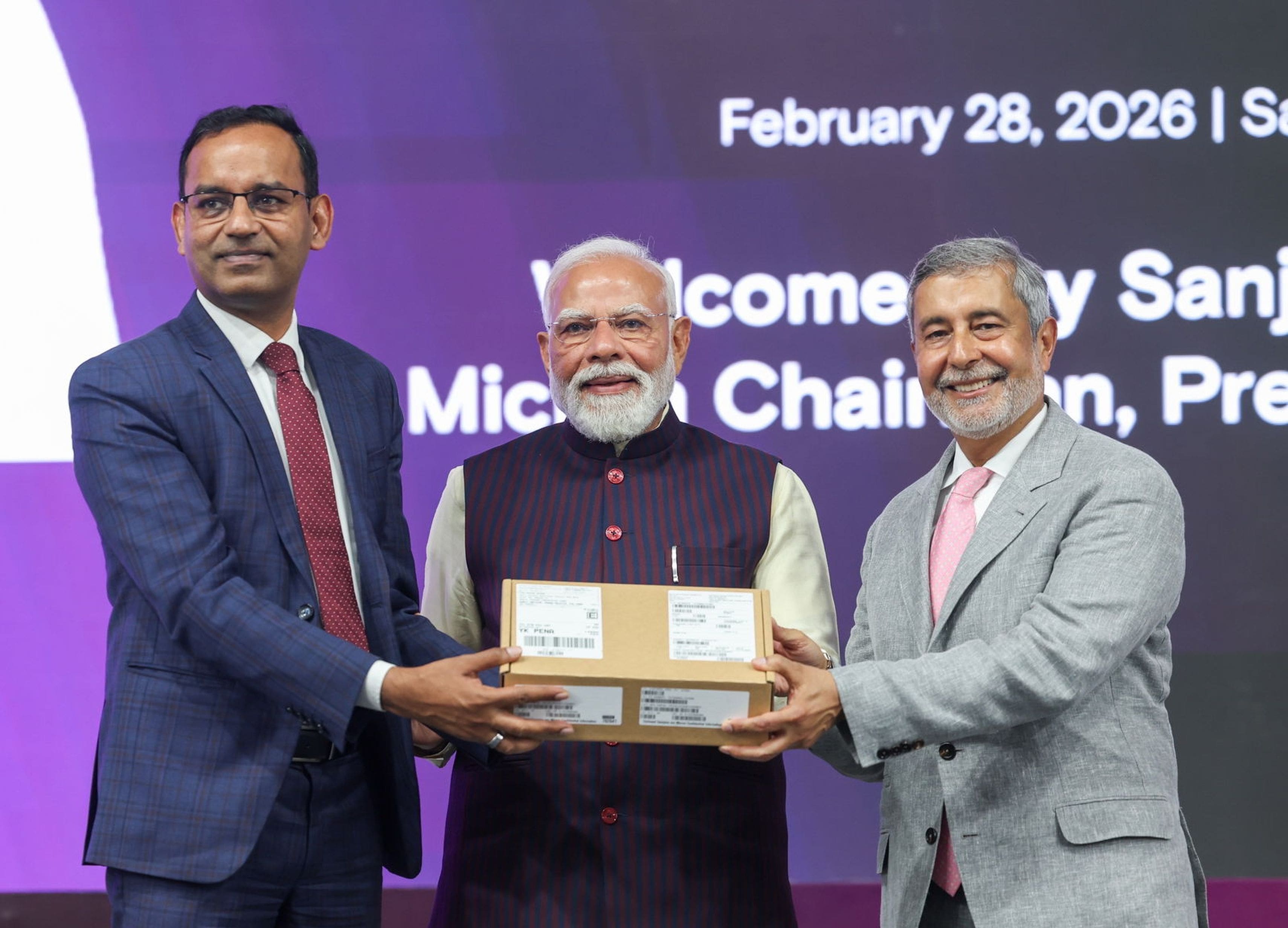
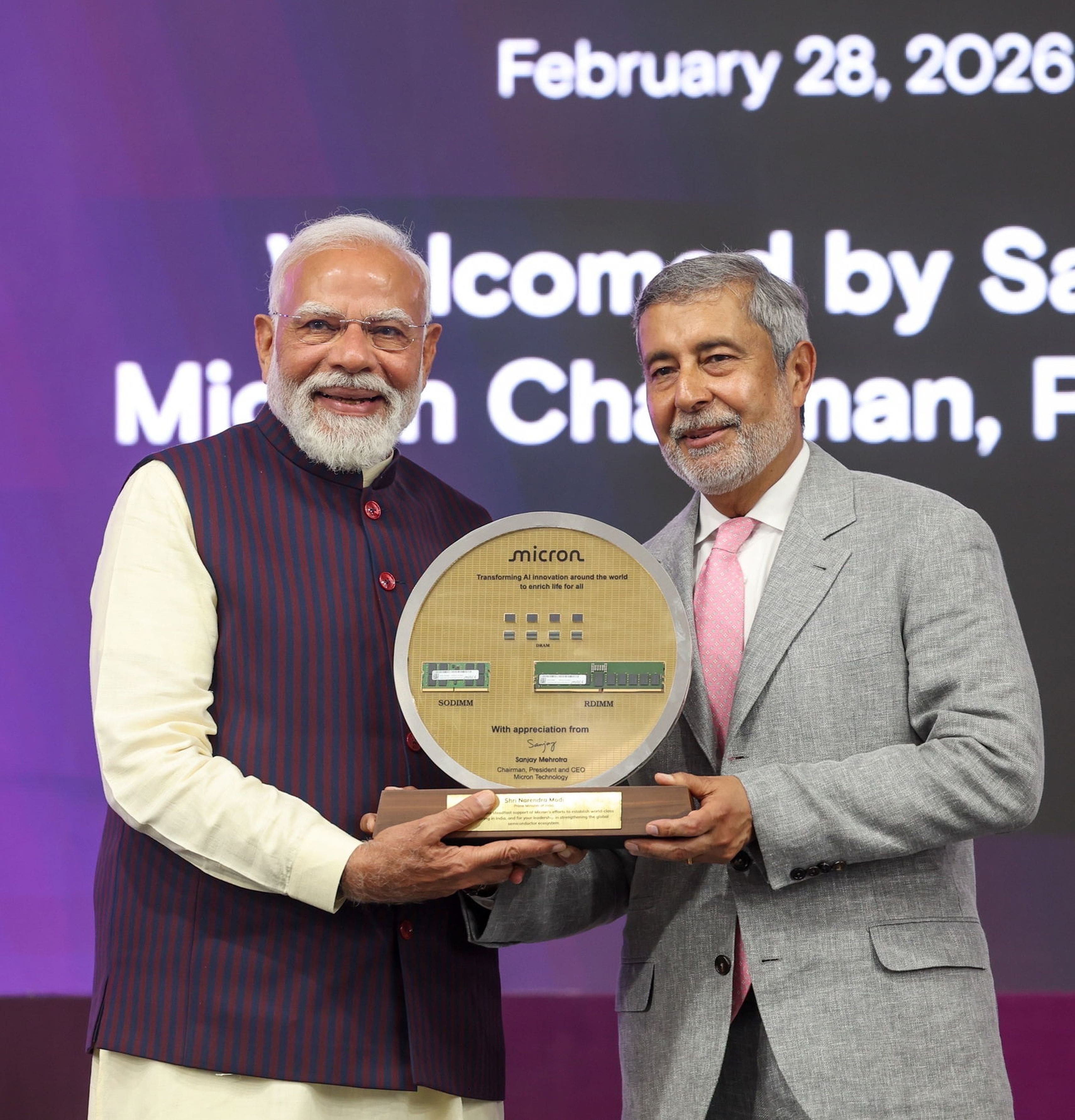
Prime Minister Shri Narendra Modi, today inaugurated the Micron ATMP (Assembly, Test, Marking, and Packaging) facility in Sanand, Gujarat. This landmark event, marking the commencement of commercial production, signifies a historic milestone in India's journey toward global technology leadership.

The Prime Minister noted that after the world's largest and most successful AI Summit, today we are witnessing another historic milestone. “While the AI Summit introduced the world to India's AI prowess, today is a testament to India’s commitment to technology leadership”, Shri Modi remarked.

The Prime Minister noted that while India was once primarily known for software and IT services, it is now rapidly strengthening its identity in the hardware sector. “Today, in Sanand, we see the dawn of a new future. The commencement of commercial production at Micron's ATMP Facility is set to bolster India's role in the global technology value chain”, Shri Modi emphasised.

The Prime Minister highlighted the "New India" mindset, where the transition from policy to production is happening at unprecedented speed. The Prime Minister emphasised the project’s rapid progression, noting that the Memorandum of Understanding was signed in June 2023, followed by the groundbreaking in Sanand in September 2023. “By February 2024, machine installation in the pilot facility had begun, leading to the commencement of commercial production in February 2026”, Shri Modi added.
Shri Modi stated that India has significantly streamlined complex regulatory processes, successfully clearing Advanced Pricing Agreements (APAs) in just a few months. He noted that this same procedure typically takes between three and five years to complete, even in developed nations.

"When the intent is clear and the dedication is toward the nation's rapid development, policies become transparent and decisions gain momentum," the Prime Minister remarked.

The Prime Minister emphasized that this facility is a testament to the robust partnership between India and the USA, particularly in AI and chip technology. He mentioned that two of the world’s largest democracies, India and the USA are working continuously to secure the global supply chain, citing the Pax Silica agreement signed during the AI Summit as a key effort to make the supply chain for critical minerals more reliable.

Noting this century as the century of the AI Revolution, the Prime Minister called semiconductors a bridge to this change. Comparing historical shifts, Shri Modi stated that if oil was the regulator of the 20th century, the micro-chip is the regulator of the 21st century. A tiny chip is the medium connecting the Industrial Revolution to the AI Revolution. “With this vision, India decided to move forward aggressively in the semiconductor sector. Recall that when the world was struggling with the havoc of Covid, India announced its Semiconductor Mission. During the pandemic, when everything felt like it was falling apart, the seeds we planted with conviction are now growing and bearing fruit.” Shri Modi highlighted.
The Prime Minister reiterated India’s commitment to the semiconductor sector, noting that while 10 projects have been approved under the Semicon India program, three more are set to begin production soon across various states, including Uttar Pradesh, Assam, Odisha, and Punjab. “This ecosystem we are building is not limited to one region; it is Pan-India. New tech hubs for a 'Viksit Bharat' are being developed in every corner of the country. “ Shri. Modi stated.

The Prime Minister noted that a semiconductor ecosystem is far more than just a factory; it is a multi-layered system comprising machine manufacturers, design engineers, research institutions, logistics networks, and skilled technicians. A chip is produced through the seamless coordination of all these elements. "India is focusing on the entire value chain. In this year’s budget, we announced the 'India Semiconductor Mission 2.0' for this very purpose," the PM stated. Highlighting the scale of the growth, PM Modi added, “As production increases, the demand for materials, components, and services within India will also grow. This is the greatest opportunity.”

Shri Modi highlighted, “ A massive portion of India’s population is becoming first-time gadget users. Whether it is electronics, automobiles, or other technologies, demand is constantly rising. "Make in India" is now in full swing.” Stating the manifold growth in the production and exports of the electronics sector in the last 11 years, Shri Modi pointed out that, “ For investors, both the domestic market and global opportunities stand ready.”
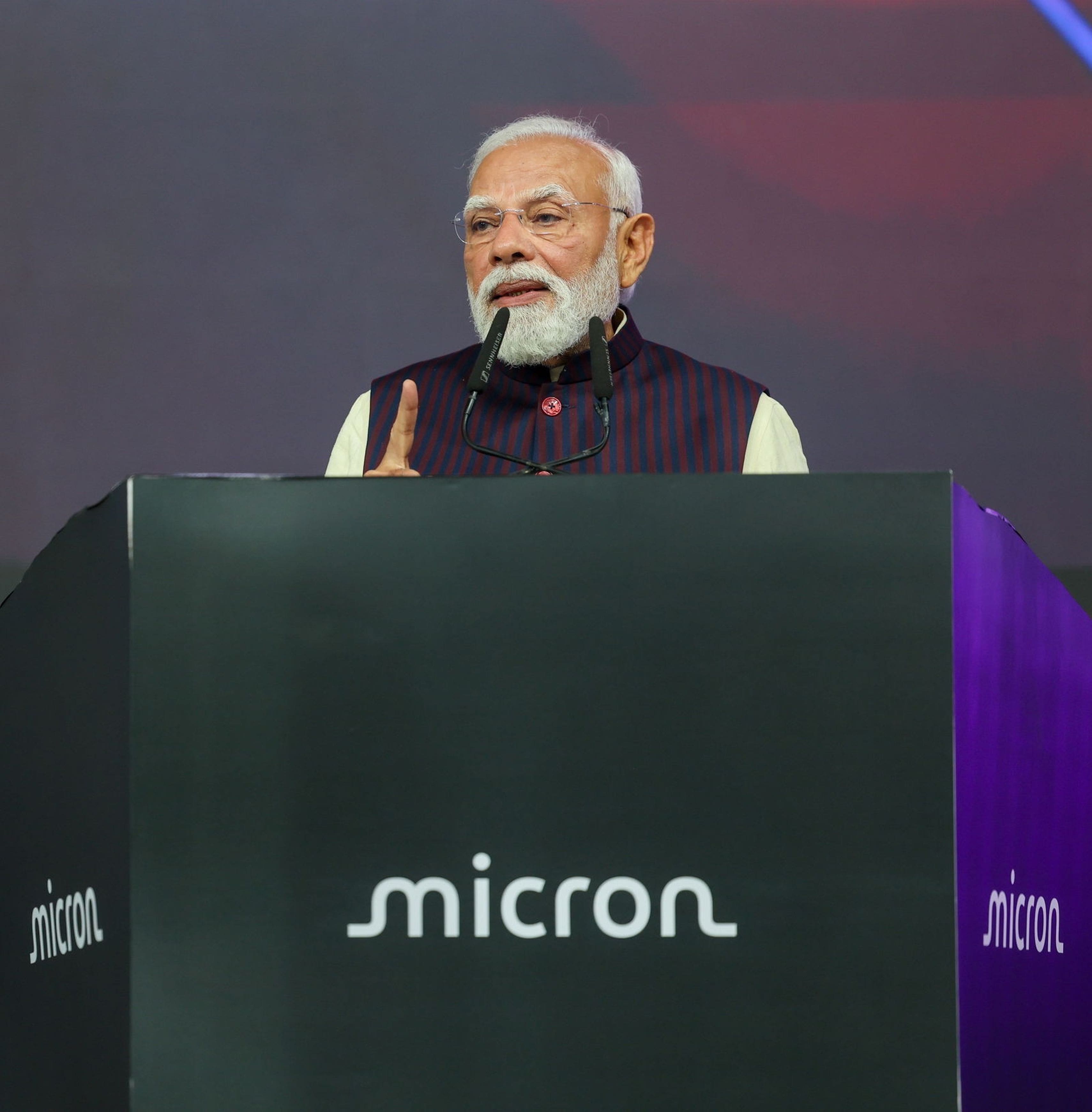
Drawing parallels to Sanand’s transformation into an automobile hub, the Prime Minister expressed confidence that the Micron facility would anchor a new semiconductor ecosystem. The plant will produce D-RAM and NAND solutions to power global data centers, AI applications, and mobile devices. He also lauded the facility for housing one of the world’s largest ATMP cleanrooms and its focus on environmental sustainability through minimized water consumption.

Praising the policies of the Gujarat government, Shri Modi noted that the policies created for the semiconductor sector are now yielding results on the ground. The Prime Minister highlighted that Gujarat is advancing rapidly in technology. “Simplifying processes like approvals, land allotment, and utilities has strengthened investor confidence. Dholera and Sanand are developing as the semiconductor clusters of Western India”, noted Shri Modi. The Prime Minister further stated that industries related to the inputs required for the semiconductor sector,such as chemicals and petrochemicals,along with skill centers and training initiatives, are being developed simultaneously.
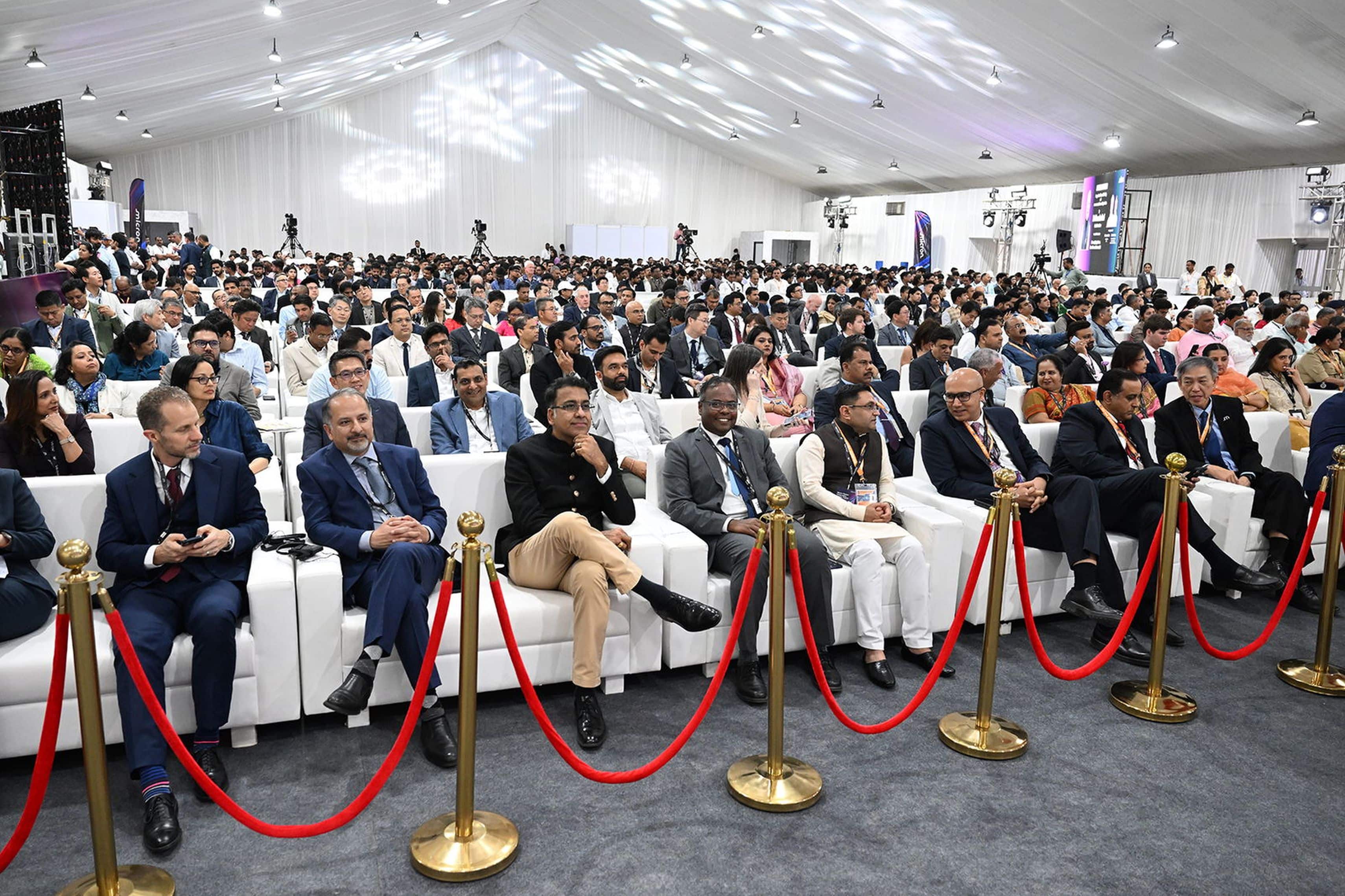
The Prime Minister concluded with a powerful message to global investors, asserting, “India is ready. India is reliable. India delivers.” He assured global partners and investors of unwavering support from both the Central and State governments, marking this decade as a historic turning point for India’s technological trajectory. His address resonated globally with a clear, firm commitment: “India is Capable. India is Competitive. India is Committed.”

Click here to read full text speech

Explore More
Today, the entire country and entire world is filled with the spirit of Bhagwan Shri Ram: PM Modi at Dhwajarohan Utsav in Ayodhya

Popular Speeches

Today, the entire country and entire world is filled with the spirit of Bhagwan Shri Ram: PM Modi at Dhwajarohan Utsav in Ayodhya
India records highest-ever startup surge with 55,200 recognised in FY26

Media Coverage

India records highest-ever startup surge with 55,200 recognised in FY26
NM on the go

Nm on the go

Always be the first to hear from the PM. Get the App Now!
...
Cabinet approves two railway projects in Uttar Pradesh and Andhra Pradesh worth Rs 24,815 crore
April 18, 2026

The Cabinet Committee on Economic Affairs, chaired by the Prime Minister Shri Narendra Modi, today has approved 02 (Two) projects of Ministry of Railways with total cost of Rs. 24,815 crore (approx.). These projects include:

Name of Project

Route Length (in km)

Track Length (in km)

Completion Cost (Rs. in Cr.)

Ghaziabad – Sitapur 3rd and 4th Line

403

859

14,926

Rajahmundry (Nidadavolu) – Visakhapatnam (Duvvada) 3rd and 4th Line


198


458


9,889

Total

601

1,317

24,815

The increased line capacity will significantly enhance mobility, resulting in improved operational efficiency and service reliability for Indian Railways. These multi-tracking proposals are poised to streamline operations and alleviate congestion. The projects are in line with the Prime Minister Shri Narendra Modiji’s Vision of a New India which will make people of the region “Atmanirbhar” by way of comprehensive development in the area which will enhance their employment/ self-employment opportunities.

The projects are planned on PM-Gati Shakti National Master Plan with focus on enhancing multi-modal connectivity & logistic efficiency through integrated planning and stakeholder consultations. These projects will provide seamless connectivity for movement of people, goods, and services.

The 02 (Two) projects covering 15 Districts across the states of Uttar Pradesh and Andhra Pradesh will increase the existing network of Indian Railways by about 601 Kms.

The proposed capacity enhancement will improve rail connectivity to several prominent tourist destinations across the country, including Dudheshwarnath Temple, Garhmukteshwar Ganga Ghat, Dargah Shah Wilayat Jama Masjid (Amroha), Naimisharanya (Sitapur), Annavaram, Antarvedi, Draksharamam, etc.

The proposed projects are essential routes for transportation of commodities such as coal, foodgrains, cement, POL, iron and steel, container, fertilizers, sugar, chemical salts, limestone, etc. The Railways being environment friendly and energy efficient mode of transportation, will help both in achieving climate goals and minimizing logistics cost of the country lowering CO2 emissions (180.31Crore Kg) which is equivalent to plantation of 7.33 Crore trees.

Ghaziabad – Sitapur 3rd and 4th Line (403 Km)

  • Ghaziabad – Sitapur is an existing double line section forming a key part of Delhi- Guwahati High Density Network (HDN 4).
  • The project is crucial for improving connectivity between the Northern and Eastern region of the country.
  • The existing line capacity utilization of the section is up to 168% and is projected to be up to 207% in case the project is not taken up.
  • Transverses through Ghaziabad, Hapur, Amroha, Moradabad, Rampur, Bareilly, Sahjahanpur, Lakhimpur Kheri and Sitapur districts of Uttar Pradesh.
  • The project route passes through major industrial centres - Ghaziabad (machinery, electronics, pharmaceuticals), Moradabad (brassware and handicrafts), Bareilly (furniture, textiles, engineering), Shahjahanpur (carpets and cement-related industries), and Roza (thermal power plant).
  • For seamless transportation, the project alignment is planned to bypass congested stations of Hapur, Simbhaoli, Moradabad, Rampur, Bareilly, Shahjahanpur, and Sitapur and accordingly, six new stations are proposed on the bypassing sections.
  • Key tourist/religious places along/near to the project section are Dudheshwarnath Temple, Garhmukteshwar Ganga Ghat, Dargah Shah Wilayat Jama Masjid (Amroha), and Naimisharanya (Sitapur) among others.
  • Anticipated additional freight traffic of 35.72 MTPA consisting of Coal, Foodgrains, Chemical Manures, Finished Steel, etc.
  • Estimated Cost: Rs.14,926 crore (approx.)
  • Employment generation: 274 lakh human-days.
  • CO2 emissions saved: About 128.77 crore Kg CO2 equivalent to 5.15 Cr trees.

  • Logistic cost saving: Rs. 2,877.46 crore every year vis-a vis road transportation.

Ghaziabad – Sitapur 3rd and 4th Line (403 Km)

Rajahmundry (Nidadavolu) – Visakhapatnam (Duvvada) 3rd and 4th Line (198 Km)

  • Rajahmundry (Nidadavolu) – Visakhapatnam (Duvvada) section forms part of the Howrah – Chennai High Density Network (HDN).
  • The proposed project is part of quadrupling initiative of Howrah – Chennai High Density Network (HDN) route.
  • The project traverses through East Godavari, Konaseema, Kakinada, Anakapalle and Vishakapatnam districts of Andhra Pradesh.
  • Visakhapatnam is identified as an Aspirational District in the Aspirational Districts Programme.
  • It provides connectivity to major ports along the East Coast such as Visakhapatnam, Gangavaram, Machilipatnam and Kakinada.
  • The project route runs along the eastern coastline and is among the busiest, predominantly freight-oriented sections of the East Coast Rail Corridor.
  • The line capacity utilization of the section has already reached up to 130%, leading to frequent congestion and operational delays. The line capacity is expected to increase further due to proposed expansion of ports and industries in the region.
  • Project section includes 4.3 km rail bridge over Godavari River, 2.67 km viaduct, 3 bypasses and the new alignment is around 8 km shorter than the existing route, improving connectivity and operational efficiency.
  • The proposed section will also boost tourism by improving access to key destinations such as Annavaram, Antarvedi and Draksharamam etc.
  • Anticipated additional freight traffic of 29.04 MTPA consisting of Coal, Cement, Chemical Manures, Iron and Steel, Foodgrains, Containers, Bauxite, Gypsum, Limestone, etc.
  • Estimated Cost: Rs.9,889 crore (approx.)
  • Employment generation: 135 lakh human-days.
  • CO2 emissions saved: About 51.49 crore Kg CO2 equivalent to 2.06 Cr trees.

  • Logistic cost saving: Rs. 1,150.56 crore every year vis-a vis road transportation.


आर्थिक सशक्तिकरण:

Aspirational districts - Visakhapatnam district will get improved connectivity

Additional economic opportunities in the region through tourism & industries.

Better healthcare and education for the citizens due to enhanced rail connectivity.


Rajahmundry (Nidadavolu) – Visakhapatnam (Duvvada) 3rd and 4th Line (198 Km)

Prime Minister’s focus on railways:

  • Record budget allocation of Rs. 2,65,000 crore for FY 26-27.
  • Manufacturing more than 1600 locomotives- surpassed US and Europe in manufacturing of locomotive production
  • In FY 26, Indian Railways is expected to rank among the top three freight carriers globally, moving 1.6 billion tonnes of cargo.

  • India starts exporting metro coaches to Australia and bogie to United Kingdom, Saudi Arabia, France and Australia.